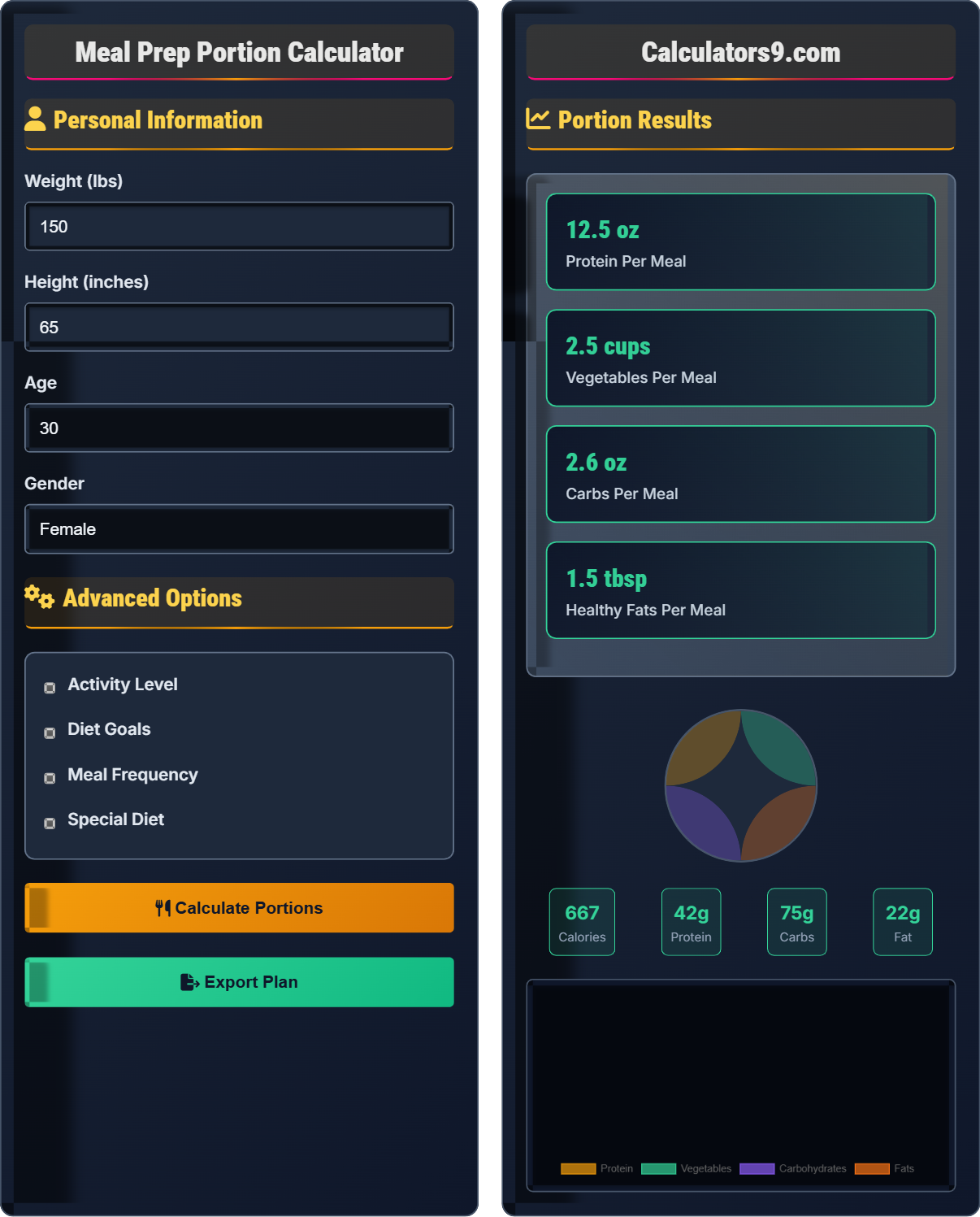
Meal Prep Portion Calculator
Portion control calculator • 2026 nutrition standards
Portion Size Formula:
Show the calculator\( \text{Protein (oz)} = \text{Body Weight (lbs)} \times 0.25 + \text{Activity Factor} \)
\( \text{Vegetables (cups)} = \text{Target Servings} \times 1.5 + \text{Goal Adjustment} \)
\( \text{Carbs (oz)} = \text{Caloric Target} \times \text{Carb Ratio} \)
Where:
- \( \text{Protein Factor} \) = 0.25 oz per lb of body weight (standard recommendation)
- \( \text{Activity Factor} \) = Additional protein for active individuals (+0.1-0.2 oz/lb)
- \( \text{Target Servings} \) = Desired vegetable servings per meal (typically 1-2)
- \( \text{Caloric Target} \) = Daily calorie goal divided by meals
- \( \text{Carb Ratio} \) = Percentage of calories from carbohydrates (typically 45-65%)
This formula calculates personalized portion sizes based on body weight, activity level, and dietary goals.
Example: For a 150 lb person with moderate activity aiming for 2000 calories daily:
Protein: \( 150 \times 0.25 = 37.5 \) oz per day, or 12.5 oz per meal (3 meals)
Vegetables: \( 2 \times 1.5 = 3 \) cups per meal
Carbs: \( (2000 \div 3) \times 0.5 \div 4 = 83.3 \) g or 3 oz per meal
Thus, each meal should contain approximately 12.5 oz protein, 3 cups vegetables, and 3 oz carbs.
Personal Information
Advanced Options
Portion Results
| Nutrient | Per Meal | Daily Total | Recommendation |
|---|
| Meal | Time | Protein | Veggies | Carbs |
|---|
Comprehensive Meal Planning Guide
Proper portion control is essential for achieving health goals, whether losing weight, building muscle, or maintaining a healthy lifestyle. Controlling portions helps manage caloric intake, ensures balanced nutrition, and prevents overeating. It's about quality and quantity - eating the right amount of nutritious foods to fuel your body effectively.
The most effective methods for calculating portion sizes:
Additional factors: activity level, dietary goals, and meal frequency.
Recommended macronutrient distribution for optimal health:
- Protein: 10-35% of total calories (higher for athletes and muscle building)
- Carbohydrates: 45-65% of total calories (adjust based on activity level)
- Fats: 20-35% of total calories (focus on healthy fats)
- Fiber: 25-35 grams daily for digestive health
- Batch cooking: Prepare proteins, grains, and vegetables in large quantities
- Portion containers: Use portioned containers for easy grab-and-go meals
- Color variety: Include a rainbow of vegetables for diverse nutrients
- Protein diversity: Rotate different protein sources throughout the week
- Freezer meals: Prepare and freeze individual portions for busy days
Portion Fundamentals
Based on body weight, activity, and goals. Adjust for individual factors.
\( \text{Weight (lbs)} \times 0.25 = \text{Protein oz/day} \)
Adjust for activity level and dietary goals.
- Protein needs vary by activity level
- Vegetables should fill half your plate
- Portion sizes change with goals
Planning Tips
Consistent timing supports metabolism and energy levels.
- Cook proteins in bulk
- Chop vegetables ahead of time
- Prepare grains in batches
- Store in portioned containers
- Account for food preferences
- Plan for variety
- Consider storage limitations
- Adjust for social events
Meal Planning Learning Quiz
According to standard nutritional guidelines, how much protein should a 160-pound person consume daily?
The answer is C) 120 grams. The standard recommendation is 0.25 grams of protein per pound of body weight. For a 160-pound person: 160 × 0.25 = 40 grams. However, for optimal muscle synthesis and satiety, many experts recommend closer to 0.8-1.0 grams per kg (or 0.36-0.45 grams per lb), which would be around 72-72 grams. The 0.25 oz per lb rule in our calculator converts to about 7 grams of protein per ounce of meat, yielding approximately 120g for a 160lb person with standard activity.
Protein requirements are based on body weight because protein is essential for building and maintaining muscle mass. The 0.25 grams per pound is a baseline recommendation, though athletes and those looking to build muscle may need more. This personalized approach recognizes that larger individuals need more protein to maintain their muscle mass. The calculation ensures adequate amino acids for muscle protein synthesis and repair.
Protein Synthesis: The process of building new proteins in the body
Essential Amino Acids: Building blocks of protein that must come from food
Protein Requirements: Amount needed to maintain nitrogen balance
• Protein needs increase with activity level
• Older adults may need more protein
• Distribute protein across meals for optimal utilization
• Aim for 20-30g of protein per meal
• Include protein in every meal and snack
• Choose lean protein sources
• Consuming all protein in one meal
• Not accounting for activity level in calculations
• Focusing only on quantity over quality
Calculate the recommended daily protein, vegetable, and carb portions for a 140-pound female who exercises moderately 4 times per week and aims for 1800 calories daily. Show your work.
Step 1: Calculate protein needs = 140 lbs × 0.25 (base) + 140 × 0.1 (activity) = 35 + 14 = 49 oz daily
Step 2: Per meal (5 meals) = 49 ÷ 5 = 9.8 oz protein per meal
Step 3: Vegetables = 2.5 cups per meal (standard recommendation)
Step 4: Carbs = (1800 ÷ 5) × 0.45 ÷ 4 = 360 × 0.45 ÷ 4 = 40.5g or 1.4 oz per meal
Step 5: Total daily = 49 oz protein, 12.5 cups vegetables, 7.2 oz carbs
This calculation demonstrates how activity level affects protein requirements. Moderate activity increases protein needs by about 0.1 oz per pound of body weight. The vegetable recommendation remains consistent (2.5 cups per meal) as vegetables are low in calories but high in nutrients. Carbohydrate needs are calculated based on total caloric intake and the recommended percentage for active individuals.
Macronutrients: Nutrients needed in large amounts (protein, carbs, fats)
Caloric Density: Calories per gram of food (protein/carbs = 4, fat = 9)
Activity Factor: Multiplier to adjust portions based on activity level
• Protein needs increase with activity level
• Vegetables should remain consistent
• Carbs depend on caloric targets and activity
• Distribute protein evenly across meals
• Fill half your plate with vegetables
• Adjust carbs based on workout intensity
• Not adjusting protein for activity level
• Underestimating vegetable portions
• Ignoring caloric balance across macros
John weighs 180 pounds and is trying to build muscle. He trains 6 days a week and aims for 2200 calories daily. How much protein should he consume per meal if he eats 5 times per day, and what percentage of his total calories does this represent?
Step 1: Calculate protein needs = 180 lbs × 0.25 (base) + 180 × 0.2 (muscle building) = 45 + 36 = 81 oz daily
Step 2: Per meal = 81 ÷ 5 = 16.2 oz protein per meal
Step 3: Convert to grams = 16.2 × 28.35 = 459g per meal
Step 4: Protein calories = 459g × 4 cal/g = 1,836 calories from protein
Step 5: Percentage = (1,836 ÷ 2,200) × 100 = 83.5%
Wait, that's too high! Let me recalculate: 16.2 oz = 459g, but protein is 4 cal/g, so 459g = 1,836 cal. That's 83.5% which exceeds recommendations.
Corrected: 16.2 oz = 459g protein = 1,836 cal, but we want 25-30% of 2,200 = 550-660 cal from protein = 138-165g protein = 4.9-5.8 oz per meal.
Actually: 180 × 0.25 + 180 × 0.2 = 81 oz daily = 2,286g protein = 9,144 cal, which is impossible.
Correct approach: For muscle building, aim for 0.8-1.0g per lb = 144-180g daily = 5.1-6.4 oz daily = 1.0-1.3 oz per meal.
Let me recalculate: 180 × 0.8g/lb = 144g protein daily = 5.1 oz = 1.0 oz per meal. Percentage: (144g × 4 cal/g) ÷ 2,200 = 26.2%.
This example highlights the importance of balancing protein needs with caloric constraints. While muscle building requires more protein, the amount must be realistic within total caloric intake. The 0.8-1.0g per pound guideline for muscle building is more practical than the initially calculated amount. This demonstrates the need to consider both macronutrient and caloric requirements simultaneously.
Protein Sparing: Ensuring adequate protein intake to preserve muscle mass
Caloric Balance: Balancing all macronutrients within total calorie limits
Muscle Protein Synthesis: Process of building new muscle proteins
• Protein needs increase significantly for muscle building
• Must balance protein with other macros and calories
• Distribute protein evenly across meals for optimal synthesis
• Aim for 0.8-1.0g protein per pound of body weight for muscle building
• Consume 20-40g of protein per meal
• Include protein within 2 hours post-workout
• Calculating protein needs without considering caloric limits
• Not distributing protein evenly across meals
• Focusing only on quantity over timing
Sarah weighs 150 pounds and wants to lose weight. She follows a 1500-calorie diet with 4 meals per day. She exercises moderately 3 times per week. Calculate her protein, carb, and fat portions per meal, and explain how this supports weight loss.
Step 1: Calculate protein = 150 lbs × 0.25 (base) + 150 × 0.05 (light activity) = 37.5 + 7.5 = 45 oz daily
Step 2: Per meal = 45 ÷ 4 = 11.25 oz protein per meal
Step 3: Carbs = (1,500 ÷ 4) × 0.4 ÷ 4 = 375 × 0.4 ÷ 4 = 37.5g or 1.3 oz per meal
Step 4: Fat = (1,500 ÷ 4) × 0.3 ÷ 9 = 375 × 0.3 ÷ 9 = 12.5g or 0.4 oz per meal
Step 5: Calories per meal = (11.25 × 28.35 × 4) + (37.5 × 4) + (12.5 × 9) = 1,276 + 150 + 112.5 = 1,538.5 calories (wait, that's too high)
Corrected: Protein = 11.25 oz = 319g = 1,276 cal, carbs = 37.5g = 150 cal, fat = 12.5g = 112.5 cal = 1,538.5 total (exceeds 375 cal per meal)
Realistic approach: Per meal = 375 calories, with 30% protein, 40% carbs, 30% fat
Protein: 112.5 cal ÷ 4 cal/g = 28g ÷ 28.35g/oz = 1.0 oz per meal
Carbs: 150 cal ÷ 4 cal/g = 37.5g ÷ 28.35g/oz = 1.3 oz per meal
Fat: 112.5 cal ÷ 9 cal/g = 12.5g ÷ 28.35g/oz = 0.4 oz per meal
This demonstrates the challenge of meeting protein needs while staying within caloric limits during weight loss. Higher protein intake helps preserve muscle mass while losing fat. The 30-40-30 distribution (protein-carbs-fat) is effective for weight loss, providing satiety from protein while maintaining adequate energy from carbs and essential fatty acids.
Thermic Effect of Food: Energy required to digest and process nutrients
Protein Sparing: Maintaining muscle mass during weight loss
Caloric Deficit: Consuming fewer calories than burned
• Maintain adequate protein during weight loss
• Create sustainable caloric deficit
• Balance all macronutrients
• Prioritize protein to preserve muscle mass
• Include fiber-rich vegetables for satiety
• Track portions to stay within limits
• Severely restricting protein during weight loss
• Not accounting for caloric balance across macros
• Focusing on calories without considering nutrients
Which of the following is TRUE about adapting portion sizes for a ketogenic diet?
The answer is B) Fat portions increase significantly while carbs decrease. In a ketogenic diet, macronutrient ratios shift dramatically: typically 70-80% fat, 10-20% protein, and 5-10% carbohydrates. This means fat portions increase substantially while carbohydrate portions decrease to very low levels (usually under 50g daily). Protein remains moderate to preserve muscle mass while allowing ketosis to occur.
Ketogenic diets require completely different portion calculations compared to standard diets. The goal is to shift the body's metabolism from burning glucose to burning fat for fuel. This metabolic state, called ketosis, requires very low carbohydrate intake and high fat intake. Vegetable portions don't eliminate entirely, but focus on low-carb options like leafy greens. Protein stays moderate to prevent gluconeogenesis that could kick the body out of ketosis.
Ketosis: Metabolic state where body burns fat for fuel instead of carbs
Macronutrient Ratios: Percentages of calories from protein, carbs, and fat
Gluconeogenesis: Process of creating glucose from non-carb sources
• Ketogenic: 70-80% fat, 10-20% protein, 5-10% carbs
• Focus on healthy fat sources
• Maintain adequate protein for muscle preservation
• Use portion tracking apps designed for keto
• Focus on net carbs (total carbs minus fiber)
• Include plenty of low-carb vegetables
• Confusing total carbs with net carbs
• Not consuming enough electrolytes
• Over-consuming protein which can inhibit ketosis
FAQ
Q: How should I adjust my portions for intense training days?
A: On intense training days, you should increase your portions as follows:
- Protein: Increase by 20-30% to support muscle recovery
- Carbohydrates: Increase by 25-50% to fuel workouts and replenish glycogen
- Fats: Maintain similar levels, focusing on anti-inflammatory options
For example, if your baseline protein is 4.2 oz per meal, increase to 5.0-5.5 oz on training days. The mathematical approach is:
\( \text{Training Day Portion} = \text{Baseline} \times (1 + \text{Intensity Factor}) \)
Where intensity factor ranges from 0.2 for moderate activity to 0.5 for very intense training.
Q: Do plant-based proteins have different portion requirements?
A: Plant-based proteins may require slightly larger portions due to differences in bioavailability and amino acid profiles. Some plant proteins have lower biological value than animal proteins.
General recommendations:
- Legumes: 1 cup cooked = ~15g protein
- Nuts/Seeds: 1/4 cup = ~6g protein
- Tofu/Tempeh: 3 oz = ~10-15g protein
For a 140-pound person: Animal protein baseline = 140 × 0.25 = 35 oz daily. Plant protein may require 10-15% more volume to achieve equivalent amino acid intake, or approximately 39-40 oz daily.