Protein Intake Calculator
Nutrition planning tool • 2026 standards
Protein Intake Formulas:
Show the calculator\( \text{Protein (g/day)} = \text{Body Weight (kg)} \times \text{Protein Factor} \)
\( \text{Protein (g/day)} = \frac{\text{Total Daily Calories} \times \text{Protein \%}}{4} \)
\( \text{Protein Calories} = \text{Protein (g)} \times 4 \)
Where:
- \( \text{Protein Factor} \) = 0.8-2.2 g/kg body weight depending on goals
- \( \text{Protein \%} \) = Desired percentage of calories from protein
- \( \text{Body Weight} \) = Current weight in kilograms
These formulas calculate daily protein needs based on body weight and goals. The protein factor varies by activity level and specific objectives. Proteins provide 4 calories per gram. The RDA is 0.8g/kg, but athletes may need up to 2.2g/kg.
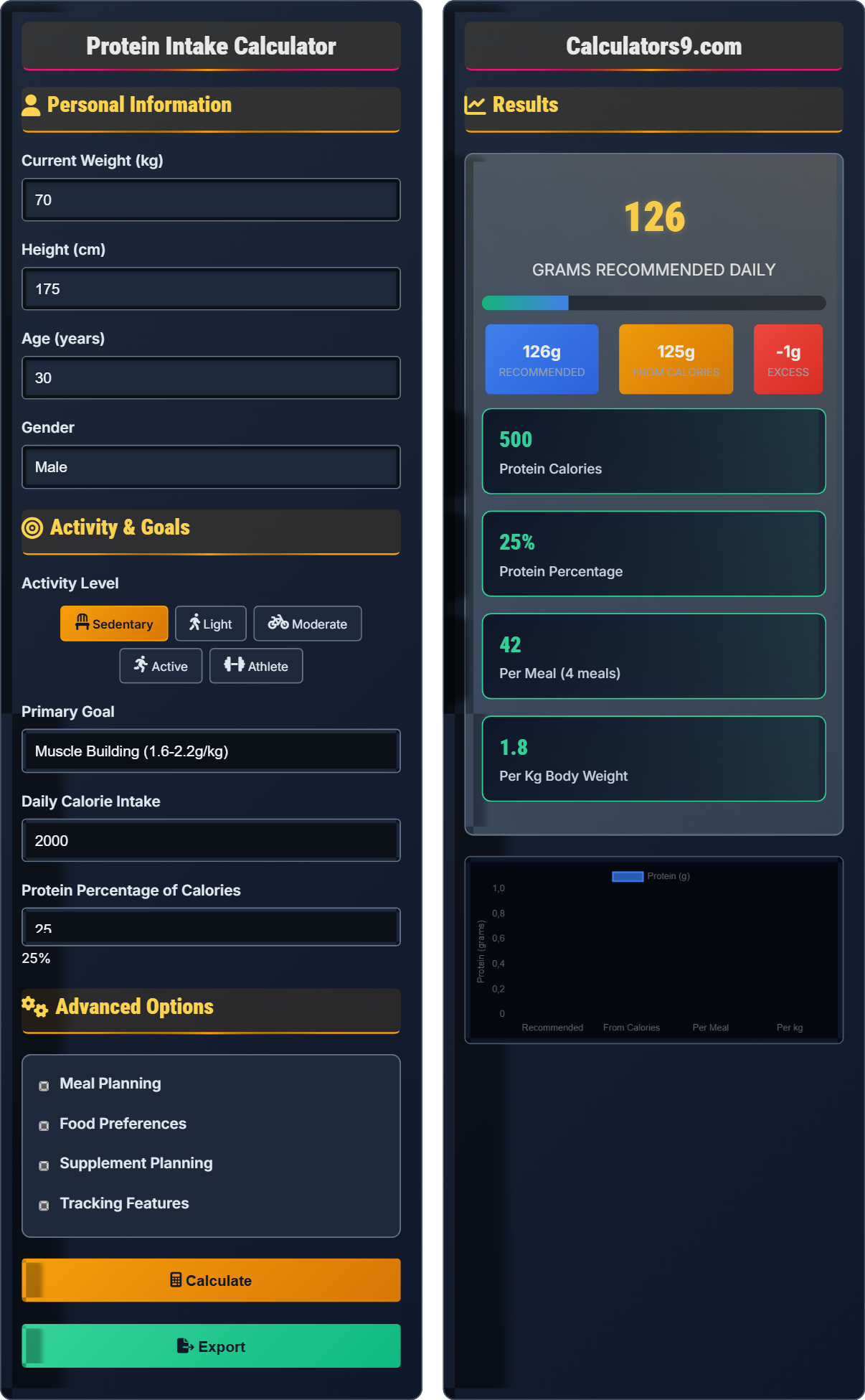
Example: For a 70kg person with moderate activity needing 1.6g/kg:
\( \text{Protein} = 70 \times 1.6 = 112 \text{ g/day} \)
For 2,000 calories daily with 25% protein:
\( \text{Protein} = \frac{2000 \times 0.25}{4} = 125 \text{ g/day} \)
This results in 112-125g protein daily.
Personal Information
Activity & Goals
Advanced Options
Results
| Food | Protein (g) | Per Serving | Recommendation |
|---|
| Meal | Time | Protein (g) | Food Suggestions |
|---|
Comprehensive Protein Nutrition Guide
Protein is a macronutrient composed of amino acids that are essential for building and repairing tissues in the body. Proteins are made up of 20 different amino acids, 9 of which are essential (must be obtained from food) and 11 that are non-essential (can be synthesized by the body).
Key formulas for calculating protein needs:
Where:
- \( \text{Protein Factor} \) = 0.8-2.2 g/kg depending on goals
- \( \text{Body Weight} \) = Current weight in kilograms
- \( \text{Protein Calories} \) = Protein (g) × 4
Protein sources vary in quality and amino acid profiles:
- Complete Proteins: Contain all essential amino acids (meat, fish, eggs, dairy)
- Incomplete Proteins: Lack one or more essential amino acids (plants, grains)
- Complementary Proteins: Combining incomplete sources (beans + rice)
- Biological Value: Measures protein utilization (eggs = 100, whey = 104)
- PDCAAS: Protein Digestibility Corrected Amino Acid Score
- Spread Intake: Distribute protein across meals (20-30g per meal)
- Post-Workout: Consume protein within 30-60 minutes after exercise
- Leucine Trigger: Include 2-3g leucine per meal for muscle synthesis
- Timing: Include protein at each meal for optimal synthesis
- Variety: Mix animal and plant sources for complete nutrition
Protein Fundamentals
Essential macronutrient for tissue repair and growth.
\( \text{Protein (g)} = \text{Body Weight (kg)} \times \text{Factor} \)
Where factor = 0.8-2.2 based on goals.
- 4 calories per gram
- Essential amino acids needed
- Vary by activity level
Applications
Calculating protein for specific outcomes.
- Muscle building
- Weight loss
- General health
- Recovery
- Body weight
- Activity level
- Health conditions
- Food preferences
Protein Nutrition Learning Quiz
How many calories does 1 gram of protein provide?
The answer is A) 4 calories. Proteins provide 4 calories per gram, the same as carbohydrates. Fats provide 9 calories per gram, and alcohol provides 7 calories per gram. This knowledge is essential for calculating protein calories and determining macro distributions.
Understanding the caloric density of macronutrients is fundamental to nutrition planning. This knowledge allows for accurate calculations when converting between grams and calories. The consistent 4 calories per gram for both protein and carbohydrates simplifies many nutrition calculations.
Caloric Density: Calories per gram of nutrient
Macronutrients: Protein, carbs, and fat
Energy Content: Calories provided by nutrients
• Protein: 4 calories per gram
• Carbs: 4 calories per gram
• Fat: 9 calories per gram
• Remember: Protein and carbs = 4 cal/g
• Fat = 9 cal/g (highest)
• Use for macro calculations
• Confusing caloric values of macros
• Assuming all macros have same calories
• Forgetting alcohol has 7 calories per gram
Calculate the recommended protein intake for a 75kg person who wants to build muscle with a protein factor of 2.0g/kg body weight. Show your work.
Step 1: Identify the formula
\( \text{Protein (g/day)} = \text{Body Weight (kg)} \times \text{Protein Factor} \)
Step 2: Substitute the values
\( \text{Protein} = 75 \times 2.0 \)
Step 3: Calculate the result
\( \text{Protein} = 150 \text{ g/day} \)
Therefore, the recommended protein intake is 150g per day.
This calculation demonstrates the body weight-based approach to protein recommendation. The protein factor (2.0g/kg) is based on research showing optimal protein intake for muscle protein synthesis. This approach is more personalized than percentage-based calculations and accounts for individual body size.
Protein Factor: Amount per kg of body weight
Muscle Building: 1.6-2.2g/kg recommended
Body Weight Method: Personalized calculation
• Protein = Body weight × Factor
• Muscle building: 1.6-2.2g/kg
• Use kg for body weight
• Convert lbs to kg if needed
• Higher factors for muscle goals
• Spread intake across meals
• Using wrong units (lbs instead of kg)
• Forgetting to multiply by body weight
• Using too low factors for goals
A person consumes 2,200 calories daily with 30% of calories from protein. Calculate the grams of protein consumed daily. How does this compare to the recommendation for a 70kg person?
Step 1: Calculate protein calories
Protein calories = 2,200 × 0.30 = 660 calories
Step 2: Convert to grams
Protein grams = 660 ÷ 4 = 165g
Step 3: Calculate recommendation for 70kg person (muscle building)
Recommended = 70 × 2.0 = 140g
Step 4: Compare
Actual vs Recommendation = 165g vs 140g = 25g excess
Therefore, the person consumes 165g protein daily, which exceeds the 140g recommendation.
This problem demonstrates the calorie-percentage approach to protein calculation. This method is useful when following a specific macro distribution. The comparison shows that the person is consuming more protein than the minimum recommendation, which is generally safe and potentially beneficial for muscle building goals.
Calorie-Based: Protein calculated from total calories
Percentage Method: Fixed percentage approach
Excess Protein: Above recommendation
• Protein calories = Total calories × Percentage
• Grams = Calories ÷ 4
• Excess protein is generally safe
• Both methods are valid
• Body weight method is more personalized
• Percentage method fits macro goals
• Forgetting to divide by 4
• Using wrong conversion factor
• Not comparing to recommendations
A person needs 120g of protein daily and eats 4 meals. If they want to consume 25g of protein per meal, how many grams will they consume in total? How should they adjust their meal distribution to meet the goal?
Step 1: Calculate total protein from 4 meals at 25g each
Total = 4 × 25 = 100g
Step 2: Calculate how much more protein is needed
Deficit = 120 - 100 = 20g
Step 3: Calculate adjusted per-meal amount
Per meal = 120 ÷ 4 = 30g
Therefore, they would need to increase each meal to 30g of protein to meet the 120g goal.
This problem demonstrates meal planning considerations for protein intake. Distributing protein evenly across meals is important for optimal muscle protein synthesis. Research suggests consuming 20-30g of protein per meal is optimal for muscle building. This distribution allows for consistent amino acid availability.
Meal Distribution: Protein spread across meals
Muscle Synthesis: Building muscle tissue
Amino Acid Availability: Building blocks for protein
• Optimal per meal: 20-30g
• Distribute evenly across meals
• Consistent amino acid supply
• Include protein at each meal
• Plan portions in advance
• Use high-quality sources
• Concentrating protein in one meal
• Not accounting for meal frequency
• Forgetting to distribute evenly
Which of the following protein sources is considered a complete protein?
The answer is C) Quinoa. Complete proteins contain all nine essential amino acids in adequate amounts. Animal proteins (meat, fish, eggs, dairy) are complete proteins. Among plant proteins, quinoa, soy, and hemp are complete. Rice, beans, and corn are incomplete proteins that lack one or more essential amino acids.
Understanding protein quality is important for meal planning, especially for vegetarians and vegans. While animal proteins are typically complete, plant-based eaters need to combine different protein sources to ensure they get all essential amino acids. Quinoa is unique among grains as it's a complete protein.
Complete Protein: Contains all essential amino acids
Incomplete Protein: Lacks one or more essential amino acids
Essential Amino Acids: Must be obtained from food
• Animal proteins are complete
• Most plant proteins are incomplete
• Quinoa is a complete plant protein
• Combine complementary proteins (beans + rice)
• Include quinoa in plant-based diets
• Soy products are complete proteins
• Assuming all plant proteins are complete
• Not combining complementary proteins
• Overlooking quinoa's completeness
FAQ
Q: How much protein can the body absorb in one meal?
A: The concept of "maximum absorption" in one meal is a common misconception:
Muscle Protein Synthesis: Maximizes with ~20-30g protein per meal
Total Absorption: The body can absorb much more protein, but excess amino acids are oxidized for energy
Leucine Threshold: ~2-3g leucine triggers muscle synthesis
Research shows that while muscle protein synthesis peaks at 20-30g per meal, the body continues to use additional protein for other functions. The idea of "wasting" excess protein is not supported by current research.
For optimal results: 20-30g protein per meal is ideal for muscle building.
Q: What's the difference between animal and plant protein quality?
A: Protein quality differs between animal and plant sources:
Animal Proteins: Complete proteins with all essential amino acids
Plant Proteins: Often incomplete, lacking one or more essential amino acids
Biological Value: Measures protein utilization (eggs = 100, whey = 104)
For example, a 70kg person would need:
- Animal Protein: 112g/day (muscle building) = 448 cal
- Plant Protein: May need 125-140g/day to match quality
Plant-based eaters should combine complementary proteins (beans + rice) or consume complete plant proteins like quinoa and soy to ensure adequate essential amino acid intake.