Sugar Intake Calculator
Daily sugar tracker • 2026 nutrition guide
Sugar Intake Guidelines:
Show CalculatorWorld Health Organization (WHO) recommends limiting free sugars to less than 10% of total energy intake per day. For optimal health benefits, WHO suggests reducing this further to below 5%.
Key facts about sugar intake:
- Recommended maximum: 25g (6 tsp) for women, 36g (9 tsp) for men
- Free sugars include added sugars plus those in honey, syrups, and fruit juices
- Natural sugars in whole fruits and vegetables don't count toward limit
- Hidden sugars in processed foods can quickly exceed daily limits
This calculator tracks your daily sugar consumption against recommended limits, helping you make informed dietary choices.
Formula: Daily sugar intake = Sum of all free sugars consumed ÷ Daily limit × 100%
Example: If you consume 45g of sugar and your limit is 25g:
\( \text{Percentage} = \frac{45}{25} \times 100\% = 180\% \)
This means you've exceeded your recommended daily limit by 80%.
Personal Information
Food Intake
Advanced Options
Results
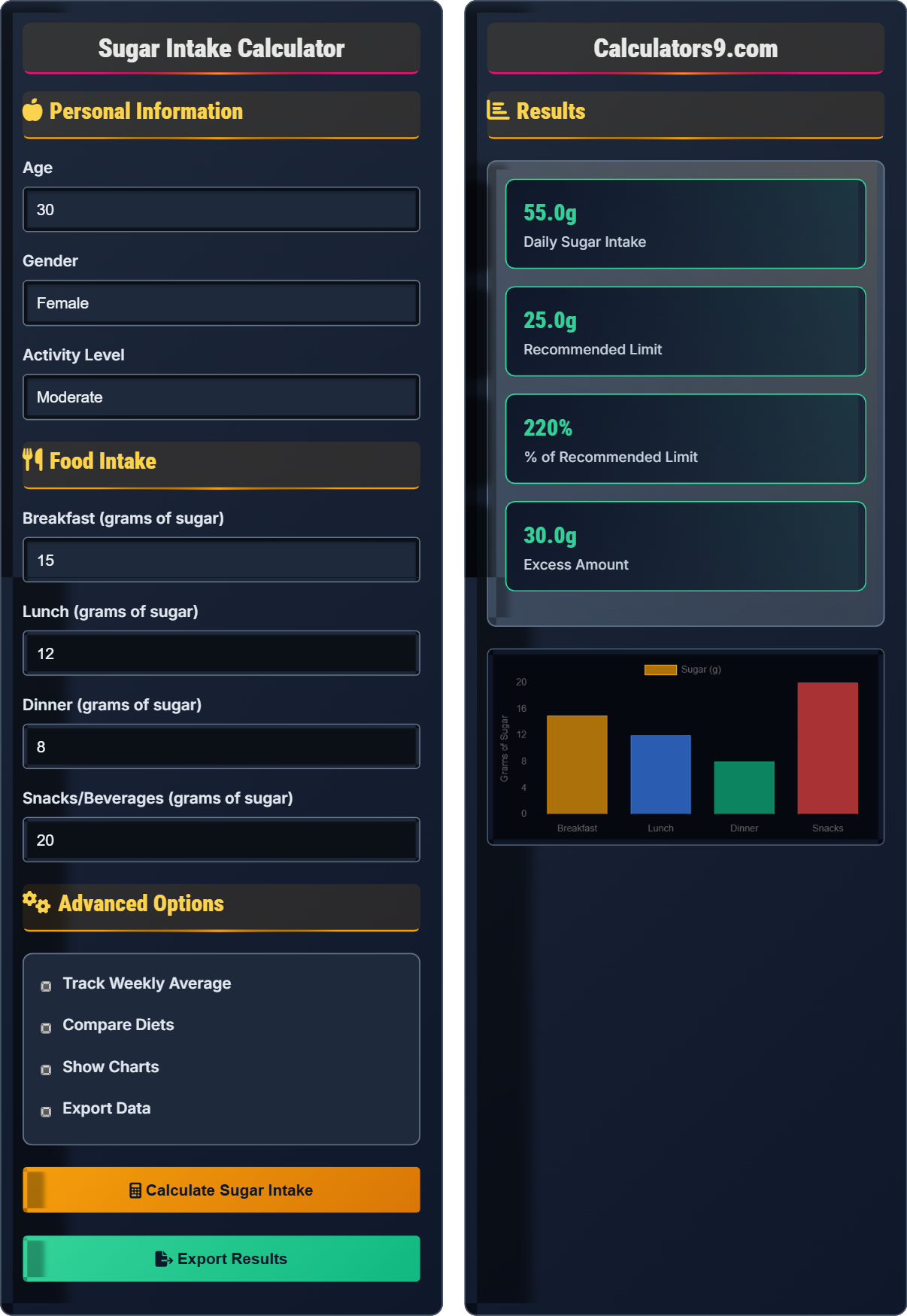
| Meal | Sugar (g) | % of Daily Limit |
|---|---|---|
| Breakfast | 15.0g | 60% |
| Lunch | 12.0g | 48% |
| Dinner | 8.0g | 32% |
| Snacks | 20.0g | 80% |
| Total | 55.0g | 220% |
| Day | Sugar (g) | Status |
|---|---|---|
| Monday | 55.0g | High |
| Tuesday | 42.0g | High |
| Wednesday | 38.0g | High |
| Thursday | 61.0g | Very High |
| Friday | 50.0g | High |
| Saturday | 72.0g | Very High |
| Sunday | 45.0g | High |
Comprehensive Sugar Guide
Added sugars are sugars and syrups that are added to foods or beverages during processing or preparation. They differ from naturally occurring sugars found in fruits, vegetables, and dairy products. Common sources include table sugar, brown sugar, corn syrup, high-fructose corn syrup, honey, and maple syrup.
The calculation of daily sugar intake follows WHO guidelines:
Where:
- Actual Sugar (g) = Sum of all free sugars consumed in a day
- Recommended Limit (g) = 25g for women, 36g for men (based on 2000 kcal/day)
- Daily Percentage = How much of your daily sugar allowance you've consumed
Many processed foods contain hidden sugars that can quickly exceed daily recommendations:
- Sauces and dressings: Ketchup, BBQ sauce, salad dressings
- Processed meats: Deli meats, sausages, bacon
- Yogurt: Flavored varieties often contain 15-30g of sugar per serving
- Breakfast cereals: Many contain 10-15g of sugar per serving
- Bread and baked goods: Even savory breads contain added sugars
- Read labels: Check ingredient lists for hidden sugars (over 60 names exist)
- Choose whole foods: Fresh fruits, vegetables, lean proteins
- Gradual reduction: Reduce sugar intake gradually to allow taste preferences to adjust
- Substitute naturally: Use spices like cinnamon or vanilla instead of sugar
- Hydrate properly: Choose water over sugary drinks
Sugar Basics
Sugars added to foods by manufacturer, cook or consumer, plus sugars naturally present in honey, syrups, and fruit juices.
\( \text{Percentage} = \frac{\text{Total Sugar}}{\text{Daily Limit}} \times 100\% \)
Where total sugar is sum of all free sugars consumed.
- Less than 10% of daily calories from free sugars
- Ideal: Less than 5% for optimal health
- Women: 25g/day, Men: 36g/day
Health Impact
Increased risk of obesity, diabetes, heart disease, dental caries, and fatty liver disease.
- Log food intake daily
- Check nutrition labels
- Use apps or calculators
- Plan meals ahead
- Children under 2: No added sugar
- Children 2-18: Less than 25g/day
- Adults: Follow WHO guidelines
- Monitor hidden sugars
Sugar Intake Learning Quiz
According to WHO guidelines, what percentage of daily calories should come from free sugars?
The answer is D) Both A and B are correct. The WHO recommends that free sugars should make up less than 10% of total energy intake per day, with a further reduction to below 5% providing additional health benefits. This means that for a 2000-calorie diet, free sugars should be less than 50g per day (less than 10%) or ideally less than 25g per day (less than 5%).
Understanding sugar recommendations is crucial because many people consume far more sugar than recommended without realizing it. The WHO guidelines provide clear benchmarks for healthy sugar consumption. The distinction between the 10% and 5% recommendations reflects that even meeting the basic recommendation is challenging for many people, while the 5% target provides optimal health benefits.
Free Sugars: Added sugars plus those naturally present in honey, syrups, and fruit juices (does not include sugars in fresh fruits and vegetables)
WHO Guidelines: World Health Organization recommendations for sugar intake based on scientific evidence
Energy Intake: Total calories consumed in a day
• Free sugars should be less than 10% of daily calories
• Optimal intake is less than 5% of daily calories
• Natural sugars in whole fruits and vegetables don't count toward limit
• Remember: 4g of sugar = 1 teaspoon
• Use the "5-10 rule": Aim for 5% for optimal health, but 10% is still beneficial
• Track sugar intake using food diaries or apps
• Confusing added sugars with natural sugars in fruits
• Underestimating sugar content in processed foods
• Not reading ingredient labels carefully
A 30-year-old woman consumes 45 grams of free sugars in one day. According to WHO guidelines, calculate her sugar intake as a percentage of the recommended daily limit and determine whether she meets the guidelines.
Step 1: Identify the recommended daily limit for women
WHO recommends 25g of free sugars per day for women (based on 2000 kcal/day diet)
Step 2: Apply the sugar intake formula
Percentage of recommended limit = (Actual intake ÷ Recommended limit) × 100%
Percentage = (45g ÷ 25g) × 100% = 1.8 × 100% = 180%
Step 3: Interpret the result
The woman consumed 180% of her recommended daily sugar limit, which means she exceeded the limit by 80%. This exceeds both the basic recommendation (less than 10% of calories) and the optimal recommendation (less than 5% of calories).
This calculation demonstrates how to convert actual sugar intake into a percentage of recommended limits. The formula is straightforward but requires understanding of what constitutes free sugars. The result shows that even moderate-seeming amounts of sugar (45g) can significantly exceed daily recommendations (25g). This example illustrates why awareness and tracking of sugar intake are essential for maintaining a healthy diet.
Free Sugars: Added sugars plus those naturally present in honey, syrups, and fruit juices
Recommended Limit: 25g/day for women, 36g/day for men (based on 2000 kcal/day)
Percentage Calculation: Actual intake divided by recommended limit, multiplied by 100
• Calculate percentage as (actual ÷ recommended) × 100%
• Values above 100% indicate exceeding the daily limit
• Even values below 100% may still exceed optimal recommendations
• Use the formula: (Actual ÷ Recommended) × 100% = Percentage
• Remember that 100% = meeting the limit exactly
• Track intake over several days to identify patterns
• Using the wrong recommended limit (confusing male/female recommendations)
• Including natural sugars from whole fruits in the calculation
• Forgetting to multiply by 100 to get percentage
FAQ
Q: What's the difference between added sugars and natural sugars, and why does it matter for my health?
A: Added sugars are sugars and syrups that are added to foods during processing or preparation, while natural sugars occur naturally in whole foods like fruits, vegetables, and dairy products. The key difference lies in the nutritional context:
Added Sugars: These provide empty calories without nutrients. Common forms include table sugar (sucrose), high-fructose corn syrup, dextrose, and fructose. They're found in sodas, candy, baked goods, and many processed foods. When you consume 45g of added sugars compared to your recommended 25g daily limit, you're consuming 180% of your allowance.
Natural Sugars: These come packaged with fiber, vitamins, minerals, and antioxidants. For example, an apple contains fructose but also fiber that slows absorption, preventing blood sugar spikes. The fiber also promotes satiety and digestive health.
From a calculation perspective, if someone consumes 30g of sugar from an apple (natural) and 20g from a soda (added), only the 20g from the soda counts toward the daily limit: \( \frac{20}{25} \times 100\% = 80\% \) of the daily limit.
Q: How does excess sugar consumption affect my fitness goals and overall health?
A: Excess sugar consumption significantly impacts both fitness goals and overall health through multiple mechanisms:
Metabolic Effects: When you exceed your sugar limit (e.g., consuming 55g when your limit is 25g, representing 220% of the recommendation), your body converts excess glucose to fat through lipogenesis. This process occurs primarily in the liver and leads to increased fat storage.
Insulin Response: High sugar intake causes repeated insulin spikes, leading to insulin resistance over time. The formula for insulin response can be simplified as: \( IR = \frac{S \times G}{T} \) where IR is insulin response, S is sugar amount, G is glycemic index, and T is time. Consistent high values promote fat storage and muscle breakdown.
Energy Impact: While sugar provides quick energy, excessive consumption leads to energy crashes, reduced workout performance, and difficulty maintaining consistent training intensity. This makes achieving fitness goals more challenging.
Inflammation: Studies show that consuming more than 25g of added sugars daily increases inflammatory markers, which can impair recovery and increase injury risk.