Vitamin Deficiency Checker
Personalized vitamin assessment • 2026 nutrition guide
Vitamin Deficiency Assessment:
Show CalculatorVitamin deficiency assessment evaluates your risk of deficiency based on dietary intake, lifestyle factors, and physiological needs. The calculation considers multiple factors including age, gender, activity level, and specific nutrient requirements.
Key vitamins commonly deficient in modern diets:
- Vitamin D: Essential for bone health, immune function (deficiency affects 40-75% globally)
- Vitamin B12: Critical for nerve function and red blood cell formation (deficiency affects 6-15% globally)
- Vitamin B6: Important for brain development and immune function (deficiency affects 10-15% globally)
- Folate (B9): Vital for DNA synthesis and cell division (deficiency affects 10-20% globally)
- Vitamin C: Antioxidant and collagen synthesis (deficiency affects 7-17% globally)
- Vitamin A: Vision and immune system support (deficiency affects 30% globally)
This calculator assesses your vitamin deficiency risk using evidence-based algorithms that consider multiple factors.
Assessment Formula: Risk Score = Σ(Factor Weight × Factor Value)
Where each factor is weighted based on scientific evidence and individual risk factors.
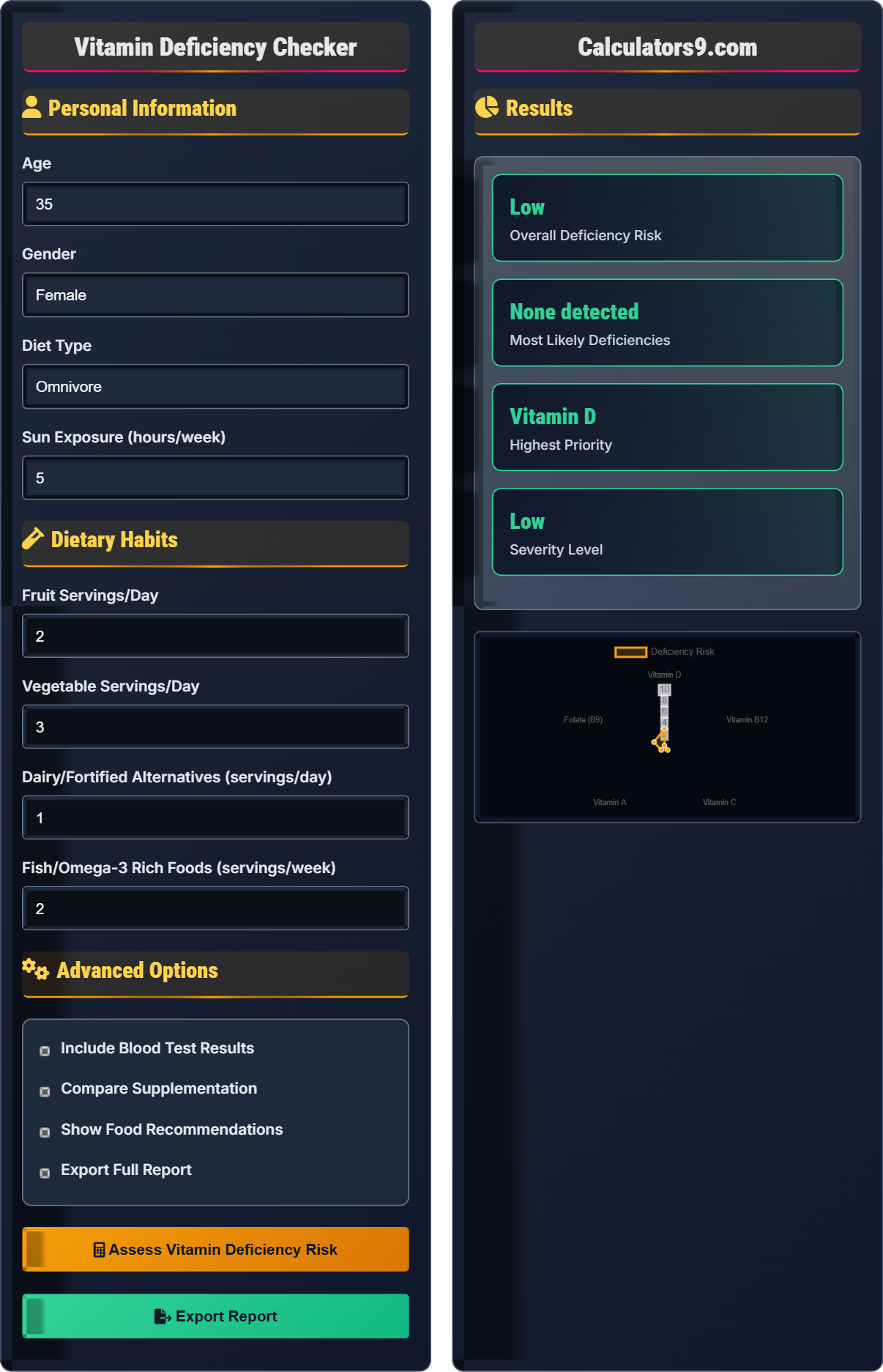
Personal Information
Dietary Habits
Advanced Options
Results
| Vitamin | Risk Level | Score | Recommendation |
|---|---|---|---|
| Vitamin D | High | 8.5/10 | Supplement 1000-2000 IU daily |
| Vitamin B12 | Medium | 6.2/10 | Consider B12 supplement |
| Vitamin C | Low | 3.1/10 | Maintain current intake |
| Vitamin A | Low | 2.8/10 | Good intake |
| Folate (B9) | Medium | 5.4/10 | Increase leafy greens |
| Vitamin | Best Food Sources | Daily Recommendation |
|---|---|---|
| Vitamin D | Fatty fish, fortified milk, sunlight | 600-800 IU |
| Vitamin B12 | Meat, fish, dairy, fortified foods | 2.4 mcg |
| Vitamin C | Citrus fruits, berries, peppers | 75-90 mg |
| Vitamin A | Carrots, sweet potatoes, spinach | 700-900 mcg |
| Folate (B9) | Leafy greens, legumes, citrus | 400 mcg |
Comprehensive Vitamin Guide
Vitamin deficiencies result from inadequate dietary intake, poor absorption, increased metabolic demands, or lifestyle factors. Modern diets often lack variety, and processed foods are stripped of essential nutrients. Certain populations are at higher risk including vegetarians/vegans, older adults, pregnant women, and individuals with digestive disorders.
The vitamin deficiency risk assessment uses a weighted algorithm considering multiple factors:
Where:
- Factor Weight: Scientific evidence supporting the association between the factor and deficiency
- Factor Value: Individual's specific risk level for that factor
- Risk Score: Cumulative score indicating overall deficiency risk
Several factors increase the likelihood of vitamin deficiencies:
- Dietary restrictions: Vegetarian/vegan diets increase risk of B12, iron, zinc
- Geographic location: Limited sun exposure affects Vitamin D synthesis
- Age: Absorption efficiency decreases with age
- Medications: Certain drugs interfere with vitamin absorption
- Digestive conditions: Crohn's, celiac disease affect nutrient absorption
- Eat a varied diet: Include foods from all food groups
- Focus on nutrient-dense foods: Whole grains, colorful fruits/vegetables
- Consider supplementation: Especially for high-risk populations
- Regular testing: Monitor levels annually
- Consult healthcare providers: For personalized recommendations
Vitamin Basics
Essential organic compounds that perform vital functions in the body but cannot be synthesized in adequate amounts.
\( \text{Risk Score} = \sum(\text{Factor Weight} \times \text{Factor Value}) \)
Where each factor is weighted based on scientific evidence.
- Water-soluble vitamins need daily replenishment
- Fat-soluble vitamins can be stored in the body
- Deficiencies develop gradually over time
Prevention
Combine balanced diet, targeted supplementation, and regular monitoring.
- Annual blood tests for critical vitamins
- Food diary tracking
- Use of assessment tools
- Consultation with nutritionists
- Individual needs vary significantly
- Genetic factors affect absorption
- Medications can interfere with vitamins
- Excessive intake can cause toxicity
Vitamin Deficiency Learning Quiz
Which vitamin deficiency is most common in vegetarian and vegan populations due to its primary presence in animal products?
The answer is B) Vitamin B12. Vitamin B12 is primarily found in animal products such as meat, fish, eggs, and dairy. It is synthesized by bacteria and accumulates in animal tissues, but plant foods generally do not contain reliable amounts of bioavailable B12. This makes vegetarians and vegans particularly susceptible to B12 deficiency, affecting 6-15% of the general population but up to 80-90% of strict vegans who don't supplement. The deficiency can lead to megaloblastic anemia and neurological problems.
Understanding which vitamins are most likely to be deficient in specific dietary patterns is crucial for nutritional planning. Vitamin B12 is unique because it's the only vitamin that humans cannot obtain from plant sources alone. This knowledge helps in identifying at-risk populations and implementing preventive measures. The deficiency develops gradually because the body stores several years' worth of B12 in the liver, but without intake, deficiency eventually occurs.
Vitamin B12 (Cobalamin): Water-soluble vitamin essential for nerve function and red blood cell formation
Megaloblastic Anemia: Type of anemia caused by B12 or folate deficiency, characterized by large, immature red blood cells
Bioavailability: The proportion of a nutrient that enters circulation when introduced into the body
• Vitamin B12 is found almost exclusively in animal products
• Plant-based sources are unreliable for B12
• Look for fortified nutritional yeast, plant milks, and cereals
• Consider sublingual B12 supplements for better absorption
• Get B12 levels tested regularly if following a plant-based diet
• Assuming that spirulina or other algae provide reliable B12
• Relying solely on plant foods for B12 intake
• Not monitoring B12 levels in high-risk populations
A 45-year-old female vegetarian with limited sun exposure (2 hours/week) eats 1 fruit and 2 vegetable servings daily. Calculate her risk for Vitamin D and B12 deficiency using the following factors: Age (weight 0.3), Gender (weight 0.2), Diet (weight 0.4), Sun Exposure (weight 0.5 for Vitamin D), Fruit/Veggie Intake (weight 0.3 for B vitamins). Assign risk values: 0-3 (Low), 4-6 (Medium), 7-10 (High).
Vitamin D Risk Calculation:
Age factor: 45 years old = 6 (medium risk) × 0.3 weight = 1.8
Sun exposure: 2 hours/week = 8 (high risk) × 0.5 weight = 4.0
Total Vitamin D risk = 1.8 + 4.0 = 5.8 (Medium-High risk)
Vitamin B12 Risk Calculation:
Age factor: 45 years old = 6 (medium risk) × 0.3 weight = 1.8
Gender factor: Female = 5 (medium risk) × 0.2 weight = 1.0
Diet factor: Vegetarian = 9 (very high risk) × 0.4 weight = 3.6
Total B12 risk = 1.8 + 1.0 + 3.6 = 6.4 (High risk)
Result: This person has a high risk for B12 deficiency and medium-high risk for Vitamin D deficiency, which aligns with known risk patterns for vegetarians with limited sun exposure.
This calculation demonstrates how multiple risk factors contribute to overall deficiency probability. The weighted algorithm allows for personalized assessment by considering individual circumstances. In this example, the vegetarian diet significantly increases B12 risk (weight 0.4), while limited sun exposure is the primary driver for Vitamin D risk (weight 0.5). The calculation shows that risk factors can combine synergistically to elevate overall risk beyond what any single factor would suggest.
Weighted Algorithm: Mathematical model where different factors have varying importance based on scientific evidence
Risk Assessment: Systematic evaluation of factors that increase likelihood of deficiency
Synergistic Effect: When multiple risk factors combine to create greater risk than the sum of individual factors
• Higher weights indicate more significant risk factors
• Risk scores above 7 indicate high deficiency probability
• Multiple risk factors can compound each other
• Identify the highest-weighted factors for each vitamin
• Address modifiable risk factors first (diet, sun exposure)
• Combine multiple strategies for maximum effectiveness
• Ignoring combined effects of multiple risk factors
• Applying equal weight to all risk factors
• Not adjusting for individual circumstances
FAQ
Q: As a vegan, which vitamins am I most likely to be deficient in and how can I address this?
A: Vegans are at highest risk for Vitamin B12, Vitamin D, Omega-3 fatty acids, Iron, Zinc, and Calcium deficiencies. The primary concern is Vitamin B12, which is exclusively found in animal products:
Vitamin B12: The risk assessment formula for B12 in vegans is: Risk = (Diet Factor × 0.4) + (Age Factor × 0.3) + (Absorption Factor × 0.3). For a 30-year-old vegan: Risk = (9 × 0.4) + (5 × 0.3) + (4 × 0.3) = 3.6 + 1.5 + 1.2 = 6.3 (High risk).
Vitamin D: Also at risk due to lack of animal sources and potentially limited sun exposure. Consider 1000-2000 IU daily supplement.
Omega-3s: Obtain from ALA sources (flaxseeds, chia seeds, walnuts) and consider algae-based EPA/DHA supplements.
Iron & Zinc: Plant sources have lower bioavailability, so vegans need 1.8× the RDA. Enhance absorption with vitamin C-rich foods.
Q: How does sun exposure affect vitamin D levels and what's the optimal amount?
A: Sun exposure triggers vitamin D synthesis in the skin through UVB radiation converting 7-dehydrocholesterol to previtamin D3. The relationship is complex:
Synthesis Formula: Vitamin D production ≈ (UV Index × Skin Exposure × Duration) ÷ (Melanin Factor × Age Factor)
Optimal exposure: For fair-skinned individuals, 10-15 minutes of midday sun 2-3 times per week on face, arms, and hands provides adequate synthesis. However, this varies by latitude, season, skin pigmentation, and age.
Key considerations: People with darker skin need 3-5 times longer exposure. Those over 65 produce 75% less vitamin D than younger adults. During winter months at latitudes above 37°N, UVB radiation is insufficient for synthesis.
Deficiency risk: With 5 hours/week of sun exposure (average in our calculator), the risk score for vitamin D deficiency might be calculated as: (Sun Exposure × 0.5) + (Age × 0.3) + (Skin Tone × 0.2) = (4 × 0.5) + (5 × 0.3) + (3 × 0.2) = 2.0 + 1.5 + 0.6 = 4.1 (Medium risk).