Water Intake Calculator
Daily hydration calculator • 2026 nutrition standards
Daily Water Intake Formula:
Show the calculator\( \text{Daily Water (oz)} = \text{Body Weight (lbs)} \times 0.5 + \text{Activity Factor} + \text{Climate Adjustment} \)
Where:
- \( \text{Body Weight (lbs)} \) = Current body weight in pounds
- \( 0.5 \) = Standard water intake per pound of body weight
- \( \text{Activity Factor} \) = Additional ounces for physical activity (typically 12-24 oz)
- \( \text{Climate Adjustment} \) = Additional ounces for hot/humid conditions (typically 8-16 oz)
This formula calculates the recommended daily water intake based on body weight, activity level, and environmental factors.
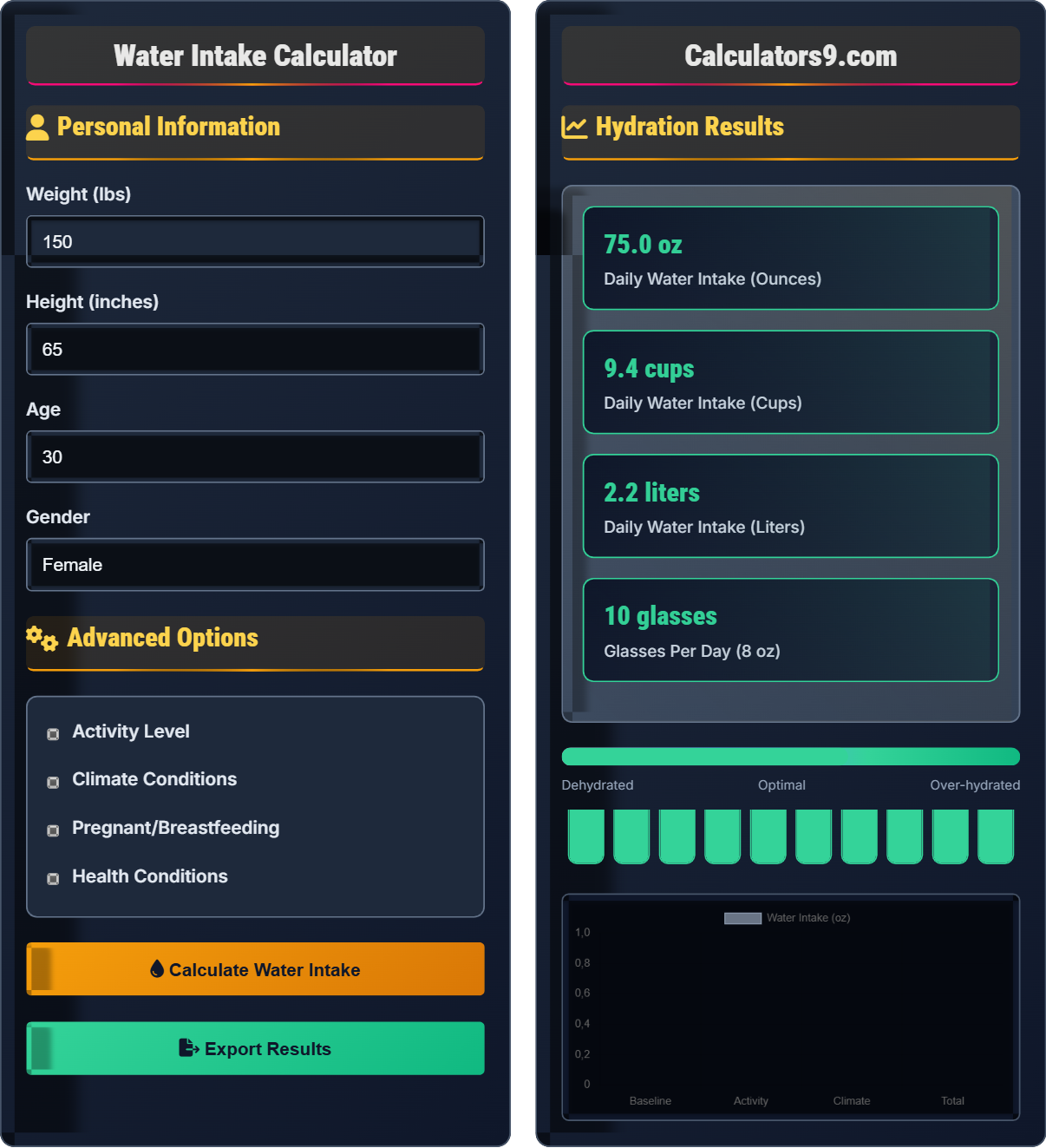
Example: For a person weighing 150 lbs with moderate activity and normal climate:
Base intake: \( 150 \times 0.5 = 75 \) oz
Activity factor: \( +12 \) oz
Climate adjustment: \( +0 \) oz
Total recommended: \( 75 + 12 + 0 = 87 \) oz
Thus, the person should aim for approximately 87 ounces (about 11 cups) of water daily.
Personal Information
Advanced Options
Hydration Results
| Factor | Contribution | Amount |
|---|
| Time | Glasses | Notes |
|---|
Comprehensive Hydration Guide
Water is essential for every cell, tissue, and organ in your body. It helps regulate temperature, lubricate joints, transport nutrients, and remove waste. Proper hydration supports cognitive function, physical performance, and overall health. Dehydration can lead to fatigue, headaches, decreased physical performance, and impaired cognitive function.
The most common methods for calculating daily water needs:
Additional factors to consider: activity level (+12-24 oz), climate (+8-16 oz), pregnancy/breastfeeding (+16-32 oz).
Your daily fluid intake comes from various sources:
- Drinking Water: Plain water is the best source of hydration
- Food: Many fruits and vegetables contain significant water content
- Beverages: Tea, coffee, juices, and other drinks contribute to hydration
- Metabolic Water: Produced internally during metabolism
- Start your day with water: Drink a glass of water first thing in the morning
- Carry water with you: Keep a water bottle accessible throughout the day
- Eat hydrating foods: Include water-rich fruits and vegetables in meals
- Set reminders: Use apps or alarms to remind yourself to drink
- Track your intake: Monitor your daily water consumption
Hydration Fundamentals
8-10 glasses (64-80 oz) for average adults, adjusted for individual factors.
\( \text{Weight (lbs)} \times 0.5 = \text{oz/day} \)
Adjust for activity, climate, and health conditions.
- Drink water before feeling thirsty
- More water needed during exercise
- Hydration needs vary by individual
Hydration Tips
First thing in morning, before meals, during exercise, and before bed.
- Flavor water with lemon or cucumber
- Drink a glass before each meal
- Replace sugary drinks with water
- Use a marked water bottle
- Monitor urine color
- Listen to your body
- Adjust for medications
- Avoid over-hydration
Hydration Learning Quiz
According to the standard calculation method, how much water should a 160-pound person aim to drink daily?
The answer is B) 80 ounces. The standard calculation is body weight in pounds multiplied by 0.5. For a 160-pound person: 160 × 0.5 = 80 ounces. This is the baseline recommendation before adjusting for activity, climate, and other factors.
The weight-based calculation is a simple and effective way to estimate daily water needs. This method recognizes that larger individuals need more water to maintain proper hydration. The 0.5 multiplier represents the standard amount of water (in ounces) needed per pound of body weight. This formula provides a personalized starting point that can then be adjusted based on individual circumstances.
Hydration: The process of providing adequate water to the body's cells and tissues
Baseline Recommendation: The minimum amount of water needed before considering other factors
Body Weight Multiplier: The factor used to calculate water needs based on weight
• Body weight (lbs) × 0.5 = baseline daily water needs (oz)
• Adjust for activity level, climate, and health conditions
• Individual needs may vary based on multiple factors
• Remember: Weight × 0.5 = baseline water needs
• Use the "half your body weight in ounces" rule
• Convert ounces to cups by dividing by 8
• Using kilograms instead of pounds in the calculation
• Forgetting to adjust for activity level and other factors
• Applying the same amount to everyone regardless of size
Calculate the recommended daily water intake for a 140-pound female who exercises moderately 4 times per week in a warm climate. Show your work.
Step 1: Calculate baseline water needs = 140 lbs × 0.5 = 70 oz
Step 2: Add activity factor (moderate exercise) = +16 oz
Step 3: Add climate adjustment (warm climate) = +12 oz
Step 4: Total recommended intake = 70 + 16 + 12 = 98 oz
Step 5: Convert to cups = 98 ÷ 8 = 12.25 cups
Step 6: Convert to liters = 98 × 0.0296 = 2.9 liters
This problem demonstrates how multiple factors combine to determine total water needs. The baseline calculation is just the starting point - activity level and climate significantly impact hydration requirements. Exercise increases water loss through sweat, while warm climates cause additional fluid loss through perspiration. This calculation shows why a one-size-fits-all approach to hydration recommendations is inadequate.
Activity Factor: Additional water needed based on physical activity level
Climate Adjustment: Additional water needed based on environmental conditions
Total Water Intake: Sum of all contributing factors for hydration needs
• Start with weight-based calculation as baseline
• Add activity-specific adjustments
• Account for environmental conditions
• Always calculate baseline first
• Add factors incrementally
• Remember to convert units if needed
• Forgetting to add activity or climate factors
• Adding too much or too little for specific factors
• Mixing up units of measurement
John weighs 180 pounds and recently started training for a marathon. He now runs 6 days a week for 1 hour each day. If he lives in a temperate climate, how much additional water should he drink compared to his sedentary baseline?
Step 1: Calculate baseline sedentary intake = 180 lbs × 0.5 = 90 oz
Step 2: Calculate active intake with running = 90 oz + activity factor
Step 3: For very active (daily exercise), add 24 oz = 90 + 24 = 114 oz
Step 4: Additional water needed = 114 - 90 = 24 oz
Step 5: In cups = 24 ÷ 8 = 3 additional cups per day
Therefore, John should drink 24 additional ounces (3 more cups) compared to his sedentary baseline.
This example highlights how intense physical activity dramatically increases water needs. Running for an hour daily significantly increases sweat production and fluid loss. The additional 24 ounces represents the extra water needed to replace fluids lost during exercise and support increased metabolic demands. Athletes often need 50-100% more water than sedentary individuals.
Sweat Rate: The amount of fluid lost through sweating during exercise
Metabolic Demand: Increased water needs due to higher metabolic activityExercise-Induced Dehydration: Fluid loss that occurs during physical activity
• Exercise significantly increases water requirements
• Duration and intensity both affect hydration needs
• Replace fluids lost during activity
• Weigh yourself before and after exercise to measure fluid loss
• Drink 16-24 oz of water for every pound lost during exercise
• Pre-hydrate before intense activities
• Underestimating water needs during intense training
• Waiting until thirsty to drink during exercise
• Not accounting for post-exercise rehydration
Sarah weighs 130 pounds and lives in Phoenix, Arizona where summer temperatures regularly exceed 100°F. During the summer, she works outdoors for 4 hours daily. How much water should she aim to drink daily, and what percentage increase is this from her baseline winter intake in a temperate climate?
Step 1: Calculate baseline winter intake = 130 lbs × 0.5 = 65 oz
Step 2: Add outdoor work factor (heavy activity) = +24 oz
Step 3: Add extreme heat factor = +20 oz
Step 4: Total summer intake = 65 + 24 + 20 = 109 oz
Step 5: Percentage increase = ((109 - 65) / 65) × 100 = 67.7%
Therefore, Sarah should drink 109 oz daily during summer, representing a 67.7% increase from her winter baseline.
This demonstrates how environmental conditions can dramatically increase hydration needs. Extreme heat causes the body to sweat profusely to cool down, leading to significant fluid loss. Working outdoors amplifies this effect. The 67.7% increase shows that seasonal and climatic factors can more than double someone's baseline water needs. People living in hot climates need to be particularly vigilant about hydration.
Thermoregulation: The body's process of maintaining optimal temperature through sweating
Environmental Stress: Additional physiological demands caused by extreme weather
Seasonal Adjustment: Modifying water intake based on seasonal climate changes
• Hot climates significantly increase water needs
• Outdoor work amplifies hydration requirements
• Seasonal adjustments are necessary for optimal hydration
• Increase water intake gradually when moving to hotter climates
• Monitor hydration status more closely in extreme conditions
• Consider electrolyte replacement in extreme heat
• Applying temperate climate recommendations to hot environments
• Not increasing water intake quickly enough in hot weather
• Confusing thirst with hydration needs in extreme heat
Which of the following statements about hydration during pregnancy is TRUE?
The answer is B) Pregnancy increases blood volume, requiring more water. During pregnancy, blood volume increases by 30-50% to support the growing fetus. This increased blood volume requires additional water to maintain proper circulation and nutrient delivery. Pregnant women are generally advised to drink an extra 8-16 ounces of water daily beyond their baseline needs.
Pregnancy creates unique physiological demands that increase water requirements. The body produces more blood to carry oxygen and nutrients to the developing baby. Amniotic fluid also contributes to increased water needs. Proper hydration during pregnancy supports fetal development, prevents complications, and helps manage common pregnancy symptoms like constipation and swelling.
Blood Volume Expansion: The increase in total blood volume during pregnancy
Amniotic Fluid: The protective liquid surrounding the fetus that requires additional water
Physiological Demands: The additional requirements placed on the body during pregnancy
• Pregnancy increases baseline water needs
• Blood volume expansion requires additional water
• Proper hydration supports fetal development
• Add 8-16 oz of water daily during pregnancy
• Monitor urine color more carefully
• Stay hydrated before, during, and after meals
• Assuming pregnancy doesn't affect hydration needs
• Restricting water due to concerns about swelling
• Not accounting for increased blood volume requirements
FAQ
Q: How much more water should I drink when exercising intensely?
A: For intense exercise, you should consume an additional 16-24 ounces of water for every pound of body weight lost during exercise. The general recommendation adds 12-24 ounces to your baseline daily intake for moderate activity, but for intense exercise lasting over an hour, you may need 24-32 additional ounces.
Mathematically, if your baseline is \( W \times 0.5 \) ounces (where \( W \) is weight in pounds), then with intense exercise:
\( \text{Total} = (W \times 0.5) + \text{Activity Factor} \)
For very active individuals (6-7 days/week), the activity factor is typically 24-32 ounces. It's also important to hydrate before, during, and after exercise to maintain optimal performance and recovery.
Q: Should I really drink more water during pregnancy?
A: Yes, pregnant women need significantly more water than usual. Blood volume increases by 30-50% during pregnancy to support the growing fetus, and amniotic fluid also requires additional water.
The Institute of Medicine recommends pregnant women consume about 10 cups (80 ounces) of water daily, compared to 8 cups for non-pregnant women. For a 140-pound woman:
- Baseline: 140 × 0.5 = 70 oz
- Plus pregnancy: +16 oz
- Total: 86 oz (≈10.75 cups)
Adequate hydration during pregnancy helps prevent complications, supports fetal development, and manages common symptoms.