Black-Scholes Calculator
Option pricing model • 2026 standards
Black-Scholes Formula:
Show the calculator\( C = S_0 N(d_1) - Ke^{-rT} N(d_2) \)
\( P = Ke^{-rT} N(-d_2) - S_0 N(-d_1) \)
Where:
- \( C \) = Call option price
- \( P \) = Put option price
- \( S_0 \) = Current stock price
- \( K \) = Strike price
- \( T \) = Time to expiration (in years)
- \( r \) = Risk-free interest rate
- \( \sigma \) = Volatility of the underlying asset
- \( N(x) \) = Cumulative distribution function of standard normal distribution
Where:
- \( d_1 = \frac{\ln(S_0/K) + (r + \sigma^2/2)T}{\sigma\sqrt{T}} \)
- \( d_2 = d_1 - \sigma\sqrt{T} \)
The Black-Scholes model provides a theoretical estimate of European-style option prices. It assumes no dividends, constant volatility, and log-normal distribution of returns. The model revolutionized options pricing and earned its creators a Nobel Prize.
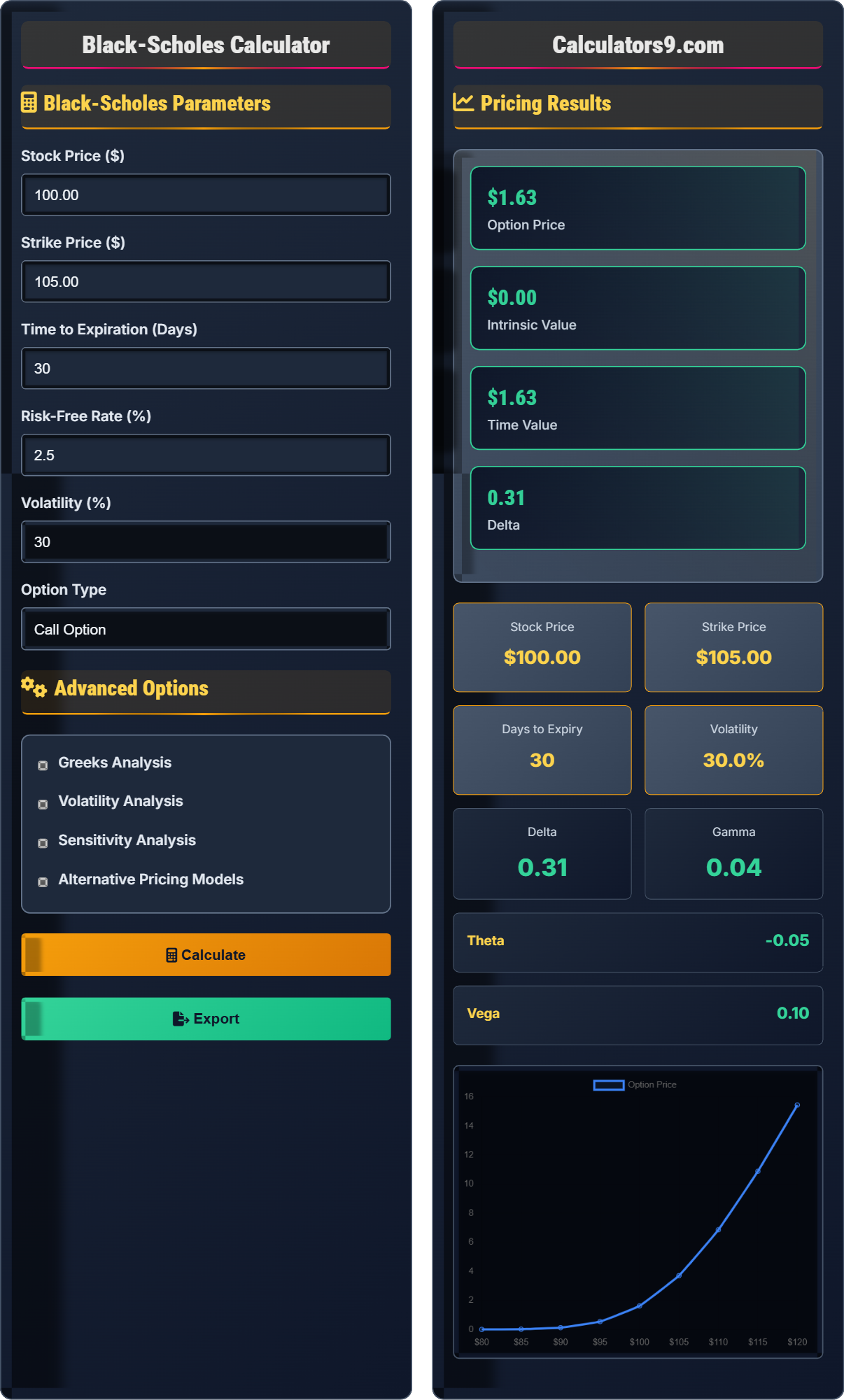
Black-Scholes Parameters
Advanced Options
Pricing Results
| Component | Value | Description |
|---|
| Greek | Value | Interpretation |
|---|
| Analysis | Value | Significance |
|---|
Black-Scholes Model Fundamentals
The Black-Scholes model is a mathematical framework for pricing European-style options. Developed by Fischer Black, Myron Scholes, and Robert Merton in the early 1970s, it provides a theoretical estimate of option prices based on five key variables: stock price, strike price, time to expiration, risk-free rate, and volatility.
Where:
- \( S_0 \) = Current stock price
- \( K \) = Strike price
- \( T \) = Time to expiration (in years)
- \( r \) = Risk-free interest rate
- \( \sigma \) = Volatility of the underlying asset
- No Dividends: Stock pays no dividends during option life
- Constant Volatility: Volatility remains constant over time
- Log-Normal Distribution: Returns follow log-normal distribution
- No Arbitrage: No riskless profit opportunities
- European Exercise: Options can only be exercised at expiration
Greek Letters Analysis
Pricing Applications
- Option Valuation: Determine fair value of traded options
- Hedging Strategies: Use Greeks to hedge positions
- Implied Volatility: Back-calculate market's volatility expectation
- Portfolio Management: Risk assessment and management
- Trading Decisions: Identify over/under-valued options
- Assumes constant volatility (real markets vary)
- Doesn't account for dividends
- Only applies to European options
- Assumes continuous trading
- May not reflect extreme market events
Black-Scholes Model Quiz
An option has a delta of 0.65. What does this mean?
The answer is C) Both A and B are correct. Delta represents both the rate of change in option price per dollar change in stock price AND the approximate probability that the option will expire in-the-money. A delta of 0.65 means the option price will change by approximately $0.65 for every $1 change in the stock price, and there's approximately a 65% chance the option will expire in-the-money.
Delta is a fundamental Greek that has dual interpretations. As a sensitivity measure, it indicates how much the option price will change for a small movement in the underlying asset. As a probability measure, it approximates the likelihood of the option expiring in-the-money. This duality makes delta particularly important for both pricing and risk management.
Delta: Sensitivity of option price to underlying asset price
Probability: Approximate chance of option finishing in-the-money
Sensitivity: Rate of change in option value
• Call delta ranges from 0 to 1
• Put delta ranges from -1 to 0
• At-the-money options have deltas near 0.5
• Delta approaches 1 as call goes deep in-the-money
• Delta approaches 0 as option moves out-of-the-money
• Put delta is negative, call delta is positive
• Confusing delta with theta (time decay)
A stock is trading at $100, and a 3-month call option with a strike price of $105 has a Black-Scholes value of $3.72. If the risk-free rate is 2.5% and volatility is 30%, calculate the intrinsic and time value of the option. Explain why the option has value despite being out-of-the-money.
For a call option: Intrinsic Value = max(Stock Price - Strike Price, 0) = max(100 - 105, 0) = $0. Time Value = Option Price - Intrinsic Value = $3.72 - $0 = $3.72.
The option has value despite being out-of-the-money because of time value. With 3 months until expiration and 30% volatility, there's significant probability that the stock price could rise above the strike price before expiration. The time value reflects this probability and the potential for profit if the stock moves favorably.
Option value consists of two components: intrinsic value (actual profit if exercised immediately) and time value (potential future profit). Out-of-the-money options have zero intrinsic value but positive time value because there's still time for the stock to move in the right direction. Time value decreases as expiration approaches (theta decay).
Intrinsic Value: Actual value if option exercised immediately
Time Value: Value from potential future movement
Out-of-the-Money: Option with no intrinsic value
• Option Value = Intrinsic Value + Time Value
• In-the-money options have positive intrinsic value
• Time value decreases as expiration approaches
• Time value is highest for at-the-money options
• Out-of-the-money options have pure time value
• Volatility increases time value
• Thinking out-of-the-money options are worthless
Options Pricing Q&A
Q: What is implied volatility and how is it calculated?
A: Implied volatility is the market's expectation of future volatility, derived by plugging the current market price of an option into the Black-Scholes model and solving for volatility. It's called "implied" because it's the volatility level that makes the model price equal to the market price.
Since volatility is the only parameter in Black-Scholes that cannot be directly observed, traders use the market price of the option to back-calculate the implied volatility. Higher implied volatility indicates that the market expects larger price swings in the underlying asset.
Q: How do the Greeks help in options trading?
A: The Greeks provide crucial insights into how option prices change with various factors. Delta helps determine how many shares to buy/sell to hedge an option position. Gamma indicates how much Delta will change with stock price movement. Theta shows daily time decay, helping traders understand how value erodes. Vega measures sensitivity to volatility changes, which is critical for options trading.
Traders use the Greeks to manage risk, construct hedging strategies, and understand their position's sensitivity to market movements. A delta-neutral portfolio has zero directional exposure, while gamma helps predict how Delta will change.