Options Profit Calculator

Derivatives trading tool • 2026 standards

Options Profit Formulas:

Show the calculator

Call Option Profit: \( \text{Profit} = \max(S - K, 0) - P \)

Put Option Profit: \( \text{Profit} = \max(K - S, 0) - P \)

Where:

  • \( S \) = Stock price at expiration
  • \( K \) = Strike price
  • \( P \) = Premium paid

These formulas calculate the profit or loss for options positions at expiration. For call options, profit occurs when stock price exceeds strike price plus premium. For put options, profit occurs when strike price exceeds stock price plus premium.

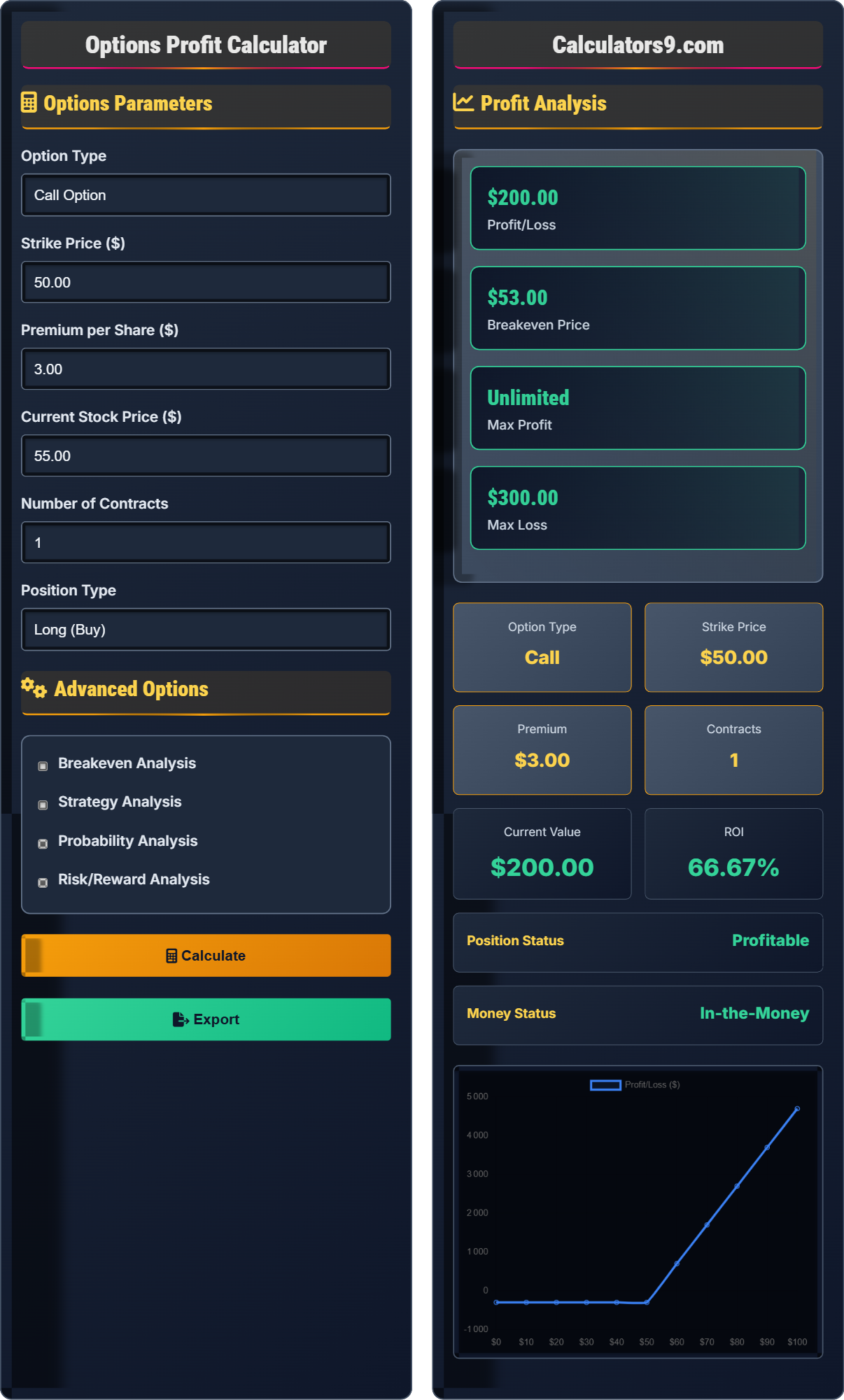
Example: Buying a call option with strike $50, premium $3, and stock price $55 at expiration: Profit = max(55-50, 0) - 3 = 5 - 3 = $2 per share ($200 for 1 contract).

Options Parameters

Advanced Options

Profit Analysis

$200.00
Profit/Loss
$53.00
Breakeven Price
$200.00
Max Profit
$300.00
Max Loss
Option Type
Call
Strike Price
$50.00
Premium
$3.00
Contracts
1
Current Value
$200.00
ROI
66.67%
Position Status
Profitable
Money Status
In-the-Money
Component Value Description
Strategy Element Value Significance
Analysis Point Value Interpretation

Options Trading Fundamentals

What are Options?

Options are financial derivatives that give buyers the right, but not the obligation, to buy (call) or sell (put) an underlying asset at a specific price (strike price) before or at expiration. The buyer pays a premium for this right. Options can be used for speculation, hedging, or income generation.

Key Options Concepts
\( \text{Call Profit} = \max(S - K - P, -P) \times 100 \times N \)

Where:

  • \( S \) = Stock price at expiration
  • \( K \) = Strike price
  • \( P \) = Premium paid per share
  • \( N \) = Number of contracts (100 shares per contract)

Key Options Rules:
  • Call Options: Profit when stock > strike + premium
  • Put Options: Profit when strike > stock + premium
  • Max Loss: Premium paid (for buyers)
  • Max Profit: Unlimited for calls, limited for puts
  • Contract Size: 100 shares per contract

Options Strategy Analysis

1
Long Call: Buy call option expecting stock to rise. Limited risk (premium paid), unlimited profit potential. Breakeven = Strike + Premium.
2
Long Put: Buy put option expecting stock to fall. Limited risk (premium paid), limited profit potential. Breakeven = Strike - Premium.
Short Call: Sell call option expecting stock to stay same or fall. Limited profit (premium received), unlimited risk.
Short Put: Sell put option expecting stock to stay same or rise. Limited profit (premium received), limited risk.

Risk Management Strategies

Options Risk Management:
  • Position Sizing: Never risk more than 1-2% of account per trade
  • Stop Losses: Exit positions at predetermined loss levels
  • Time Decay: Be aware of theta (time decay) impact
  • Implied Volatility: Trade high IV when expecting it to decrease
  • Assignment Risk: Understand obligations when short options
Common Options Mistakes:
  • Buying options close to expiration (high time decay)
  • Not understanding assignment risk when shorting options
  • Over-leveraging positions
  • Ignoring implied volatility levels
  • Not having an exit strategy

Options Trading Quiz

Question 1: Multiple Choice - Call Option Profit

An investor buys a call option with a strike price of $40 for a premium of $2. If the stock price at expiration is $45, what is the profit per share?

Solution:

The answer is B) $3. For a call option: Profit = max(Stock Price - Strike Price - Premium, -Premium) = max(45 - 40 - 2, -2) = max(3, -2) = $3 per share. The option is exercised because 45 > 40, and the investor realizes a profit of $3 per share after paying the premium.

Pedagogical Explanation:

Call option profit calculation involves three components: the stock price at expiration, the strike price, and the premium paid. The investor profits when the stock price exceeds the sum of the strike price and premium. The maximum loss is limited to the premium paid, which occurs when the stock price is below the strike price at expiration.

Key Definitions:

In-the-Money: Option has intrinsic value (profit if exercised immediately)

Out-of-the-Money: Option has no intrinsic value

At-the-Money: Strike price equals current stock price

Important Rules:

• Call option is ITM when Stock > Strike

• Put option is ITM when Strike > Stock

• Maximum loss = Premium paid for long positions

Tips & Tricks:

• Remember: Profit = Intrinsic Value - Premium Paid

• For calls: Intrinsic Value = Max(Stock - Strike, 0)

• For puts: Intrinsic Value = Max(Strike - Stock, 0)

Common Mistakes:

• Forgetting to subtract the premium from intrinsic value

  • Confusing call and put option formulas
  • Not considering that profit can't be negative (limited to premium loss)
  • Question 2: Detailed Answer - Put Option Analysis

    An investor purchases a put option with a strike price of $60 for a premium of $4. Calculate the breakeven price, maximum profit, and maximum loss. At what stock price would the investor break even? Explain the profit profile.
    Solution:

    For a put option: Breakeven Price = Strike - Premium = $60 - $4 = $56. Maximum Loss = Premium Paid = $4 per share. Maximum Profit = Strike Price - Premium = $60 - $4 = $56 per share (when stock price reaches $0). The investor breaks even when the stock price is $56.

    Profit Profile: When stock > $60, loss = $4 (premium paid). When stock = $56, profit = $0 (breakeven). When stock < $56, profit increases as stock price decreases. Maximum profit occurs when stock price reaches $0.

    Pedagogical Explanation:

    Put options profit profiles are inverted compared to calls. The investor profits when the stock price falls below the breakeven point. The maximum profit for a long put is limited because the stock price cannot go below $0. The maximum loss is always the premium paid, which occurs when the stock price is at or above the strike price at expiration.

    Key Definitions:

    Breakeven Price: Stock price where position shows zero profit/loss

    Maximum Loss: Highest possible loss (premium paid for long positions)

    Maximum Profit: Highest possible profit (limited for puts)

    Important Rules:

    • Put Breakeven = Strike - Premium

    • Put Max Loss = Premium Paid

    • Put Max Profit = Strike - Premium (when stock = $0)

    Tips & Tricks:

    • Put options are bearish bets on stock price decline

    • Breakeven is always below the strike price

    • Profit increases as stock price decreases below breakeven

    Common Mistakes:

    • Calculating breakeven as Strike + Premium (wrong for puts)

    • Thinking put maximum profit is unlimited (it's limited)

    • Confusing profit direction (puts profit when stock falls)

    Options Profit Calculator

    Options Trading Q&A

    Q: What happens if I don't close my options position before expiration?

    A: If you hold a long option until expiration, it will be automatically exercised if it's in-the-money (profitable). If it's out-of-the-money (losing), it will expire worthless. For short options, you'll be assigned if the option is in-the-money at expiration.

    Automatic exercise typically occurs for options that are $0.01 or more in-the-money. However, you can submit an exercise notice to avoid automatic exercise. It's generally better to close profitable positions before expiration to capture any remaining time value.

    Q: How do I calculate the probability of success for an options trade?

    A: Probability of success is often estimated using the option's delta. For call options, delta approximates the probability that the option will be in-the-money at expiration. For example, a call option with a delta of 0.35 has approximately a 35% chance of expiring in-the-money.

    However, this is a simplified estimate. More sophisticated analysis involves implied volatility, time to expiration, and statistical models. The probability of profitability is different from the probability of being in-the-money, as profitability also depends on the premium paid.

    About

    Trading Team
    This calculator was created
    This calculator was created by our Options Trading Team , may make errors. Consider checking important information. Updated: April 2026.