Allowance Calculator
Teach kids money skills • 2026 edition
Age-Based Allowance Formula:
Show the calculator\( \text{Weekly Allowance} = \frac{\text{Child's Age}}{2} \times \$1 \)
Where:
- \( \text{Child's Age} \) = Age in years
- Divided by 2 to normalize for developmental appropriateness
- Multiply by $1 for basic allowance per normalized age unit
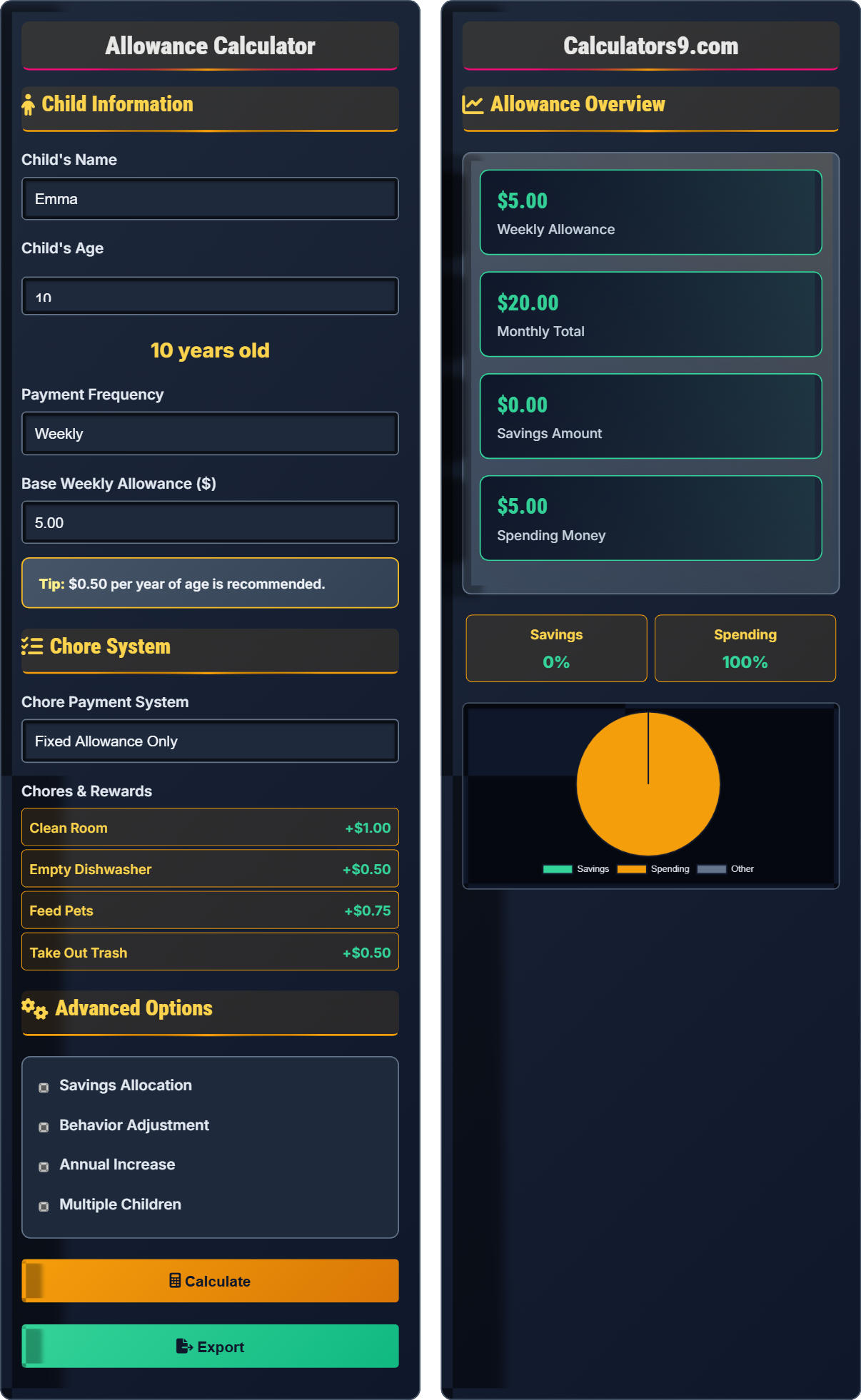
This formula calculates a recommended weekly allowance based on a child's age, following financial experts' recommendations. The $0.50 per year of age guideline helps children learn money management appropriate to their developmental stage.
Example: For a 10-year-old child:
\( \text{Weekly Allowance} = \frac{10}{2} \times \$1 = 5 \times \$1 = \$5.00 \)
Therefore, a 10-year-old should receive approximately $5.00 per week as a baseline allowance.
Child Information
Chore System
Advanced Options
Allowance Overview
| Category | Amount | Percentage |
|---|
| Goal | Amount Needed | Weeks to Achieve |
|---|
Allowance Planning Guide
Allowance provides children with hands-on experience managing money. Starting with a small amount appropriate to their age allows children to learn budgeting, saving, and spending decisions in a safe environment. The goal is to teach financial responsibility without creating unrealistic expectations.
Experts recommend calculating allowance based on age:
Where:
- \(A\) = Weekly allowance amount
- Age is divided by 2 to normalize for developmental appropriateness
- Multiply by $1 for basic allowance per normalized age unit
Many experts recommend dividing allowance into three categories:
- Save (50%): For larger purchases and delayed gratification
- Spend (30%):strong> For immediate wants and learning to budget
- Give (20%): For charity and understanding generosity
- Ages 3-5: Simple concepts, piggy bank, $0.50-$1.00 weekly
- Ages 6-9: Basic allowance, simple budgeting, $1.00-$3.00 weekly
- Ages 10-13: More responsibility, savings goals, $3.00-$7.00 weekly
- Ages 14-18: Part-time job preparation, independent budgeting, $7.00-$15.00+ weekly
Allowance Basics
Regular monetary payment for children.
\(A = \frac{\text{Age}}{2} \times \$1\)
Where A=allowance, Age=child's age in years.
- Don't tie to basic chores
- Be consistent with payments
- Teach money management
Planning Strategies
Separate savings, spending, and giving jars.
- Save 50% for larger purchases
- Spend 30% for immediate needs
- Give 20% for charity
- Adjust for family income
- Consider regional costs
- Match to child's maturity
- Review periodically
Allowance Planning Learning Quiz
According to financial experts, what should be the weekly allowance for a 12-year-old child using the age-based formula?
The answer is B) $6.00. Using the age-based formula: \(A = \frac{\text{Age}}{2} \times \$1\)
For a 12-year-old: \(A = \frac{12}{2} \times \$1 = 6 \times \$1 = \$6.00\)
The standard recommendation is $0.50 per year of age, which equals $6.00 for a 12-year-old.
The age-based allowance formula provides a standardized approach to determining appropriate allowance amounts. By using $0.50 per year of age, parents can scale the allowance appropriately as children grow and develop greater financial responsibility. This method ensures that older children receive more money as they're capable of handling greater financial complexity.
Age-Based Formula: $0.50 per year of age guideline
Financial Responsibility: Ability to manage money appropriately
Developmental Appropriateness: Matching financial tasks to maturity level
• $0.50 per year of age is the standard
• Adjust for family circumstances
• Review periodically as child grows
• Round to nearest dollar for simplicity
• Consider regional cost differences
• Match allowance to financial maturity
• Giving too much too soon
• Not adjusting for age changes
• Tying allowance to basic chores
If a child receives $10 per week in allowance, how much should go to savings using the recommended 50/30/20 split?
Using the 50/30/20 rule:
• 50% for savings: $10 × 0.50 = $5.00
• 30% for spending: $10 × 0.30 = $3.00
• 20% for giving: $10 × 0.20 = $2.00
Therefore, $5.00 should go to savings.
The 50/30/20 allocation teaches children to divide their money into three categories: savings for future goals, spending for current wants, and giving for charitable purposes. This system helps children develop balanced financial habits early in life, emphasizing both personal financial goals and social responsibility.
50/30/20 Rule: Allocation split for financial management
Savings: Money set aside for future purchases
Spending: Money for immediate needs/wants
• Save 50% for larger purchases
• Spend 30% for current needs
• Give 20% for charity
• Use separate jars or accounts
• Set savings goals together
• Adjust ratios as needed
• Not enforcing the allocation system
• Letting child spend all money immediately
• Not including giving component
Sarah receives $8 per week in allowance. She wants to buy a bicycle that costs $120. If she saves 50% of her allowance each week, how many weeks will it take her to save enough for the bicycle? If she also receives a $20 birthday gift toward the bicycle, how many fewer weeks will she need to save?
Step 1: Calculate weekly savings
Weekly savings = $8 × 0.50 = $4.00
Step 2: Calculate weeks needed without gift
Weeks needed = $120 ÷ $4.00 = 30 weeks
Step 3: Calculate weeks needed with $20 gift
Amount still needed = $120 - $20 = $100
Weeks needed with gift = $100 ÷ $4.00 = 25 weeks
Step 4: Calculate weeks saved
Fewer weeks = 30 - 25 = 5 weeks
Sarah would need 30 weeks without the gift, or 25 weeks with the $20 gift, saving 5 weeks of saving time.
This problem demonstrates how to set financial goals and calculate the time needed to achieve them. It also shows how additional funds (like gifts) can accelerate goal achievement. The calculation helps children understand the relationship between their saving rate and time to achieve goals.
Financial Goal: Specific amount to save for
Saving Rate: Percentage of income saved
Time Value: Relationship between saving and time
• Larger goals require more time
• Increasing savings rate reduces time
• Additional funds accelerate goal achievement
• Set achievable short-term goals
• Celebrate savings milestones
• Use visual progress trackers
• Setting unrealistic goals
• Not accounting for unexpected expenses
• Giving up on goals too easily
Mike's parents want to implement a performance-based chore system. His base allowance is $6 per week. For each chore completed perfectly, he earns $1.50 bonus. If Mike completes 4 chores per week, what is his total weekly income? If he saves 40% of his total income, how much does he save per week?
Step 1: Calculate chore bonuses
Chore bonus = 4 chores × $1.50 = $6.00
Step 2: Calculate total weekly income
Total income = Base allowance + Chore bonuses
Total income = $6.00 + $6.00 = $12.00
Step 3: Calculate savings amount
Weekly savings = $12.00 × 0.40 = $4.80
Mike's total weekly income is $12.00, and he saves $4.80 per week.
This demonstrates how performance-based chore systems can incentivize work while teaching children about earning money through effort. The system rewards quality completion of tasks, helping children understand the relationship between work and compensation. It also maintains the savings habit even with increased income.
Performance-Based: Payment linked to task quality
Earned Income: Money received for work completed
Work Ethic: Valuing effort and responsibility
• Quality matters more than quantity
• Consistency builds character
• Earning money requires effort
• Set clear chore expectations
• Reward improvement over time
• Maintain base allowance for non-chores
• Expecting perfection immediately
• Not distinguishing between chores and allowances
• Eliminating base allowance entirely
According to financial experts, which of these is the most appropriate weekly allowance for a 7-year-old child?
The answer is B) $3.50. Using the age-based formula: \(A = \frac{\text{Age}}{2} \times \$1\)
For a 7-year-old: \(A = \frac{7}{2} \times \$1 = 3.5 \times \$1 = \$3.50\)
This follows the standard recommendation of $0.50 per year of age for a 7-year-old.
Age-appropriate allowance amounts consider a child's cognitive development and ability to manage money. A 7-year-old can typically understand basic addition/subtraction and simple saving concepts, making $3.50 a suitable amount to practice money management without overwhelming them. The amount allows for meaningful choices while keeping amounts manageable for young children.
Age-Appropriate: Matching amounts to developmental stage
Cognitive Development: Mental abilities at different agesMoney Management: Skills to handle money responsibly
• $0.50 per year of age is standard
• Adjust for individual maturity
• Consider family circumstances
• Start with smaller amounts
• Increase gradually with age
• Match to financial maturity
• Giving too much too soon
• Not considering developmental readiness
• Comparing to other families' allowances
FAQ
Q: Should I tie allowance to chore completion?
A: Most financial experts recommend separating allowance from basic household chores. Basic chores (like making beds, cleaning rooms) should be done as part of family responsibilities without payment. Allowance should be given to teach money management skills.
However, you can offer bonus payments for extra tasks beyond normal duties. For example, if the base allowance is calculated as:
\( A = \frac{\text{Age}}{2} \times \$1 \)
For a 10-year-old: \( A = \frac{10}{2} \times \$1 = \$5.00 \) weekly. Extra chores can be compensated separately, reinforcing work-for-payment concepts without confusing basic family responsibilities.
Q: How can I teach saving if my budget is tight?
A: Even small amounts can teach valuable lessons. For a 6-year-old, a $2 weekly allowance is sufficient. Using the 50/30/20 rule:
Savings: $2 × 0.50 = $1.00
Spending: $2 × 0.30 = $0.60
Giving: $2 × 0.20 = $0.40
Focus on the habits, not the amounts. Children can learn to save $1 to buy a $5 toy. The mathematical concept of saving over time applies regardless of the actual dollar amounts. Consistency in the system matters more than the size of the allowance.