Baby Due Date Calculator
Track your pregnancy • 2026 edition
Naegele's Rule:
Show the calculator\( \text{Due Date} = \text{LMP} + 7 \text{ days} - 3 \text{ months} + 1 \text{ year} \)
Where:
- \( \text{LMP} \) = Last Menstrual Period (first day of last period)
- Add 7 days to the LMP
- Subtract 3 months
- Add 1 year (if needed)
This formula calculates the estimated due date based on the first day of the last menstrual period, assuming a regular 28-day cycle. The average human pregnancy lasts 40 weeks (280 days) from the first day of the last menstrual period.
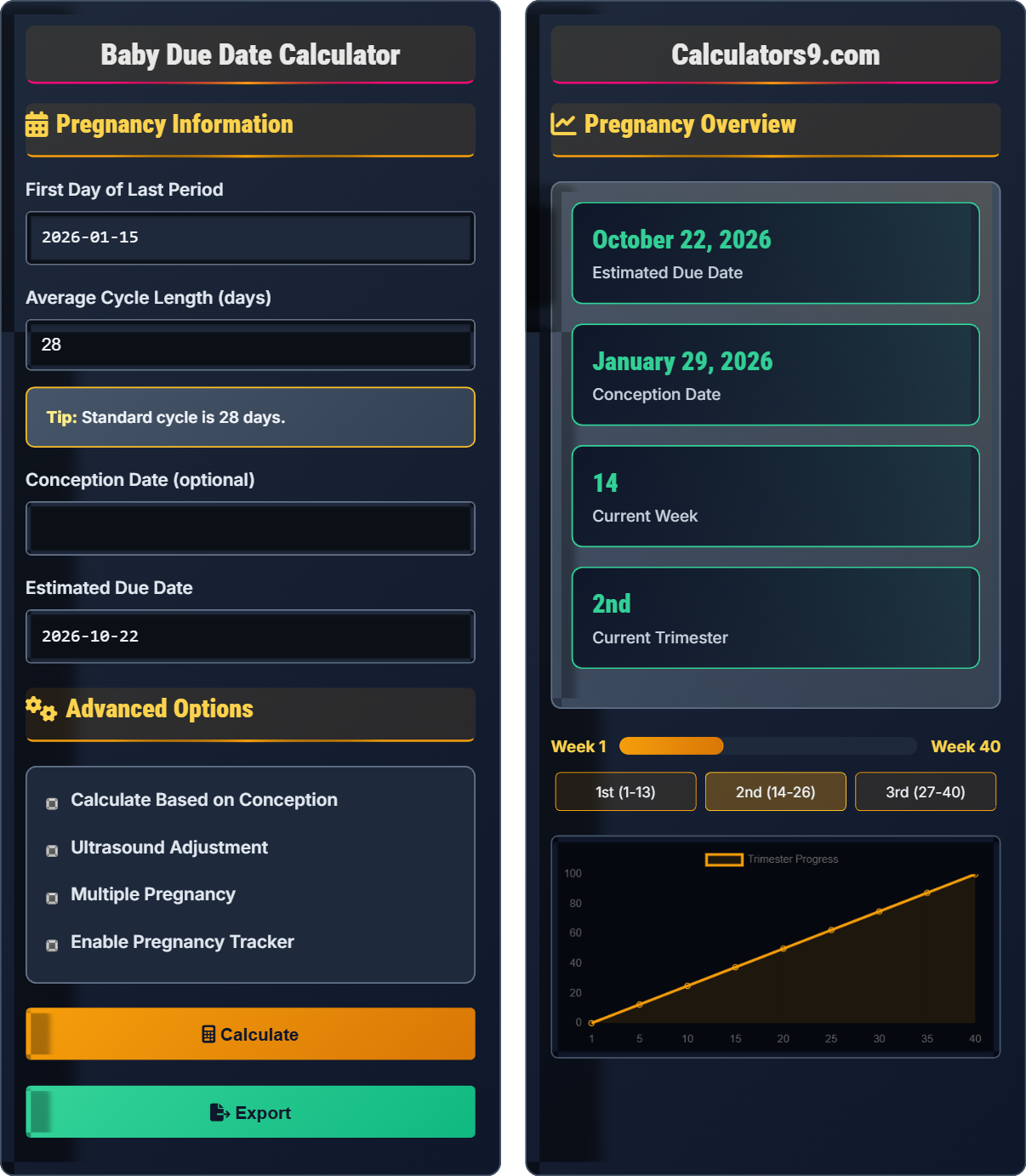
Example: If the last menstrual period started on January 15, 2026:
Add 7 days: January 22, 2026
Subtract 3 months: October 22, 2025
Add 1 year: October 22, 2026
Therefore, the estimated due date would be October 22, 2026.
Pregnancy Information
Advanced Options
Pregnancy Overview
| Week | Milestone | Development |
|---|
| Trimester | Common Symptoms | Tips |
|---|
Pregnancy Planning Guide
An estimated due date (EDD) is calculated based on the first day of your last menstrual period (LMP). Despite its name, only about 5% of babies are born on their exact due date. The due date is actually a "due window" spanning about 2 weeks before and after the estimated date.
The most common method is Naegele's rule:
Alternative methods include:
- Conception-based: Adding 266 days to the conception date
- Ultrasound-based: Measuring fetal size in early pregnancy
- IVF dates: Using embryo transfer date for IVF pregnancies
Important events during pregnancy:
- Week 6: Heartbeat detectable via ultrasound
- Week 12: End of first trimester, CVS testing available
- Week 18-22: Anatomy scan to check baby's development
- Week 24: Age of viability outside the womb
- Week 28: Third trimester begins, more frequent visits
- Week 36: Full-term pregnancy begins
- Start prenatal vitamins: Especially folic acid before conception
- Healthy diet: Focus on nutrient-rich foods
- Regular exercise: As approved by healthcare provider
- Stay hydrated: Drink plenty of water
- Regular checkups: Attend all scheduled appointments
Pregnancy Basics
Method to estimate due date from LMP.
Add 7 days, subtract 3 months, add 1 year.
Standard 280 days from LMP to due date.
- Only 5% of babies born on due date
- Due date is a 2-week window
- Early ultrasounds most accurate
Trimesters
Each covers distinct developmental stages.
- Weeks 1-13: Organ formation
- Weeks 14-26: Growth phase
- Weeks 27-40: Final preparations
- First trimester highest risk
- Second trimester most comfortable
- Third trimester requires most care
Pregnancy Planning Learning Quiz
According to Naegele's rule, if a woman's last menstrual period started on March 15, 2026, what is her estimated due date?
The answer is C) December 22, 2026. Using Naegele's rule:
1. Start with LMP: March 15, 2026
2. Add 7 days: March 22, 2026
3. Subtract 3 months: December 22, 2026
4. Add 1 year if crossing year boundary (not needed here)
The estimated due date is December 22, 2026.
Naegele's rule is the standard method for estimating due dates. It assumes a regular 28-day menstrual cycle with ovulation occurring on day 14. The calculation adds 7 days to the first day of the last menstrual period, subtracts 3 months, and adds 1 year if necessary. This method estimates a 280-day pregnancy from the first day of the last period.
Naegele's Rule: Standard method for calculating estimated due date
LMP: Last Menstrual Period - first day of last period
EDD: Estimated Due Date
• Add 7 days to LMP
• Subtract 3 months
• Add 1 year if crossing year boundary
• Remember: Add 7, subtract 3, add 1
• Count from first day of period, not last day
• Due date is a window, not exact day
• Counting from the last day of period instead of first
• Forgetting to subtract 3 months
• Misunderstanding that it's an estimate
Which week of pregnancy marks the beginning of the second trimester?
The second trimester begins at week 14 of pregnancy. The three trimesters are defined as:
• First Trimester: Weeks 1-13
• Second Trimester: Weeks 14-26
• Third Trimester: Weeks 27-40
Week 14 marks the beginning of the second trimester, which is often called the "golden period" of pregnancy.
Pregnancy is divided into three equal parts called trimesters, each lasting about 13-14 weeks. The trimesters represent different developmental stages for the baby and different experiences for the mother. The second trimester is typically when morning sickness subsides and energy levels increase.
Trimester: One-third of pregnancy duration
First Trimester: Weeks 1-13, organ formation
Second Trimester: Weeks 14-26, growth phase
• Trimesters are not exactly 3 months each
• Week counting starts from LMP
• Each trimester has distinct characteristics
• Remember: 1-13, 14-26, 27-40
• Count from first day of LMP
• Each trimester brings different changes
• Thinking trimesters are exactly 3 months
• Counting from conception instead of LMP
• Misremembering week boundaries
A woman's last menstrual period started on February 10, 2026, and she has a regular 30-day cycle. Assuming ovulation occurred on day 16 of her cycle, what was her likely conception date? How many days after the LMP did conception occur?
Step 1: Calculate ovulation date
Ovulation occurred on day 16 of her 30-day cycle
LMP started on February 10, 2026
Ovulation date: February 10 + 15 days = February 25, 2026
Step 2: Estimate conception date
Conception typically occurs within 24-48 hours of ovulation
Likely conception date: February 25-26, 2026
Step 3: Calculate days after LMP
From February 10 to February 25 = 15 days
Conception occurred approximately 15 days after the LMP.
Using the conception-based method: Due date would be approximately 266 days after conception (February 25), which would be around November 17, 2026.
This problem demonstrates how cycle length affects conception timing. In a typical 28-day cycle, ovulation occurs around day 14, but in longer cycles, ovulation occurs later. The conception-based due date calculation adds 266 days to the conception date, compared to 280 days from the LMP. This accounts for the 14-day difference between LMP and typical conception.
Ovulation: Release of egg from ovary
Conception: Fertilization of egg by sperm
Menstrual Cycle: Monthly reproductive cycle
• Ovulation typically occurs mid-cycle
• Conception occurs 24-48 hours after ovulation
• Different calculation methods for LMP vs. conception
• Track cycle length to predict ovulation
• Use ovulation tests for accuracy
• Consider cycle variations when calculating
• Assuming all women have 28-day cycles
• Confusing LMP date with conception date
• Not accounting for cycle length variations
A woman had her last period on January 5, 2026, giving an Naegele's due date of October 12, 2026. At her 12-week ultrasound on April 3, 2026, the baby measured at 11 weeks 3 days gestational age. Based on ultrasound dating, what should her adjusted due date be?
Step 1: Calculate the difference between expected and measured age
Expected age on April 3: January 5 to April 3 = 88 days = 12 weeks 4 days
Measured age: 11 weeks 3 days
Difference: 12w4d - 11w3d = 1 week 1 day behind
Step 2: Adjust due date based on measurement
If baby is measuring 1 week 1 day smaller, due date should be moved back by the same amount
Original due date: October 12, 2026
Adjusted due date: October 12 + 1 week 1 day = October 20, 2026
The adjusted due date based on ultrasound measurement would be October 20, 2026.
Ultrasound dating is often more accurate than LMP dating, especially in early pregnancy. If the ultrasound measurement differs significantly from LMP-based dating (typically by more than 7 days in the first trimester), healthcare providers may adjust the due date. Early ultrasounds (before 12 weeks) are considered the most accurate for dating.
Ultrasound Dating: Estimating due date based on fetal measurements
Gestational Age: Age of fetus from LMP
Adjusted Due Date: Modified due date based on measurements
• Early ultrasounds are most accurate for dating
• Adjustments typically made if difference >7 days
• First trimester measurements are most reliable
• Early ultrasounds provide best dating accuracy
• Combine LMP and ultrasound data
• Follow healthcare provider's recommendation
• Relying solely on LMP with irregular cycles
• Not adjusting for significant ultrasound discrepancies
• Using later ultrasounds for dating adjustments
At which week of pregnancy can a baby's heartbeat typically be detected via ultrasound?
The answer is B) Week 6. A baby's heartbeat can typically be detected via ultrasound around 6 weeks of pregnancy. This is one of the earliest signs of a viable pregnancy. Before this point, the heart tube is forming but may not be beating strongly enough to detect. By 6-7 weeks, the heartbeat should be clearly visible on ultrasound.
The detection of a fetal heartbeat is a significant milestone that confirms pregnancy viability. The heart begins forming around day 21 after conception and starts beating around day 22. However, it's not typically detectable via ultrasound until around 6 weeks of pregnancy. This milestone is often when parents begin to feel more connected to the pregnancy.
Fetal Heartbeat: Early sign of cardiac development
Viable Pregnancy: Pregnancy with positive indicators
Ultrasound Detection: Visualization via sound waves
• Heartbeat detectable around week 6
• Confirms pregnancy viability
• Earlier detection indicates healthy development
• Transvaginal ultrasound detects earlier than abdominal
• Heart rate increases during early weeks
• Normal early heart rate: 120-160 BPM
• Expecting to hear heartbeat at week 4
• Confusing gestational age with conception age
• Worrying if not detected at early appointment
FAQ
Q: How accurate is the due date calculated from my last period?
A: Due dates calculated from the last menstrual period (LMP) using Naegele's rule are estimates. Only about 5% of babies are born on their exact due date. The due date represents the middle of a 2-week window when birth is most likely.
Mathematically, if \( EDD \) is the estimated due date and \( LMP \) is the first day of the last period, then: $$ EDD = LMP + 280 \text{ days} $$
However, normal pregnancies can last from 37 to 42 weeks, so the actual birth date can vary significantly from the estimated date. Ultrasounds, especially in the first trimester, can provide more accurate dating if there's uncertainty about LMP dates.
Q: When can we find out the baby's gender?
A: The baby's gender can typically be determined during the anatomy scan, which is performed between 18-22 weeks of pregnancy. At this stage, the genitalia are developed enough to identify male or female characteristics.
Some advanced ultrasounds may suggest gender as early as 16 weeks, but the accuracy improves significantly after 18 weeks. Non-invasive prenatal testing (NIPT) blood tests can sometimes reveal gender as early as 9-10 weeks by detecting fetal DNA in the mother's blood.
The probability of correct identification during the 18-22 week ultrasound is approximately 95-99%, depending on fetal positioning and technician experience.