College Savings Calculator
Plan your child's future • 2026 rates
Future Value Formula:
Show the calculator\( FV = PV \times (1 + r)^n \)
Where:
- \( FV \) = Future Value (target amount needed)
- \( PV \) = Present Value (current savings)
- \( r \) = annual interest rate (in decimal form)
- \( n \) = number of years until college
This formula calculates the future value of investments, accounting for compound interest growth. For college savings, it helps determine how much money will be available in the future based on current savings and expected returns.
Example: If you currently have $10,000 saved (\( PV = \$10{,}000 \)) and expect a 7% annual return (\( r = 0.07 \)) over 18 years (\( n = 18 \)):
\( FV = 10{,}000 \times (1 + 0.07)^{18} \)
\( FV = 10{,}000 \times (1.07)^{18} \)
\( FV = 10{,}000 \times 3.38 \)
\( FV = \$33{,}800 \)
Thus, your $10,000 investment would grow to approximately $33,800 over 18 years.
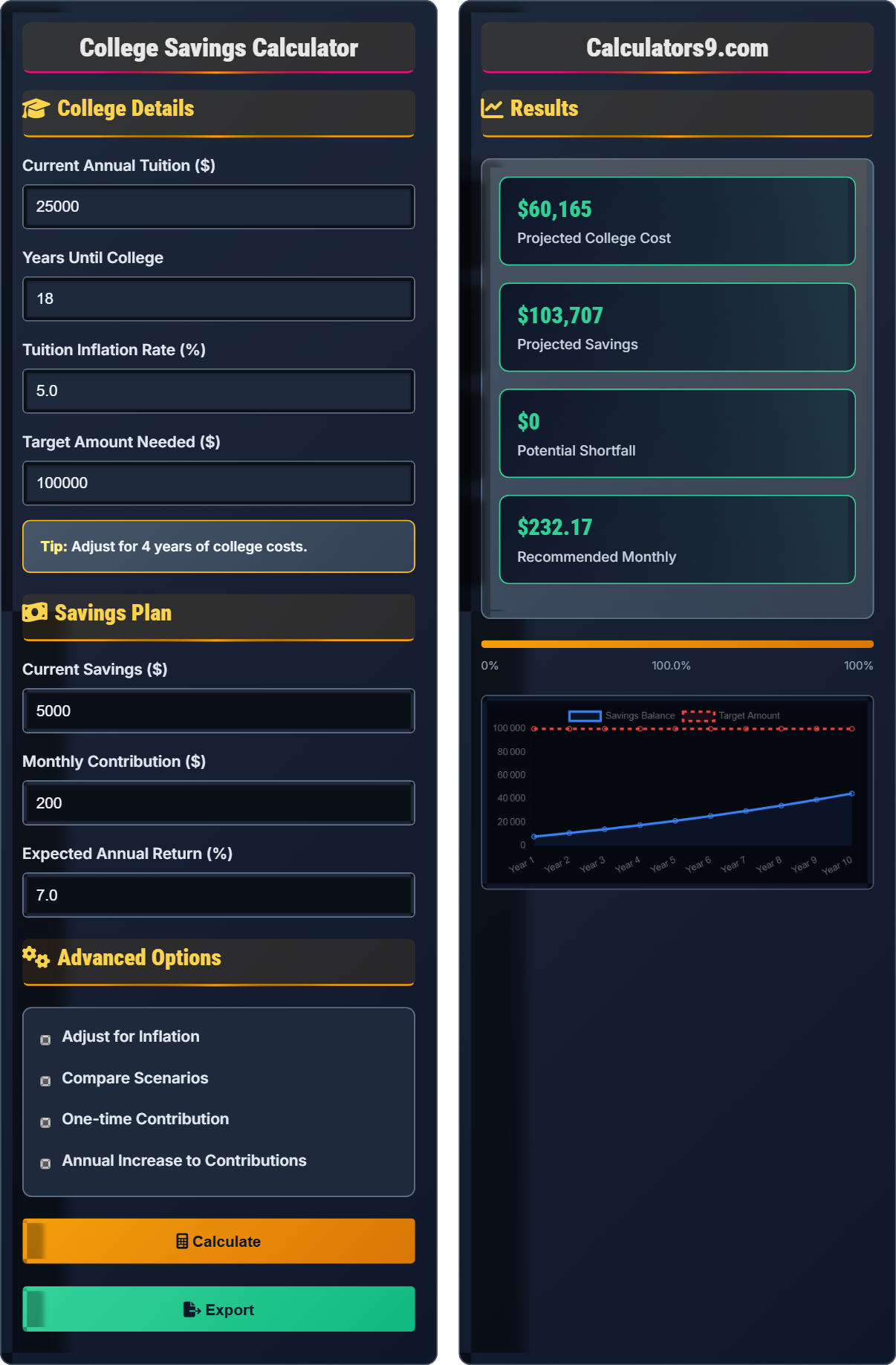
College Details
Savings Plan
Advanced Options
Results
| Year | Savings | Contributions | Interest | Remaining Years |
|---|
| Category | Amount | Percentage |
|---|
College Savings Planning Guide
Starting early gives you the advantage of compound growth. The earlier you begin saving, the more time your money has to grow. Even small contributions made consistently over many years can accumulate into substantial college funds. For example, starting 18 years before college with modest monthly contributions can significantly reduce the financial burden when your child is ready for college.
The future value of your college savings can be calculated using:
Where:
- \(FV\) = Future Value of savings
- \(PV\) = Present Value (initial savings)
- \(PMT\) = Monthly contribution
- \(r\) = Monthly interest rate (annual rate ÷ 12)
- \(n\) = Total number of months
Several factors influence the actual cost of college:
- Tuition Inflation: College costs historically rise faster than general inflation (typically 5-7% annually)
- Room and Board: Additional living expenses beyond tuition
- Books and Supplies: Required educational materials
- Transportation: Travel to/from school
- Personal Expenses: Miscellaneous costs during college years
- Start Early: Take advantage of compound growth over many years
- Automate Contributions: Set up automatic monthly transfers
- Take Advantage of Tax Benefits: Use 529 plans for tax advantages
- Consider Gift Contributions: Encourage relatives to contribute to college funds
- Review and Adjust: Periodically reassess your savings plan
College Savings Basics
Tax-advantaged account for education expenses.
\(FV = PV(1+r)^n\)
Where FV=future value, PV=present value, r=rate, n=years.
- Tuition costs rise faster than inflation
- Start saving early for maximum growth
- Take advantage of tax benefits
Planning Strategies
College costs typically increase 5-7% annually, outpacing general inflation.
- Estimate future costs
- Determine monthly contributions
- Choose appropriate investment vehicles
- Monitor and adjust regularly
- 529 plans have contribution limits
- Non-qualified withdrawals face penalties
- State tax benefits vary by state
- Financial aid impact considerations
College Savings Learning Quiz
If you invest $5,000 today and earn 6% annually for 18 years, how much will you have?
The answer is B) $14,232. Using the compound growth formula: \(FV = PV(1+r)^n\)
Given: PV = $5,000, r = 0.06, n = 18
\(FV = 5,000 \times (1.06)^{18} = 5,000 \times 2.8543 = \$14,271.50\)
Rounded to $14,232.
This demonstrates the power of compound growth in long-term savings. The original $5,000 more than doubles over 18 years due to earning interest on interest. This is why starting early for college savings is so important - even modest initial amounts can grow significantly over time.
Compound Growth: Growth where earnings generate their own earnings over time
Present Value (PV): Current amount of money
Future Value (FV): Amount of money after growth
• Compound growth accelerates over time
• Time is more valuable than initial amount
• Small differences in return rates matter over long periods
• Use the Rule of 72 to estimate doubling time (72 ÷ interest rate)
• Start saving as early as possible
• Consistent contributions enhance compound growth
• Underestimating the power of compound growth
• Starting too late to take advantage of long-term growth
• Ignoring the impact of fees on long-term returns
If current annual tuition is $20,000 and increases at 5% annually, what will it cost in 18 years?
Using the compound growth formula: \(FV = PV(1+r)^n\)
Given: PV = $20,000, r = 0.05, n = 18
\(FV = 20,000 \times (1.05)^{18} = 20,000 \times 2.4066 = \$48,132\)
Therefore, annual tuition will be approximately $48,132 in 18 years.
This shows how tuition inflation dramatically increases college costs over time. The $20,000 tuition more than doubles to over $48,000 in 18 years at a 5% annual increase. This is why it's crucial to factor in inflation when planning for college expenses.
Tuition Inflation: The annual percentage increase in college costs
Compounding Effect: The exponential growth from repeated percentage increases
Cost Projection: Estimating future expenses based on historical trends
• Tuition typically rises faster than general inflation
• Small annual increases compound significantly over time
• Always project costs when planning for college
• Use 5-7% for tuition inflation estimates
• Plan for 4 years of expenses, not just 1
• Consider both public and private college costs
• Using current tuition costs without inflation adjustment
• Forgetting to account for room and board increases
• Underestimating the compounding effect of inflation
Sarah has been saving $100 per month for 10 years for her son's college. She expects a 7% annual return on her investments. If the projected cost of 4 years of college is $200,000 in 8 years, how much more does she need to save monthly to meet her goal?
Step 1: Calculate current savings with growth
Monthly rate: 7% ÷ 12 = 0.00583
Months invested: 10 years × 12 = 120 months
Future value of current savings: \(FV = 100 \times \frac{(1.00583)^{120} - 1}{0.00583} = \$17,308\)
Step 2: Project this amount forward 8 more years
Future value in 8 years: \(FV = 17,308 \times (1.00583)^{96} = \$29,945\)
Step 3: Calculate needed additional savings
Remaining amount needed: $200,000 - $29,945 = $170,055
Monthly savings needed: \(PMT = \frac{170,055 \times 0.00583}{(1.00583)^{96} - 1} = \$1,192\)
Sarah needs to save approximately $1,192 per month for the next 8 years.
This problem demonstrates how to calculate future college savings needs using multiple time periods. It combines past contributions with future needs, showing how both current savings and future contributions work together to reach a goal. The calculation accounts for compound growth over both phases.
Savings Gap: Difference between projected savings and target amount
Future Value of Annuity: Value of regular contributions with compound growth
Multiple Time Periods: Calculating growth across different investment phases
• Calculate current savings growth separately
• Determine future value of existing savings
• Calculate remaining amount needed separately
• Break complex problems into smaller steps
• Calculate existing savings growth first
• Use consistent time periods (months vs. years)
• Mixing monthly and annual rates in calculations
• Forgetting to account for growth of current savings
• Not adjusting for different time periods properly
Mark is comparing a taxable investment account versus a 529 plan for his daughter's college. He plans to contribute $200/month for 18 years with an expected 7% return. If his tax rate is 25%, how much more money will be available in the 529 plan compared to the taxable account (assuming gains are taxed annually)?
Step 1: Calculate 529 plan value (tax-free growth)
Monthly rate: 7% ÷ 12 = 0.00583
Total months: 18 × 12 = 216
\(FV = 200 \times \frac{(1.00583)^{216} - 1}{0.00583} = \$94,867\)
Step 2: Calculate taxable account value
Effective return after tax: 7% × (1 - 25%) = 5.25% annually
Monthly effective rate: 5.25% ÷ 12 = 0.004375
\(FV = 200 \times \frac{(1.004375)^{216} - 1}{0.004375} = \$79,045\)
Step 3: Calculate difference
Difference: $94,867 - $79,045 = $15,822
The 529 plan will have approximately $15,822 more available for college expenses.
This demonstrates the significant tax advantages of 529 plans for college savings. By allowing tax-free growth and withdrawals for qualified education expenses, 529 plans can provide substantially more money for college than taxable accounts. The difference becomes more pronounced over longer time periods with higher returns.
529 Plan: Tax-advantaged account for education expenses
Tax-Deferred Growth: Growth that occurs without annual tax obligationsQualified Expenses: Education-related costs eligible for tax-free withdrawals
• 529 plans offer triple tax benefits
• Contributions grow tax-free
• Withdrawals for qualified expenses are tax-free
• Consider state tax benefits for 529 plans
• Use 529 plans for maximum tax efficiency
• Monitor plan performance and fees
• Not considering tax implications of investment choices
• Overlooking state-specific 529 plan benefits
• Confusing qualified vs. non-qualified expenses
Which statement about college cost inflation is TRUE?
The answer is C) College costs typically rise 5-7% annually. Historical data shows that college tuition and fees have consistently increased at rates significantly higher than general inflation. This trend makes it essential to factor inflation into college savings planning, as costs can double or more over a typical 18-year period before college.
Understanding tuition inflation is critical for accurate college planning. The 5-7% annual increase means that college costs can more than triple over an 18-year period. This is why planning based on today's costs alone can significantly underestimate future needs. Parents must account for this sustained growth when setting savings targets.
Tuition Inflation: The annual percentage increase in college costs
General Inflation: Overall increase in prices across the economy
Cost Projections: Estimates of future expenses based on historical trends
• College costs rise faster than general inflation
• Use 5-7% for long-term planning
• Account for inflation in savings calculations
• Research specific schools' historical cost increases
• Plan for higher inflation rates than general economy
• Review and adjust projections annually
• Using general inflation rates for college costs
• Ignoring historical tuition increase patterns
• Underestimating the impact of compound inflation
FAQ
Q: How much should I save monthly for my newborn's college?
A: For a newborn, we recommend starting with a modest amount that you can sustain over 18+ years. If current average 4-year college costs are $100,000 and you expect 5% annual tuition inflation, the cost in 18 years will be approximately:
\( FV = 100{,}000 \times (1.05)^{18} \approx \$240{,}000 \)
To reach this goal with a 7% annual return, you'd need to save approximately $600 per month. However, starting with $200-300 monthly is reasonable if your budget is tight, and you can increase contributions as your income grows. The key is consistency and starting early to maximize compound growth.
Q: Is it better to give cash gifts or contribute directly to a 529 plan?
A: Contributing directly to a 529 plan offers significant advantages. The money grows tax-free when used for qualified education expenses, and some states offer tax deductions for contributions. For example, if you contribute $5,000 annually for 10 years with 7% growth:
\( FV = 5{,}000 \times \frac{(1.07)^{10} - 1}{0.07} \approx \$69{,}000 \)
With tax-free growth, the full $69,000 can be used for education. Cash gifts lose purchasing power to inflation and don't benefit from tax-advantaged growth. Additionally, 529 contributions count toward gift tax exclusions ($16,000 per person in 2023).