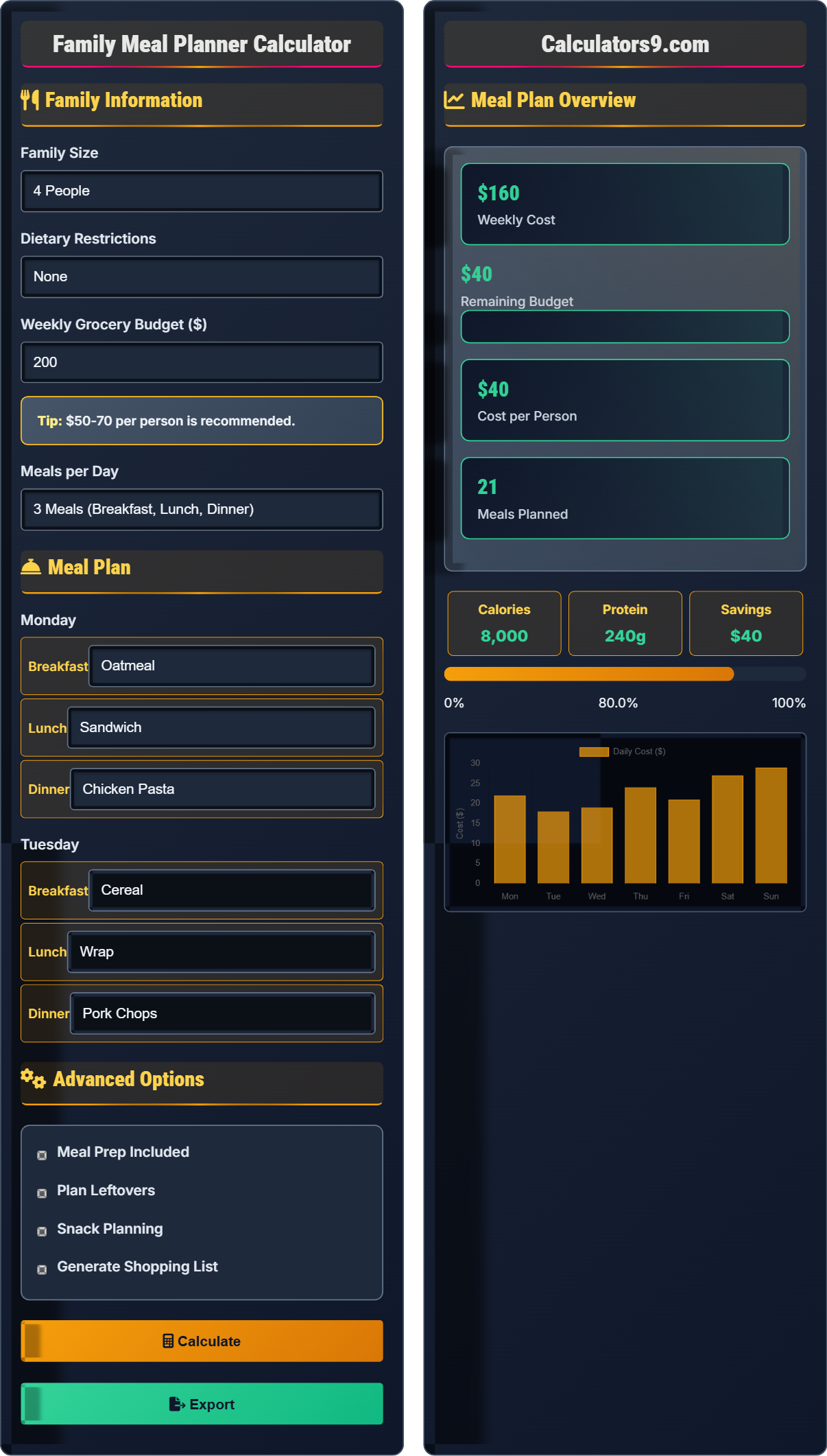
Family Meal Planner Calculator
Plan your meals • 2026 edition
Meal Planning Formula:
Show the calculator\( \text{Weekly Grocery Cost} = \sum_{i=1}^{n} \text{Recipe Cost}_i \)
Where:
- \( \text{Recipe Cost}_i \) = Cost of ingredients for recipe i
- \( n \) = Total number of recipes planned
Alternatively, to calculate per-meal cost:
\( \text{Cost per Meal} = \frac{\text{Total Weekly Cost}}{\text{Number of Meals}} \)
This formula helps families plan their grocery spending by estimating the cost of each meal and calculating the total weekly expense. The goal is to create nutritious, satisfying meals while staying within budget.
Example: For a family of 4 planning 7 dinners per week:
If each dinner costs $15 on average: $15 × 7 = $105
Additional meals (lunches, breakfasts): $35
Total weekly cost: $105 + $35 = $140
This approach ensures consistent meal planning while controlling grocery expenses.
Family Information
Meal Plan
Advanced Options
Meal Plan Overview
| Day | Breakfast | Lunch | Dinner | Cost |
|---|
| Nutrient | Per Day | Per Week | Recommended |
|---|
Recipe Recommendations
Family Meal Planning Guide
Meal planning involves organizing meals for the week in advance, considering nutrition, budget, and time constraints. Effective meal planning saves money, reduces food waste, and ensures balanced nutrition for the whole family.
Experts recommend budgeting $50-$70 per person per week for groceries:
Where:
- \(GB\) = Grocery budget
- \(P\) = Number of people
- \(C\) = Cost per person ($50-$70)
Recommended daily intake per person:
- Calories: 1,800-2,400 (varies by age/activity)
- Protein: 50-70g
- Vegetables: 2-3 cups
- Fruits: 1.5-2 cups
- Grains: 6-8 oz (half whole grains)
- Plan around sales: Build meals around discounted items
- Cook in batches: Prepare large portions for leftovers
- Use versatile ingredients: Items that work in multiple dishes
- Keep staples stocked: Rice, pasta, canned goods
- Prep ahead: Wash and cut vegetables in advance
Meal Planning Basics
Organizing meals in advance.
\(GB = P \times C\)
Where GB=budget, P=people, C=cost per person.
- Plan for 3 meals per day
- Include snacks if needed
- Account for dietary restrictions
Planning Strategies
Using meals twice in one week.
- Choose 3-4 recipes
- Prepare ingredients
- Cook in batches
- Store for the week
- Adjust for special occasions
- Consider seasonal ingredients
- Account for picky eaters
- Plan for variety
Family Meal Planning Learning Quiz
According to nutritionists, what is the recommended weekly grocery budget per person?
The answer is B) $50-70. Nutritionists and financial experts recommend budgeting $50-70 per person per week for groceries. This range allows for a balanced diet with fresh produce, proteins, and other essentials while maintaining financial sustainability. For a family of 4, this would mean a weekly budget of $200-$280.
The $50-70 range is considered optimal for balancing nutrition and affordability. It allows families to purchase fresh ingredients, lean proteins, and whole foods while avoiding the cost-cutting measures that often lead to less nutritious choices. This budget also accounts for occasional treats and specialty items.
Grocery Budget: Planned spending for food
Nutritious Diet: Balanced intake of nutrients
Financial Sustainability: Long-term affordability
• Budget $50-70 per person
• Adjust for dietary needs
• Include all family members
• Shop seasonal produce
• Buy in bulk when economical
• Plan meals around sales
• Underestimating costs
• Not accounting for waste
• Forgetting special occasions
If a family of 5 budgets $60 per person per week for groceries, what is their total weekly grocery budget?
Using the grocery budget formula:
Total budget = Number of people × Cost per person
Total budget = 5 × $60 = $300
The family's total weekly grocery budget is $300.
This calculation demonstrates how to scale the per-person recommendation to accommodate family size. The formula is straightforward but essential for accurate meal planning. It's important to include all family members in the calculation, including children who consume different quantities.
Per-Person Budget: Individual spending allocation
Total Budget: Combined family spending
Family Size: Number of people to feed
• Multiply per-person by family size
• Include all family members
• Adjust for special dietary needs
• Round to nearest $10 for simplicity
• Set aside 10% for extras
• Track spending weekly
• Forgetting to include all family members
• Not accounting for varying appetites
• Ignoring dietary restrictions
Sarah plans to cook a large pot of chili that costs $15 to make and serves 8 people. If her family only eats half the pot for dinner, and they eat the remaining chili for lunch the next day, how much does each meal actually cost? What is the cost savings compared to making separate lunches?
Step 1: Calculate cost per serving
Cost per serving = $15 ÷ 8 = $1.875
Step 2: Calculate actual meal costs
Dinner cost (4 servings): 4 × $1.875 = $7.50
Lunch cost (4 servings): 4 × $1.875 = $7.50
Step 3: Calculate cost savings
If separate lunches cost $3 each: 4 × $3 = $12
Savings: $12 - $7.50 = $4.50
Each meal costs $1.875, saving $4.50 by using leftovers instead of preparing separate lunches.
This problem demonstrates the economic benefits of meal planning with leftovers. By preparing larger portions and repurposing them, families can significantly reduce their per-meal costs while minimizing food waste. The key is recognizing that the ingredient cost is spread across multiple meals.
Leftover Planning: Using excess food for subsequent meals
Cost Per Serving: Ingredient cost divided by servings
Meal Efficiency: Maximizing value from cooking efforts
• Plan for extra portions
• Cook 25% more than needed
• Label and date leftovers
• Repurpose creatively
• Not planning for storage containers
• Forgetting to account for taste fatigue
• Improper storage leading to waste
A family of 4 typically spends $200 per week on groceries. They discover one family member has celiac disease and needs gluten-free products. Gluten-free products typically cost 2-3 times more than regular versions. If 40% of their grocery budget goes to products that have gluten-free alternatives (bread, pasta, cereals), what will be their new weekly budget?
Step 1: Calculate portion affected by dietary restriction
Amount for gluten-free items = $200 × 0.40 = $80
Step 2: Calculate increased cost for gluten-free items
New cost for gluten-free = $80 × 2.5 = $200 (assuming 2.5x multiplier)
Step 3: Calculate new total budget
Non-gluten-free items: $200 - $80 = $120
New budget: $120 + $200 = $320
The new weekly budget will be $320, representing a 60% increase.
This problem illustrates how dietary restrictions can significantly impact grocery budgets. Families must account for the higher cost of specialty products when planning meals. The calculation shows that even partial dietary changes can have substantial financial impacts, requiring budget adjustments.
Dietary Restriction: Foods that cannot be consumed
Specialty Products: Higher-cost alternative foods
Budget Adjustment: Changing spending due to restrictions
• Account for specialty product costs
• Research cost differences
• Plan budget accordingly
• Buy generic brands when possible
• Shop discount stores for specialty items
• Plan meals around affordable options
• Not accounting for specialty food costs
• Assuming similar pricing
• Forgetting to adjust budget
According to dietary guidelines, what is the recommended daily vegetable intake per person?
The answer is B) 2-3 cups. According to the Dietary Guidelines for Americans, adults should consume 2-3 cups of vegetables per day as part of a balanced diet. This recommendation varies slightly based on age, sex, and activity level, but 2-3 cups is the standard for most adults. For children, the recommendation is typically 1-2 cups per day.
The 2-3 cup recommendation ensures adequate intake of essential vitamins, minerals, fiber, and antioxidants. Vegetables provide nutrients that are difficult to obtain from other food groups, making them a critical component of healthy meal planning. This guideline helps families plan meals that meet nutritional requirements.
Dietary Guidelines: Government nutrition recommendations
Vegetable Intake: Amount needed for health
Nutritional Balance: Adequate nutrient consumption
• Include 2-3 cups of vegetables daily
• Vary types for different nutrients
• Include in multiple meals
• Add vegetables to every meal
• Try different preparation methods
• Include frozen vegetables for convenience
• Not including enough vegetables
• Limited variety
• Cooking methods that reduce nutrients
FAQ
Q: How do I meal plan for picky eaters while staying within budget?
A: For picky eaters, incorporate familiar foods with new items:
\( \text{Acceptable Foods} = \text{Familiar} + \frac{1}{4} \times \text{New Item} \)
Start with small portions of new foods alongside preferred items. Budget-wise, focus on versatile ingredients that can be prepared multiple ways. For example, ground turkey can become meatballs, tacos, or spaghetti sauce, appealing to different preferences while controlling costs.
Q: What are the best quick meal options for busy schedules?
A: Focus on one-pot meals and sheet pan cooking that minimize cleanup:
• Sheet pan chicken with vegetables (20 minutes)
• Rice cooker meals (set and forget)
• Slow cooker recipes (prepare in morning)
• Pasta dishes with protein and vegetables
These options maximize nutrition while minimizing time spent cooking and cleaning.