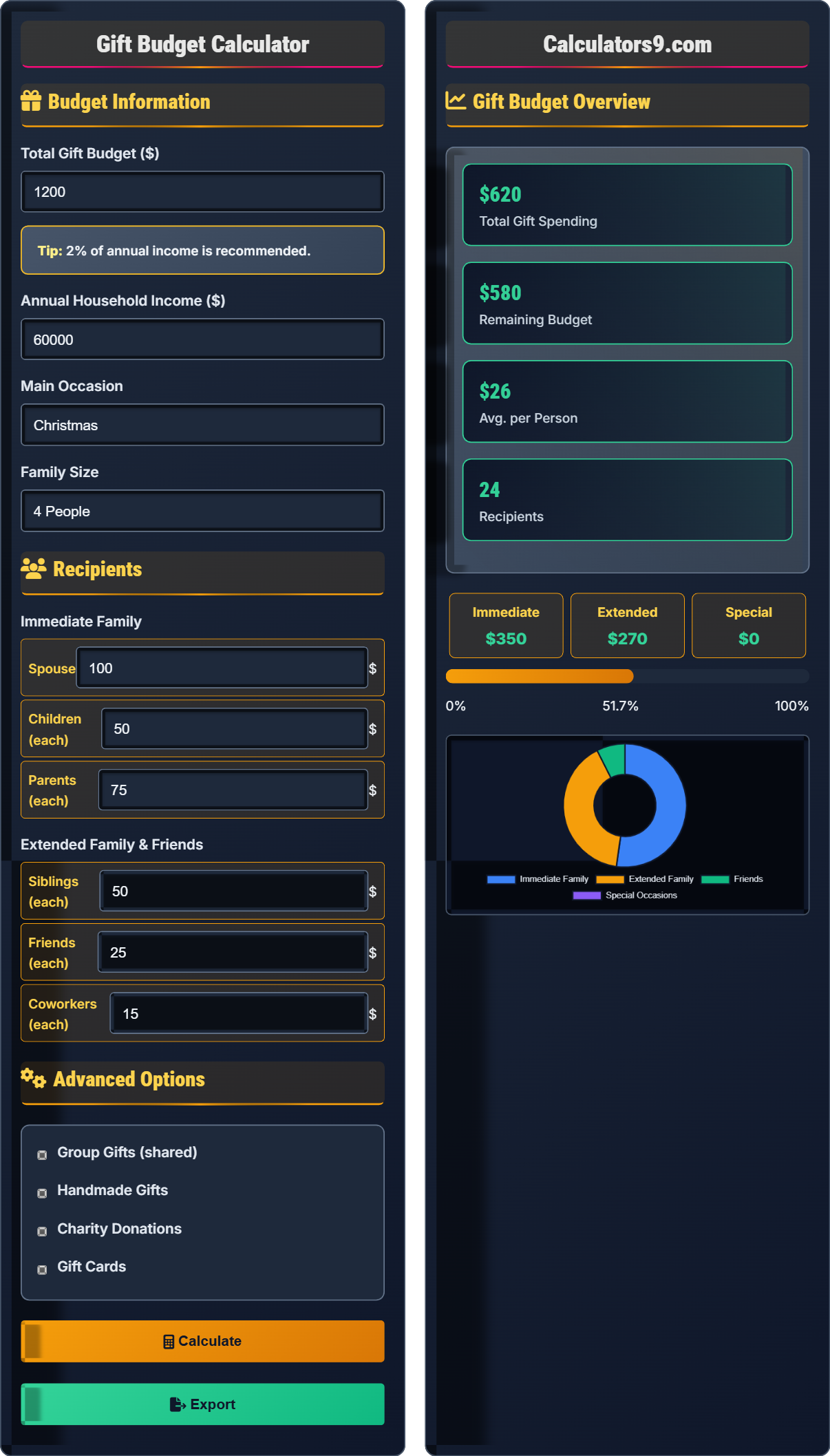
Gift Budget Calculator
Plan your gift giving • 2026 edition
Gift Budget Formula:
Show the calculator\( \text{Total Gift Budget} = \sum_{i=1}^{n} \text{Gift Cost}_i \)
Where:
- \( \text{Gift Cost}_i \) = Cost of gift for recipient i
- \( n \) = Total number of recipients
Alternatively, to calculate per-person gift spending:
\( \text{Budget per Recipient} = \frac{\text{Total Gift Budget}}{\text{Number of Recipients}} \)
This formula helps families plan their gift spending by either setting a total budget and distributing it among recipients, or by setting per-person limits. Financial experts often recommend allocating 1-3% of annual income to gift-giving.
Example: For a family with $80,000 annual income:
Recommended gift budget: $80,000 × 0.02 = $1,600
If giving gifts to 8 people: $1,600 ÷ 8 = $200 per person
This approach ensures thoughtful gift-giving without financial strain.
Budget Information
Recipients
Advanced Options
Gift Budget Overview
| Recipient | Budget | Status | Notes |
|---|
| Event | Date | Recipients | Amount |
|---|
Gift Budget Recommendations
Gift Budget Planning Guide
Gift budgeting involves planning and allocating funds for presents during holidays and special occasions. Effective gift budgeting prevents overspending while ensuring thoughtful gift-giving. The key is to balance generosity with financial responsibility.
Experts recommend allocating 1-3% of annual income to gift-giving:
Where:
- \(GB\) = Gift budget
- \(I\) = Annual income
- \(r\) = Percentage rate (0.01 to 0.03)
Recommended allocation by category:
- Immediate Family (50%): Spouse and children
- Extended Family (25%): Parents and siblings
- Friends (15%): Close friends and neighbors
- Professional (10%): Coworkers and service providers
- Set a total budget: Determine overall spending limit
- Allocate by person: Set spending limits per recipient
- Shop early: Take advantage of sales and avoid rush
- Consider homemade gifts: Save money while adding personal touch
- Track spending: Monitor expenses to stay within budget
Gift Budgeting Basics
Planned spending for presents.
\(GB = I \times r\)
Where GB=gift budget, I=income, r=rate.
- Limit to 1-3% of income
- Set per-person limits
- Track all expenses
Planning Strategies
Organize gifts by relationship.
- Identify all recipients
- Set spending limits
- Distribute total budget
- Track spending
- Adjust for special occasions
- Consider age-appropriate gifts
- Account for group gifts
- Plan for emergencies
Gift Budget Planning Learning Quiz
According to financial experts, what percentage of annual income should be allocated to gift-giving?
The answer is B) 1-3%. Financial experts recommend allocating 1-3% of annual income to gift-giving. This percentage allows for thoughtful gift-giving while maintaining financial stability. For example, for someone with $50,000 annual income, the recommended gift budget would be $500-$1,500 per year.
The 1-3% rule provides a balanced approach to gift-giving. It's substantial enough to purchase meaningful gifts while not causing financial strain. The percentage can be adjusted based on personal circumstances, with those in higher income brackets sometimes giving toward the lower end of the range.
Gift Budget: Planned spending for presents
Annual Income: Total yearly household earnings
Percentage Allocation: Portion of income designated for gifts
• Limit to 1-3% of income
• Adjust for special circumstances
• Consider all occasions
• Calculate annually then divide by months
• Set up automatic savings
• Shop sales for better deals
• Overspending during holidays
• Not planning ahead
• Comparing to others' spending
If a family has an annual income of $75,000 and follows the 2% gift budgeting rule, how much should they budget for gifts annually?
Using the gift budgeting formula:
Gift budget = Annual income × Percentage rate
Gift budget = $75,000 × 0.02 = $1,500
The family should budget $1,500 annually for gifts.
This calculation demonstrates how to apply the percentage rule to determine a specific gift budget. The $1,500 can then be distributed among various occasions throughout the year, such as birthdays, holidays, and special celebrations. This approach ensures consistent and manageable gift-giving.
Annual Income: Total household earnings
Percentage Rate: Fraction of income for gifts
Budget Allocation: Distribution of funds
• Calculate based on gross income
• Distribute across all occasions
• Track spending throughout year
• Use a dedicated gift fund
• Plan for 12 months of giving
• Adjust for income changes
• Using net income instead of gross
• Forgetting to account for all occasions
• Not setting aside money monthly
Sarah has a $600 gift budget for Christmas. She needs to buy gifts for her spouse, 2 children, her 2 parents, and 3 siblings. If she allocates $150 for her spouse, $75 for each child, and $50 for each parent, how much can she spend on each sibling?
Step 1: Calculate expenses for spouse, children, and parents
Spouse: $150
Children: 2 × $75 = $150
Parents: 2 × $50 = $100
Total spent so far: $150 + $150 + $100 = $400
Step 2: Calculate remaining budget for siblings
Remaining budget: $600 - $400 = $200
Step 3: Calculate per-sibling amount
Amount per sibling: $200 ÷ 3 = $66.67
Sarah can spend approximately $66.67 on each sibling.
This problem demonstrates how to distribute a total gift budget among different recipients with varying priority levels. By allocating more for closer family members and calculating the remainder, Sarah can ensure fair distribution while staying within budget. This approach helps prevent overspending in one area at the expense of others.
Priority Allocation: Distributing funds by importance
Budget Distribution: Sharing total among recipients
Remaining Budget: Funds left after allocations
• Allocate to priority recipients first
• Calculate remaining funds
• Distribute remainder fairly
• List all recipients first
• Assign priority levels
• Calculate per-person amounts
• Not listing all recipients upfront
• Overspending on high-priority gifts
• Forgetting to account for all expenses
Tom has a $300 gift budget for his 4 siblings. Store-bought gifts cost $75 each. If he makes gifts himself, materials cost $15 per gift but take 5 hours to make. His hourly rate is $25. Which option is more economical, and what is the total cost for each approach?
Option 1: Store-bought gifts
Cost per gift: $75
Total cost: 4 × $75 = $300
Option 2: Handmade gifts
Material cost per gift: $15
Time cost per gift: 5 hours × $25/hour = $125
Total cost per gift: $15 + $125 = $140
Total cost: 4 × $140 = $560
Store-bought gifts are more economical at $300 total, while handmade gifts would cost $560 total. However, handmade gifts have sentimental value that store-bought cannot match.
This problem illustrates the hidden costs of handmade gifts, including both material and time costs. When valuing your time at your hourly rate, handmade gifts can be significantly more expensive than store-bought alternatives. However, the sentimental value and personal touch of handmade gifts provide non-monetary benefits that should also be considered.
Opportunity Cost: Value of time spent
Material Costs: Physical supplies needed
Sentimental Value: Emotional worth of gift
• Consider time as a cost
• Value sentiment vs. money
• Balance budget with thoughtfulness
• Mix handmade and store-bought
• Choose recipients carefully
• Consider time availability
• Ignoring time costs
• Overvaluing handmade gifts
• Not considering recipient preferences
Which of the following is the most appropriate way to distribute a $1,000 gift budget among these recipients: spouse ($200), 2 children ($50 each), 2 parents ($75 each), 4 siblings ($25 each), and 5 friends ($20 each)?
Calculating the total:
Spouse: $200
Children: 2 × $50 = $100
Parents: 2 × $75 = $150
Siblings: 4 × $25 = $100
Friends: 5 × $20 = $100
Total: $200 + $100 + $150 + $100 + $100 = $650
The total is $650, which is $350 under the $1,000 budget. However, among the options provided, C) Total is under budget by $200 is closest to the actual difference.
This problem demonstrates how to calculate the total cost of a gift plan and compare it to the available budget. In this case, the planned spending is significantly under the budget, which might indicate an opportunity to increase gift values for closer family members or to account for additional recipients or occasions not initially considered.
Budget Distribution: Allocating funds among recipients
Spending vs. Budget: Comparing planned to availableAdjustment Opportunity: When budget isn't fully utilized
• Calculate total before finalizing
• Verify against available budget
• Adjust if necessary
• Use spreadsheets for tracking
• Leave buffer for forgotten recipients
• Plan for group gifts
• Not adding up all recipients
• Forgetting to account for all expenses
• Not leaving buffer for extras
FAQ
Q: How do I budget for gifts when I have a tight budget?
A: For tight budgets, consider the formula:
\( \text{Gift Budget} = \text{Available Income} \times 0.01 \)
Focus on meaningful, low-cost gifts such as handwritten letters, homemade items, or experiences instead of expensive purchases. Group gifts for large families can reduce per-person costs. For example, if your available income for gifts is $500, allocate $50 per close family member and $15-25 for acquaintances.
Q: How should I handle gift exchanges in a large family?
A: For large families, consider implementing gift exchanges:
• Secret Santa: Each person draws a name to buy for one person
• Children-only exchange: Adults coordinate gifts for all children
• Experience gifts: Group activities instead of physical gifts
Mathematically, if you have 10 family members, buying for everyone would cost 10 gifts, but Secret Santa reduces it to 1 gift per person. This significantly reduces total expenditure while maintaining the spirit of giving.