Vacation Cost per Person Calculator
Plan your family trip • 2026 edition
Vacation Cost Formula:
Show the calculator\( \text{Cost per Person} = \frac{\text{Total Vacation Cost}}{\text{Number of Travelers}} \)
Where:
- \( \text{Total Vacation Cost} = \text{Flights} + \text{Accommodation} + \text{Food} + \text{Activities} + \text{Transportation} + \text{Miscellaneous} \)
- \( \text{Number of Travelers} \) = Total people going on vacation
This formula provides the per-person cost by evenly distributing all shared expenses across all travelers. For expenses that vary by age (like airfare), individual costs are calculated separately and added to the shared per-person cost.
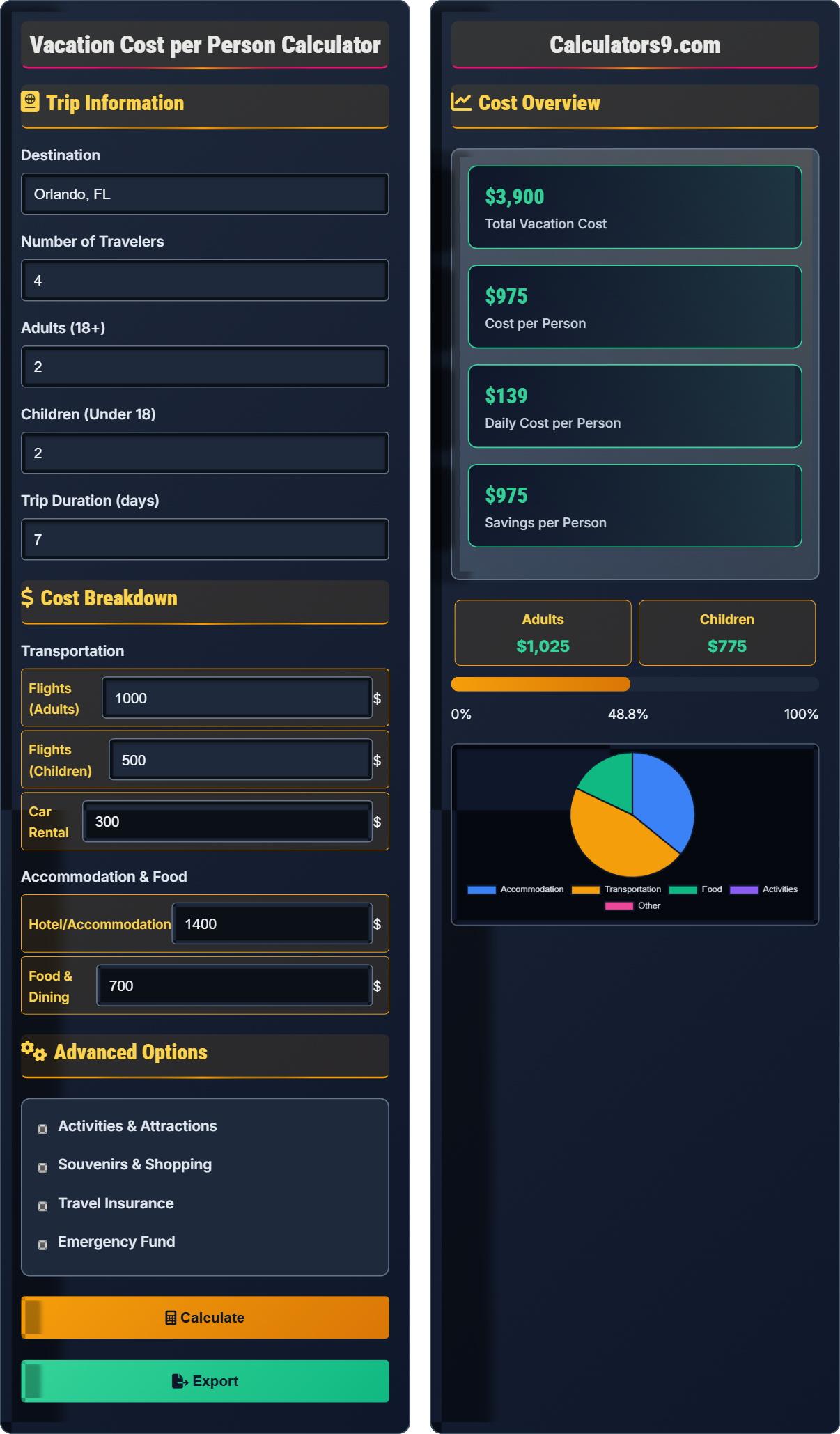
Example: For a family of 4 (2 adults, 2 children) going on a 7-day vacation:
Flights: $2,000 (adults) + $1,000 (children) = $3,000
Accommodation: $1,400 (shared)
Food: $700 (shared)
Activities: $400 (shared)
Total: $5,500
Per-person cost: $5,500 ÷ 4 = $1,375 per person
Trip Information
Cost Breakdown
Advanced Options
Cost Overview
| Category | Cost | Per-Person | Percentage |
|---|
| Option | Per-Person Cost | Savings Timeline | Monthly Savings |
|---|
Vacation Options
Vacation Planning Guide
Effective vacation planning requires understanding all potential expenses and distributing them fairly among travelers. The per-person cost calculation helps families budget appropriately and decide if a trip fits within their financial means.
The per-person vacation cost is calculated as:
Where:
- \(CP\) = Cost per person
- \(TC\) = Total vacation cost
- \(N\) = Number of travelers
Experts recommend this typical vacation cost breakdown:
- Accommodation (35%): Lodging and related fees
- Transportation (25%): All travel-related expenses
- Food (20%): All meals and drinks
- Activities (15%): Entertainment and attractions
- Shopping/Souvenirs (5%): Miscellaneous purchases
- Book early: Save on flights and accommodations
- Travel off-season: Significant savings on all expenses
- Use vacation rentals: More economical for groups
- Look for package deals: Bundled savings opportunities
- Set up a vacation fund: Save monthly for the trip
Vacation Planning Basics
Distribution of total expenses among travelers.
\(CP = \frac{TC}{N}\)
Where CP=cost per person, TC=total cost, N=number of travelers.
- Include all expenses in calculation
- Account for age-based price differences
- Plan for unexpected costs
Planning Strategies
Monthly savings for trip expenses.
- Determine total cost
- Calculate per-person share
- Set monthly savings goal
- Start saving early
- Consider exchange rates for international travel
- Factor in seasonal price fluctuations
- Account for children's varying costs
- Plan for group discounts
Vacation Planning Learning Quiz
A family of 6 (4 adults, 2 children) is planning a vacation that will cost $8,400 total. What is the cost per person?
The answer is B) $1,400. Using the per-person cost formula:
Cost per person = Total cost ÷ Number of travelers
Cost per person = $8,400 ÷ 6 = $1,400
This calculation distributes the total vacation cost equally among all travelers.
This calculation demonstrates how to distribute total vacation expenses among all travelers. The per-person cost helps families determine if a trip fits within their budget. When planning, it's important to consider that some expenses may vary by age (like airfare), but the per-person calculation provides a baseline for budgeting.
Per-Person Cost: Equal distribution of expenses
Total Vacation Cost: Sum of all expenses
Number of Travelers: All people on trip
• Include all expenses in total
• Divide by total number of travelers
• Consider age-based cost differences
• Calculate per-person early in planning
• Factor in age-specific costs
• Plan for shared expenses
• Forgetting to include all expenses
• Not accounting for age differences
• Ignoring shared vs. individual costs
A family of 4 is planning a 5-day vacation. Their estimated costs are: flights ($2,000), accommodation ($1,000), food ($500), and activities ($300). What is the daily cost per person?
Step 1: Calculate total vacation cost
Total cost = $2,000 + $1,000 + $500 + $300 = $3,800
Step 2: Calculate cost per person
Cost per person = $3,800 ÷ 4 = $950
Step 3: Calculate daily cost per person
Daily cost per person = $950 ÷ 5 days = $190
The daily cost per person is $190.
This calculation shows how to determine the daily cost per person, which helps families budget for ongoing expenses during their trip. Breaking down costs by day allows for better planning of spending during the vacation and helps prevent overspending.
Daily Cost: Per-person expense per day
Per-Person Cost: Individual share of total
Trip Duration: Length of vacation
• Calculate total first
• Divide by number of travelers
• Then divide by number of days
• Use daily budget to control spending
• Set daily spending limits
• Plan for fluctuating daily costs
• Forgetting to divide by days
• Not accounting for all expenses
• Assuming equal daily spending
The Johnson family wants to take a vacation that will cost $6,000 total. They have 8 months to save for the trip. If there are 4 family members, how much does each person need to save monthly to reach their goal?
Step 1: Calculate per-person cost
Per-person cost = $6,000 ÷ 4 = $1,500
Step 2: Calculate monthly savings per person
Monthly savings per person = $1,500 ÷ 8 months = $187.50
Each family member needs to save $187.50 per month for 8 months to reach the vacation goal.
This problem demonstrates how to plan for vacation expenses by breaking down the total cost into manageable monthly savings goals. By calculating the per-person monthly amount, families can budget effectively and ensure everyone contributes fairly to the vacation fund.
Vacation Fund: Savings specifically for travel
Monthly Savings: Amount saved each month
Savings Timeline: Duration to save
• Start saving early
• Calculate per-person amounts
• Set up automatic savings
• Open a dedicated vacation account
• Use round-up apps for savings
• Consider cutting expenses to save more
• Not starting to save early enough
• Forgetting to account for all expenses
• Not involving all family members
A family of 5 is considering a vacation package that costs $100 per person for adults and $75 per person for children under 12. They have 2 adults and 3 children (ages 8, 10, and 14). The package includes accommodation for 7 nights. What is the total cost and cost per person?
Step 1: Identify travelers by category
Adults: 2 (ages 30, 35)
Children under 12: 2 (ages 8, 10)
Child 12+: 1 (age 14)
Step 2: Calculate costs
Adult cost: 2 × $100 = $200
Child cost (under 12): 2 × $75 = $150
Child cost (12+): 1 × $100 = $100
Total cost = $200 + $150 + $100 = $450
Step 3: Calculate cost per person
Cost per person = $450 ÷ 5 = $90
Total cost: $450, Cost per person: $90
This problem demonstrates how to handle age-based pricing structures common in vacation packages. Some services charge different rates for adults, children under 12, and teenagers. The per-person calculation still divides the total cost equally among all travelers, even when individual ticket prices differ.
Age-Based Pricing: Different rates by age group
Group Discounts: Reduced rates for families
Per-Person Average: Equal distribution of total
• Calculate individual costs first
• Sum to get total cost
• Divide by total number of travelers
• Look for family package deals
• Check age restrictions carefully
• Consider booking for all travelers
• Not accounting for age-based pricing
• Misclassifying teenager as child
• Calculating per-person before total
According to travel experts, what is the typical percentage breakdown for vacation expenses?
The answer is B) Accommodation 35%, Transport 25%, Food 20%, Activities 15%, Other 5%. This is the commonly recommended breakdown for vacation budgeting. Accommodation typically takes the largest portion of vacation expenses, followed by transportation, food, and activities. The "other" category includes souvenirs, emergency funds, and miscellaneous expenses.
This standard vacation budget allocation helps families plan their spending appropriately. Understanding typical expense distributions allows for better budgeting and prevents overspending in one category at the expense of others. These percentages serve as guidelines that can be adjusted based on specific trip types and preferences.
Budget Allocation: Distribution of funds by category
Expense Categories: Different types of costs
Spending Guidelines: Recommended proportions
• Accommodation is typically largest expense
• Transportation is second largest
• Plan for miscellaneous expenses
• Adjust allocations for destination type
• Consider all-inclusive options
• Plan for unexpected expenses
• Underestimating accommodation costs
• Forgetting about transportation
• Not planning for miscellaneous expenses
FAQ
Q: How do I calculate vacation costs when some expenses are per-person and others are shared?
A: Calculate the per-person cost by separating individual and shared expenses:
\( \text{Total Individual Costs} = \sum (\text{Per-Person Rates} \times \text{Quantity}) \)
\( \text{Shared Costs per Person} = \frac{\text{Total Shared Costs}}{\text{Number of Travelers}} \)
\( \text{Total Cost per Person} = \text{Individual Costs} + \text{Shared Costs per Person} \)
For example, if airfare is $800 per person (individual) and accommodation is $1,200 total for 4 people (shared), then shared cost per person is $1,200 ÷ 4 = $300. Total per person = $800 + $300 = $1,100.
Q: How should I budget differently for a large family versus a couple?
A: Large families benefit from economies of scale in some areas but face increased costs in others:
• Accommodation: Family suites or vacation rentals may be more economical per person than multiple rooms
• Transportation: Car rentals or van rentals can be more cost-effective than multiple flights
• Food: Bulk purchasing and kitchen access can reduce per-person meal costs
• Activities: Many attractions offer family discounts or free admission for children
However, airfare, park tickets, and some meals will increase proportionally with the number of travelers. The per-person cost calculation remains the same: Total Cost ÷ Number of Travelers.