Resume ATS Score Checker
Fast resume optimization • 2026 tools
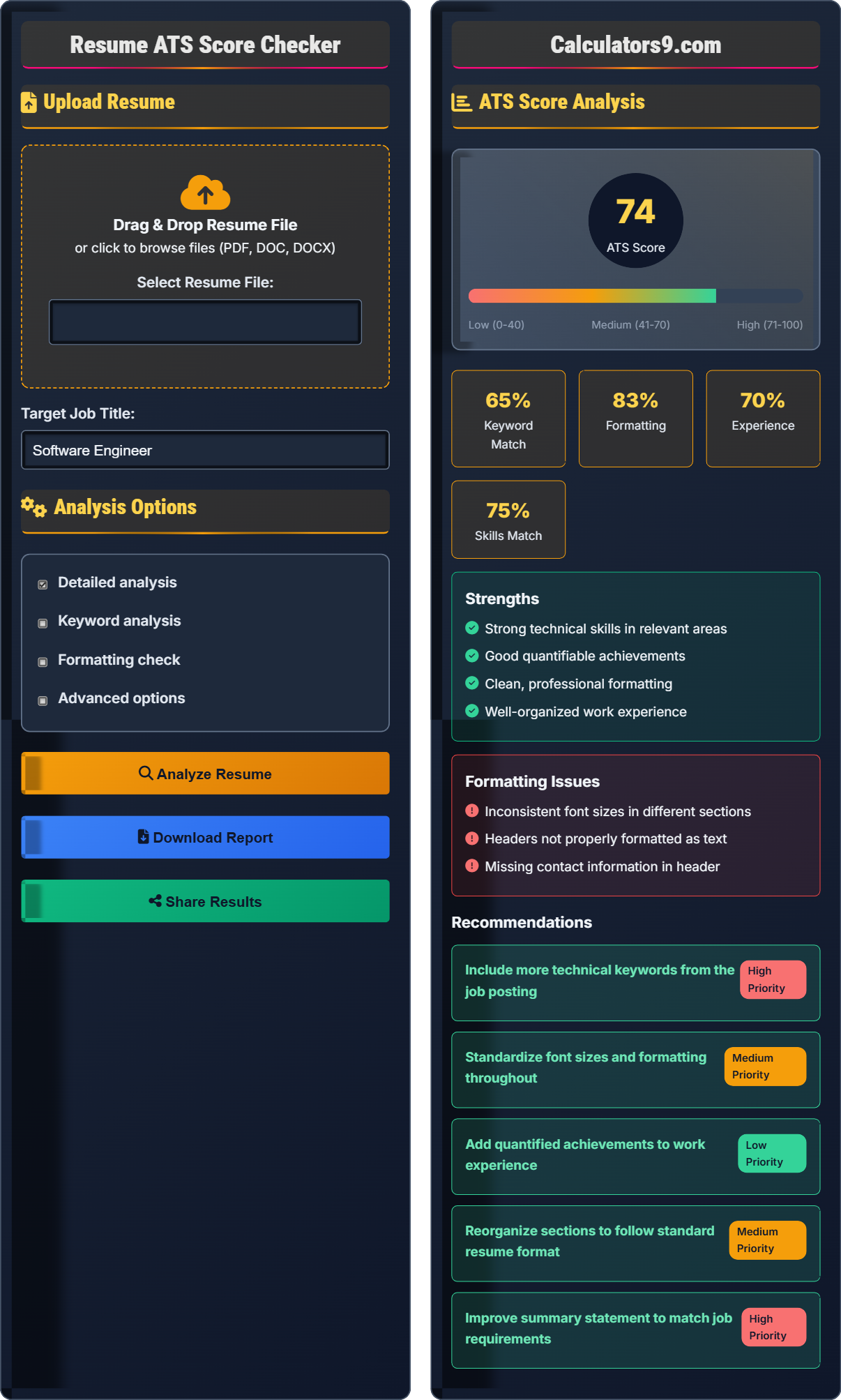
ATS Resume Scoring Algorithm:
Check My ResumeATS (Applicant Tracking System) scoring evaluates resumes based on multiple criteria to determine compatibility with job requirements. The algorithm includes:
- Keyword Matching: Percentage of job-specific terms found in resume
- Formatting Quality: Proper structure, readable fonts, and clean layout
- Content Relevance: Alignment between skills/experience and job requirements
- Contact Information: Complete and properly formatted contact details
- Experience Timeline: Clear, chronological work history
- Skills Match: Technical and soft skills matching job requirements
The overall ATS score is calculated using weighted factors: Keyword Match (30%), Formatting (20%), Experience Relevance (25%), Skills Match (15%), and Contact Info (10%).
Formula: ATS Score = (Keyword × 0.3) + (Formatting × 0.2) + (Experience × 0.25) + (Skills × 0.15) + (Contact × 0.1)
Upload Resume
Drag & Drop Resume File
or click to browse files (PDF, DOC, DOCX)
Analysis Options
ATS Score Analysis
Recommendations
ATS Resume Optimization Guide
Applicant Tracking Systems (ATS) are software applications that scan and rank resumes based on keywords, format, and relevance to job requirements. These systems filter candidates before human review, making ATS compatibility crucial for resume success.
- Keyword Integration: Include relevant technical terms and skills
- Proper Formatting: Use standard fonts and avoid complex layouts
- Clear Structure: Organize sections with standard headings
- Relevant Experience: Align experience with job requirements
- Quantified Results: Include metrics and achievements
- Optimal Length: Keep to 1-2 pages depending on experience
- Use standard section headings (Experience, Education, Skills)
- Include relevant keywords from job postings
- Use standard fonts (Arial, Calibri, Times New Roman)
- Avoid graphics, tables, and complex formatting
- Include complete contact information
- Quantify achievements with numbers and metrics
Best Practices
Follow professional standards to create ATS-friendly resumes that pass initial screening and appeal to hiring managers.
- Customize for each application
- Use industry-specific keywords
- Maintain consistent formatting
- Include measurable achievements
- Proofread for errors
- Test with ATS simulators
- Using non-standard fonts or colors
- Adding graphics or images
- Creating complex tables or columns
- Omitting important keywords
- Having inconsistent formatting
- Not tailoring to job requirements
Resume ATS Optimization Quiz
What is the primary function of an Applicant Tracking System (ATS)?
The answer is B) To scan and rank resumes based on keywords and relevance. ATS software is designed to parse resume content, identify relevant keywords, match skills and experience to job requirements, and rank candidates accordingly. This helps employers efficiently screen large volumes of applications.
Understanding ATS functionality is crucial for resume optimization. These systems act as gatekeepers, filtering candidates before human review. Knowing how ATS works helps job seekers tailor their resumes to pass initial screenings and reach hiring managers.
ATS: Applicant Tracking System - software that parses and ranks resumes
Keywords: Specific terms that match job requirements
Ranking: Scoring system to prioritize most relevant candidates
• ATS filters resumes before human review
• Keywords significantly impact ranking scores
• Proper formatting affects ATS readability
• Include exact keywords from job postings
• Use standard section headings
• Avoid graphics and complex formatting
• Assuming all resumes receive human review
• Not including relevant keywords
• Using non-standard formatting
If a job posting requires "Python, Java, SQL, Machine Learning", what is the minimum percentage of these keywords you should include in your resume to maximize ATS score? Show your calculation.
For maximum ATS score, you should aim to include at least 80% of the required keywords. In this case, there are 4 keywords: Python, Java, SQL, Machine Learning.
Minimum required = 4 × 0.8 = 3.2 keywords
Since you can't include partial keywords, you should include at least 3 out of 4 keywords.
However, for optimal scoring, including all 4 keywords would yield 100% keyword match = 4/4 = 100%.
Keyword matching is a critical component of ATS scoring. Most systems calculate the percentage of job-specific terms found in a resume. Including more relevant keywords increases the likelihood of passing the initial screening threshold set by employers.
Keyword Density: Percentage of job-related terms in resume
Match Threshold: Minimum percentage required to pass ATS
Technical Terms: Industry-specific skills and technologies
• Include exact keywords from job postings
• Match both technical and soft skills mentioned
• Contextualize keywords within relevant experience
• Copy and paste keywords from job descriptions
• Include variations (e.g., "MS Office" and "Microsoft Office")
• Place keywords strategically throughout resume
• Keyword stuffing without context
• Using synonyms instead of exact terms
• Not including enough relevant keywords
An ATS scoring algorithm assigns weights: Keywords (40%), Formatting (25%), Experience (20%), Skills (10%), Contact Info (5%). If a candidate scores 90% on keywords, 60% on formatting, 85% on experience, 80% on skills, and 100% on contact info, what is their overall ATS score?
Overall ATS Score = (Keyword Score × Weight) + (Formatting Score × Weight) + (Experience Score × Weight) + (Skills Score × Weight) + (Contact Score × Weight)
= (90 × 0.40) + (60 × 0.25) + (85 × 0.20) + (80 × 0.10) + (100 × 0.05)
= 36 + 15 + 17 + 8 + 5
= 81%
Therefore, the candidate's overall ATS score is 81%.
This calculation demonstrates how different components contribute to the overall ATS score. Keywords have the highest weight (40%) showing their importance, while formatting also significantly impacts the score (25%). Understanding these weights helps prioritize resume improvements.
Weighted Score: Component multiplied by its importance factor
Algorithm: Mathematical formula for calculating ATS score
Component Contribution: Individual impact on total score
• Higher weights indicate greater importance
• Poor performance in high-weight areas significantly impacts total
• Balanced improvement across all areas is optimal
• Focus improvement efforts on high-weight categories
• Address formatting issues for immediate score gains
• Ensure contact information is complete and accessible
• Ignoring formatting in favor of content alone
• Not understanding component weights
• Focusing only on high-scoring areas
A software engineer with 8 years of experience has a 3-page resume. Industry standards suggest 1-2 pages for this experience level. If ATS scoring penalizes excessive length (-10% per extra page beyond recommended), and the base score is 85%, what would be the adjusted ATS score?
Step 1: Determine recommended length for 8 years experience = 2 pages
Step 2: Calculate excess pages = 3 - 2 = 1 extra page
Step 3: Calculate penalty = 1 × 10% = 10% reduction
Step 4: Adjusted score = Base score - Penalty = 85% - 10% = 75%
Therefore, the adjusted ATS score would be 75% due to the length penalty.
Resume length significantly impacts ATS scoring as many systems penalize excessive length. The optimal length varies by experience level - entry level (1 page), mid-career (1-2 pages), and executive level (up to 3 pages). Staying within recommended lengths prevents unnecessary penalties.
Recommended Length: Standard page count for experience level
Penalty System: Deductions for exceeding limits
Optimal Length: Maximum pages without penalties
• Entry level: 1 page maximum
• Mid-career: 1-2 pages
• Executive level: Up to 3 pages
• Prioritize most relevant experience
• Use concise language to save space
• Remove outdated information
• Including irrelevant early-career experience
• Using excessive white space
• Not tailoring length to experience level
Which strategy is most effective for optimizing a resume for ATS while maintaining human reader appeal?
The answer is B) Include keywords naturally within relevant experience. This strategy satisfies both ATS requirements (finding keywords) and human readers (seeing context and relevance). Placing keywords within actual job descriptions, achievements, and responsibilities makes the resume authentic and effective.
Successful resume optimization requires balancing ATS compatibility with human appeal. Keywords must be present for scanning but integrated naturally within meaningful content. This dual-purpose approach ensures the resume passes initial screening and impresses human reviewers.
Dual Optimization: Satisfying both ATS and human reader needs
Contextual Keywords: Terms within relevant experience
Natural Integration: Keywords appearing organically
• Integrate keywords within actual experience
• Maintain readability for human reviewers
• Avoid keyword stuffing or hiding
• Use action verbs with keywords
• Quantify keyword-related achievements
• Match terminology to industry standards
• Separating keywords from context
• Creating unreadable keyword dumps
• Sacrificing human appeal for ATS
FAQ
Q: How can I tell if my resume passed an ATS?
A: Unfortunately, most employers don't disclose whether a resume passed or failed ATS screening. However, you can look for indicators:
- Quick rejection: If rejected within minutes of submission
- Generic responses: Messages that seem computer-generated
- No feedback: Lack of specific reasons for rejection
- High-volume postings: Jobs receiving hundreds of applications
The best approach is to optimize your resume for ATS compatibility and test it using online ATS checkers before applying.
Q: What percentage of resumes are typically filtered by ATS?
A: Studies show that 98% of Fortune 500 companies and 67% of mid-size companies use ATS. On average, ATS filters out 75-90% of submitted resumes before human review. For example, if a job posting receives 200 applications, only 20-50 might reach human recruiters. This highlights the critical importance of ATS optimization in today's job market.