Aquarium Volume Calculator
Tank size & water capacity • Fish care tool
Volume Calculation Formula:
Show Calculator\( \text{Volume (gallons)} = \frac{\text{Length (in)} \times \text{Width (in)} \times \text{Height (in)}}{231} \)
Where:
- Length, Width, Height = internal tank dimensions in inches
- 231 = cubic inches per US gallon
- For rectangular tanks only
For other shapes:
- Cylindrical: \( V = \pi \times r^2 \times h \) (divide by 231 for gallons)
- Hexagonal: \( V = \frac{3\sqrt{3}}{2} \times s^2 \times h \) (divide by 231 for gallons)
Example: For a 24" × 12" × 16" rectangular tank:
\( V = \frac{24 \times 12 \times 16}{231} = \frac{4608}{231} = 19.9 \) gallons
Stocking Rule: 1 inch of fish per gallon for small fish, less for larger species.
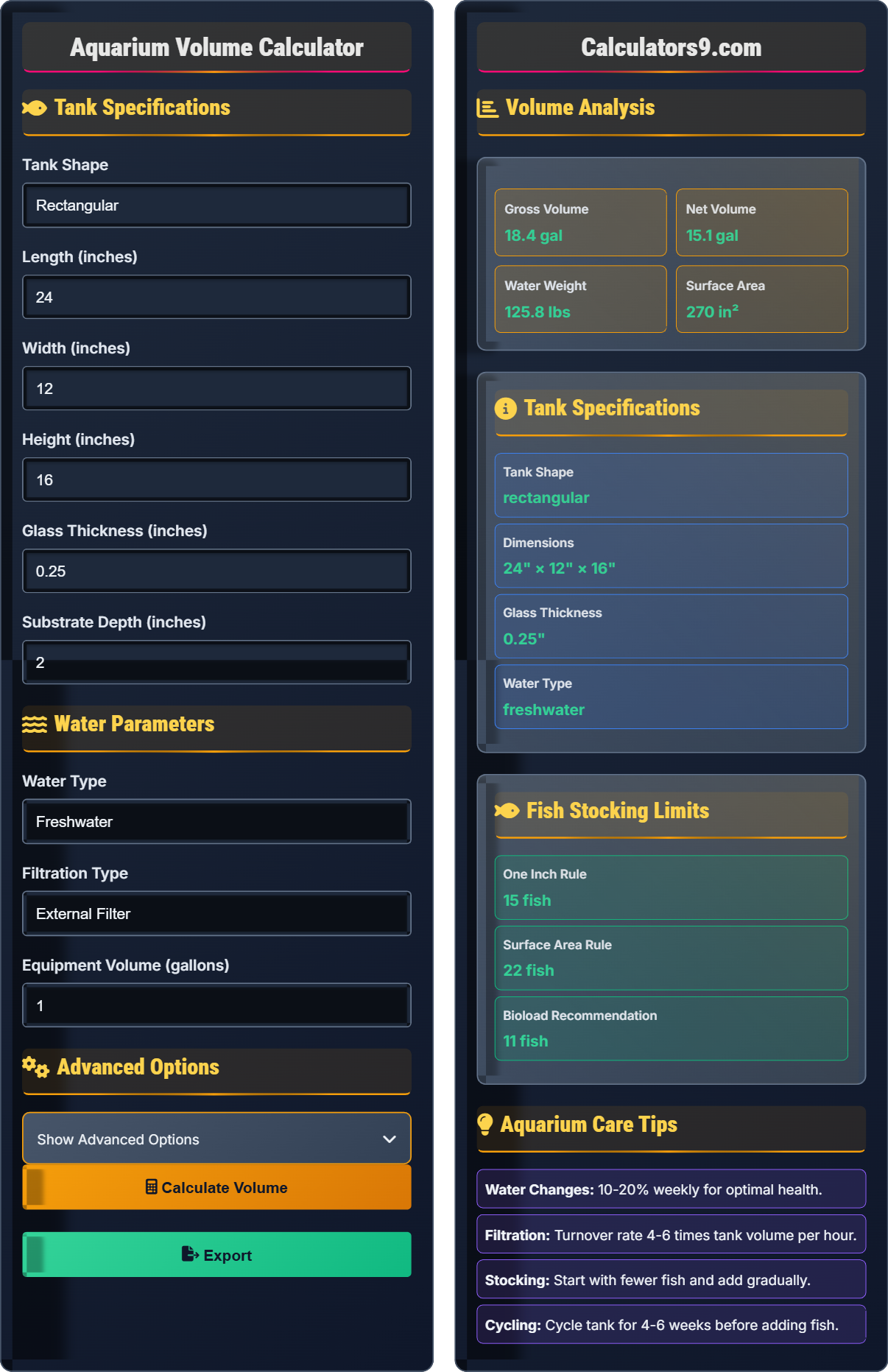
Tank Specifications
Water Parameters
Advanced Options
Volume Analysis
Tank Specifications
Fish Stocking Limits
Aquarium Care Tips
Water Changes: 10-20% weekly for optimal health.
Filtration: Turnover rate 4-6 times tank volume per hour.
Stocking: Start with fewer fish and add gradually.
Cycling: Cycle tank for 4-6 weeks before adding fish.
Aquarium Volume Fundamentals
Aquarium volume calculation depends on tank shape. For rectangular tanks, use length × width × height ÷ 231. For cylindrical tanks, use π × radius² × height ÷ 231. Always measure internal dimensions and account for substrate and equipment displacement.
Accurate volume calculation requires measuring internal dimensions (subtracting glass thickness). Net volume accounts for substrate, decorations, and equipment displacement. Proper volume calculation is essential for medication dosing, chemical treatments, and fish stocking recommendations.
- Measure internal dimensions only
- Account for substrate displacement
- Subtract equipment volume
- Consider net vs. gross volume
Stocking Guidelines
Traditional "one inch per gallon" rule provides a starting point, but surface area and bioload are more important. Larger fish require more space than the rule suggests. Consider fish behavior, territoriality, and filtration capacity when determining stocking levels.
- Calculate available volume after displacement
- Consider fish size and behavior
- Account for filtration capacity
- Plan for fish growth
- Add fish gradually
- Start with fewer fish than maximum
- Consider adult fish size
- Account for territorial behavior
- Provide adequate filtration
Aquarium Volume Quiz
What is the correct formula to calculate the volume of a rectangular aquarium in gallons?
The answer is B) (Length × Width × Height) ÷ 231. This formula calculates the volume in cubic inches and converts it to gallons by dividing by 231 (the number of cubic inches in one US gallon). For example, a 24" × 12" × 16" tank has a volume of (24 × 12 × 16) ÷ 231 = 4608 ÷ 231 = 19.95 gallons.
The division by 231 is crucial because it converts cubic inches to gallons. There are 231 cubic inches in one US gallon. This conversion factor is essential for accurate volume calculation, which is fundamental for medication dosing, chemical treatments, and fish stocking recommendations.
Cubic Inches: Volume measurement in imperial system
US Gallon: Volume unit equal to 231 cubic inches
Internal Dimensions: Measurements inside the tank walls
• Always measure internal dimensions
• Divide by 231 to convert to gallons
• Account for glass thickness in measurements
• Measure from inside glass surfaces
• Use a calculator for accuracy
• Verify measurements before calculating
• Using external instead of internal dimensions
• Forgetting to divide by 231
• Not accounting for glass thickness
Calculate the volume of a rectangular aquarium with dimensions 30" × 15" × 18". Then calculate the net volume after accounting for 2" of substrate and 1 gallon of equipment displacement.
Step 1: Calculate gross volume
Gross Volume = (Length × Width × Height) ÷ 231
Gross Volume = (30 × 15 × 18) ÷ 231
Gross Volume = 8100 ÷ 231 = 35.06 gallons
Step 2: Calculate substrate displacement
Substrate volume = (Length × Width × Substrate Depth) ÷ 231
Substrate volume = (30 × 15 × 2) ÷ 231
Substrate volume = 900 ÷ 231 = 3.89 gallons
Step 3: Calculate net volume
Net Volume = Gross Volume - Substrate Volume - Equipment Volume
Net Volume = 35.06 - 3.89 - 1 = 30.17 gallons
Step 4: Calculate water weight
Water weight = Net Volume × 8.34 lbs/gallon
Water weight = 30.17 × 8.34 = 251.6 lbs
Therefore, the gross volume is 35.06 gallons, the net volume is 30.17 gallons, and the water weight is 251.6 lbs.
This calculation demonstrates the importance of accounting for displacement. Substrate and equipment reduce the available water volume, which affects fish stocking capacity and chemical dosing. The water weight calculation is important for structural considerations when placing the tank.
Gross Volume: Total internal volume
Net Volume: Usable water volume after displacement
Displacement: Volume occupied by substrate and equipment
• Always calculate net volume for stocking
• Account for all displacement sources
• Water weighs 8.34 lbs per gallon
• Measure substrate depth accurately
• Account for all equipment volume
• Consider structural support for weight
• Not accounting for substrate displacement
• Forgetting equipment volume
• Using gross volume for stocking calculations
You have a 40-gallon tank with a net volume of 36 gallons after accounting for substrate and equipment. According to the "one inch per gallon" rule, how many fish can you keep? If you're keeping 3-inch fish, how many can you safely stock? What if they're territorial species?
Step 1: Apply the "one inch per gallon" rule
According to the rule: 36 gallons = 36 inches of fish
This means you could theoretically keep 36 one-inch fish
Step 2: Calculate for 3-inch fish
If each fish is 3 inches long: 36 inches ÷ 3 inches per fish = 12 fish
Step 3: Consider territorial behavior
For territorial species, reduce the stocking level by 30-50%
Reduced capacity: 12 fish × 0.7 = 8.4 ≈ 8 fish
Or: 12 fish × 0.5 = 6 fish (conservative approach)
Step 4: Consider other factors
Additional considerations that might further reduce capacity:
- Active swimmers may need more space
- Larger fish produce more waste
- Community fish may have different requirements
- Filtration capacity
- Desire for future additions
Step 5: Surface area rule consideration
Surface area rule suggests 1 inch of fish per 12 square inches of surface area
For a 40-gallon tank (approximately 36" × 18" surface):
Surface area = 36 × 18 = 648 square inches
Surface area rule allows: 648 ÷ 12 = 54 inches of fish
This is more generous than the volume rule
Therefore, for 3-inch fish in a 36-gallon net volume tank: you could keep 12 fish according to the one-inch rule, but only 6-8 if they're territorial species.
This problem demonstrates that multiple factors affect fish stocking. The "one inch per gallon" rule is a starting point, but behavior, size, and other factors must be considered. Surface area provides an alternative calculation that may be more restrictive for small fish but more generous for large fish.
One Inch Rule: Classic stocking guideline
Surface Area Rule: Alternative stocking method
Net Volume: Usable water volume
• Use net volume for calculations
• Consider fish behavior
• Account for growth potential
• Start with fewer fish than maximum
• Consider multiple calculation methods
• Plan for fish growth
• Using gross volume instead of net volume
• Not considering fish behavior
• Ignoring growth potential
You have a cylindrical aquarium with a diameter of 16 inches and a height of 20 inches. Calculate the volume in gallons. How does this differ from calculating a rectangular tank? What are the advantages of cylindrical tanks?
Step 1: Calculate the volume of a cylinder
Formula: V = π × r² × h
Radius = Diameter ÷ 2 = 16 ÷ 2 = 8 inches
V = π × 8² × 20
V = 3.14159 × 64 × 20
V = 4,021.24 cubic inches
Step 2: Convert to gallons
Volume in gallons = 4,021.24 ÷ 231 = 17.41 gallons
Step 3: Compare to rectangular calculation
Rectangular formula: V = L × W × H ÷ 231
Cylindrical formula: V = π × r² × H ÷ 231
Key difference: Rectangular uses length × width (area of rectangle), while cylindrical uses π × r² (area of circle)
Step 4: Advantages of cylindrical tanks
Cylindrical tanks offer:
- Unique visual appeal and aesthetics
- Stronger structural integrity (pressure distributed evenly)
- Interesting optical effects (refraction)
- Often better for certain fish species that prefer circular swimming patterns
- Less sharp corners (safer for some fish)
Step 5: Disadvantages of cylindrical tanks
However, they also have:
- Less floor space for bottom-dwelling fish
- More difficult to place in corners
- Harder to measure and calculate volume
- Less efficient use of space in terms of surface area to volume ratio
- More expensive for same volume
Therefore, the cylindrical tank holds approximately 17.41 gallons, calculated using the formula V = π × r² × h ÷ 231.
This problem demonstrates how different tank shapes require different volume calculation formulas. The key insight is that volume calculations depend on the base area (circle for cylinders, rectangle for rectangular tanks) multiplied by height, then converted to gallons.
Cylinder Volume: V = π × r² × h
Base Area: Area of the tank's bottom surface
Structural Integrity: Tank's ability to withstand water pressure
• Use appropriate formula for tank shape
• Always measure internal dimensions
• Consider unique properties of each shape
• Memorize formulas for common shapes
• Measure radius, not diameter
• Consider tank purpose when choosing shape
• Using diameter instead of radius
• Applying rectangular formula to cylindrical tanks
• Not accounting for glass thickness
How much does one gallon of freshwater weigh?
The answer is B) 8.34 pounds. One gallon of freshwater weighs 8.34 pounds at room temperature (62°F). This is a standard conversion factor used in aquarium calculations for determining total tank weight, which is important for structural support considerations.
Knowing the weight of water is crucial for aquarium setup. For example, a 55-gallon tank weighs approximately 459 pounds when full (55 × 8.34), not including the weight of the tank itself, substrate, and decorations. This information is vital for ensuring proper placement and support.
Water Weight: 8.34 lbs per gallon at room temp
Structural Load: Total weight the floor must support
Room Temperature: Standard 62°F for calculations
• 1 gallon = 8.34 pounds
• Include tank weight in calculations
• Consider substrate and equipment weight
• Calculate total weight before setup
• Verify floor support capacity
• Consider furniture weight limits
• Forgetting to include tank weight
• Not verifying structural support
• Underestimating total weight
FAQ
Q: How do I measure my aquarium's dimensions accurately for volume calculation?
A: Accurate measurement is crucial for proper volume calculation:
Internal vs External Dimensions:
- Always measure internal dimensions (inside the glass)
- Subtract glass thickness from external measurements
- For most tanks, subtract ¼ inch from each dimension
- For large/heavy tanks, glass may be ½ inch thick
Measurement Techniques:
- Use a metal ruler or measuring tape for accuracy
- Measure from the inside edge of the glass on one side to the inside edge on the opposite side
- Take measurements at multiple points and average them
- For height, measure from the bottom inside surface to the desired water line (not the top of the glass)
For Irregular Shapes:
- Cylindrical: Measure diameter (not radius) and divide by 2
- Hexagonal: Measure across the flat sides
- Bow-front: Use the straight-line distance between sides
Verification:
- Fill the tank with measured containers (gallons/quarts) to verify calculations
- Compare your calculated volume to manufacturer specifications
- Round measurements to the nearest 0.1 inch for accuracy
Important: Always use internal dimensions for medication dosing, chemical treatments, and fish stocking calculations.
Q: What are the different fish stocking rules and which one should I use?
A: There are several stocking rules, each with different applications:
One Inch Per Gallon Rule:
- Classic rule: 1 inch of fish per gallon of water
- Based on oxygen consumption and waste production
- Works best for small, peaceful fish
- Does not account for fish behavior or adult size
Surface Area Rule:
- 1 inch of fish per 12 square inches of surface area
- Focuses on oxygen exchange at the water surface
- Better for larger fish that need more oxygen
- More restrictive for small fish, more generous for large fish
Bioload Rule:
- Based on the filtration capacity and waste production
- Accounts for fish size, feeding habits, and filtration
- More complex but more accurate
- Requires understanding of nitrogen cycle
Which Rule to Use:
Start with the most restrictive rule and adjust based on:
- Fish size: Large fish need more space than the inch rule suggests
- Behavior: Territorial or aggressive fish need more space
- Activity level: Active swimmers need more swimming room
- Filtration: Better filtration allows for higher stocking
- Experience: Beginners should use conservative estimates
Best Practice: Use multiple rules and choose the most conservative recommendation. Always start with fewer fish than the maximum and add gradually while monitoring water parameters.