Benadryl Dosage Calculator for Dogs
Veterinary medication calculator • 2026 animal health
Benadryl Dosage Formula:
Show the calculator\( \text{Dosage (mg)} = \text{Weight (kg)} \times \text{Dose Rate} \)
Where:
- \( \text{Weight (kg)} \) = Dog's weight in kilograms
- \( \text{Dose Rate} \) = 1-2 mg/kg (2-4 mg per lb)
Standard Dosage Range:
- Low dose: 1 mg/kg (0.45 mg/lb)
- Standard dose: 2 mg/kg (0.9 mg/lb)
- Maximum dose: 4 mg/kg (1.8 mg/lb)
Example: For a 20kg (44lb) dog:
Standard dose = 20kg × 2 mg/kg = 40 mg
Or: 44lb × 0.9 mg/lb = 40 mg
Thus, the standard dose for a 20kg dog is 40 mg.
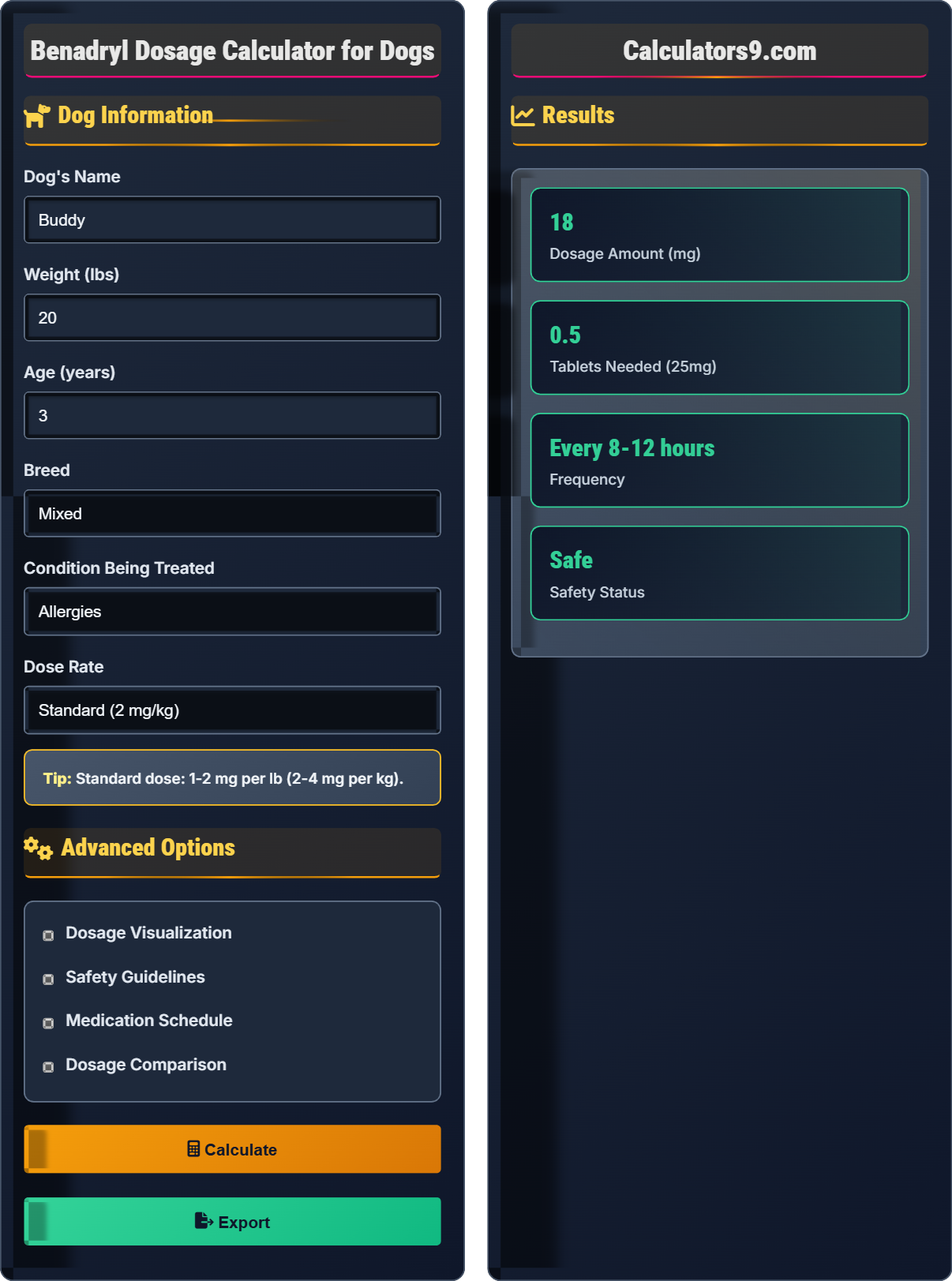
Dog Information
Advanced Options
Results
Comprehensive Benadryl for Dogs Guide
Benadryl (diphenhydramine) is a common antihistamine used to treat allergic reactions in dogs. It works by blocking histamine receptors, reducing symptoms like itching, swelling, and inflammation. When administered correctly under veterinary guidance, it can provide relief for various conditions.
The standard dosage formula is:
Recommended dosages:
- Low dose: 1 mg/kg (0.45 mg/lb)
- Standard dose: 2 mg/kg (0.9 mg/lb)
- High dose: 4 mg/kg (1.8 mg/lb)
- Never use: Products with alcohol, acetaminophen, or pseudoephedrine
- Frequency: Every 8-12 hours as needed
- Duration: Consult vet for extended use
- Side Effects: Drowsiness, dry mouth, urinary retention
- Contraindications: Glaucoma, heart conditions, pregnancy
- Allergic Reactions: Food, insect, environmental allergies
- Travel Anxiety: Mild sedation for travel
- Itching Relief: Skin irritation and dermatitis
- Emergency: Acute allergic reactions
- Prevention: Before allergen exposure
Benadryl Dosage Fundamentals
Diphenhydramine - antihistamine for dogs.
\( \text{Dosage} = \text{Weight (kg)} \times \text{Rate} \)
Standard: 2mg per kg of body weight.
- Only plain diphenhydramine
- Accurate weight required
- Watch for side effects
Administration Tips
Verify formulation and dosage.
- Confirm dog's weight
- Calculate dosage
- Check medication ingredients
- Administer with food if needed
- Consult veterinarian first
- Monitor for reactions
- Don't exceed frequency
Benadryl Safety Learning Quiz
Which ingredient is safe for dogs in Benadryl products?
The answer is A) Diphenhydramine. Plain diphenhydramine is the only safe ingredient for dogs. Acetaminophen, pseudoephedrine, and ibuprofen are all toxic to dogs and should never be given. Always check the label to ensure the product contains only diphenhydramine.
This highlights a critical safety aspect of pet medication. Many human medications contain ingredients that are toxic to dogs. The active ingredient in Benadryl (diphenhydramine) is safe, but other formulations may include harmful additives.
Diphenhydramine: Safe antihistamine for dogs
Toxic Ingredients: Harmful to dogs
Active Ingredient: Therapeutic component
• Only plain diphenhydramine
• Check all ingredients
• Avoid combination products
• Look for "pure" or "plain" diphenhydramine
• Read labels carefully
• Giving human combination products
Calculate the standard Benadryl dosage for a 25-pound dog using the formula: Dosage (mg) = Weight (kg) × 2 mg/kg. Show your work.
Using the formula: \( \text{Dosage (mg)} = \text{Weight (kg)} \times \text{Dose Rate} \)
Step 1: Convert pounds to kilograms
Weight in kg = Weight in lbs ÷ 2.205
Weight in kg = 25 lbs ÷ 2.205 = 11.34 kg
Step 2: Apply the dosage formula
Dosage = 11.34 kg × 2 mg/kg = 22.68 mg
Step 3: Round to practical dosage
Standard dosage ≈ 25 mg (nearest 5mg increment)
Therefore, a 25-pound dog should receive approximately 25 mg of Benadryl.
This demonstrates the conversion process necessary for proper dosing. The formula requires weight in kilograms, so pounds must be converted. The standard dose of 2 mg/kg is commonly used for treating allergies in dogs. Practical dosing often rounds to available tablet sizes.
Conversion Factor: 1 kg = 2.205 lbs
Standard Dose: 2 mg/kg for dogs
Practical Dosing: Rounding to tablet sizes
• Convert to kg first
• Use 2 mg/kg standard
• Round to practical amounts
• 1 kg = 2.2 lbs (approx)
• Standard: 1-2 mg per lb
• Round to nearest tablet size
• Using pounds instead of kg
• Incorrect conversion
• Forgetting to round appropriately
A 40-pound dog needs Benadryl at the standard dosage rate. If you only have 25mg tablets available, how many tablets should you give? What is the total milligram amount?
Step 1: Convert weight to kg
Weight in kg = 40 lbs ÷ 2.205 = 18.14 kg
Step 2: Calculate dosage
Dosage = 18.14 kg × 2 mg/kg = 36.28 mg
Step 3: Calculate number of tablets
Number of tablets = 36.28 mg ÷ 25 mg/tablet = 1.45 tablets
Step 4: Determine practical dosage
Give 1.5 tablets (37.5 mg total)
Therefore, give 1.5 tablets for a total of 37.5 mg.
This demonstrates the practical challenge of matching calculated dosages to available tablet sizes. Sometimes partial tablets are needed, or you may need to choose between slightly under or over-dosing. Close approximation is acceptable in most cases.
Tablet Calculation: Matching dosage to tablet size
Partial Tablets: Sometimes necessary for accuracy
Practical Dosing: Close approximation acceptable
• Calculate precise dosage first
• Then adapt to tablet size
• Close approximation is acceptable
• Split tablets if needed
• Use liquid form for precision
• Calculate total amount
• Not calculating precise dosage first
• Guessing tablet amounts
• Forgetting to calculate total mg
A dog owner gives their 30-pound dog Benadryl at the maximum dosage rate (4 mg/kg) for anxiety during thunderstorms. Calculate the dosage and identify potential side effects. How often can this medication be safely given?
Step 1: Convert weight to kg
Weight in kg = 30 lbs ÷ 2.205 = 13.61 kg
Step 2: Calculate maximum dosage
Maximum dosage = 13.61 kg × 4 mg/kg = 54.44 mg
Step 3: Identify potential side effects
Common side effects at maximum dose:
- Excessive drowsiness
- Dry mouth
- Urinary retention
- Loss of coordination
Step 4: Determine frequency
Safe frequency: Every 8-12 hours as needed
Therefore, give approximately 55mg every 8-12 hours, watch for side effects.
This demonstrates the relationship between dosage and side effects. Higher doses increase the likelihood of adverse reactions. The frequency guidelines ensure the medication doesn't accumulate to toxic levels in the system.
Maximum Dose: 4 mg/kg for dogs
Side Effects: Adverse reactions to medication
Frequency: How often to administer
• Maximum dose: 4 mg/kg
• Frequency: Every 8-12 hours
• Monitor for side effects
• Start with lower doses
• Monitor response
• Increase only if needed
• Giving maximum dose without need
• Not monitoring for side effects
• Incorrect frequency
Which medical condition is a contraindication for Benadryl use in dogs?
The answer is B) Glaucoma. Benadryl can increase intraocular pressure, making it dangerous for dogs with glaucoma. Other contraindications include prostate enlargement, heart conditions, and certain respiratory conditions. Always consult a veterinarian before administering to dogs with medical conditions.
This highlights the importance of knowing contraindications before administering medication. Benadryl has anticholinergic effects that can worsen certain conditions. A thorough medical history is essential before treatment.
Contraindication: Condition where drug should not be used
Glaucoma: Elevated eye pressure
Anticholinergic: Blocks acetylcholine effects
• Check medical history first
• Glaucoma is a contraindication
• Consult veterinarian for conditions
• Know your dog's medical history
• Consult vet for chronic conditions
• Monitor for adverse effects
• Not checking medical history
• Giving to dogs with glaucoma
• Assuming it's always safe
FAQ
Q: How often can I give Benadryl to my dog?
A: Benadryl can typically be given every 8-12 hours as needed. The maximum frequency is usually 3 times per day. However, it's important to:
- Start with the lowest effective dose
- Monitor for side effects like drowsiness
- Consult your veterinarian before extended use
- Never exceed 4 mg/kg per dose
For ongoing conditions, your vet may recommend alternative treatments.
Q: Can I give my dog children's Benadryl?
A: Children's Benadryl is often safer than adult versions because it's less likely to contain alcohol. However:
- Check the inactive ingredients
- Ensure it contains only diphenhydramine
- Verify the concentration matches what you expect
- Calculate dosage based on your dog's weight, not age
The active ingredient (diphenhydramine) is the same for both, but concentrations may vary. Always verify the label and consult your veterinarian before administering.