Dog Age Calculator
Pet age converter • 2026 animal health
Dog Age Conversion Formula:
Show the calculator\( \text{Human Years} = 16 \times \ln(\text{Dog Years}) + 31 \)
Where:
- \( \text{Human Years} \) = Equivalent human age
- \( \text{Dog Years} \) = Actual dog age in years
- \( \ln() \) = Natural logarithm function
Alternative Breed-Specific Formula:
\( \text{Human Years} = \text{Base Age} + (\text{Dog Years} - 2) \times \text{Multiplier} \)
For different breeds: Small (×4), Medium (×5), Large (×6), Giant (×7)
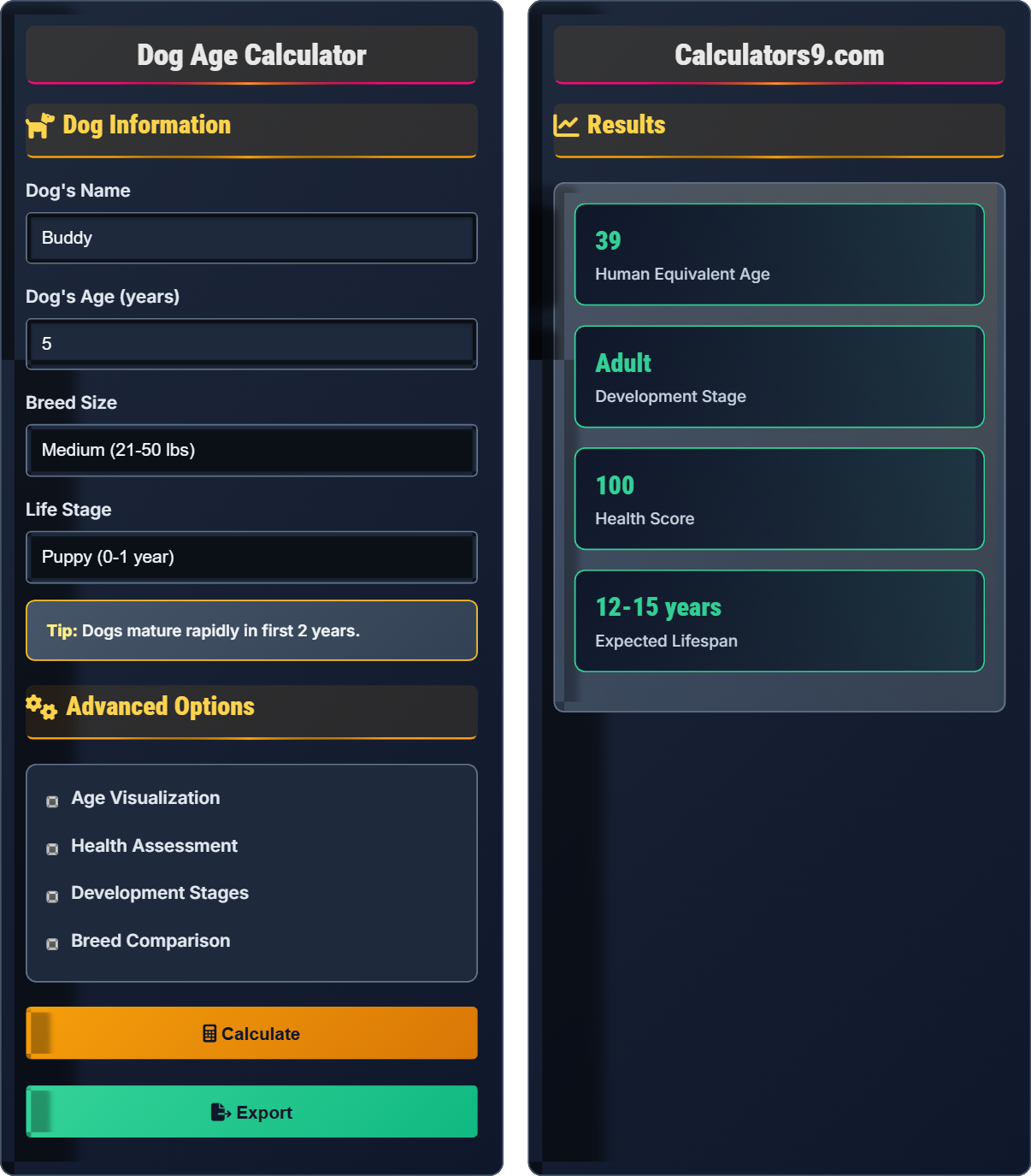
Example: A 5-year-old medium-sized dog:
First 2 years: 24 human years
Remaining 3 years: 3 × 5 = 15 human years
Total: 24 + 15 = 39 human years
Thus, a 5-year-old dog is approximately 39 human years old.
Dog Information
Advanced Options
Results
Comprehensive Dog Aging Guide
Dog aging is a complex biological process that varies significantly based on breed size, genetics, and environmental factors. Unlike the common misconception of "one dog year equals seven human years," dogs mature much faster in their early years and then age more slowly as adults.
The modern scientific approach uses a logarithmic formula:
For practical purposes, the breed-specific formula:
- Small Breeds: First 2 years = 24 human years, then ×4 per year
- Medium Breeds: First 2 years = 24 human years, then ×5 per year
- Large Breeds: First 2 years = 24 human years, then ×6 per year
- Giant Breeds: First 2 years = 24 human years, then ×7 per year
- Breed Size: Smaller dogs live longer
- Genetics: Family history influences longevity
- Diet: Nutrition affects aging process
- Exercise: Physical activity maintains health
- Veterinary Care: Regular checkups extend life
- Nutrition: Adjust diet based on age
- Exercise: Modify activity for life stage
- Healthcare: Increase vet visits with age
- Training: Adapt to cognitive changes
- Environment: Make senior-friendly adjustments
Dog Aging Fundamentals
Biological process of growing older.
\( H = 16\ln(D) + 31 \)
Where H=human years, D=dog years.
- First 2 years = rapid maturation
- Smaller dogs live longer
- Size affects aging rate
Care Tips
Age-appropriate care requirements.
- Assess current age stage
- Adjust nutrition accordingly
- Modify exercise routine
- Monitor health changes
- Regular vet checkups
- Appropriate exercise
- Balanced nutrition
Dog Aging Learning Quiz
What is the correct understanding about the "one dog year equals seven human years" rule?
The answer is B) It's a myth - dogs age non-linearly. Dogs mature very rapidly in their first two years (approximately 24 human years), then the aging rate slows down. The 1:7 ratio is not scientifically accurate and doesn't account for breed size differences in aging rates.
This addresses a widespread misconception about dog aging. Understanding the non-linear nature of dog aging is crucial for proper care, as different life stages have different nutritional, exercise, and healthcare requirements.
Non-linear Aging: Rate changes over time
Maturation Rate: Speed of early development
Breed Size Impact: Size affects lifespan
• First 2 years = rapid aging
• Aging rate varies by breed size
• 1:7 rule is inaccurate
• Use breed-specific calculators
• Consider size in aging calculations
• Applying 1:7 ratio universally
Using the logarithmic formula Human Years = 16×ln(Dog Years) + 31, calculate the human equivalent age of a 4-year-old dog. Show your work.
Using the formula: \( \text{Human Years} = 16 \times \ln(\text{Dog Years}) + 31 \)
Given: Dog Years = 4
Step 1: Calculate natural logarithm
\( \ln(4) = 1.386 \)
Step 2: Multiply by 16
\( 16 \times 1.386 = 22.18 \)
Step 3: Add 31
\( 22.18 + 31 = 53.18 \)
Therefore, a 4-year-old dog is approximately 53 human years old.
This demonstrates the logarithmic nature of dog aging. The formula accounts for the rapid early development followed by slower aging. The natural logarithm function captures this non-linear relationship between dog and human years.
Natural Logarithm (ln): Logarithm with base e
Logarithmic Function: Models non-linear growth
Non-linear Model: Rate changes over time
• Use ln function, not log base 10
• Follow order of operations
• Verify with common sense
• ln(1) = 0, ln(e) = 1
• ln(4) ≈ 1.386
• Use calculator for precision
• Using log base 10 instead of ln
• Incorrect order of operations
• Arithmetic errors
A small breed dog (15 lbs) and a giant breed dog (120 lbs) are both 5 years old. Using the breed-specific aging formula, calculate their respective human equivalent ages. How much faster do giant breeds age compared to small breeds?
Step 1: Calculate small breed age
First 2 years: 24 human years
Remaining 3 years: 3 × 4 = 12 human years
Total: 24 + 12 = 36 human years
Step 2: Calculate giant breed age
First 2 years: 24 human years
Remaining 3 years: 3 × 7 = 21 human years
Total: 24 + 21 = 45 human years
Step 3: Calculate difference
45 - 36 = 9 human years
Therefore, the giant breed is 9 years "older" than the small breed.
This demonstrates how breed size significantly impacts aging rates. Giant breeds age approximately 25% faster than small breeds, which explains why they have shorter lifespans. This is crucial for determining appropriate care and health monitoring schedules.
Small Breed: Up to 20 lbs
Giant Breed: Over 90 lbs
Aging Rate: Speed of biological aging
• Small: ×4 after year 2
• Giant: ×7 after year 2
• First 2 years = 24 human years
• Remember: bigger = faster aging
• First 2 years are critical
• Adjust care by breed size
• Using same formula for all breeds
• Forgetting first 2 years rule
• Incorrect multiplication factors
A 7-year-old medium-sized dog has a human equivalent age of 49 years. At what age should the owner start considering senior-specific health screenings? What types of tests might be recommended based on the dog's developmental stage?
Step 1: Determine senior transition age
For medium breeds, senior stage begins at 7+ years
At 7 years old, the dog is entering senior stage
Step 2: Recommended health screenings
Baseline tests for 7-year-old senior dog:
- Complete blood panel (CBC, chemistry)
- Thyroid function test
- Urinalysis
- Dental examination
- Joint health assessment
Step 3: Ongoing care
Annual senior panels recommended
Therefore, the owner should start senior health screenings immediately at age 7.
This demonstrates the practical application of age conversion in veterinary care. Knowing the human equivalent age helps veterinarians recommend appropriate preventive care based on the dog's developmental stage and associated health risks.
Senior Stage: 7+ years for medium breeds
Baseline Testing: Preventive health screening
Age-related Risks: Health issues by life stage
• Senior care begins at 7 years
• Regular screenings prevent disease
• Adjust care with age
• Start senior care early
• Monitor weight changes
• Watch for behavioral changes
• Delaying senior care until symptoms appear
• Not adjusting diet for age
• Reducing exercise too much
Which of the following correctly identifies the typical life stages of a medium-sized dog?
The answer is B) Puppy (0-1 year), Young Adult (1-3 years), Adult (3-7 years), Senior (7+ years). This reflects the current veterinary understanding of canine life stages, which recognizes distinct developmental phases with specific care requirements. The 7-year threshold for senior status is widely accepted for medium-sized dogs.
This classification system helps veterinarians and pet owners provide age-appropriate care. Each stage has specific nutritional, exercise, and healthcare needs. The 7-year threshold for senior status is based on research showing increased health risks and changing physiological needs at this age.
Puppy Stage: Rapid growth and socialization
Young Adult: Peak physical condition
Senior Stage: Increased health monitoring
• Medium breeds: Senior at 7+
• Each stage has specific needs
• Care changes with development
• Adjust food at each stage
• Modify exercise for age
• Increase vet visits with age
• Using outdated age classifications
• Not adjusting care for life stages
• Missing senior care transition
FAQ
Q: How do I know if my dog is entering the senior stage?
A: Senior stage begins at different ages depending on breed size:
- Small Breeds: 10-12 years
- Medium Breeds: 7-9 years
- Large Breeds: 6-8 years
- Giant Breeds: 5-6 years
Signs of aging include decreased activity, graying muzzle, joint stiffness, and changes in sleep patterns. Regular veterinary check-ups help monitor health transitions.
Q: Why do larger dogs have shorter lifespans?
A: The "rate of living theory" suggests that larger animals have faster metabolic rates, leading to increased cellular damage and faster aging. Additionally:
- Larger dogs grow faster, which may increase cancer risk
- Greater mechanical stress on joints and organs
- More cells to maintain, increasing mutation chances
Mathematically, lifespan scales with body mass to the power of approximately 0.2, meaning a 10-fold increase in body mass corresponds to only a 1.5-fold increase in lifespan.