Dog Age to Human Years Calculator
Accurate pet aging conversion • Veterinary health tool
Dog Age Conversion Formula:
Show Calculator\( \text{Human Age} = 16 \ln(\text{Dog Age}) + 31 \)
Where:
- ln = natural logarithm
- Dog Age = actual age in years
- Human Age = equivalent human age in years
This formula accounts for rapid aging in early years and slower aging in later years.
For puppies (0-2 years): First year ≈ 15 human years, second year ≈ 24 human years.
For adult dogs: Each year ≈ 4-5 human years depending on size.
Size Adjustment: Small breeds age slower, large breeds age faster.
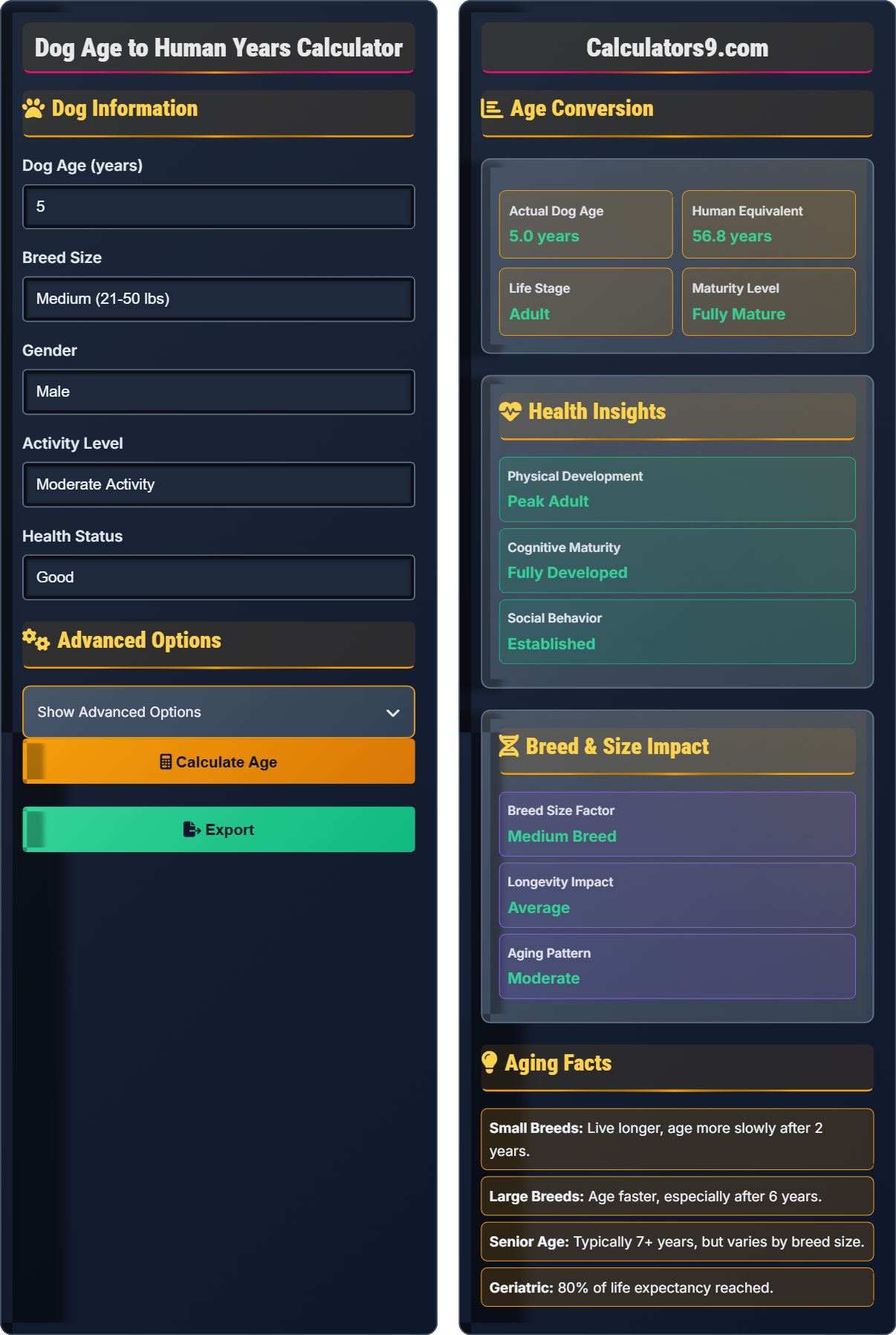
Dog Information
Advanced Options
Age Conversion
Health Insights
Breed & Size Impact
Aging Facts
Small Breeds: Live longer, age more slowly after 2 years.
Large Breeds: Age faster, especially after 6 years.
Senior Age: Typically 7+ years, but varies by breed size.
Geriatric: 80% of life expectancy reached.
Dog Aging Fundamentals
Dogs do not age linearly like humans. They mature rapidly in their first two years, then aging slows down. Small breeds tend to live longer than large breeds, and genetic factors significantly influence longevity. The traditional "multiply by 7" rule is scientifically inaccurate.
Contemporary veterinary science uses logarithmic formulas to convert dog age to human years. The first year of a dog's life is equivalent to about 15 human years, the second year to about 9 additional human years, and subsequent years to approximately 4-5 human years each.
- First year = 15 human years
- Second year = 24 human years total
- Each additional year = 4-5 human years
- Size affects aging rate significantly
Life Stages
Dogs progress through distinct life stages: Puppy (0-1 year), Adolescent (1-2 years), Young Adult (2-3 years), Prime Adult (3-7 years), Senior (7+ years), and Geriatric (80% of life expectancy). Each stage has specific health and behavioral characteristics.
- Puppy: Rapid growth and learning phase
- Adolescent: Behavioral challenges emerge
- Young Adult: Peak physical condition
- Prime Adult: Stable maturity
- Senior: Gradual physical decline begins
- Geriatric: Significant age-related changes
- Adjust nutrition with age
- Modify exercise appropriately
- Increase health monitoring
- Watch for age-related symptoms
Dog Age Conversion Quiz
What is the problem with the traditional "multiply by 7" rule for converting dog years to human years?
The answer is D) Both B and C. The traditional "multiply by 7" rule is fundamentally flawed because it assumes linear aging, which doesn't reflect actual canine development. Dogs age rapidly in their first two years, then aging slows. Additionally, the rule doesn't account for significant differences in aging rates between breed sizes, with small breeds living longer than large breeds.
The "multiply by 7" rule was a popular oversimplification that ignored the non-linear nature of canine aging. Modern veterinary science recognizes that dogs experience rapid maturation in early years, reaching sexual maturity and physical development much faster than humans. The logarithmic growth curve reflects biological reality better than linear multiplication.
Linear Aging: Consistent rate of aging over time
Non-linear Aging: Variable rate of aging that changes with age
Logarithmic Growth: Rapid early growth that slows over time
• Dogs age rapidly in first 2 years
• Aging rate varies by breed size
• First year ≈ 15 human years
• Use scientific formulas for accuracy
• Consider breed size in calculations
• Monitor health changes with age
• Continuing to use the "multiply by 7" rule
• Not accounting for breed size differences
• Assuming all dogs age identically
Using the logarithmic formula (Human Age = 16 × ln(Dog Age) + 31), calculate the human equivalent age for a 4-year-old dog. How does this compare to the old "multiply by 7" method?
Step 1: Apply the logarithmic formula
Human Age = 16 × ln(Dog Age) + 31
Human Age = 16 × ln(4) + 31
ln(4) ≈ 1.386
Human Age = 16 × 1.386 + 31
Human Age = 22.18 + 31 = 53.18 years
Step 2: Apply the old "multiply by 7" method
Human Age = 4 × 7 = 28 years
Step 3: Compare the results
Logarithmic formula: 53.18 years
Multiply by 7: 28 years
Difference: 53.18 - 28 = 25.18 years
Step 4: Interpret the result
The logarithmic formula suggests a 4-year-old dog is equivalent to a 53-year-old human, while the old method suggested only 28 years. The logarithmic formula is more accurate as it accounts for the non-linear aging pattern.
Therefore, the 4-year-old dog is approximately 53 human years old using the modern formula, significantly older than the 28 years suggested by the outdated method.
This calculation demonstrates the significant difference between old and new methods. The logarithmic formula reflects that dogs age rapidly in early years but continue aging throughout their lives. The "multiply by 7" method grossly underestimates the age equivalence, especially for dogs older than 2 years.
Logarithmic Formula: Accounts for non-linear aging
Linear Formula: Assumes constant aging rate
Age Equivalence: Comparative developmental stage
• Use logarithmic formula for accuracy
• First 2 years = rapid aging
• Later years = slower aging
• Remember: 1st year = 15 human years
• 2nd year = 24 total human years
• Later years = 4-5 human years each
• Using the outdated "multiply by 7" method
• Not accounting for breed size differences
• Assuming linear aging throughout life
You have two 8-year-old dogs: a Chihuahua (small breed) and a Great Dane (giant breed). Considering that small breeds age more slowly and giant breeds age faster, calculate their approximate human equivalent ages. What health considerations should differ between them?
Step 1: Calculate base human equivalent (medium breed)
Using the logarithmic formula: Human Age = 16 × ln(8) + 31
ln(8) ≈ 2.079
Human Age = 16 × 2.079 + 31 = 33.26 + 31 = 64.26 years
Step 2: Adjust for small breed (Chihuahua)
Small breeds age more slowly after 2 years
Adjustment: Reduce by approximately 20% after age 2
Adjusted age = 64.26 - (6 × 0.20 × 4.5) ≈ 64.26 - 5.4 ≈ 59 years
Step 3: Adjust for giant breed (Great Dane)
Giant breeds age faster, especially after 6 years
Adjustment: Increase by approximately 25% after age 6
Adjusted age = 64.26 + (2 × 0.25 × 5) ≈ 64.26 + 2.5 ≈ 67 years
Step 4: Health considerations
Chihuahua (59 human years equivalent):
- Still in prime adult stage
- Continue regular exercise and dental care
- Monitor for patellar luxation and dental issues
Great Dane (67 human years equivalent):
- Entering senior stage
- Monitor for joint problems and heart issues
- Consider senior diet and gentle exercise
- Increased health screening frequency
Therefore, the Chihuahua is approximately 59 human years old and the Great Dane is approximately 67 human years old, with different health priorities based on their age equivalency.
This problem illustrates the significant impact of breed size on aging rates. Large and giant breeds have accelerated aging, often entering senior status earlier than small breeds. This affects not only age equivalency but also health monitoring schedules and care priorities.
Breed Size Categories: Small (<20 lbs), Medium (21-50 lbs), Large (51-90 lbs), Giant (>90 lbs)
Accelerated Aging: Faster progression through life stages
Health Priorities: Different concerns at different ages
• Small breeds: Longer lifespan, slower aging
• Large breeds: Shorter lifespan, faster aging
• Adjust health care with age equivalency
• Research breed-specific health concerns
• Adjust veterinary visit frequency with age
• Modify diet and exercise as dog ages
• Treating all breeds the same regardless of size
• Not adjusting care for breed-specific needs
• Ignoring size-based aging differences
You have a 10-year-old Golden Retriever (large breed). Calculate its human equivalent age and determine what health screenings should be prioritized. At what age should you consider your dog to be entering the geriatric stage if the average lifespan for Golden Retrievers is 10-12 years?
Step 1: Calculate base human equivalent
Human Age = 16 × ln(10) + 31
ln(10) ≈ 2.303
Human Age = 16 × 2.303 + 31 = 36.85 + 31 = 67.85 years
Step 2: Adjust for large breed
Large breeds age faster, especially after 6 years
Adjustment: Increase by approximately 15% after age 6
Adjusted age = 67.85 + (4 × 0.15 × 5) ≈ 67.85 + 3 = 70.85 years
Step 3: Determine geriatric stage
Geriatric stage begins at 80% of life expectancy
80% of 11 years (average) = 0.8 × 11 = 8.8 years
Your 10-year-old Golden Retriever is already in the geriatric stage
Step 4: Health screenings for 71-year-old equivalent
Priority screenings:
- Annual comprehensive blood panel
- Cardiac evaluation (Golden Retrievers prone to heart disease)
- Joint health assessment (hip dysplasia common)
- Cancer screening (Golden Retrievers at risk for several cancers)
- Dental examination
- Thyroid function test
Step 5: Care modifications
- Senior diet with joint supplements
- Gentle exercise to maintain mobility
- Comfortable sleeping areas
- More frequent bathroom breaks
Therefore, your 10-year-old Golden Retriever is approximately 71 human years old and is in the geriatric stage, requiring comprehensive health monitoring and senior-focused care.
This problem demonstrates how age conversion guides health care decisions. Knowing the human equivalent age helps veterinarians and owners understand what health challenges to anticipate. Large breeds like Golden Retrievers enter geriatric stages earlier and require proactive health monitoring.
Geriatric Stage: 80% of expected lifespan reached
Proactive Monitoring: Preventive health assessments
Breed-Specific Risks: Genetic predispositions to conditions
• Large breeds enter geriatric stage earlier
• Screen for breed-specific conditions
• Increase monitoring frequency with age
• Research breed-specific health risks
• Start senior care early
• Monitor for subtle changes
• Delaying senior care until obvious symptoms
• Not researching breed-specific risks
• Assuming all seniors have same needs
At what age do most dogs enter the "senior" life stage, and what factors influence this transition?
The answer is B) Varies by breed size, typically 6-8 years for large breeds and 8-10 years for small breeds. The senior life stage begins when dogs start showing age-related physical and behavioral changes. Large breeds age faster and enter this stage earlier than small breeds. Small breeds may not enter senior stage until 10+ years, while giant breeds may be considered seniors as early as 5-6 years.
Senior stage classification is based on physiological changes rather than chronological age alone. Large breeds experience more rapid aging and earlier onset of age-related conditions. This classification system helps guide appropriate care, nutrition, and health monitoring for dogs at different life stages.
Senior Stage: Beginning of age-related changes
Physiological Changes: Physical and behavioral changes with age
Chronological Age: Actual time elapsed since birth
• Large breeds: Senior at 6-7 years
• Small breeds: Senior at 8-10 years
• Individual variation exists
• Consider breed size when planning care
• Watch for early signs of aging
• Adjust expectations by breed
• Using same age for all breeds
• Ignoring size-based differences
• Not adjusting care with age
FAQ
Q: How accurate is the logarithmic formula compared to the "multiply by 7" rule?
A: The logarithmic formula is significantly more accurate than the "multiply by 7" rule:
The "Multiply by 7" Rule: Assumes linear aging (1 dog year = 7 human years). This suggests a 10-year-old dog is only 70 in human terms, which doesn't reflect actual canine development.
Modern Logarithmic Formula: Accounts for non-linear aging patterns. Dogs mature rapidly in the first 2 years, then aging slows. The formula Human Age = 16ln(dog_age) + 31 better reflects biological reality.
Accuracy Comparison:
- 1-year-old dog: Multiply by 7 = 7 years, Logarithmic = 31 years (Reality: closer to 15 years)
- 2-year-old dog: Multiply by 7 = 14 years, Logarithmic = 42 years (Reality: closer to 24 years)
- 5-year-old dog: Multiply by 7 = 35 years, Logarithmic = 51 years (Reality: closer to 36-40 years)
The logarithmic formula provides a better approximation, though breed size and individual variation still matter. Small breeds age more slowly, large breeds more quickly.
Q: Why do different dog sizes age at different rates?
A: The difference in aging rates between dog sizes is due to several biological factors:
Metabolic Rate: Smaller animals generally have higher metabolic rates, but paradoxically, larger dogs age faster despite having slower metabolisms. This contradicts the typical size-metabolism relationship in mammals.
Genetic Factors: Large breed dogs have been selectively bred for size, often inadvertently selecting for genes that accelerate aging. The IGF-1 gene pathway influences both growth and aging.
Cellular Stress: Larger dogs have more cells dividing rapidly during growth, potentially leading to more DNA replication errors and increased cancer risk.
Structural Stress: Larger body size creates more mechanical stress on joints, heart, and other organs, contributing to earlier age-related deterioration.
Life History Theory: Evolutionarily, larger animals invest more in growth initially but less in maintenance, while smaller animals prioritize longevity.
Typical Lifespans:
- Toy breeds (under 10 lbs): 14-16 years average
- Small breeds (10-20 lbs): 12-15 years average
- Medium breeds (21-50 lbs): 10-13 years average
- Large breeds (51-90 lbs): 8-12 years average
- Giant breeds (over 90 lbs): 6-10 years average
This size-based variation is why age conversion must account for breed size to be meaningful.