Pet Adoption Cost Calculator
Comprehensive expenses & budget planning • 2026 edition
Pet Details
Advanced Options
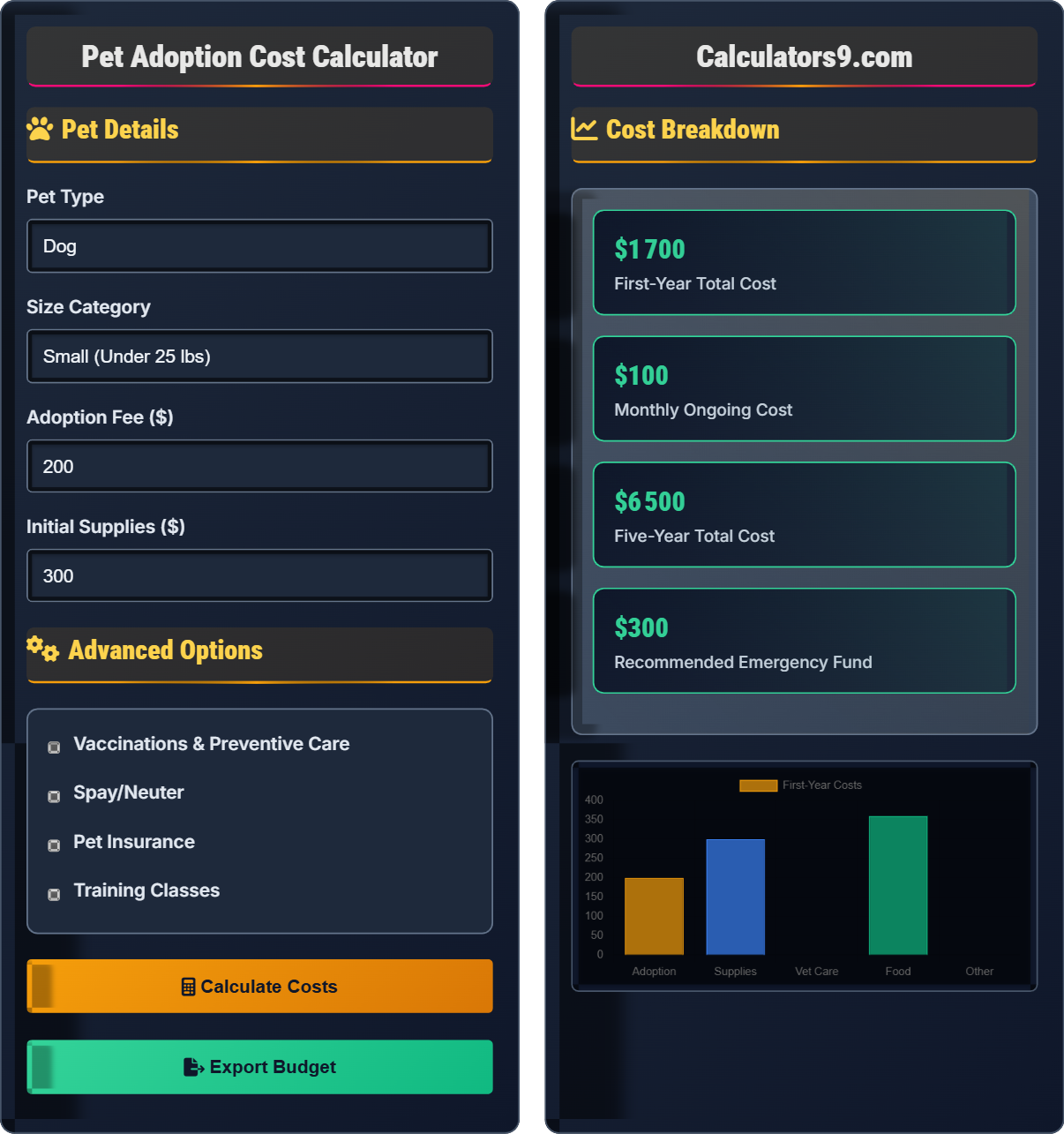
Cost Breakdown
| Category | One-Time | Monthly | Annual |
|---|
| Year | Cost | Breakdown | Percentage |
|---|
Comprehensive Pet Ownership Guide
Owning a pet involves significant financial responsibilities that extend far beyond the initial adoption fee. The ASPCA estimates that the first year of pet ownership costs $1,200-$2,500 for dogs and $800-$2,000 for cats. These costs include adoption fees, initial supplies, veterinary care, food, and other necessities.
Essential supplies vary by pet type but typically include:
- Food & Water Bowls: $10-50
- Collar & Leash (dogs): $15-100
- Litter Box & Supplies (cats): $30-100
- Bedding: $20-100
- Toys: $20-100
- Grooming Supplies: $20-100
- Crate/Carrier: $50-300
- Create a pet fund: Set aside money monthly for pet expenses
- Shop smart: Buy supplies in bulk and look for sales
- Preventive care: Regular vet visits prevent costly emergencies
- Pet insurance: Consider coverage for major medical expenses
- Emergency fund: Maintain $500-1000 for unexpected costs
Pet Ownership Learning Quiz
According to ASPCA estimates, what is the average first-year cost of dog ownership?
The answer is C) $1,200-2,500. The ASPCA estimates that first-year dog ownership costs range from $1,200 to $2,500, including adoption fees, initial supplies, veterinary care, food, and other necessities. This represents a significant financial commitment that many people underestimate.
Understanding the true cost of pet ownership is crucial before adopting. Many people focus only on the adoption fee and forget about the substantial ongoing expenses. The first year is typically the most expensive due to initial supplies and comprehensive veterinary care. This knowledge helps potential pet owners prepare financially and avoid having to surrender pets due to financial constraints.
ASPCA: American Society for the Prevention of Cruelty to Animals
First-Year Costs: Total expenses incurred during the initial year of pet ownership
Financial Preparedness: Having adequate resources to meet pet care needs
• Always budget for first-year costs before adopting
• Consider ongoing monthly expenses for the pet's lifetime
• Plan for unexpected veterinary emergencies
• Research costs specific to your chosen pet type and size
• Ask shelters for cost estimates before adopting
• Consider pet insurance to offset major expenses
• Underestimating veterinary care costs
• Not accounting for premium pet food expenses
• Forgetting about grooming and boarding costs
If a cat owner spends $25 monthly on food, $15 on litter, $10 on treats, and $30 annually on veterinary care, what is the total monthly cost? Show your work.
Step 1: Calculate monthly recurring costs = $25 (food) + $15 (litter) + $10 (treats) = $50
Step 2: Calculate monthly equivalent for annual cost = $30 ÷ 12 months = $2.50
Step 3: Calculate total monthly cost = $50 + $2.50 = $52.50
The total monthly cost is $52.50.
This calculation demonstrates the importance of converting annual costs to monthly equivalents for accurate budgeting. Many pet expenses occur annually (like annual vet visits) but should be spread across months to understand the true monthly impact. This approach helps pet owners plan their finances more effectively and avoid surprises.
Monthly Equivalent: Annual cost divided by 12 months for budgeting purposes
Recurring Costs: Expenses that occur regularly each month
Budgeting: Planning and tracking income and expenses
• Convert annual costs to monthly equivalents for accurate budgeting
• Include all categories of expenses, not just food
• Account for both fixed and variable costs
• Use a spreadsheet to track all pet-related expenses
• Set up automatic transfers to a pet fund
• Review and adjust budgets annually
• Only budgeting for food and forgetting other expenses
• Not accounting for seasonal increases in costs
• Underestimating the frequency of veterinary visits
Sarah adopted a medium-sized dog with estimated monthly costs of $150. The shelter recommended setting aside an emergency fund of 3 months' worth of expenses. What should be the minimum amount in her emergency fund?
Step 1: Identify monthly expenses = $150
Step 2: Determine recommended emergency fund duration = 3 months
Step 3: Calculate emergency fund amount = $150 × 3 months = $450
The minimum emergency fund should be $450 to cover three months of expenses.
Emergency funds are crucial for responsible pet ownership. Unexpected veterinary bills can easily reach hundreds or thousands of dollars for emergencies like accidents, sudden illnesses, or chronic condition management. Having an emergency fund prevents difficult decisions between financial stability and pet health care. The 3-month recommendation provides a buffer for extended treatments or recovery periods.
Emergency Fund: Money set aside for unexpected expenses
Unexpected Expenses: Unplanned costs that arise suddenly
Financial Stability: Having sufficient resources to handle emergencies
• Maintain emergency fund separately from regular pet budget
• Replenish fund after using it for emergencies
• Consider pet insurance as supplement to emergency fund
• Start small and build emergency fund gradually
• Keep fund in high-yield savings account
• Reassess fund amount as pet ages and needs change
• Using emergency fund for routine expenses
• Not replenishing fund after use
• Mixing emergency fund with regular pet budget
Mike is considering pet insurance for his new puppy. The policy costs $50/month with a $250 annual deductible and 80% coverage after deductible. If his puppy has an emergency surgery costing $3,000, how much will Mike pay out-of-pocket? How does this compare to no insurance?
With insurance:
Step 1: Calculate annual premium = $50 × 12 = $600
Step 2: Apply deductible = $3,000 - $250 = $2,750
Step 3: Insurance covers 80% = $2,750 × 0.8 = $2,200
Step 4: Mike pays = $250 (deductible) + $550 (20% of remaining) + $600 (premium) = $1,400
Without insurance: Mike pays $3,000
Insurance saves Mike $1,600 in this scenario.
This example demonstrates how pet insurance works and when it provides value. Insurance involves paying premiums regularly to protect against large unexpected expenses. The deductible is paid first, then the insurance covers a percentage of remaining costs. In this case, despite paying $600 in premiums, the insurance saved Mike $1,600 on a major expense, showing the value of insurance for high-cost scenarios.
Annual Premium: Yearly cost to maintain insurance coverage
Deductible: Amount paid before insurance coverage begins
Coverage Percentage: Portion of costs covered by insurance
• Understand deductible and coverage limits before purchasing
• Consider premium costs as part of overall budget
• Insurance is most valuable for major medical expenses
• Compare multiple insurance providers and plans
• Read exclusions carefully before purchasing
• Consider wellness plans for routine care
• Expecting insurance to cover routine preventive care
• Not reading fine print about exclusions
• Choosing plan based only on premium cost
According to veterinary economists, what is the estimated lifetime cost of owning a medium-sized dog?
The answer is D) $20,000-30,000+. Veterinary economists estimate that the lifetime cost of owning a medium-sized dog ranges from $20,000 to over $30,000, including food, veterinary care, supplies, and other expenses over a 10-13 year lifespan. This figure underscores the significant long-term financial commitment of pet ownership.
This question highlights the long-term financial implications of pet adoption. Many people focus on immediate costs but don't consider the total investment over a pet's lifetime. The $20,000+ figure includes all expenses from adoption to end-of-life care. This knowledge helps potential pet owners make informed decisions and plan accordingly. It also emphasizes the responsibility aspect of pet ownership.
Lifetime Cost: Total expenses over a pet's entire lifespan
Financial Commitment: Long-term obligation to meet pet needs
End-of-Life Care: Veterinary expenses in final stages of life
• Consider lifetime costs before adopting
• Plan for increasing costs as pet ages
• Factor in potential long-term health issues
• Set up automatic savings for pet expenses
• Research costs specific to your pet's breed
• Consider age-related health costs
• Not accounting for age-related health expenses
• Forgetting about end-of-life care costs
Cost Categories
One-time purchases plus monthly recurring expenses for pet ownership.
Emergency fund: 20% of annual costs. Veterinary: 40% of annual costs. Food: 25% of annual costs.
- Always budget for emergencies
- Preventive care saves money long-term
- Consider pet insurance for high-cost breeds
Planning Tips
Set aside funds before bringing pet home to ensure responsible care.
- Buy supplies in bulk when possible
- Look for sales and discounts
- Compare veterinary prices
- Consider generic medications
- Higher costs for purebred animals
- Age affects healthcare expenses
- Location impacts veterinary costs
- Seasonal expenses (grooming, heating/cooling)
FAQ
Q: Is pet insurance worth it?
A: For most families, yes. Insurance covers major expenses that could bankrupt pet owners. Annual premiums of $50-100 can save thousands during emergencies.
Q: How can I reduce pet costs?
A: Adopt from shelters, buy generic food, use preventive care, shop sales for supplies, and consider pet insurance for major expenses.