Pet Calorie Calculator
Animal nutrition calculator • 2026 animal health
Pet Calorie Formula:
Show the calculator\( \text{RER} = 70 \times (\text{weight in kg})^{0.75} \)
Where:
- \( \text{RER} \) = Resting Energy Requirement (calories/day)
- \( \text{weight in kg} \) = Pet's body weight in kilograms
Adjusted Daily Calories:
\( \text{Daily Calories} = \text{RER} \times \text{Activity Factor} \)
Activity Factors:
- Neutered Adult: ×1.6
- Intact Adult: ×1.8
- Weight Loss: ×1.0
- Weight Gain: ×1.8
- Pregnant/Lactating: ×2.0-4.0
Example: A 10kg neutered adult dog:
RER = 70 × (10)^0.75 = 70 × 5.62 = 393 kcal/day
Adjusted = 393 × 1.6 = 629 kcal/day
Thus, the dog needs approximately 629 calories per day.
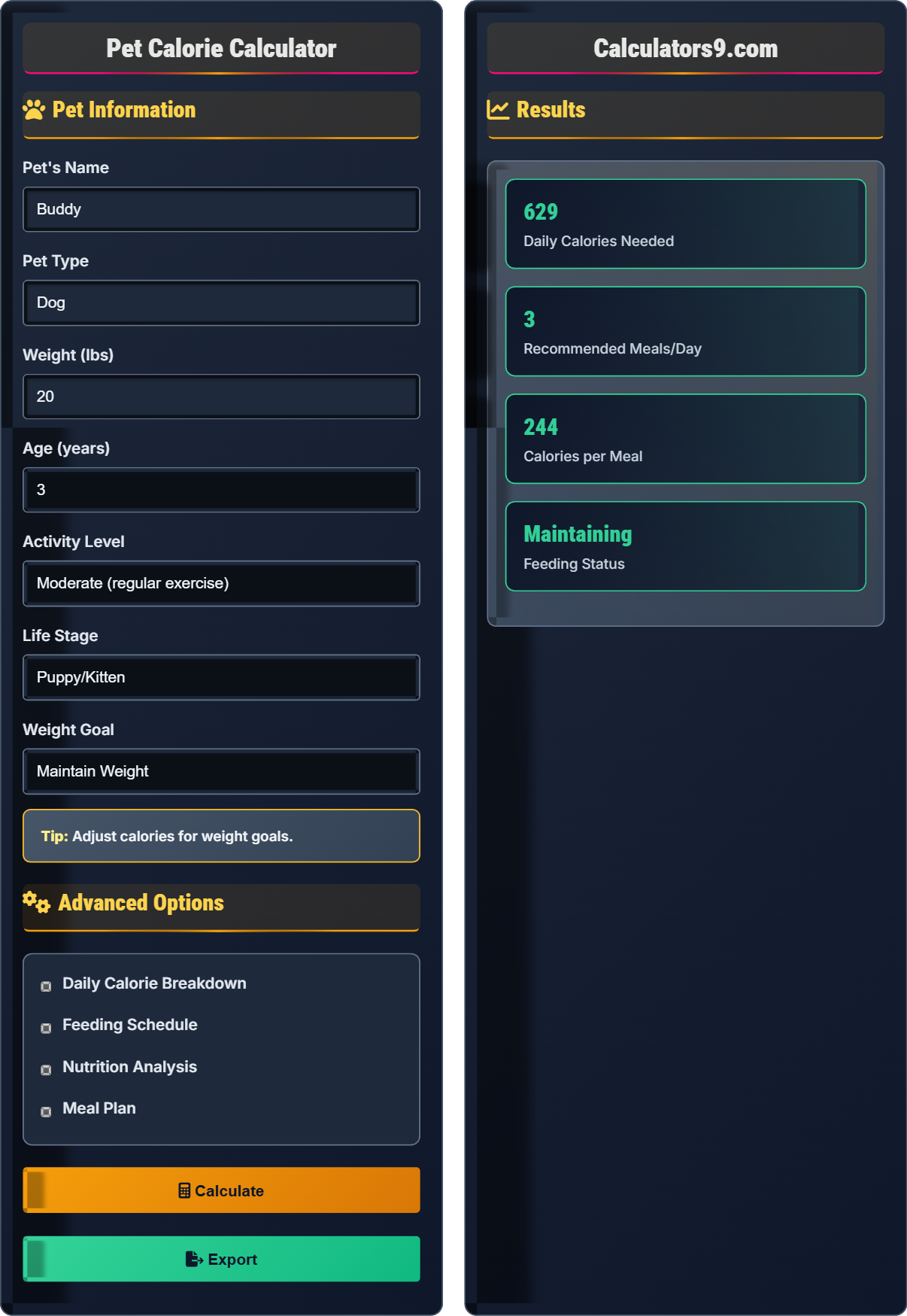
Pet Information
Advanced Options
Results
Comprehensive Pet Nutrition Guide
Accurate caloric intake is essential for maintaining optimal pet health. The Resting Energy Requirement (RER) formula provides the baseline caloric needs, which is then adjusted based on activity level, life stage, and health conditions. Proper nutrition prevents obesity, supports immune function, and promotes longevity.
The RER (Resting Energy Requirement) formula is the gold standard:
Adjusted Daily Calories:
- Neutered Adult: RER × 1.6
- Intact Adult: RER × 1.8
- Weight Loss: RER × 1.0
- Weight Gain: RER × 1.8
- Pregnant/Lactating: RER × 2.0-4.0
- Protein: Muscle development and repair
- Fats: Energy and vitamin absorption
- Carbohydrates: Energy source
- Vitamins: Metabolic functions
- Minerals: Bone and organ health
- Portion Control: Prevent overfeeding
- Weight Management: Adjust for goals
- Life Stages: Adapt to needs
- Health Conditions: Special dietary needs
- Food Quality: Nutrient density matters
Pet Nutrition Fundamentals
Resting Energy Requirement - baseline caloric needs.
\( \text{RER} = 70 \times \text{W}^{0.75} \)
Where W=weight in kg.
- Adjust for activity level
- Consider life stage
- Monitor weight regularly
Feeding Tips
Adjust calories based on activity.
- Calculate RER
- Apply activity factor
- Adjust for weight goals
- Monitor results
- Quality of food matters
- Regular weigh-ins
- Consult veterinarian
Pet Nutrition Learning Quiz
What is the Resting Energy Requirement (RER) formula for calculating a pet's baseline caloric needs?
The answer is B) 70 × (weight in kg)^0.75. The RER (Resting Energy Requirement) formula is 70 × (weight in kg)^0.75. This allometric equation accounts for the metabolic scaling relationship between body size and energy requirements.
This formula is the gold standard in veterinary nutrition. The 0.75 exponent reflects the biological relationship between body mass and metabolic rate. This formula provides the baseline caloric needs before adjustments for activity, age, and health status.
RER: Resting Energy Requirement
Allometric Scaling: Relationship between size and metabolism
Baseline Needs: Minimum caloric requirement
• Use weight in kg
• Apply 0.75 exponent
• Adjust for specific needs
• Convert lbs to kg (divide by 2.2)
• 1 kg = 2.2 lbs
• Using weight in lbs instead of kg
Calculate the RER for a 15kg dog using the formula RER = 70 × (weight in kg)^0.75. Show your work.
Using the formula: \( \text{RER} = 70 \times (\text{weight in kg})^{0.75} \)
Given: weight = 15kg
Step 1: Calculate the weight exponent
\( 15^{0.75} = 7.37 \)
Step 2: Multiply by 70
\( 70 \times 7.37 = 515.9 \)
Step 3: Round to nearest whole number
\( \text{RER} = 516 \text{ kcal/day} \)
Therefore, the RER for a 15kg dog is approximately 516 kcal/day.
This demonstrates the mathematical calculation of baseline caloric needs. The exponentiation step is crucial as it reflects the biological scaling law. Once the RER is calculated, it can be adjusted for activity level, age, and other factors.
Exponentiation: Raising to a power
Scaling Law: Biological relationship
kcal: Kilocalories (food calories)
• Use weight in kg
• Apply 0.75 exponent
• Round appropriately
• Use calculator for exponentiation
• 15^0.75 ≈ 7.37
• Check with reference values
• Incorrect exponentiation
• Using wrong weight unit
• Arithmetic errors
A 25kg neutered adult dog has an RER of 650 kcal/day. The owner wants to help the dog lose weight. Calculate the daily caloric intake needed, and determine how much the calories should be reduced from the maintenance level.
Step 1: Calculate maintenance calories
Maintenance = RER × Activity Factor
For neutered adult: Activity Factor = 1.6
Maintenance = 650 × 1.6 = 1,040 kcal/day
Step 2: Calculate weight loss calories
For weight loss: Use RER × 1.0
Weight Loss = 650 × 1.0 = 650 kcal/day
Step 3: Calculate reduction
Reduction = 1,040 - 650 = 390 kcal/day
Therefore, feed 650 kcal/day (390 kcal less than maintenance).
This demonstrates how to adjust caloric intake for weight management. The weight loss formula uses RER × 1.0, which creates a caloric deficit. The reduction of 390 kcal represents a significant 37.5% decrease from maintenance.
Caloric Deficit: Consuming fewer calories than needed
Weight Loss Formula: RER × 1.0
Maintenance Level: Calories to maintain weight
• Weight loss = RER × 1.0
• Maintenance = RER × Activity Factor
• Monitor weight regularly
• Reduce by 20-40% for weight loss
• Weigh weekly
• Increase exercise
• Not adjusting for activity level
• Too aggressive calorie reduction
• Forgetting to monitor weight
A 10kg adult cat needs 250 calories per day. The owner prefers to feed twice daily. How many calories should be provided per meal? If the cat food has 350 calories per cup, how much should be fed per meal?
Step 1: Calculate calories per meal
Daily calories = 250 kcal
Meals per day = 2
Calories per meal = 250 ÷ 2 = 125 kcal
Step 2: Calculate food amount per meal
Food calories per cup = 350 kcal
Amount per meal = 125 ÷ 350 = 0.357 cups
Step 3: Convert to standard measurements
0.357 cups ≈ 3/8 cup or 3 tablespoons
Therefore, feed 125 kcal per meal, or approximately 3/8 cup of food.
This demonstrates practical application of caloric calculations to actual feeding. The conversion from calories to volume helps pet owners measure appropriate portions. Consistent portion control is key to maintaining healthy weight.
Portion Control: Measuring appropriate amounts
Caloric Density: Calories per unit of foodVolume Measurement: Cups, tablespoons
• Divide daily calories by meals
• Use food label for density
• Measure consistently
• Use kitchen scale for precision
• Mark measuring cup
• Adjust as needed
• Free-feeding without measurement
• Not checking food calorie content
• Inconsistent portioning
Which of the following correctly identifies the activity factors for different pet categories?
The answer is B) Sedentary: ×1.2, Active: ×1.8, Athletic: ×2.0. The activity factors are standardized in veterinary nutrition:
- Sedentary/Pet: ×1.2
- Moderate/Neutered Adult: ×1.6
- Active/Intact Adult: ×1.8
- Athletic/Working: ×2.0+
These factors account for the increased energy expenditure with activity.
Activity factors adjust baseline caloric needs based on energy expenditure. The higher the activity level, the greater the caloric requirement. These standardized factors help ensure appropriate feeding for different lifestyles.
Activity Factor: Multiplier for energy needs
Energy Expenditure: Calories burned
Standardized Factors: Vet-approved values
• Higher activity = higher factor
• Standardized values exist
• Adjust for individual needs
• Assess activity level honestly
• Adjust based on results
• Consider seasonal changes
• Overestimating activity level
• Using incorrect factors
• Not adjusting for changes
FAQ
Q: How do I know if I'm feeding my pet the right amount?
A: Monitor your pet's body condition score:
- Rib Check: You should feel ribs easily without pressing hard
- Waist Check: Visible waist when viewed from above
- Abdominal Tuck: Abdomen should tuck up when viewed from side
Weigh your pet monthly and adjust portions based on weight trends. Use the RER formula as a starting point, then adjust based on your pet's body condition.
Q: Should I change my pet's food as they age?
A: Yes, nutritional needs change with age:
- Puppies/Kittens: Higher protein and fat for growth
- Adults: Maintenance levels
- Seniors: Often reduced calories, increased fiber, joint support
As pets age, their metabolism changes and caloric needs typically decrease by 10-20% every decade after age 7. Adjust food accordingly to maintain ideal body weight.