Pet Food Portion Calculator
Optimal nutrition & feeding guide • Veterinary nutrition tool
Pet Caloric Formula:
Show Calculator\( \text{Daily Calories} = RER \times \text{Activity Factor} \)
Where:
- RER = Resting Energy Requirement
- RER = 70 × (Body Weight in kg)^0.75
- Activity Factor varies by age, condition, and activity level
Activity Factors:
- Puppies/Kittens: 2.2-3.0
- Intact Adults: 1.6-1.8
- Neutered Adults: 1.2-1.4
- Senior Pets: 1.0-1.2
- Weight Loss: 0.8-1.0
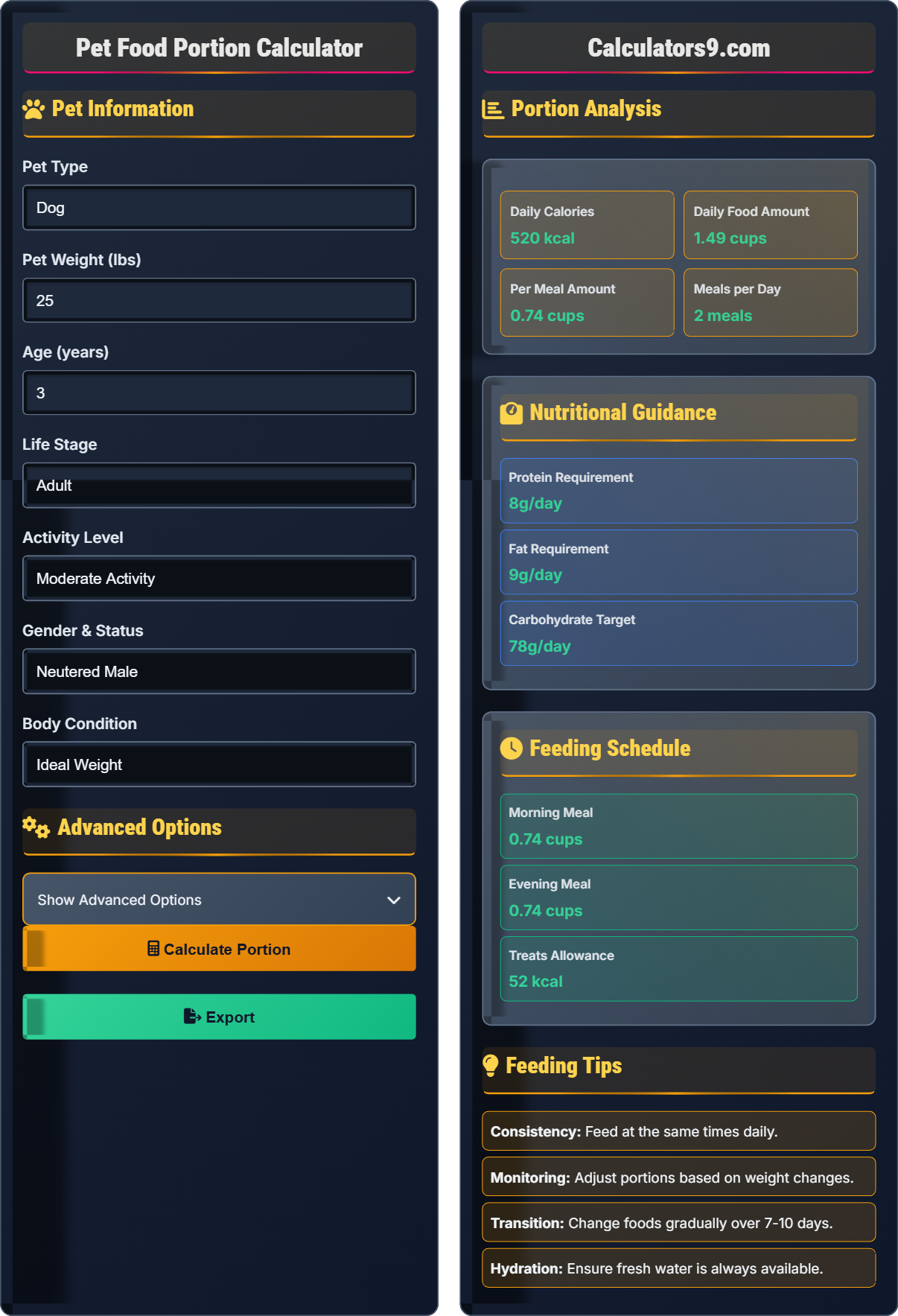
For a 25 lb adult dog: RER = 70 × (11.34)^0.75 ≈ 480 kcal
With moderate activity: 480 × 1.6 = 768 kcal/day
Pet Information
Advanced Options
Portion Analysis
Nutritional Guidance
Feeding Schedule
Feeding Tips
Consistency: Feed at the same times daily.
Monitoring: Adjust portions based on weight changes.
Transition: Change foods gradually over 7-10 days.
Hydration: Ensure fresh water is always available.
Pet Nutrition Fundamentals
Daily caloric requirements are determined by Resting Energy Requirement (RER) multiplied by activity factors. RER = 70 × (body weight in kg)^0.75. Activity factors vary by life stage, reproductive status, and activity level.
Accurate portioning requires considering pet weight, age, activity level, and body condition. Puppies and kittens need 2-3 times more calories per pound than adults. Neutered pets require fewer calories than intact pets. Senior pets may need fewer calories but higher quality nutrients.
- Adjust portions based on body condition
- Feed multiple small meals daily
- Consider life stage and activity level
- Monitor weight and adjust accordingly
Feeding Guidelines
Nutritional needs vary significantly by life stage: Puppies/kittens require higher protein and calories for growth, adults need maintenance levels, and seniors may need modified nutrition for age-related changes. Special diets may be needed for medical conditions.
- Puppies: 3-4 meals daily until 6 months
- Adults: 1-2 meals daily
- Seniors: 2 meals with possible smaller portions
- Adjust based on individual needs
- Provide fresh water always
- Use measuring cups for accuracy
- Monitor body condition regularly
- Avoid free feeding for most pets
- Limit treats to 10% of daily calories
Pet Food Portion Quiz
What is the correct formula for calculating Resting Energy Requirement (RER) in pets?
The answer is B) 70 × (weight in kg)^0.75. The correct formula for Resting Energy Requirement (RER) is 70 × (body weight in kilograms)^0.75. This formula accounts for the metabolic scaling effect where larger animals have relatively lower metabolic rates per unit of body weight. The result is in kilocalories (kcal) per day.
The RER formula is based on Kleiber's law, which describes how metabolic rate scales with body size. The 0.75 exponent reflects that metabolic rate increases more slowly than body weight. For example, a 10kg dog doesn't require 10 times the calories of a 1kg dog. This formula provides the baseline energy needed for basic bodily functions.
RER: Resting Energy Requirement - baseline calories needed
Kleiber's Law: Metabolic scaling relationship
kcal: Kilocalories, energy measurement unit
• Weight must be in kilograms
• Use 0.75 exponent for scaling
• RER is multiplied by activity factor
• Convert lbs to kg (divide by 2.2)
• Use calculator for exponentiation
• Apply activity factor after RER
• Using pounds instead of kilograms
• Forgetting the exponentiation
• Not applying activity factor
Calculate the daily caloric requirement for a 30 lb neutered adult dog with moderate activity level. Use RER = 70 × (kg)^0.75 and appropriate activity factor.
Step 1: Convert weight to kilograms
30 lbs ÷ 2.2 = 13.6 kg
Step 2: Calculate RER
RER = 70 × (13.6)^0.75
(13.6)^0.75 ≈ 7.64
RER = 70 × 7.64 = 535 kcal/day
Step 3: Apply activity factor
For neutered adult with moderate activity: Activity factor = 1.2-1.4
Daily calories = 535 × 1.3 (mid-range) = 696 kcal/day
Step 4: Calculate food amount
If food has 350 kcal per cup:
Food amount = 696 ÷ 350 = 1.99 cups per day
Step 5: Determine meal portions
For 2 meals per day: 1.99 ÷ 2 = 1.0 cup per meal
Therefore, the 30 lb neutered adult dog needs approximately 696 kcal daily, or 2.0 cups of food divided into 2 meals of 1.0 cup each.
This calculation demonstrates the step-by-step process for determining caloric needs. The conversion to kilograms is critical, as the formula requires metric units. The activity factor significantly impacts the final requirement, showing why individual pet characteristics matter in feeding plans.
Activity Factor: Multiplier based on pet's lifestyle
Caloric Density: Energy content per unit of food
Metabolic Rate: Energy expenditure at rest
• Convert lbs to kg (÷ 2.2)
• Apply correct activity factor
• Use food's caloric density
• Keep conversion factors handy
• Use measuring cups for accuracy
• Monitor body condition regularly
• Forgetting unit conversion
• Using wrong activity factor
• Not checking food caloric content
You have a 40 lb neutered adult dog that is overweight. The dog currently eats 3 cups of food daily (350 kcal/cup). Calculate the appropriate daily intake for weight loss and determine how much food to reduce. What feeding schedule would you recommend?
Step 1: Calculate current caloric intake
Current intake = 3 cups × 350 kcal/cup = 1,050 kcal/day
Step 2: Calculate RER for weight management
40 lbs = 18.2 kg
RER = 70 × (18.2)^0.75 = 70 × 9.25 = 648 kcal/day
Step 3: Calculate weight loss calories
For weight loss: Activity factor = 1.0 (sedentary) to 1.2
Weight loss calories = 648 × 1.0 = 648 kcal/day
Step 4: Calculate food reduction
Current food = 1,050 ÷ 350 = 3.0 cups
Target food = 648 ÷ 350 = 1.85 cups
Reduction = 3.0 - 1.85 = 1.15 cups per day
Step 5: Determine feeding schedule
Divide 1.85 cups into 2-3 meals:
Option 1: 2 meals of 0.93 cups each
Option 2: 3 meals of 0.62 cups each
Step 6: Additional recommendations
• Gradual transition over 7-10 days
• Increase exercise gradually
• Monitor weight weekly
Therefore, reduce daily intake from 3.0 cups to 1.85 cups (648 kcal), representing a 38% reduction. Feed in 2-3 scheduled meals daily.
This problem demonstrates weight management through caloric restriction. The 1.0 activity factor for weight loss reflects reduced metabolic demands during caloric deficit. The significant reduction (38%) shows how overweight pets often consume far more than needed, highlighting the importance of accurate portioning.
Weight Loss Protocol: Reduced caloric intake with maintained nutrition
Gradual Transition: Slow dietary changes to prevent digestive upset
Metabolic Adaptation: Body's response to caloric restriction
• Weight loss: RER × 1.0 activity factor
• Reduce gradually (10-15% initially)
• Monitor body condition weekly
• Use measuring cups for accuracy
• Gradual transitions prevent digestive issues
• Combine with increased exercise
• Too rapid caloric reduction
• Not monitoring body condition
• Abrupt dietary changes
You have a 6-month-old puppy weighing 15 lbs. Calculate the daily caloric requirement and feeding schedule. How does this compare to an adult dog of the same weight? What special considerations apply to puppy nutrition?
Step 1: Calculate RER for puppy
15 lbs = 6.8 kg
RER = 70 × (6.8)^0.75 = 70 × 4.95 = 347 kcal/day
Step 2: Apply puppy activity factor
For growing puppy: Activity factor = 2.2-3.0
Daily calories = 347 × 2.5 (mid-range) = 868 kcal/day
Step 3: Calculate food amount
Food amount = 868 ÷ 350 = 2.48 cups per day
Step 4: Determine feeding schedule for puppy
At 6 months: Feed 3 meals daily
Per meal = 2.48 ÷ 3 = 0.83 cups per meal
Step 5: Compare to adult dog of same weight
Adult RER = 347 kcal/day
Adult activity factor = 1.2-1.4 (neutered)
Adult calories = 347 × 1.3 = 451 kcal/day
Adult food = 451 ÷ 350 = 1.29 cups per day
Puppy needs 868 ÷ 451 = 1.92 times more calories than adult!
Step 6: Special puppy considerations
• Higher protein requirements (22-26% minimum)
• Increased calcium and phosphorus for bone growth
• More frequent feeding to prevent hypoglycemia
• DHA for brain development
• AAFCO growth formula required
Therefore, the 6-month-old puppy needs 868 kcal daily (2.48 cups) fed 3 times daily, which is nearly twice the amount needed by an adult dog of the same weight.
This problem illustrates the dramatically higher nutritional needs of growing puppies compared to adults. The 1.92x difference in caloric needs reflects the energy required for growth, tissue development, and higher metabolic demands. Puppies also have unique nutrient requirements beyond just calories.
Growth Requirements: Additional nutrients for development
Hypoglycemia: Low blood sugar, risk for small puppies
AAFCO Growth: Standards for puppy nutritional adequacy
• Puppies need 2-3x calories of adults
• Feed 3-4 times daily until 6 months
• Use growth-specific formulas
• Use puppy-specific food until 1 year
• Monitor growth rate
• Avoid over-supplementation
• Feeding adult food to growing puppies
• Insufficient meal frequency
• Overfeeding leading to rapid growth
Which of the following statements about senior pet nutrition is TRUE?
The answer is B) Senior pets typically need fewer calories but higher quality nutrients. As pets age, their metabolism often slows and activity levels decrease, reducing caloric needs. However, their requirement for high-quality protein, specific vitamins, and minerals may increase to maintain muscle mass and support organ function.
Senior pet nutrition is nuanced - while total caloric needs may decrease due to reduced activity and slower metabolism, the quality of nutrients becomes more critical. Older pets may need more bioavailable proteins, antioxidants, and joint-supporting nutrients even though they eat less food overall.
Senior Pets: Typically 7+ years for dogs, 11+ for cats
Bioavailable Protein: Easily absorbed and utilized protein
Metabolic Rate: Energy expenditure at rest
• Senior pets: 10-20% fewer calories typically
• Maintain high-quality protein
• Consider joint and cognitive support
• Monitor body condition closely
• Consider senior-specific formulas
• Consult veterinarian for changes
• Maintaining adult feeding amounts
• Not adjusting for decreased activity
• Assuming all seniors have same needs
FAQ
Q: How do I know if I'm feeding my pet the right amount?
A: The best way to assess proper feeding is through body condition scoring:
Visual Assessment:
- Ideal weight: You can feel ribs with light pressure, waist is visible when viewed from above, abdominal tuck is evident
- Overweight: Ribs covered with thick fat layer, no waist definition, no abdominal tuck
- Underweight: Ribs easily visible, prominent bones, no body fat
Body Condition Score (BCS): On a 9-point scale, 4-5 is ideal. Scores of 6-9 indicate overweight, 1-3 indicate underweight.
Monitoring Schedule:
- Weigh your pet monthly
- Perform body condition assessment weekly
- Adjust portions by 10-15% if changes noted
- Consult your veterinarian for persistent issues
Other Indicators:
- Energy levels appropriate for age
- Shiny, healthy coat
- Normal stool consistency
- No excessive begging between meals
Remember that caloric needs can change seasonally, with activity levels, and as pets age. Regular monitoring is essential for optimal health.
Q: Are there differences in feeding requirements between dogs and cats?
A: Yes, there are significant differences in feeding requirements between dogs and cats:
Metabolic Differences:
- Cats: Obligate carnivores with higher protein requirements (26-30% for adults)
- Dogs: Omnivores with moderate protein requirements (18-25% for adults)
Essential Nutrients:
- Cats: Require taurine, arachidonic acid, vitamin A, and niacin in preformed state
- Dogs: Can synthesize many of these nutrients from precursors
Feeding Behavior:
- Cats: Prefer frequent small meals (grazing pattern), may not regulate intake as well
- Dogs: Typically eat 1-2 larger meals, better at self-regulating
Water Intake:
- Cats: Have low thirst drive, benefit from moisture-rich food
- Dogs: Better regulated water intake
Caloric Density:
Both species have similar caloric needs per pound of body weight, but cats require more protein per calorie.
Calculating Needs:
Same RER formula applies (70 × kg^0.75), but cats typically need slightly higher activity factors due to their predatory nature.
Important: Never feed dog food to cats or cat food to dogs exclusively, as this can lead to serious nutritional deficiencies or toxicities.