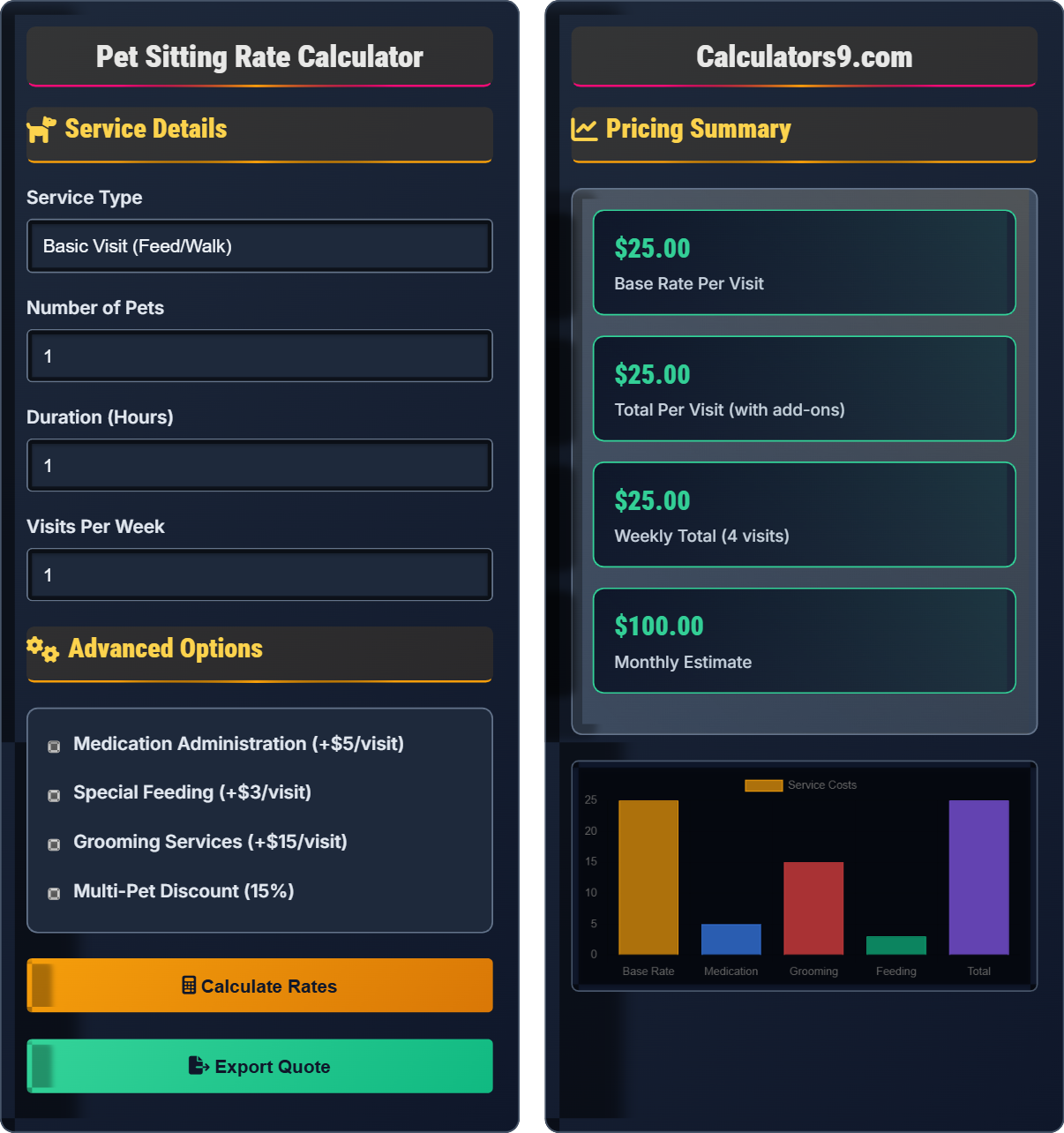
Pet Sitting Rate Calculator
Professional pricing & service planning • 2026 edition
Service Details
Advanced Options
Pricing Summary
| Service | Rate | Frequency | Total |
|---|
| Service | Description | Rate | Duration |
|---|
Professional Pet Sitting Guide
The pet sitting industry has grown significantly, with professionals charging $20-60 per visit depending on services provided. Basic visits (feeding, walking) typically cost $20-30, while extended care and overnight stays range from $40-80. Geographic location, experience level, and special services significantly impact pricing.
Successful pet sitters use various pricing strategies to remain competitive while maintaining profitability:
- Package Deals: Discounted rates for weekly or monthly contracts
- Distance Charges: Additional fees for locations beyond 10 miles
- Peak Season: 20-30% surcharge during holidays and summer
- Multi-Pet Discounts: 10-15% discount for second and additional pets
- Experience Premium: Higher rates for certified professionals
- Licensing & Insurance: Professional liability insurance costs $500-1,500 annually
- Transportation: Vehicle maintenance and fuel costs factor into pricing
- Marketing: Online presence and advertising expenses
- Equipment: Leashes, waste bags, cleaning supplies, and emergency kits
- Taxes: Self-employed tax obligations and quarterly payments
Pet Sitting Business Learning Quiz
What is the typical range for basic pet sitting visits lasting 30 minutes?
The answer is B) $20-30. The pet sitting industry standard for basic 30-minute visits (feeding, walking, brief interaction) typically ranges from $20-30. This rate reflects the time commitment, transportation costs, and professional responsibility involved in caring for someone's beloved pet.
Understanding industry standards is crucial for both clients and service providers. The $20-30 range reflects the true cost of professional pet sitting, including transportation, time, liability insurance, and expertise. Below this range might indicate amateur service, while significantly above might reflect premium services or geographic factors.
Basic Visit: Standard pet care service including feeding, watering, and brief exercise
Industry Standard: Commonly accepted price range for services
Professional Liability: Insurance protecting against damages claims
• Research local market rates before setting prices
• Ensure rates cover all business expenses
• Consider experience and certifications when pricing
• Offer package deals for regular customers
• Adjust rates seasonally for peak demand periods
• Clearly communicate what's included in each rate
• Pricing too low and being unable to sustain business
• Not accounting for transportation costs
• Failing to adjust for special service requirements
If a pet sitter charges $25 per visit for the first pet and offers a 15% discount for additional pets, what would be the rate for visiting a home with 3 pets? Show your work.
Step 1: Calculate first pet rate = $25
Step 2: Calculate discount for additional pets = 15% of $25 = $3.75
Step 3: Calculate rate for additional pets = $25 - $3.75 = $21.25
Step 4: Calculate total for 3 pets = $25 + $21.25 + $21.25 = $67.50
The total rate for visiting 3 pets would be $67.50.
This calculation demonstrates how multi-pet discounts work in practice. The discount applies to additional pets, not all pets equally. This pricing strategy encourages clients to consolidate services with one provider while maintaining profitability. The incremental cost of caring for additional pets is typically less than the first pet due to economies of scale.
Multi-Pet Discount: Reduced rate for additional pets in same household
Economies of Scale: Cost advantages from serving multiple pets simultaneously
Incremental Cost: Additional expense for each additional pet
• Apply discounts only to additional pets, not all pets
• Maintain quality of care regardless of discount
• Communicate discount policies clearly to clients
• Set maximum number of pets per visit for quality care
• Consider pet compatibility when determining rates
• Factor in time needed for multiple pets
• Applying discount to all pets instead of just additional ones
• Not adjusting time allocation for multiple pets
• Failing to account for increased liability with multiple pets
Sarah normally charges $30 for a basic visit. During the holiday season, she adds a 25% peak season surcharge. If a client books 10 visits during the holidays, how much more will they pay compared to regular season pricing?
Step 1: Calculate peak season rate = $30 + (25% of $30) = $30 + $7.50 = $37.50
Step 2: Calculate regular season total = $30 × 10 = $300
Step 3: Calculate peak season total = $37.50 × 10 = $375
Step 4: Calculate difference = $375 - $300 = $75
The client will pay $75 more during peak season compared to regular season.
Peak season pricing is a common business practice in the pet care industry. Demand typically increases during holidays when people travel, while supply may decrease as some pet sitters take vacation. The 25% surcharge reflects the increased demand and limited availability. This pricing strategy helps manage demand and compensate providers for working during high-demand periods.
Peak Season Surcharge: Additional fee during high-demand periods
Demand-Supply Economics: Pricing based on market conditions
Seasonal Pricing: Variable rates based on time of year
• Announce peak season rates well in advance
• Apply surcharges consistently across all clients
• Justify surcharges with increased demand or costs
• Book early bird specials to encourage advance booking
• Offer limited spots during peak season
• Consider offering alternative services during busy times
• Applying surcharges without advance notice
• Charging excessive peak season rates
• Not adjusting capacity for increased demand
Mike is starting a pet sitting business and estimates he'll earn $30,000 annually. Professional liability insurance costs $1,200 per year, and he wants to maintain a 20% profit margin. By what percentage should he increase his base rates to cover insurance and desired profit?
Step 1: Calculate insurance cost as percentage of revenue = $1,200 ÷ $30,000 = 0.04 = 4%
Step 2: Total additional percentage needed = 4% (insurance) + 20% (profit) = 24%
Step 3: To achieve this, rates must increase by 24% ÷ (1 - 0.24) = 24% ÷ 0.76 = 31.6%
Mike should increase his base rates by approximately 32% to cover insurance and maintain 20% profit.
This problem demonstrates the importance of understanding business costs when setting prices. Professional liability insurance is essential for pet sitters but represents a significant fixed cost. The calculation requires understanding that the markup must cover both the expense and the desired profit on the total revenue. This is a more complex calculation than simply adding percentages.
Professional Liability Insurance: Protection against damages claims
Profit Margin: Percentage of revenue kept as profit
Markup Calculation: Formula to determine required rate increase
• Include all business expenses in rate calculations
• Maintain adequate insurance coverage for protection
• Factor in desired profit when setting rates
• Review and adjust rates annually for inflation
• Track actual expenses to refine pricing models
• Consider group insurance plans to reduce costs
• Forgetting to include insurance in pricing calculations
• Not accounting for profit in business sustainability
• Calculating markups incorrectly
According to industry standards, what is the typical hourly rate for extended pet care services lasting 2-4 hours?
The answer is C) $35-50 per hour. Extended care services that involve 2-4 hours of attention, including exercise, play, training, or specialized care, typically command higher hourly rates of $35-50. This reflects the increased time commitment, expertise required, and personalized attention provided.
Extended care represents a premium service in the pet sitting industry. Unlike brief visits, extended care allows for comprehensive attention, training, exercise, and addressing special needs. The higher hourly rate reflects not just the time spent, but the quality of interaction and specialized skills required. This tier of service attracts clients willing to pay more for enhanced care.
Extended Care: Pet services lasting 2+ hours with intensive attention
Premium Service: Higher-priced offerings with enhanced features
Specialized Skills: Expertise beyond basic pet care
• Justify premium rates with enhanced service quality
• Clearly define what constitutes extended care
• Ensure skills match premium service expectations
• Market extended care to busy professionals needing full-day solutions
• Develop specialized skills to justify premium rates
• Create detailed service packages for extended care
• Not delivering value commensurate with premium pricing
• Failing to market extended care capabilities
Service Categories
Standard visits include feeding and walking; premium adds specialized care.
Base rate: $25. Add-ons: medication +$5, grooming +$15, distance +$2/mile.
- Always charge for transportation
- Offer package discounts
- Maintain consistent quality across all rates
Business Tips
Get certified, obtain insurance, and maintain professional appearance for credibility.
- Provide detailed reports after each visit
- Send photos/videos of pet activities
- Build personal relationships with pets and owners
- Offer flexible scheduling options
- Factor in seasonal demand fluctuations
- Consider geographic pricing differences
- Account for varying pet temperaments
- Plan for emergency service requirements
FAQ
Q: What justifies premium pet sitting rates?
A: Premium rates reflect: extensive experience, professional certifications, comprehensive insurance, specialized services, and superior customer service. Quality care justifies higher costs.
Q: How do I determine my starting rates?
A: Research local competitors, calculate your business expenses, determine desired profit, and consider your experience level. Start at market rate and adjust based on demand and feedback.