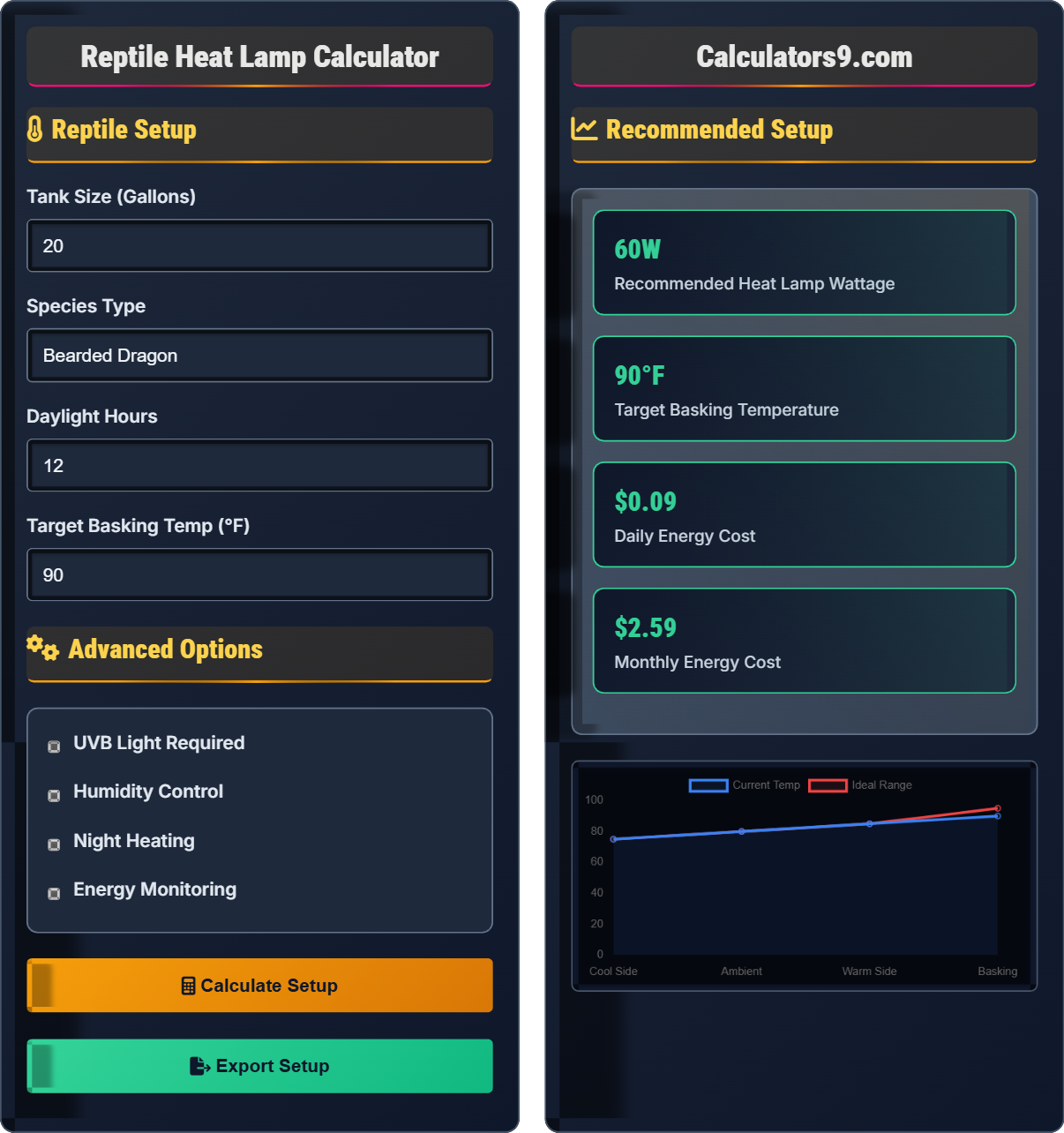
Reptile Heat Lamp Calculator
Optimal temperature & energy efficiency • 2026 best practices
Reptile Setup
Advanced Options
Recommended Setup
| Component | Type | Quantity | Watts | Notes |
|---|
| Time | Activity | Temperature | Duration |
|---|
Comprehensive Reptile Care Guide
Reptiles are ectothermic (cold-blooded) animals that rely on external heat sources to regulate their body temperature. Proper temperature gradients are crucial for digestion, immune system function, and overall health. Incorrect temperatures can lead to stress, illness, and shortened lifespans.
Different types of heat lamps serve specific purposes in reptile care:
- Halogen Bulbs: Provide excellent heat and light, energy efficient
- Ceramic Heat Emitters: Provide heat without light, ideal for night heating
- Red Heat Lamps: Provide heat with minimal light disturbance
- UVB Bulbs: Essential for vitamin D3 synthesis and calcium absorption
- Mercury Vapor Bulbs: Provide both heat and UVB in one unit
- Use timers: Automatically control lighting schedules to save energy
- Proper insulation: Well-insulated enclosures retain heat better
- Appropriate wattage: Oversized lamps waste energy and create excessive heat
- Thermostat control: Maintain consistent temperatures without overheating
- LED alternatives: Modern LED bulbs can provide UVB efficiently
Reptile Care Learning Quiz
What is the recommended basking temperature for a bearded dragon?
The answer is C) 95-105°F. Bearded dragons require high basking temperatures to properly digest food and maintain metabolic functions. Temperatures below 90°F can lead to digestive problems and weakened immune systems.
Understanding species-specific temperature requirements is fundamental to reptile husbandry. Different reptiles have evolved in different climates and require specific thermal environments. Bearded dragons originate from arid Australian regions where daytime temperatures regularly exceed 100°F, so they need high basking temperatures to thrive.
Ectothermic: Animals that rely on external heat sources to regulate body temperature
Basking Temperature: The warmest spot in the enclosure where reptiles thermoregulate
Metabolic Function: Processes like digestion and immune response that depend on proper temperature
• Reptiles cannot generate their own body heat internally
• Incorrect temperatures cause digestive and immune system problems
• Always provide temperature gradients in enclosures
• Use multiple thermometers to monitor different areas
• Create a temperature map of the enclosure
• Adjust heating based on seasonal needs
• Providing uniform temperatures instead of gradients
• Using household thermometers that aren't accurate enough
• Not accounting for seasonal temperature fluctuations
If you use a 75W heat lamp for 12 hours daily and electricity costs $0.12 per kWh, what is the monthly cost? Show your work.
Step 1: Calculate daily energy usage = 75W × 12 hours = 900 Wh = 0.9 kWh
Step 2: Calculate daily cost = 0.9 kWh × $0.12/kWh = $0.108
Step 3: Calculate monthly cost = $0.108 × 30 days = $3.24
The monthly cost is approximately $3.24.
This calculation demonstrates the importance of energy efficiency in reptile keeping. While individual costs may seem small, they add up over time. Understanding these costs helps reptile owners budget appropriately and consider more efficient heating options. The conversion from watts to kilowatt-hours is essential for utility calculations.
Watt (W): Unit of power measuring energy consumption rate
Kilowatt-hour (kWh): Unit of energy equal to 1,000 watts used for one hour
Utility Rate: Price charged by electric company per kWh of electricity
• Always convert watts to kilowatts for utility calculations
• Multiply power × time to get energy usage
• Consider energy-efficient alternatives to reduce costs
• Use programmable timers to optimize heating schedules
• Consider ceramic heat emitters for night heating
• Monitor actual temperatures to avoid oversizing equipment
• Forgetting to convert watts to kilowatts in calculations
• Not accounting for partial hour usage
• Using incorrect utility rates in calculations
Sarah has a 40-gallon terrarium for her ball python. She sets the basking area at 90°F but notices her snake is spending all its time on the cool side at 75°F. What is likely wrong with her setup?
Step 1: Ball pythons prefer basking temperatures of 88-92°F, so the target temperature is correct
Step 2: The cool side temperature of 75°F is too cold for a ball python
Step 3: Ball pythons need a cool side of 78-80°F to properly thermoregulate
The problem is likely that the cool side is too cold. Sarah should adjust her heating setup to maintain a gradient of 78-80°F on the cool side and 88-92°F on the warm side.
This example illustrates the importance of temperature gradients. Reptiles need both warm and cool areas to thermoregulate effectively. If both sides of the enclosure are uncomfortable, the reptile will seek the lesser of two evils. The snake moving to the cooler side suggests that area feels safer than the basking area, possibly due to inadequate cooling elsewhere.
Temperature Gradient: Range of temperatures within an enclosure allowing thermoregulation
Thermoregulation: Process by which reptiles move between temperatures to control body heat
Thermal Preference: Temperature range where reptiles are most comfortable and healthy
• Always provide temperature gradients, not uniform temperatures
• Research specific species requirements
• Monitor temperatures continuously with reliable thermometers
• Place thermometers on both ends of the gradient
• Create horizontal and vertical temperature gradients
• Adjust heating based on reptile behavior observations
• Creating temperature zones that are too extreme
• Not providing adequate cooling areas
• Relying on single temperature readings instead of monitoring
Mark has a chameleon that requires UVB lighting for 12 hours daily. He's considering a 20W T5 UVB bulb. If the bulb has a lifespan of 6 months and costs $30, what is the annual UVB lighting cost including replacement? (Electricity costs $0.12/kWh)
Step 1: Calculate daily energy usage = 20W × 12 hours = 240 Wh = 0.24 kWh
Step 2: Calculate daily cost = 0.24 kWh × $0.12/kWh = $0.0288
Step 3: Calculate annual electricity cost = $0.0288 × 365 = $10.51
Step 4: Calculate bulb replacement cost = $30 × 2 (for 2 bulbs per year) = $60
Step 5: Calculate total annual cost = $10.51 + $60 = $70.51
The total annual UVB lighting cost is approximately $70.51.
This demonstrates the total cost of reptile ownership beyond initial setup. UVB bulbs lose effectiveness over time and must be replaced regularly regardless of whether they still illuminate. The cost of replacement bulbs often exceeds electricity costs, making UVB lighting one of the ongoing expenses in reptile care. Proper research helps owners budget for these recurring costs.
UVB Radiation: Ultraviolet B light essential for vitamin D3 synthesis in reptiles
Effective Lifespan: Time before UVB output drops below beneficial levels
Vitamin D3 Synthesis: Process requiring UVB to enable calcium absorption
• Replace UVB bulbs every 6-12 months regardless of apparent functionality
• UVB bulbs lose effectiveness before they stop illuminating
• Inadequate UVB causes metabolic bone disease in reptiles
• Mark replacement dates on calendars
• Keep spare bulbs available
• Use UVB meters to verify bulb effectiveness
• Replacing bulbs only when they burn out
• Not accounting for declining UVB output over time
• Using household lights as UVB substitutes
For a nocturnal leopard gecko that needs heat but not light at night, which heating option is most appropriate?
The answer is B) Ceramic heat emitter. Ceramic heat emitters produce infrared heat without visible light, making them ideal for nocturnal reptiles that need warmth without light disruption. They're also very durable and energy efficient for nighttime heating.
This question highlights the importance of matching equipment to behavioral patterns. Nocturnal reptiles like leopard geckos are active at night and sleep during the day. Providing light at night disrupts their circadian rhythm, potentially causing stress and health problems. Ceramic heat emitters solve this by providing necessary warmth without light pollution.
Nocturnal: Active during night hours
Circadian Rhythm: Natural biological cycle regulating sleep and activity
Infrared Heat: Heat radiation that warms objects without producing light
• Match lighting schedule to natural behavioral patterns
• Provide heat without light for nocturnal species at night
• Consider both thermal and photoperiod needs
• Use red or blue night lights if some visibility is needed
• Install thermostats to prevent overheating
• Research natural habitat conditions for each species
• Using bright lights for nocturnal species at night
• Not providing adequate nighttime heating
• Ignoring the difference between diurnal and nocturnal needs
Temperature Basics
Ectothermic animals requiring external heat sources for body temperature.
Warm basking area + cool retreat = proper thermoregulation.
- Never provide uniform temperatures
- Research species-specific needs
- Monitor with accurate thermometers
Equipment Selection
Incandescent, ceramic, UVB, and mercury vapor bulbs serve different purposes.
- Species requirements
- Enclosure size
- Day/night needs
- Energy efficiency
- Replace UVB bulbs every 6 months
- Use thermostats for safety
- Match equipment to behavioral patterns
- Account for humidity needs
FAQ
Q: How do I know if my heat lamp is too hot?
A: Signs include: reptile avoiding basking area, panting, staying in water bowl, lethargy. Use thermometers to verify temps.
Q: Do I need both heat and UVB?
A: Most diurnal species need both. Heat for thermoregulation, UVB for vitamin D3 synthesis. Some nocturnal species only need heat.