Exposure Triangle Calculator
Camera settings guide • 2026
Exposure Triangle Formula:
Show the calculator\( E = \log_2(A^2) + \log_2(\frac{1}{S}) + \log_2(I) \)
Where:
- \( E \) = Exposure value (EV)
- \( A \) = Aperture (f-stop)
- \( S \) = Shutter speed (seconds)
- \( I \) = ISO sensitivity
This formula calculates the exposure value based on the three elements of the exposure triangle. Equal EV values produce the same exposure, allowing photographers to adjust settings for creative effects while maintaining correct exposure.
Example: f/8, 1/125s, ISO 400:
EV = log₂(8²) + log₂(125) + log₂(400/100) = log₂(64) + log₂(125) + log₂(4) = 6 + 6.97 + 2 = 14.97
Equivalent exposure: f/5.6, 1/250s, ISO 400 (same EV).
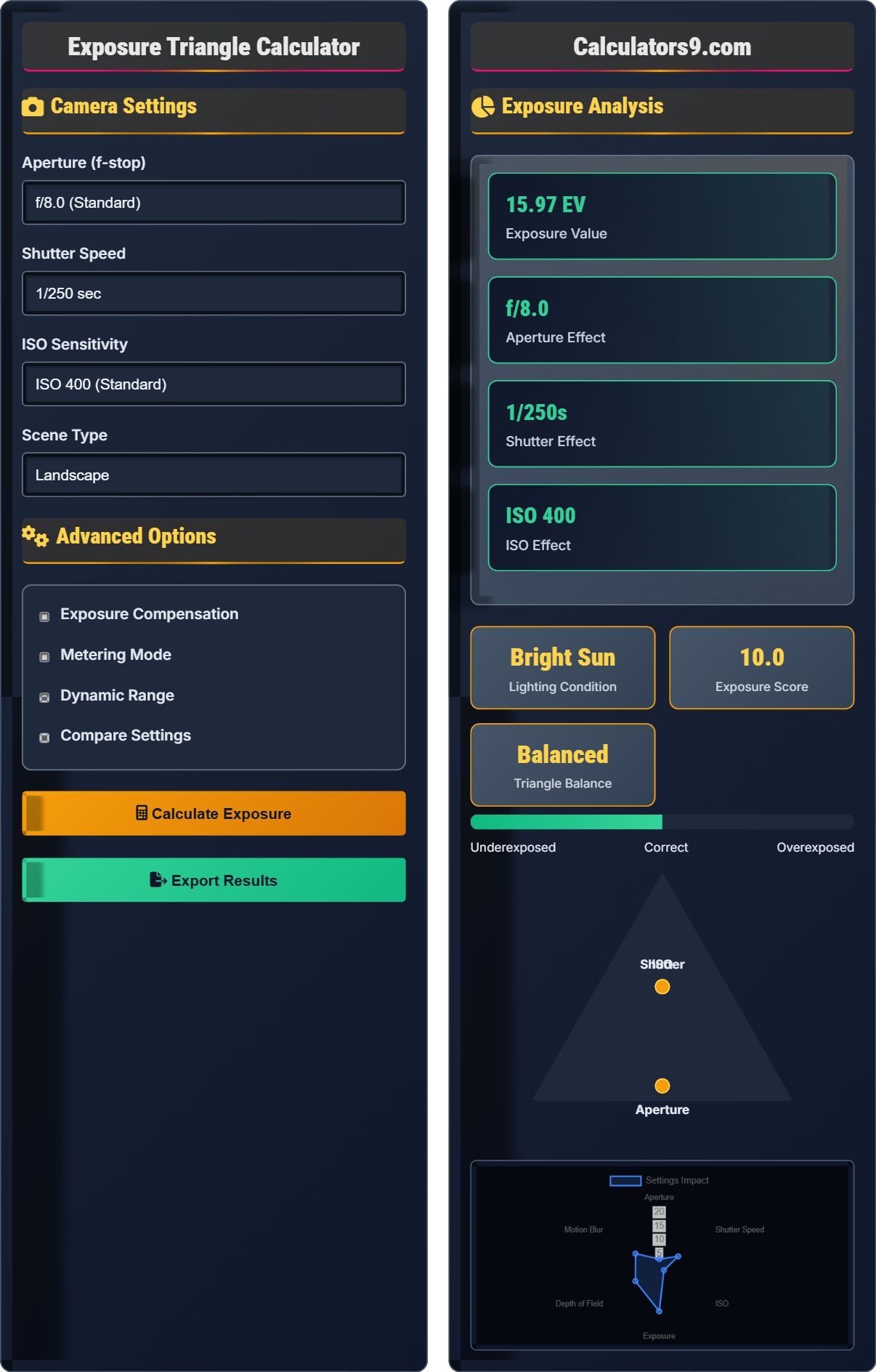
Camera Settings
Advanced Options
Exposure Analysis
| Aperture | Shutter | ISO | EV |
|---|
| Setting | Effect | Creative Use |
|---|
Exposure Triangle Tips & Creative Applications
Aperture controls depth of field and light intake:
- Wide apertures (f/1.4-f/2.8): Shallow depth of field, more light
- Medium apertures (f/4-f/5.6): Balanced depth of field
- Narrow apertures (f/8-f/22): Deep depth of field, less light
- Diffraction: Very narrow apertures reduce sharpness
- Prime lenses: Often wider maximum apertures
Shutter speed controls motion blur and light intake:
- Slow speeds (1/30s and below): Motion blur, more light
- Medium speeds (1/60s-1/250s): Freeze normal motion
- Fast speeds (1/500s and above): Freeze fast action
- Handheld rule: 1/focal length to avoid camera shake
- Bulb mode: For exposures longer than 30 seconds
ISO controls sensor sensitivity and noise:
- Low ISO (100-400): Minimal noise, less sensitive
- Medium ISO (800-1600): Moderate noise, good sensitivity
- High ISO (3200+): More noise, very sensitive
- Modern cameras: Excellent high-ISO performance
- Base ISO: Lowest native ISO for best quality
Creative Photography Settings
Exposure Triangle & Photography Quiz
Which of the following combinations would produce the same exposure as f/8, 1/125s, ISO 400?
The answer is D) All of the above. Each combination changes two settings by one stop in opposite directions, maintaining the same exposure value (EV). When you open the aperture by one stop (f/8 to f/5.6), you must increase shutter speed by one stop (1/125 to 1/250) to maintain the same exposure. This relationship is fundamental to the exposure triangle.
This question tests understanding of the inverse relationship between aperture and shutter speed. When you change one parameter by a certain number of stops, you must compensate by changing another parameter by the same number of stops in the opposite direction to maintain equivalent exposure. This principle allows photographers to adjust settings for creative purposes while keeping exposure constant.
Stop: Doubling or halving of light (aperture, shutter, or ISO)
Equivalent Exposure: Different settings producing same brightness
Exposure Triangle: Aperture, shutter, and ISO relationship
• Opening aperture = Need faster shutter or lower ISO
• Closing aperture = Need slower shutter or higher ISO
• One stop change in one setting = One stop compensation needed
• Remember: f/5.6 is one stop wider than f/8
• 1/250s is one stop faster than 1/125s
• ISO 200 is one stop lower than ISO 400
• Changing only one setting without compensation
• Confusing f-stop numbers (lower f-number = wider aperture)
• Not understanding the inverse relationship between settings
If you change from f/4, 1/125s, ISO 200 to f/8, 1/500s, what ISO setting would maintain the same exposure? Show your work.
Step 1: Calculate total stop change
Aperture: f/4 to f/8 = 2 stops smaller (less light)
Shutter: 1/125s to 1/500s = 2 stops faster (less light)
Total light reduction = 4 stops
Step 2: Compensate with ISO
ISO 200 → ISO 3200 (4 stops higher)
Therefore, ISO 3200 would maintain the same exposure.
This calculation demonstrates how to maintain equivalent exposure when changing multiple settings. When you reduce light through aperture and shutter changes, you must increase sensitivity through ISO to compensate. Each stop represents a doubling or halving of light sensitivity, so 4 stops of compensation means multiplying by 2⁴ = 16 (200 × 16 = 3200).
Stop Calculation: Logarithmic measurement of light change
Exposure Compensation: Adjusting settings to maintain brightness
Light Intensity: Amount of light reaching sensor
• Each stop doubles or halves light intensity
• Total stops changed = Stops needed for compensation
• ISO changes affect image noise levels
• Count total stops changed in all settings
• Compensate with equal number of opposite stops
• Higher ISO = More noise in image
• Not counting all setting changes
• Confusing direction of compensation needed
• Forgetting that each stop is a doubling/halving
You're shooting a portrait outdoors and want to blur the background. Your current settings are f/8, 1/250s, ISO 400. To achieve a shallower depth of field, you decide to use f/2.8. What new shutter speed and ISO would maintain the same exposure? What creative effect will this achieve?
Step 1: Calculate aperture change
f/8 to f/2.8 = 3 stops wider (more light)
Step 2: Compensate with shutter speed
1/250s → 1/2000s (3 stops faster)
Step 3: Keep ISO the same (ISO 400)
Alternative: Keep shutter at 1/250s and reduce ISO to 100
The wide aperture creates a shallow depth of field, blurring the background and isolating the subject.
This example shows how to maintain exposure while achieving creative effects. Opening the aperture from f/8 to f/2.8 allows more light, so you must compensate by either increasing shutter speed or decreasing ISO. The wide aperture creates the sought-after bokeh effect, with the subject in sharp focus and background artfully blurred.
Depth of Field: Range of distance in focus
Bokeh: Aesthetic quality of out-of-focus areas
Subject Isolation: Separating subject from background
• Wide aperture = Shallow depth of field
• Narrow aperture = Deep depth of field
• Must compensate for light changes to maintain exposure
• Use wide apertures for portraits (f/1.4-f/2.8)
• Use narrow apertures for landscapes (f/8-f/11)
• Consider available light when choosing aperture
• Not compensating for aperture changes
• Using too wide aperture for group portraits
• Ignoring available light when choosing settings
You're photographing a fast-moving sports event. Your current settings are f/5.6, 1/125s, ISO 800, but the action appears blurry. You need to use 1/500s to freeze the motion. What aperture and ISO settings would maintain the same exposure? What considerations should you make for this scenario?
Step 1: Calculate shutter speed change
1/125s to 1/500s = 2 stops faster (less light)
Step 2: Compensate with aperture
f/5.6 → f/2.8 (2 stops wider)
Step 3: Keep ISO the same (ISO 800)
Alternatively: Keep aperture at f/5.6 and increase ISO to 3200
Considerations: Lens maximum aperture, acceptable noise levels, depth of field requirements.
This problem demonstrates the challenges of sports photography, where fast shutter speeds are essential to freeze action. The photographer must balance the need for fast shutter with available light and lens capabilities. In low light conditions, high ISO settings may be necessary to achieve the required shutter speed.
Motion Blur: Streaking effect from moving subjects
Freeze Action: Capturing sharp images of fast movement
Sports Photography: Genre requiring fast shutter speeds
• Fast action requires 1/500s or faster
• More light needed for fast shutter speeds
• Consider lens limitations and image quality
• Use continuous autofocus for moving subjects
• Consider image stabilization for handheld shooting
• Practice timing for peak action moments
• Using too slow shutter speed for action
• Not considering lens maximum aperture
• Being afraid to use high ISO settings when necessary
Which of the following statements about ISO is TRUE?
The answer is B) Lower ISO produces less noise. Lower ISO settings result in cleaner images with less digital noise. Higher ISO settings increase sensor sensitivity but also amplify noise. ISO does not affect depth of field (controlled by aperture) or motion blur (controlled by shutter speed).
This question clarifies common misconceptions about ISO. ISO only affects sensor sensitivity and noise levels, not other exposure parameters. Modern cameras have significantly improved high-ISO performance, allowing photographers to shoot in lower light conditions with acceptable noise levels.
Image Noise: Random variation in brightness or color
Sensor Sensitivity: How responsive sensor is to light
Dynamic Range: Range of light intensities captured
• Lower ISO = Less noise, better image quality
• Higher ISO = More noise, more sensitivity
• Use lowest ISO possible for lighting conditions
• Shoot at base ISO (usually 100 or 200) for best quality
• Modern cameras handle ISO 1600-3200 well
• Use noise reduction software if needed
• Assuming higher ISO always degrades image quality
• Not knowing camera's high-ISO capabilities
• Confusing ISO with aperture and shutter effects
FAQ
Q: How do I balance the exposure triangle for different situations?
A: Balancing the exposure triangle depends on your creative goals:
- Portraits: Wide aperture (f/1.4-f/2.8) for shallow DOF
- Landscape: Narrow aperture (f/8-f/11) for deep DOF
- Action: Fast shutter (1/500s+) to freeze motion
- Low light: Higher ISO to maintain shutter speed
Mathematically, if you change one setting by N stops, compensate with N stops in the opposite direction in another setting:
\( \Delta EV = \log_2(\frac{A_2}{A_1})^2 + \log_2(\frac{S_1}{S_2}) + \log_2(\frac{I_2}{I_1}) = 0 \)
For equivalent exposures.
Q: What's the best approach for mastering exposure settings?
A: The most effective approach includes:
- Practice: Shoot in manual mode regularly
- Understand relationships: How settings affect each other
- Know your camera: Maximum aperture, high-ISO performance
- Study light: How different conditions affect exposure
- Review images: Analyze exposure and creative effects
Master the triangle relationships first, then focus on creative applications.