Field of View Calculator
Photography & Video Creative Tool • 2026 Edition
Field of View Formula:
Show the calculator\( FOV = 2 \times \arctan\left(\frac{d}{2f}\right) \)
Where:
- \( FOV \) = Field of View (in radians or degrees)
- \( d \) = Sensor dimension (width or height)
- \( f \) = Focal length of the lens
This formula calculates the angular field of view based on the sensor size and focal length. For diagonal FOV: \( d = \sqrt{w^2 + h^2} \) where w and h are width and height.
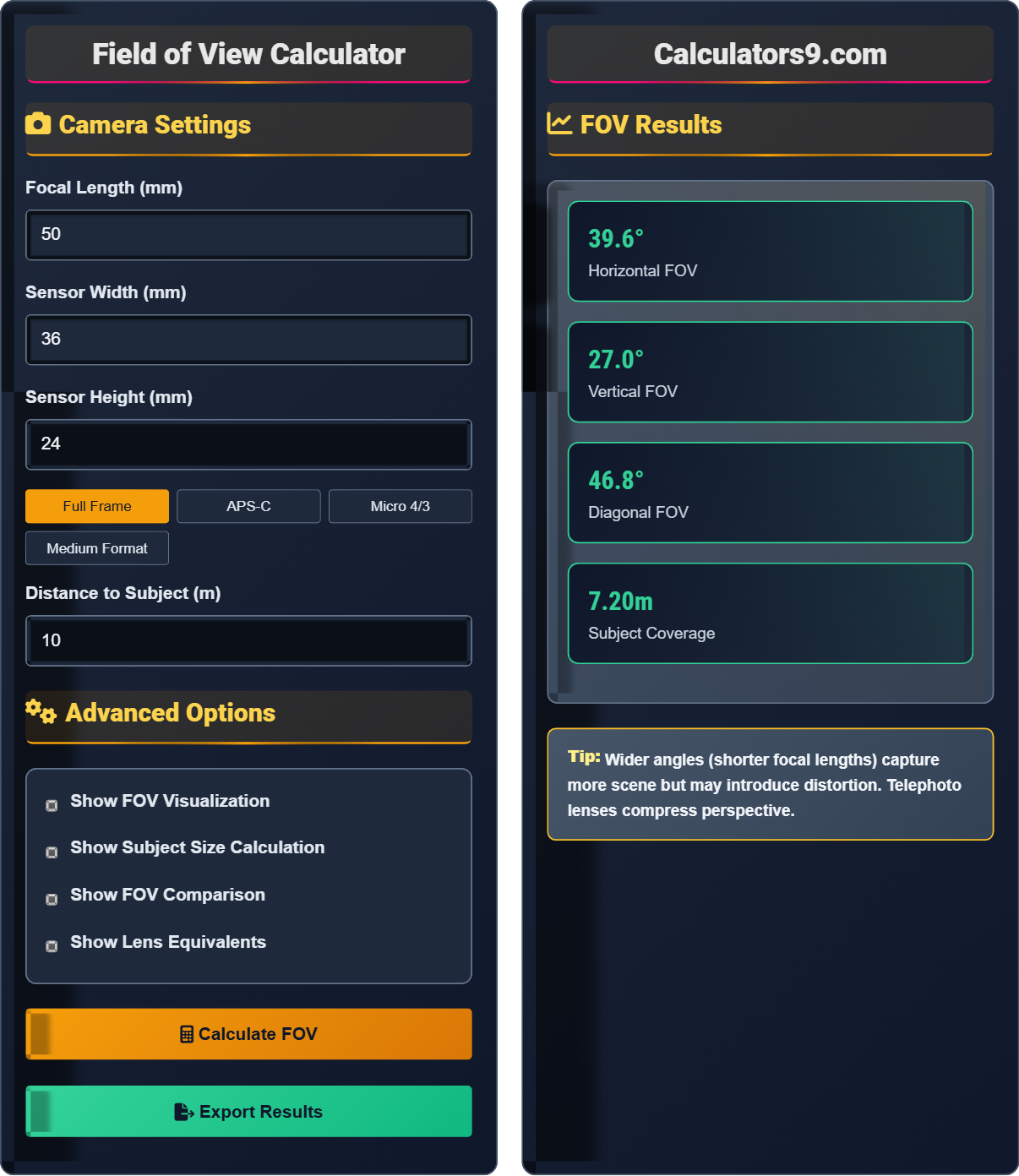
Example: For a 35mm full-frame sensor (36mm x 24mm) with a 50mm lens:
Horizontal FOV: \( FOV_h = 2 \times \arctan\left(\frac{36}{2 \times 50}\right) = 2 \times \arctan(0.36) \approx 39.6^\circ \)
Vertical FOV: \( FOV_v = 2 \times \arctan\left(\frac{24}{2 \times 50}\right) = 2 \times \arctan(0.24) \approx 27.0^\circ \)
Diagonal FOV: \( FOV_d = 2 \times \arctan\left(\frac{\sqrt{36^2 + 24^2}}{2 \times 50}\right) \approx 46.8^\circ \)
Camera Settings
Advanced Options
FOV Results
Field of View Fundamentals
Field of View (FOV) is the extent of the observable world that a camera can capture at any given moment. It's measured in degrees and represents the angular coverage of a lens. The FOV is determined by both the focal length of the lens and the size of the camera's sensor.
\(FOV = 2 \times \arctan\left(\frac{d}{2f}\right)\)
Where FOV is the field of view in radians, d is the sensor dimension (width, height, or diagonal), and f is the focal length.
- Shorter focal length = wider FOV
- Larger sensor = wider FOV at same focal length
- Wider FOV captures more of the scene
- Narrow FOV magnifies distant subjects
Practical Applications
Different sensor sizes affect the effective field of view. A full-frame sensor (36×24mm) captures the full image circle of a lens, while smaller sensors crop the image, effectively increasing the focal length.
Crop factor = Diagonal of full-frame sensor ÷ Diagonal of your sensor
- Full frame: 1.0× (36×24mm)
- APS-C: 1.5×-1.6× (23.6×15.6mm)
- Micro 4/3: 2.0× (17.3×13mm)
- 1-inch: 2.7× (13.2×8.8mm)
- Ultra-wide (14-24mm): Landscapes, architecture
- Wide (24-35mm): Street photography, interiors
- Normal (35-85mm): Portraits, general purpose
- Telephoto (85-300mm): Wildlife, sports, portraits
Field of View Learning Quiz
Which of the following statements about field of view is TRUE?
The answer is C) Shorter focal length means wider field of view. According to the FOV formula \( FOV = 2 \times \arctan\left(\frac{d}{2f}\right) \), the field of view is inversely proportional to the focal length. As focal length decreases, the fraction increases, leading to a larger arctangent value and thus a wider field of view.
Think of it like looking through different-sized windows: a wide-angle lens (short focal length) is like looking through a large window, showing you more of the scene. A telephoto lens (long focal length) is like looking through a small window from far away, showing you less of the scene but magnifying distant objects.
Field of View (FOV): The extent of the observable world that a camera can capture, measured in degrees
Focal Length: The distance between the optical center of a lens and its focus point, measured in millimeters
Arctangent Function: The inverse tangent function used to calculate angles from ratios
• FOV ∝ 1/focal length (inversely proportional)
• FOV ∝ sensor size (directly proportional)
• Shorter focal length = wider perspective
• Remember: Wide angle = short focal length = wide FOV
• Telephoto = long focal length = narrow FOV
• Use the FOV formula to verify relationships
• Confusing focal length with field of view (they're inversely related)
• Forgetting that sensor size affects FOV
• Mixing up wide-angle and telephoto characteristics
Calculate the horizontal field of view for a camera with a 24mm focal length lens on a full-frame sensor (36mm width). Show your work.
Using the FOV formula: \(FOV = 2 \times \arctan\left(\frac{d}{2f}\right)\)
Given:
- d = 36mm (sensor width)
- f = 24mm (focal length)
Step 1: Calculate the fraction: \(\frac{d}{2f} = \frac{36}{2 \times 24} = \frac{36}{48} = 0.75\)
Step 2: Calculate arctan(0.75): \(\arctan(0.75) \approx 0.6435\) radians
Step 3: Multiply by 2: \(FOV = 2 \times 0.6435 = 1.287\) radians
Step 4: Convert to degrees: \(1.287 \times \frac{180}{\pi} \approx 73.7^\circ\)
Therefore, the horizontal FOV is approximately 73.7°.
This calculation shows how a wide-angle lens (24mm) provides a very wide field of view (73.7°), which is ideal for capturing expansive landscapes or tight interior spaces. The wide FOV allows for creative composition possibilities that aren't available with longer focal lengths.
Radian: A unit of angular measurement where 1 radian ≈ 57.3°
Arctangent: The inverse of the tangent function, returns the angle whose tangent is the given value
Wide-Angle Lens: Generally considered lenses with focal lengths under 35mm
• Always use consistent units (all mm or all m)
• Convert radians to degrees if needed: degrees = radians × (180/π)
• The arctan function returns values in radians
• Memorize common FOV values: 50mm ≈ 40°, 24mm ≈ 74°
• Use online calculators to verify your results
• Round to reasonable precision (usually 1 decimal place)
• Forgetting to divide by 2f (not just f)
• Confusing radians and degrees
• Using incorrect sensor dimensions
Sarah has a 50mm lens on her full-frame camera (36×24mm sensor). She borrows her friend's APS-C camera (23.6×15.6mm sensor) with the same 50mm lens. What is the difference in horizontal field of view between the two cameras? Calculate both values and find the difference.
Step 1: Calculate FOV for full-frame camera
Full-frame: \(FOV_{ff} = 2 \times \arctan\left(\frac{36}{2 \times 50}\right) = 2 \times \arctan(0.36) \approx 2 \times 0.349 \approx 0.698\) radians
Converting to degrees: \(0.698 \times \frac{180}{\pi} \approx 40.0°\)
Step 2: Calculate FOV for APS-C camera
APS-C: \(FOV_{aps} = 2 \times \arctan\left(\frac{23.6}{2 \times 50}\right) = 2 \times \arctan(0.236) \approx 2 \times 0.232 \approx 0.464\) radians
Converting to degrees: \(0.464 \times \frac{180}{\pi} \approx 26.6°\)
Step 3: Find the difference
Difference = \(40.0° - 26.6° = 13.4°\)
Therefore, the full-frame camera captures 13.4° more horizontal field of view than the APS-C camera with the same 50mm lens.
This demonstrates the concept of crop factor. The APS-C sensor crops the image circle, effectively making the lens appear to have a longer focal length. This is why the same 50mm lens behaves like a longer lens (more telephoto) on a smaller sensor, reducing the field of view.
Crop Factor: The ratio of the diagonal of a full-frame sensor to the diagonal of a smaller sensor
Effective Focal Length: The focal length that would give the same field of view on a full-frame sensor
Image Circle: The circular area of light projected by a lens
• Smaller sensor = narrower FOV at same focal length
• Crop factor ≈ 1.5× for APS-C, 2.0× for Micro 4/3
• Same lens = different effective focal length on different sensors
• Divide full-frame focal length by crop factor to get equivalent
• APS-C makes lenses appear 1.5× longer
• Plan compositions accordingly for different sensor sizes
• Assuming the same lens gives the same FOV on different sensors
• Forgetting to consider sensor size in calculations
• Confusing actual focal length with effective focal length
John is photographing a building 50 meters tall from a distance of 100 meters. His camera has a 35mm lens on a full-frame sensor. Will the entire building fit vertically in his frame? Calculate the vertical field of view and determine how much of the building he can capture. (Hint: Use trigonometry to find the angle subtended by the building and compare to the lens FOV)
Step 1: Calculate the vertical FOV of the 35mm lens on full-frame
Vertical FOV: \(FOV_v = 2 \times \arctan\left(\frac{24}{2 \times 35}\right) = 2 \times \arctan(0.343) \approx 2 \times 0.332 \approx 0.664\) radians
Converting to degrees: \(0.664 \times \frac{180}{\pi} \approx 38.0°\)
Step 2: Calculate the angle subtended by the building
Angle = \(2 \times \arctan\left(\frac{\text{building height}/2}{\text{distance}}\right) = 2 \times \arctan\left(\frac{25}{100}\right) = 2 \times \arctan(0.25)\)
Angle = \(2 \times 0.245 \approx 0.490\) radians \(\approx 28.1°\)
Step 3: Compare angles
Since 28.1° < 38.0°, the building will fit vertically in the frame with room to spare.
Step 4: Calculate the percentage of frame filled
Percentage = \(\frac{28.1}{38.0} \times 100\% \approx 74\%\) of the vertical frame
Yes, the entire 50-meter building will fit in the frame, filling approximately 74% of the vertical field of view.
This application demonstrates how understanding FOV helps in planning shots. By comparing the angle subtended by a subject with the camera's field of view, photographers can predict whether subjects will fit in frame. This is especially useful for architectural photography, wildlife photography, and event photography.
Angle Subtended: The angle formed by an object at the observer's eye
Field Coverage: The portion of the scene that fits within the frame
Subject Distance: The distance between the camera and the subject
• Subject angle = 2 × arctan((subject size/2) / distance)
• If subject angle < FOV, subject fits in frame
• Closer distance = larger subtended angle
• Use this method to plan shots before traveling to locations
• Consider the aspect ratio of your camera (3:2, 4:3, etc.)
• Account for lens distortion in wide-angle shots
• Forgetting to divide subject size by 2 in angle calculations
• Confusing horizontal and vertical FOV requirements
• Not accounting for the aspect ratio of the sensor
Which of the following is a characteristic effect of using a wide-angle lens (short focal length) compared to a normal lens?
The answer is B) Exaggeration of perspective between foreground and background. Wide-angle lenses have a wider field of view and create a visual effect where objects closer to the camera appear significantly larger relative to objects further away. This is known as perspective exaggeration and is a distinctive characteristic of wide-angle photography.
This effect occurs because wide-angle lenses capture a broader scene, and the relative distances between objects become more apparent. For example, if you photograph a person holding a flower with a wide-angle lens, the flower (closer to the camera) will appear much larger compared to the person's face (farther from the camera) than it would with a normal lens.
Perspective Exaggeration: The visual effect where distances between near and far objects are emphasized
Compression: The visual effect where distant objects appear closer together (typical of telephoto lenses)
Distortion: Geometric alterations caused by lens design
• Wide-angle lenses exaggerate perspective differences
• Telephoto lenses compress perspective
• Normal lenses provide natural perspective
• Use wide-angle lenses for dramatic foreground emphasis
• Avoid placing people at edges of frame (distortion)
• Consider the exaggerated perspective in composition
• Expecting wide-angle lenses to behave like normal lenses
• Not accounting for perspective exaggeration in composition
• Confusing the effects of focal length with aperture effects
FOV FAQ
Q: How does sensor size affect my lens's field of view?
A: Sensor size directly affects the field of view through the crop factor. A smaller sensor crops the image circle projected by the lens, effectively narrowing the field of view.
Mathematically, the crop factor is calculated as:
\(CF = \frac{\text{Diagonal of Full-Frame Sensor}}{\text{Diagonal of Your Sensor}}\)
For example, with a 50mm lens on a full-frame camera (36×24mm sensor, diagonal ≈ 43.3mm) vs. an APS-C camera (23.6×15.6mm sensor, diagonal ≈ 28.3mm):
Crop Factor = \( \frac{43.3}{28.3} \approx 1.53× \)
The 50mm lens on APS-C effectively becomes a 76.5mm lens in terms of field of view, reducing the horizontal FOV from approximately 39.6° to 26.3°.
Q: What's the difference between horizontal, vertical, and diagonal field of view?
A: The three measurements refer to different dimensions of the sensor:
- Horizontal FOV: Calculated using sensor width: \(FOV_h = 2 \times \arctan\left(\frac{w}{2f}\right)\)
- Vertical FOV: Calculated using sensor height: \(FOV_v = 2 \times \arctan\left(\frac{h}{2f}\right)\)
- Diagonal FOV: Calculated using sensor diagonal: \(FOV_d = 2 \times \arctan\left(\frac{\sqrt{w^2+h^2}}{2f}\right)\)
For a 50mm lens on full-frame (36×24mm): Horizontal ≈ 39.6°, Vertical ≈ 27.0°, Diagonal ≈ 46.8°. Horizontal is usually quoted for wide-angle lenses, while diagonal is often used for ultra-wide lenses.