Flash Guide Number Calculator
Photography & Video Creative Tool • 2026 Edition
Guide Number Formula:
Show the calculator\( \text{GN} = \text{Aperture} \times \text{Distance} \)
\( \text{Aperture} = \frac{\text{GN}}{\text{Distance}} \)
\( \text{Distance} = \frac{\text{GN}}{\text{Aperture}} \)
Where:
- GN = Guide Number (dimensionless value)
- Aperture = f-stop value (f/2.8, f/4, etc.)
- Distance = Distance from flash to subject (feet or meters)
Guide Number is measured at ISO 100
For different ISO: GN = Original GN × √(ISO/100)
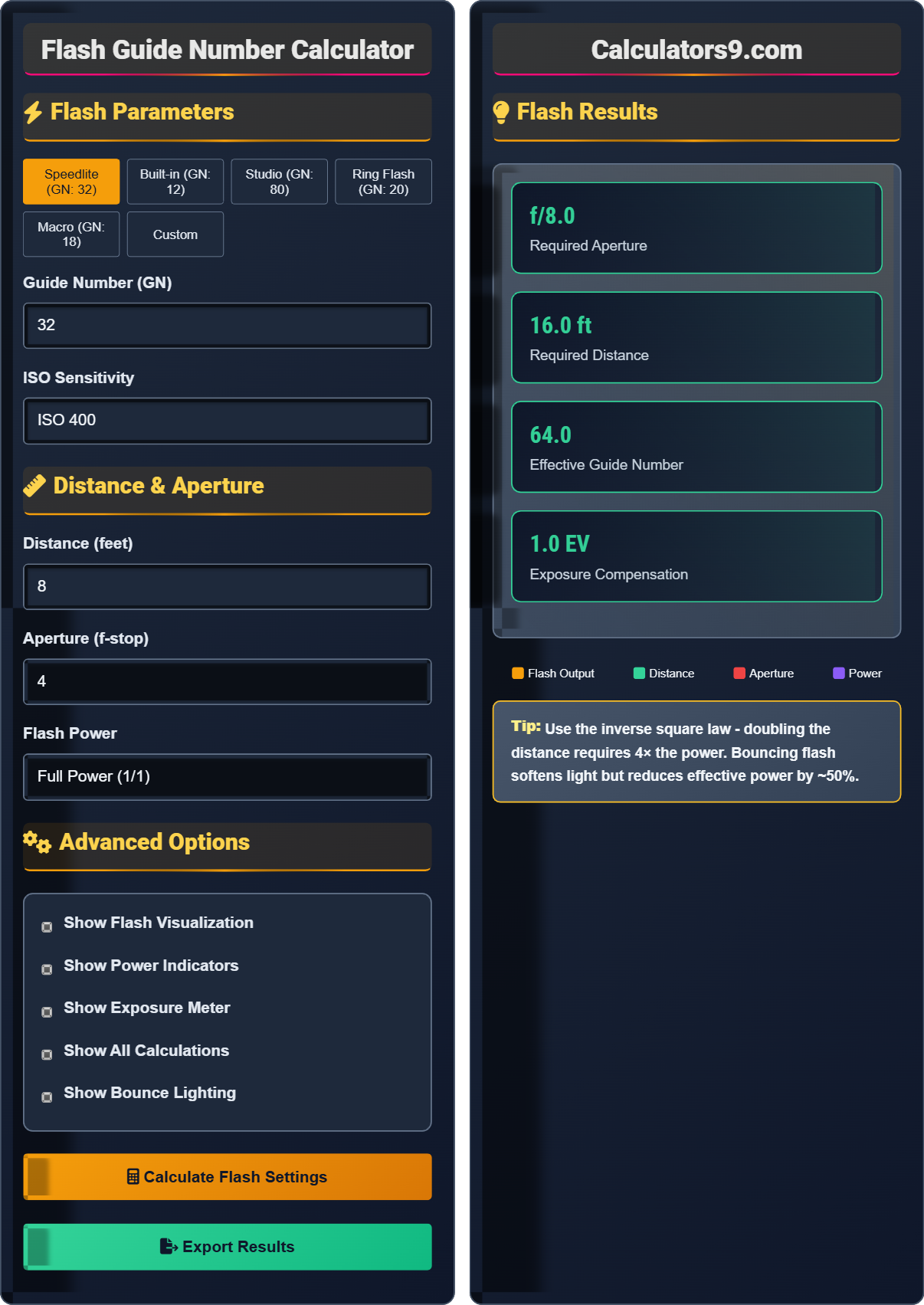
Example: If GN = 32 (at ISO 100), distance = 8 feet
Required aperture = 32 ÷ 8 = f/4
At ISO 400: GN = 32 × √(400/100) = 32 × 2 = 64
Flash Parameters
Distance & Aperture
Advanced Options
Flash Results
Flash Fundamentals
Guide Number (GN) is a measure of flash power that relates aperture, distance, and ISO sensitivity. It's calculated as GN = Aperture × Distance (at ISO 100). Guide Number allows photographers to quickly determine the correct aperture for a given distance or the distance possible at a given aperture.
\( \text{GN} = \text{Aperture} \times \text{Distance} \)
\( \text{Aperture} = \frac{\text{GN}}{\text{Distance}} \)
\( \text{Distance} = \frac{\text{GN}}{\text{Aperture}} \)
- GN is measured at ISO 100
- GN increases with ISO
- GN is affected by flash power
- Follows inverse square law
Creative Applications
Bounce flash involves directing the flash head toward a ceiling or wall rather than the subject directly. This creates softer, more natural lighting but reduces effective flash power by approximately 50% (requires 2× the GN).
- Full Power (1/1): Maximum output
- Half Power (1/2): 50% output
- Quarter Power (1/4): 25% output
- Low Power (1/128): 0.8% output
- Adjust based on ambient light
- Distance affects light intensity
- Aperture controls exposure
- ISO affects sensitivity
- Power affects recycle time
Flash Guide Number Learning Quiz
What is the relationship between Guide Number, aperture, and distance?
The answer is B) GN = Aperture × Distance. The Guide Number is calculated by multiplying the aperture (f-stop) by the distance to the subject. This relationship is fundamental to flash photography and allows photographers to quickly determine the correct aperture for a given distance or vice versa.
The Guide Number system simplifies flash exposure calculations. If you know the GN of your flash, you can easily calculate the required aperture for any distance, or determine how far you can light a subject at a given aperture. The relationship follows the inverse square law of light, where light intensity decreases with the square of distance.
Guide Number (GN): Product of aperture and distance at ISO 100
Aperture: Lens opening size (f-stop)
Distance: Distance from flash to subject
• GN = Aperture × Distance
• Measured at ISO 100
• Follows inverse square law
• Remember: GN is constant for a flash at ISO 100
• If distance doubles, aperture must halve (or power quadruple)
• Adjust GN for different ISO values
• Confusing the relationship between variables
• Forgetting ISO adjustments
• Not accounting for power settings
A flash has a Guide Number of 40 at ISO 100. If you want to photograph a subject at 10 feet, what aperture should you set? Show your work.
Step 1: Use the Guide Number formula
GN = Aperture × Distance
Step 2: Rearrange to solve for aperture
Aperture = GN ÷ Distance
Step 3: Substitute the values
Aperture = 40 ÷ 10 = f/4.0
Step 4: Verify the calculation
GN = f/4.0 × 10 ft = 40 ✓
Therefore, you should set the aperture to f/4.0.
This calculation demonstrates the practical application of the Guide Number system. Once you know your flash's GN, you can quickly determine the correct aperture for any distance. This is particularly useful in manual flash situations where you need to make quick exposure calculations without relying on TTL metering.
Manual Flash: Flash operated without automatic exposure control
TTL: Through-The-Lens metering system
Exposure Calculation: Determining correct aperture and distance
• GN = Aperture × Distance
• Aperture = GN ÷ Distance
• Distance = GN ÷ Aperture
• Always verify your calculations
• Practice with common distances
• Know your flash's GN by heart
• Using wrong formula arrangement
• Forgetting ISO adjustments
• Confusing feet and meters
Sarah's flash has a Guide Number of 32 at ISO 100. She increases her camera's ISO to 800. What is the new effective Guide Number? If she wants to photograph a subject at 16 feet, what aperture should she use?
Step 1: Calculate the ISO adjustment factor
ISO adjustment = √(New ISO ÷ 100)
ISO adjustment = √(800 ÷ 100) = √8 = 2.83
Step 2: Calculate the new effective Guide Number
New GN = Original GN × ISO adjustment
New GN = 32 × 2.83 = 90.6
Step 3: Calculate the required aperture
Aperture = GN ÷ Distance
Aperture = 90.6 ÷ 16 = f/5.7
Therefore, the effective GN at ISO 800 is 90.6, and the required aperture is f/5.7.
This example shows how ISO affects Guide Number. When ISO increases, the effective Guide Number also increases proportionally to the square root of the ISO ratio. This is because higher ISO makes the sensor more sensitive to light, effectively increasing the flash's power. The relationship is: GN_new = GN_original × √(ISO_new/100).
Effective Guide Number: GN adjusted for current ISO
ISO Sensitivity: Sensor's light sensitivity
Square Root Relationship: How ISO affects GN
• GN increases with √ISO
• Effective GN = Original GN × √(ISO/100)
• Higher ISO = Higher effective GN
• Remember: GN ∝ √ISO
• ISO 400 = 2× GN of ISO 100
• ISO 800 = 2.83× GN of ISO 100
• Linear instead of square root relationship
• Forgetting to adjust for ISO
• Using wrong ISO reference value
David is using bounce flash with his speedlite (GN 32 at ISO 100). He bounces the flash off a ceiling, which reduces effective power by 50%. If he's photographing a subject at 8 feet and using ISO 400, what aperture should he set? How does this compare to direct flash?
Step 1: Calculate effective GN at ISO 400
ISO adjustment = √(400 ÷ 100) = √4 = 2
GN at ISO 400 = 32 × 2 = 64
Step 2: Account for bounce loss
Bounce reduces power by 50%, so effective GN is reduced by √2 ≈ 1.41
Bounced GN = 64 ÷ 1.41 = 45.4
Step 3: Calculate required aperture
Aperture = Bounced GN ÷ Distance
Aperture = 45.4 ÷ 8 = f/5.7
Step 4: Compare with direct flash
Direct flash aperture = 64 ÷ 8 = f/8.0
Therefore, with bounce flash, David should use f/5.7, compared to f/8.0 with direct flash.
Bounce flash is a technique that creates softer, more natural lighting by reflecting the flash off a surface. However, this technique reduces the effective power of the flash. The loss is typically around 50% (or 1 stop), which means the effective Guide Number is reduced by a factor of √2 ≈ 1.41. This requires opening up the aperture by 1 stop to maintain the same exposure.
Bounce Flash: Flash directed at reflector surface
Soft Light: Diffused, even lighting
Light Loss: Reduction in effective power
• Bounce flash loses ≈50% power
• Effective GN ÷ √2 for bounce
• Opens aperture by 1 stop
• Use white surfaces for bounce
• Consider ceiling height
• White umbrellas are alternatives
• Not accounting for bounce loss
• Using same settings as direct flash
• Poor color temperature of bounce surface
According to the inverse square law, if you double the distance between flash and subject, how much more power is needed to maintain the same exposure?
The answer is B) 4 times more power. The inverse square law states that light intensity decreases with the square of the distance. When distance doubles, the light spreads over 4 times the area (2² = 4), requiring 4 times the power to maintain the same illumination. This is why flash effectiveness drops off dramatically with distance.
The inverse square law is fundamental to understanding light behavior. As light travels, it spreads out in all directions, covering an increasingly larger area. When distance doubles, the same amount of light covers 4 times the area, reducing intensity to 1/4 of the original. This explains why flash power requirements increase exponentially with distance.
Inverse Square Law: Intensity ∝ 1/distance²
Light Falloff: Decrease in light intensity with distance
Exponential Relationship: Non-linear light behavior
• Intensity = Power ÷ Distance²
• Double distance = 4× power needed
• Triple distance = 9× power needed
• Keep flash close to subject when possible
• Use reflectors to redirect light
• Consider ambient light for distant subjects
• Assuming linear distance-power relationship
• Underestimating power requirements
• Not accounting for falloff in calculations
Flash GN FAQ
Q: How does ISO affect Guide Number?
A: ISO affects Guide Number according to the square root relationship:
\( \text{Effective GN} = \text{Base GN} \times \sqrt{\frac{\text{ISO}}{100}} \)
Examples:
ISO 100: GN = Base GN × 1
ISO 400: GN = Base GN × 2
ISO 800: GN = Base GN × 2.83
Higher ISO makes the sensor more sensitive, effectively increasing the flash's power.
Q: What's the difference between feet and meters for Guide Numbers?
A: Guide Numbers are expressed in either feet or meters, and they are related by the conversion factor:
1 foot = 0.3048 meters
Conversion formulas:
GN (meters) = GN (feet) × 0.3048
GN (feet) = GN (meters) ÷ 0.3048
Example: A flash with GN 32 (feet) has GN 9.8 (meters).
Always ensure distance units match the GN units in calculations.