Golden Hour Calculator
Photography & Video Creative Tool • 2026 Edition
Golden Hour Calculation:
Show the calculatorGolden Hour = Sunset - 1 hour to Sunset OR Sunrise to Sunrise + 1 hour
Where:
- Sunrise: Time when sun appears above horizon
- Sunset: Time when sun disappears below horizon
- Golden Hour: Period when sun is 6° above to 4° below horizon
- Blue Hour: Period when sun is 4° to 6° below horizon
Approximate formulas for sunrise/sunset (simplified):
\(HRA = \arccos\left[\frac{\sin(-0.83°) - \sin(lat) \times \sin(dec)}{\cos(lat) \times \cos(dec)}\right]\)
Where HRA = Hour Angle, lat = latitude, dec = solar declination
Example: At 40°N latitude on March 21 (equinox):
Solar declination ≈ 0°
Hour angle: \(HRA = \arccos\left[\frac{\sin(-0.83°)}{\cos(40°)}\right] \approx 90.8°\)
Time difference: \(90.8° ÷ 15°/hour ≈ 6.05 hours\)
If solar noon is at 12:00 PM, sunrise ≈ 5:57 AM, sunset ≈ 6:03 PM
Golden Hour: 5:00-6:03 AM (sunrise) and 5:00-6:03 PM (sunset)
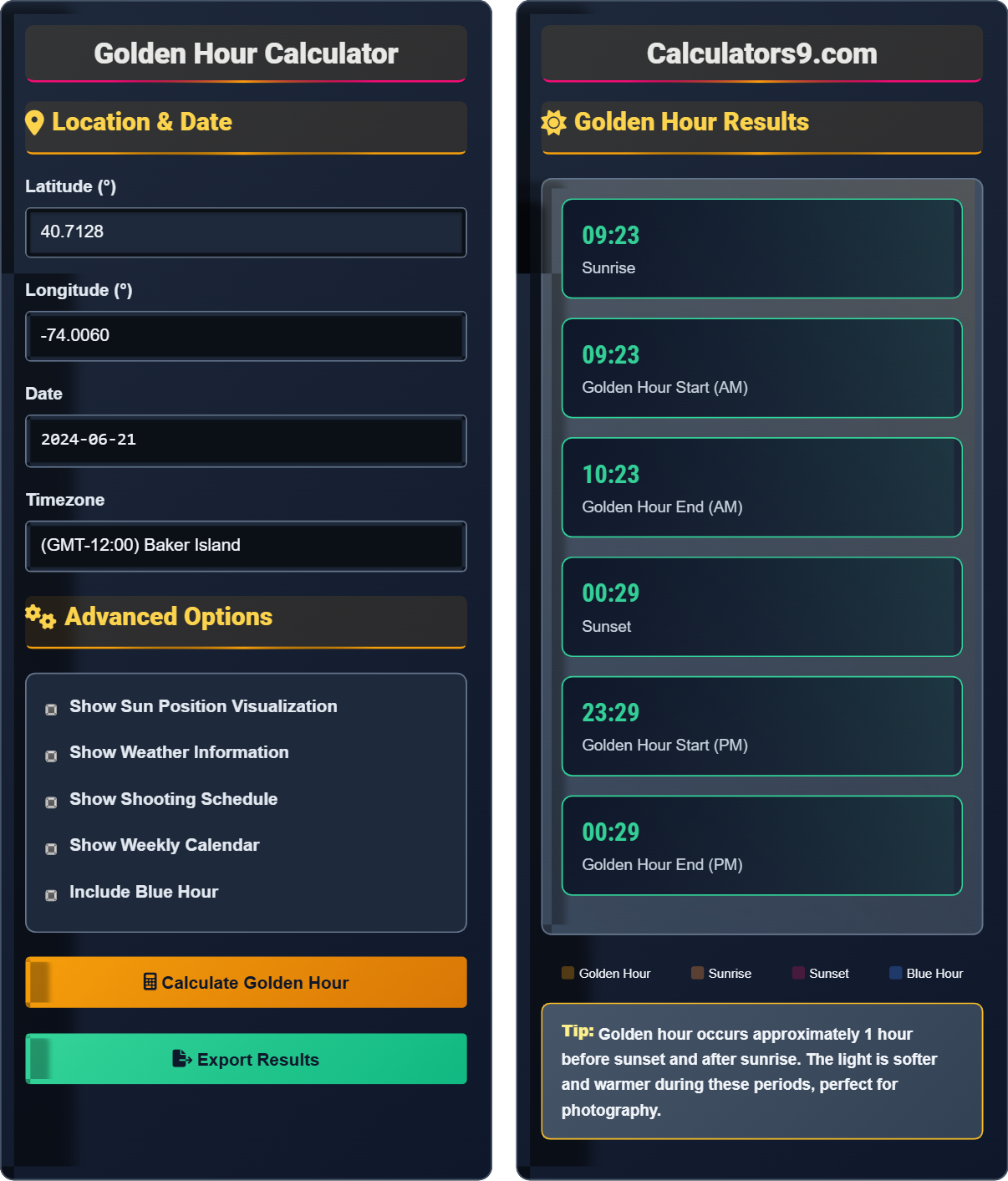
Location & Date
Advanced Options
Golden Hour Results
Golden Hour Fundamentals
Golden hour refers to the first hour after sunrise and the last hour before sunset, when the sun is low on the horizon. During this time, the light is characterized by its warm, soft quality, low contrast, and minimal harsh shadows, making it ideal for photography and videography.
Golden Hour = Sunset - 1 hour to Sunset OR Sunrise to Sunrise + 1 hour
More precisely: Sun is 6° above to 4° below horizon
- Golden hour duration varies with latitude and season
- Longer in summer, shorter in winter
- Softer light creates fewer harsh shadows
- Warm color temperature (3200K-4000K)
Creative Applications
Blue hour occurs just before sunrise and just after sunset, when the sun is 4° to 6° below the horizon. The sky takes on a deep blue hue while artificial lights begin to illuminate urban scenes, creating opportunities for dramatic twilight photography.
- Arrive 30 minutes before golden hour
- Scout locations during daylight
- Prepare equipment in advance
- Track weather conditions
- Consider blue hour opportunities
- Use graduated ND filters
- Shoot in RAW format
- Bracket exposures
- Focus manually if needed
- Monitor changing light conditions
Golden Hour Learning Quiz
What defines the timing of golden hour?
The answer is C) The first hour after sunrise and last hour before sunset. Golden hour is specifically defined as the period when the sun is low on the horizon, typically occurring during the first hour after sunrise and the last hour before sunset. During this time, the sun's rays travel through more atmosphere, scattering shorter wavelengths and leaving the warm, golden light.
Golden hour gets its name from the golden color of the light during these periods. The sun is positioned at a low angle (typically 6° above to 4° below the horizon), creating warm, soft light with minimal harsh shadows. This is in contrast to midday when the sun is overhead, creating harsh shadows and high contrast.
Golden Hour: First hour after sunrise and last hour before sunset when the sun is low on the horizon
Blue Hour: Period just before sunrise and after sunset when the sky appears blue
Solar Elevation: The angle of the sun above the horizon
• Golden hour occurs twice daily (morning and evening)
• Duration varies by latitude and season
• Light quality changes rapidly during golden hour
• Arrive 30 minutes before golden hour begins
• Track the exact times for your location
• The best light often occurs in the middle of golden hour
• Confusing golden hour with any time of good lighting
• Not accounting for seasonal variations in timing
• Missing the limited window of optimal light
If sunrise is at 6:30 AM and sunset is at 7:45 PM, what are the exact times for golden hour? Calculate both morning and evening golden hour periods.
Step 1: Calculate morning golden hour
Golden hour starts at sunrise: 6:30 AM
Golden hour ends 1 hour later: 6:30 AM + 1 hour = 7:30 AM
Morning golden hour: 6:30 AM - 7:30 AM
Step 2: Calculate evening golden hour
Golden hour starts 1 hour before sunset: 7:45 PM - 1 hour = 6:45 PM
Golden hour ends at sunset: 7:45 PM
Evening golden hour: 6:45 PM - 7:45 PM
Therefore, morning golden hour is 6:30 AM - 7:30 AM and evening golden hour is 6:45 PM - 7:45 PM.
This calculation demonstrates the simple rule for determining golden hour: it spans from sunrise to one hour after sunrise (morning) and from one hour before sunset to sunset (evening). However, in practice, the exact duration can vary based on atmospheric conditions and the sun's angle relative to the horizon.
Sunrise: Time when the upper limb of the sun appears above the horizon
Sunset: Time when the upper limb of the sun disappears below the horizon
Golden Hour Window: Approximately 60 minutes around sunrise/sunset
• Morning GH: Sunrise to (Sunrise + 1 hour)
• Evening GH: (Sunset - 1 hour) to Sunset
• Duration can vary by ±15 minutes based on conditions
• Use apps or calculators for precise timing
• Account for your specific location's horizon
• Consider atmospheric conditions that may extend the window
• Adding 1 hour to sunset instead of subtracting
• Forgetting that morning and evening are different calculations
• Not accounting for obstacles that may block sunrise/sunset
Sarah is planning a photo shoot in New York City (40.7°N) during winter (December) and summer (June). In December, sunrise is at 7:20 AM and sunset at 4:30 PM. In June, sunrise is at 5:25 AM and sunset at 8:30 PM. Calculate the total daily golden hour duration for each season and explain the difference.
Step 1: Calculate December golden hour
Morning: 7:20 AM - 8:20 AM (1 hour)
Evening: 3:30 PM - 4:30 PM (1 hour)
Total December: 2 hours
Step 2: Calculate June golden hour
Morning: 5:25 AM - 6:25 AM (1 hour)
Evening: 7:30 PM - 8:30 PM (1 hour)
Total June: 2 hours
Step 3: Compare seasons
Both seasons have 2 hours of golden hour, but the timing differs significantly. In winter, golden hour occurs from 7:20-8:20 AM and 3:30-4:30 PM. In summer, it occurs from 5:25-6:25 AM and 7:30-8:30 PM.
However, the actual duration of optimal light may vary due to atmospheric conditions and the sun's path across the sky, which changes with the seasons.
While the simplified calculation suggests equal golden hour duration in both seasons, the reality is more complex. The sun's path and atmospheric conditions vary seasonally, affecting the quality and duration of the golden light. In winter, the sun moves more horizontally across the southern sky, while in summer it moves more overhead, potentially affecting the duration of the optimal lighting conditions.
Solar Declination: The angle between the sun's rays and Earth's equatorial plane
Day Length: The time between sunrise and sunset
Atmospheric Refraction: Bending of light as it passes through Earth's atmosphere
• Day length varies significantly with seasons
• Golden hour timing shifts with day length
• Atmospheric conditions affect light quality
• Use seasonal planning for consistent shooting schedules
• Winter mornings may be more favorable due to longer shadows
• Summer evenings offer extended shooting opportunities
• Assuming golden hour duration is the same year-round
• Not accounting for seasonal atmospheric differences
• Forgetting that sunrise/sunset times vary significantly
David is planning a wedding photoshoot during golden hour. He knows the golden hour is from 6:00 PM to 7:00 PM, but weather reports indicate scattered clouds (30% coverage) and possible light rain. How should he adjust his shooting strategy to maximize the golden hour opportunity? Consider both technical and creative aspects.
Technical Adjustments:
1. Set up equipment 45 minutes before golden hour (arrive at 5:15 PM)
2. Prepare backup indoor locations in case of rain
3. Have lens cloths ready for moisture protection
4. Use faster shutter speeds to compensate for changing light
5. Bracket exposures to capture details in varying conditions
Creative Opportunities:
1. Scattered clouds can create dramatic lighting with patches of golden light
2. Clouds can act as natural diffusers, softening the light
3. Rain drops can add texture and reflection opportunities
4. Cloud movement creates dynamic lighting scenarios
5. Use the changing conditions to create mood and emotion
Strategy:
Be flexible and ready to adapt to changing conditions. The partial cloud cover may actually enhance the golden hour experience by creating interesting light patterns and reducing the intensity of direct sunlight.
This scenario highlights the importance of preparation and adaptability in golden hour photography. While clear skies provide the classic golden hour experience, some atmospheric conditions can actually enhance the visual impact. Scattered clouds can create interesting light patterns and reduce the intensity of direct sunlight, while still maintaining the warm color temperature characteristic of golden hour.
Exposure Bracketing: Taking multiple shots at different exposure settings
Dynamic Range: The range of light intensities a scene contains
Atmospheric Conditions: Factors like clouds, humidity, and air quality that affect light
• Always have contingency plans for weather
• Some cloud cover can enhance golden hour light
• Be prepared to work quickly during optimal light
• Monitor weather apps with minute-by-minute forecasts
• Use cloudy conditions to your advantage for softer light
• Have backup locations ready
• Assuming clear skies are always best for golden hour
• Not having backup plans for weather changes
• Failing to monitor conditions that change rapidly
Which of the following is NOT a characteristic of golden hour lighting?
The answer is C) Harsh, direct lighting with strong shadows. This describes the opposite of golden hour lighting. During golden hour, the sun is low on the horizon and its light travels through more atmosphere, which scatters shorter wavelengths and creates warm, soft light with minimal harsh shadows. Harsh, direct lighting with strong shadows is characteristic of midday sun when the sun is high overhead.
The atmospheric filtering effect during golden hour is what creates its distinctive characteristics. As sunlight travels through more of Earth's atmosphere at low angles, shorter wavelengths (blue light) are scattered out, leaving longer wavelengths (red/orange light) to reach the camera. This results in the warm color temperature and soft, diffused quality that makes golden hour so sought after by photographers.
Color Temperature: Measurement of light color in Kelvin (K)
Rayleigh Scattering: The scattering of light by particles smaller than the wavelength of light
Atmospheric Path Length: The distance light travels through Earth's atmosphere
• Golden hour light is soft and warm
• Contrast is lower than midday light
• Shadows are longer and softer
• Use golden hour for portrait photography to minimize harsh shadows
• Take advantage of the warm color temperature
• The low angle creates interesting shadow patterns
• Expecting harsh lighting during golden hour
• Confusing golden hour with midday lighting characteristics
• Not appreciating the unique quality of golden hour light
Golden Hour FAQ
Q: How does latitude affect the duration of golden hour?
A: Latitude significantly affects golden hour duration. Near the equator, the sun rises and sets more vertically, making golden hour shorter (typically 20-30 minutes). At higher latitudes, the sun follows a more oblique path across the sky, extending golden hour to 60+ minutes.
Mathematically, the solar elevation rate changes with latitude:
\( \text{Elevation Rate} = \frac{90° - \text{latitude}}{6 \text{ hours}} \)
At 40°N: Rate ≈ 8.3°/hour
At 60°N: Rate ≈ 5°/hour
Slower solar movement at higher latitudes extends the time spent in the golden hour elevation range (6° above to 4° below horizon).
Q: What's the difference between golden hour and blue hour?
A: Golden hour and blue hour differ in solar elevation and light characteristics:
- Golden Hour: Sun 6° above to 4° below horizon
- Blue Hour: Sun 4° to 6° below horizon
During golden hour, the sun provides direct warm light (3200K-4000K) with visible sun disc. During blue hour, the sun is below the horizon but still illuminates the atmosphere with cool blue tones (10000K-15000K). Blue hour is excellent for combining natural sky light with artificial lighting.