Lens Crop Factor Calculator
Photography & Video Creative Tool • 2026 Edition
Crop Factor Formula:
Show the calculator\( \text{Crop Factor} = \frac{\text{Diagonal of Full-Frame Sensor}}{\text{Diagonal of Crop Sensor}} \)
\( \text{Equivalent Focal Length} = \text{Actual Focal Length} \times \text{Crop Factor} \)
\( \text{Diagonal} = \sqrt{\text{Width}^2 + \text{Height}^2} \)
Where:
- Full-frame diagonal ≈ 43.3mm (36×24mm sensor)
- Crop factor affects field of view
- Smaller sensors = higher crop factor
- Higher crop factor = narrower field of view
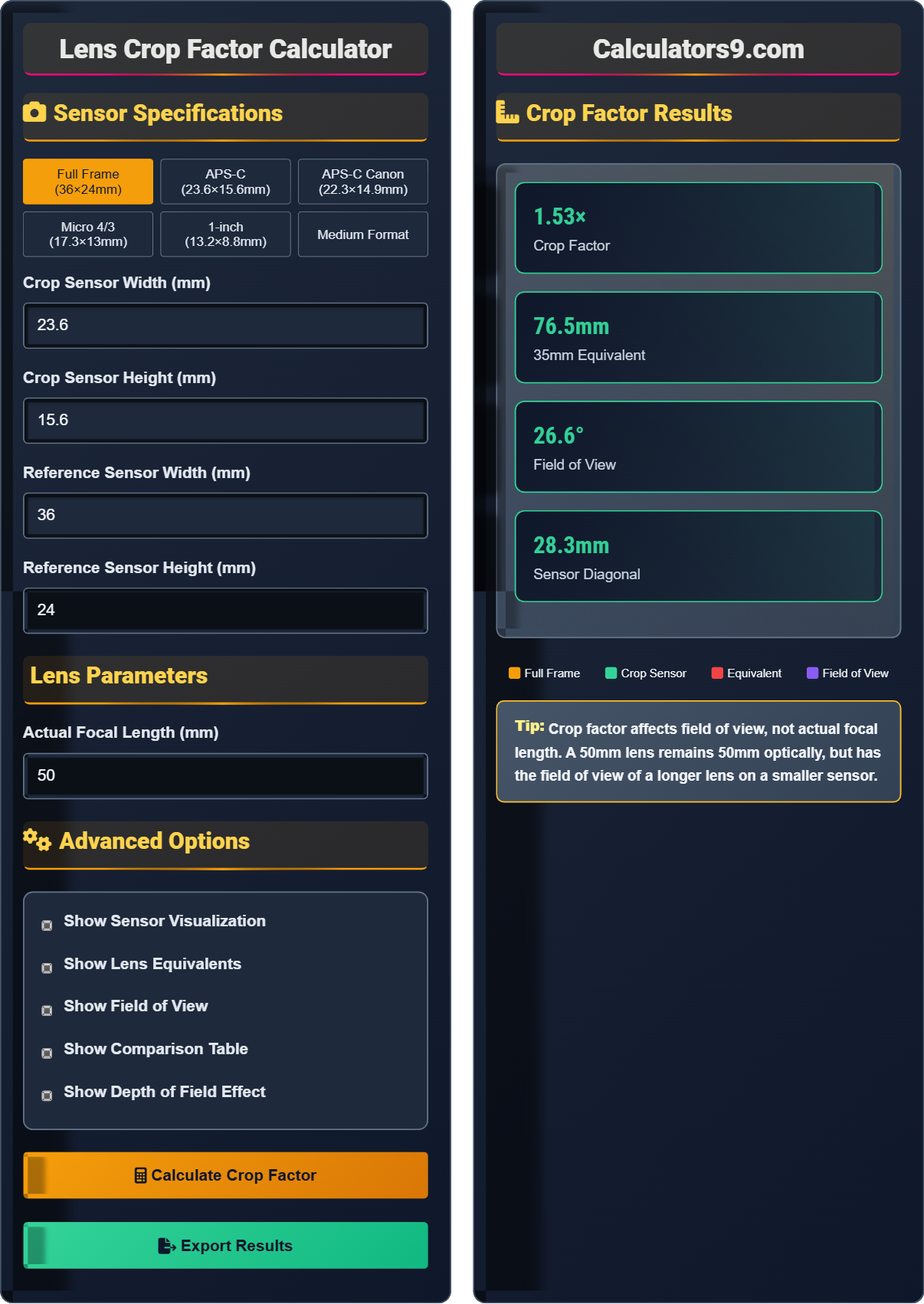
For APS-C (23.6×15.6mm): Diagonal = √(23.6² + 15.6²) = 28.3mm
Crop Factor = 43.3 / 28.3 = 1.53
50mm lens on APS-C = 50 × 1.53 = 76.5mm equivalent
Sensor Specifications
Lens Parameters
Advanced Options
Crop Factor Results
Crop Factor Fundamentals
Crop factor is the ratio of a camera's sensor size to a standard 35mm film frame (36×24mm). It describes how the field of view of a lens changes when used on a camera with a sensor smaller than full-frame. A crop factor of 1.5× means the sensor is 1.5× smaller diagonally than full-frame.
\( \text{Crop Factor} = \frac{\text{Diagonal of Full-Frame Sensor}}{\text{Diagonal of Crop Sensor}} \)
\( \text{Equivalent Focal Length} = \text{Actual Focal Length} \times \text{Crop Factor} \)
- Full-frame = 1.0× crop factor
- APS-C ≈ 1.5-1.6× crop factor
- Micro 4/3 = 2.0× crop factor
- Smaller sensor = higher crop factor
Creative Applications
Crop sensors offer several advantages: extended reach for telephoto photography, lighter and more portable systems, and often better depth of field control. However, they may have reduced low-light performance and wider-angle limitations.
- Wildlife/Sports: Extended reach with existing lenses
- Travel: More compact kit
- Portrait: Natural compression effect
- Macro: Enhanced magnification
- Video: Stabilization benefits
- Field of view becomes narrower
- Depth of field increases
- Background compression decreases
- ISO sensitivity appears reduced
Crop Factor Learning Quiz
What is the crop factor of an APS-C sensor measuring 23.6mm × 15.6mm compared to full-frame (36mm × 24mm)?
The answer is B) 1.53×. To calculate the crop factor, we need to find the diagonal of each sensor and divide the full-frame diagonal by the crop sensor diagonal.
Step 1: Calculate full-frame diagonal
Full-frame diagonal = √(36² + 24²) = √(1296 + 576) = √1872 ≈ 43.3mm
Step 2: Calculate crop sensor diagonal
Crop sensor diagonal = √(23.6² + 15.6²) = √(556.96 + 243.36) = √800.32 ≈ 28.3mm
Step 3: Calculate crop factor
Crop factor = 43.3 / 28.3 = 1.53×
Crop factor is calculated using the diagonal dimensions of the sensors because it represents the hypotenuse of the rectangular sensor. This gives the most accurate representation of how much smaller the sensor is in total area. The diagonal measurement accounts for both width and height dimensions simultaneously.
Crop Factor: Ratio of sensor diagonal to full-frame diagonal
Full-Frame: 36×24mm sensor size (35mm film equivalent)
Diagonal: Hypotenuse of sensor rectangle (√(width² + height²))
• Crop Factor = Full-frame diagonal / Crop sensor diagonal
• Always use diagonal measurements
• Smaller sensor = Higher crop factor
• Remember: √(a² + b²) for diagonal calculation
• Common crop factors: APS-C ≈ 1.5×, Micro 4/3 = 2.0×
• Always verify sensor dimensions for accuracy
• Using only width or height instead of diagonal
• Confusing crop factor with focal length
• Not accounting for different APS-C sizes
Calculate the equivalent focal length of a 300mm telephoto lens when mounted on a camera with a crop factor of 1.6× (Canon APS-C). What would be the effective field of view compared to full-frame?
Step 1: Calculate equivalent focal length
Equivalent Focal Length = Actual Focal Length × Crop Factor
Equivalent Focal Length = 300mm × 1.6 = 480mm
Step 2: Determine effective field of view
On full-frame: 300mm has a certain field of view
On crop sensor: 300mm acts like 480mm on full-frame
Since longer focal lengths have narrower fields of view, the 300mm lens on crop sensor has the field of view of a 480mm lens on full-frame.
Step 3: Calculate field of view change
If the full-frame 300mm has a field of view of X degrees, the crop sensor version has the field of view of 480mm on full-frame, which is narrower.
Therefore, the 300mm lens on a 1.6× crop sensor camera has an equivalent focal length of 480mm.
This calculation shows how crop sensors provide "free telephoto reach." The 300mm lens physically remains 300mm, but the smaller sensor captures only the center portion of the image circle, effectively magnifying the central area. This is why wildlife and sports photographers often prefer crop sensor cameras for telephoto work.
Equivalent Focal Length: The full-frame focal length with the same field of view
Field of View: The extent of the scene captured by the lensImage Circle: The circular area of light projected by the lens
• Equivalent FL = Actual FL × Crop Factor
• Crop factor affects field of view, not optical properties
• Narrower field of view with higher crop factor
• Crop factor "extends" telephoto reach
• Doesn't actually change lens focal length
• Consider when comparing lens equivalency
• Thinking the lens physically changes focal length
• Forgetting that field of view narrows
• Confusing crop factor with zoom multiplication
Sarah has a 16-35mm wide-angle lens for her full-frame camera. She rents an APS-C camera (crop factor 1.5×) for a landscape shoot. What is the equivalent focal length range when she mounts the lens on the APS-C camera? How does this affect her ability to capture wide landscapes?
Step 1: Calculate equivalent focal length range
Wide end: 16mm × 1.5 = 24mm equivalent
Telephoto end: 35mm × 1.5 = 52.5mm equivalent
Step 2: Analyze the effect on landscape photography
On full-frame: 16-35mm provides ultra-wide to standard perspective
On APS-C: 24-52.5mm provides wide to moderate telephoto perspective
Step 3: Determine impact
The 16mm ultra-wide becomes equivalent to 24mm, which is significantly less wide.
The 35mm becomes equivalent to 52.5mm, approaching portrait focal length.
Conclusion: The APS-C camera with this lens will capture much narrower scenes, making it difficult to capture the wide vistas Sarah intended. The ultra-wide capability is significantly reduced.
This example illustrates the disadvantage of crop sensors for wide-angle photography. While crop sensors provide benefits for telephoto work, they limit wide-angle capabilities. A 16mm lens that provides dramatic wide-angle perspectives on full-frame becomes merely a "normal" wide lens on crop sensor.
Ultra-Wide: Lenses with focal lengths shorter than 24mm
Wide: Lenses with focal lengths 24-35mm
Normal: Lenses with focal lengths around 50mm
• Crop sensors reduce wide-angle capability
• Ultra-wide becomes merely wide
• Consider lens choices for crop sensors
• Use wider lenses on crop sensors for landscape
• Consider rectilinear lenses for minimal distortion
• Plan compositions accordingly
• Expecting full-frame wide-angle on crop sensors
• Not accounting for field of view reduction
• Assuming all lenses work equally well
David is comparing depth of field between his full-frame camera and an APS-C camera (crop factor 1.5×). He uses a 50mm f/1.4 lens on both cameras at the same aperture and shooting distance. How does the crop factor affect the depth of field and background compression?
Step 1: Analyze the crop factor effect on depth of field
The crop sensor effectively crops the image center, which increases the depth of field.
Effective aperture for DOF = f/1.4 × 1.5 = f/2.1 equivalent for DOF purposes
Step 2: Analyze background compression
Background compression depends on actual focal length and distance.
Since the actual focal length remains 50mm, compression stays the same.
However, the field of view is narrower, so less background is visible.
Step 3: Compare the effects
Full-frame: f/1.4 with shallow DOF and full background compression
APS-C: f/1.4 with deeper DOF (equivalent to f/2.1) and same compression but less visible background
Conclusion: The APS-C camera will have more depth of field and less visible background area, though the compression effect remains the same.
Crop factor affects depth of field perception. Smaller sensors inherently provide more depth of field at the same aperture. This is why full-frame cameras are preferred for shallow depth of field effects. However, the actual optical compression remains unchanged as it depends on focal length and distance.
Depth of Field: The range of distance that appears acceptably sharp
Background Compression: The visual effect of flattening perspective
Effective Aperture: Aperture considering sensor size effects
• Smaller sensors = More depth of field
• Compression depends on actual focal length
• Field of view narrows with crop factor
• Use wider apertures on crop sensors for shallow DOF
• Consider focal length for compression effects
• Test different combinations for desired effects
• Assuming same DOF on different sensor sizes
• Confusing compression with field of view
• Not accounting for effective aperture
Which of the following statements about crop factor is TRUE?
The answer is B) Crop factor affects the field of view but not the lens's optical properties. Crop factor is an imaging effect that changes the field of view by cropping the image circle, but it does not physically alter the lens. The lens maintains its original optical properties (focal length, maximum aperture, etc.), but only the center portion of the image circle is captured by the smaller sensor.
This is a critical distinction for photographers to understand. The lens physically remains unchanged - its glass elements, focal length, and optical construction stay the same. Crop factor is simply a result of the sensor size relative to the image circle the lens projects. The lens doesn't know what sensor it's projecting onto.
Field of View: The extent of scene captured by the camera
Optical Properties: Physical characteristics of the lens
Image Circle: Circular area of light projected by lens
• Crop factor affects FOV only
• Lens properties remain unchanged
• Only the captured portion changes
• Think of it as cropping the final image
• Lens specifications remain constant
• Only the captured area changes
• Believing the lens physically changes
• Confusing equivalent with actual focal length
• Misunderstanding the imaging mechanism
Crop Factor FAQ
Q: Does crop factor actually change the focal length of a lens?
A: No, crop factor does not change the actual focal length of a lens. The lens maintains its physical optical properties. Crop factor is an imaging effect that changes the field of view by using only the center portion of the lens's image circle. A 50mm lens remains 50mm optically, but appears to have a narrower field of view on a smaller sensor.
Formula: Equivalent FL = Actual FL × Crop Factor
Example: 50mm lens on 1.5× crop sensor = 75mm equivalent FOV
The lens still projects the same image circle, but only the center is captured.
Q: How do I calculate the crop factor for any sensor size?
A: Use the diagonal measurements:
\( \text{Crop Factor} = \frac{\text{Diagonal of Reference Sensor}}{\text{Diagonal of Your Sensor}} \)
For a sensor of width W and height H:
Diagonal = \( \sqrt{W^2 + H^2} \)
Example: APS-C 23.6×15.6mm
Diagonal = \( \sqrt{23.6^2 + 15.6^2} = \sqrt{556.96 + 243.36} = \sqrt{800.32} = 28.3mm \)
Crop Factor = 43.3mm ÷ 28.3mm = 1.53×