Wavelength Calculator
Wave properties • Frequency • Energy • Electromagnetic spectrum
Wave Equation Formulas:
Show CalculatorWavelength (λ) = Velocity (v) ÷ Frequency (f)
Frequency (f) = Velocity (v) ÷ Wavelength (λ)
Energy (E) = Planck's Constant (h) × Frequency (f)
E = hc/λ (where h = 6.626×10⁻³⁴ J·s, c = 3×10⁸ m/s)
For electromagnetic waves in vacuum: λ = c/f where c = 299,792,458 m/s
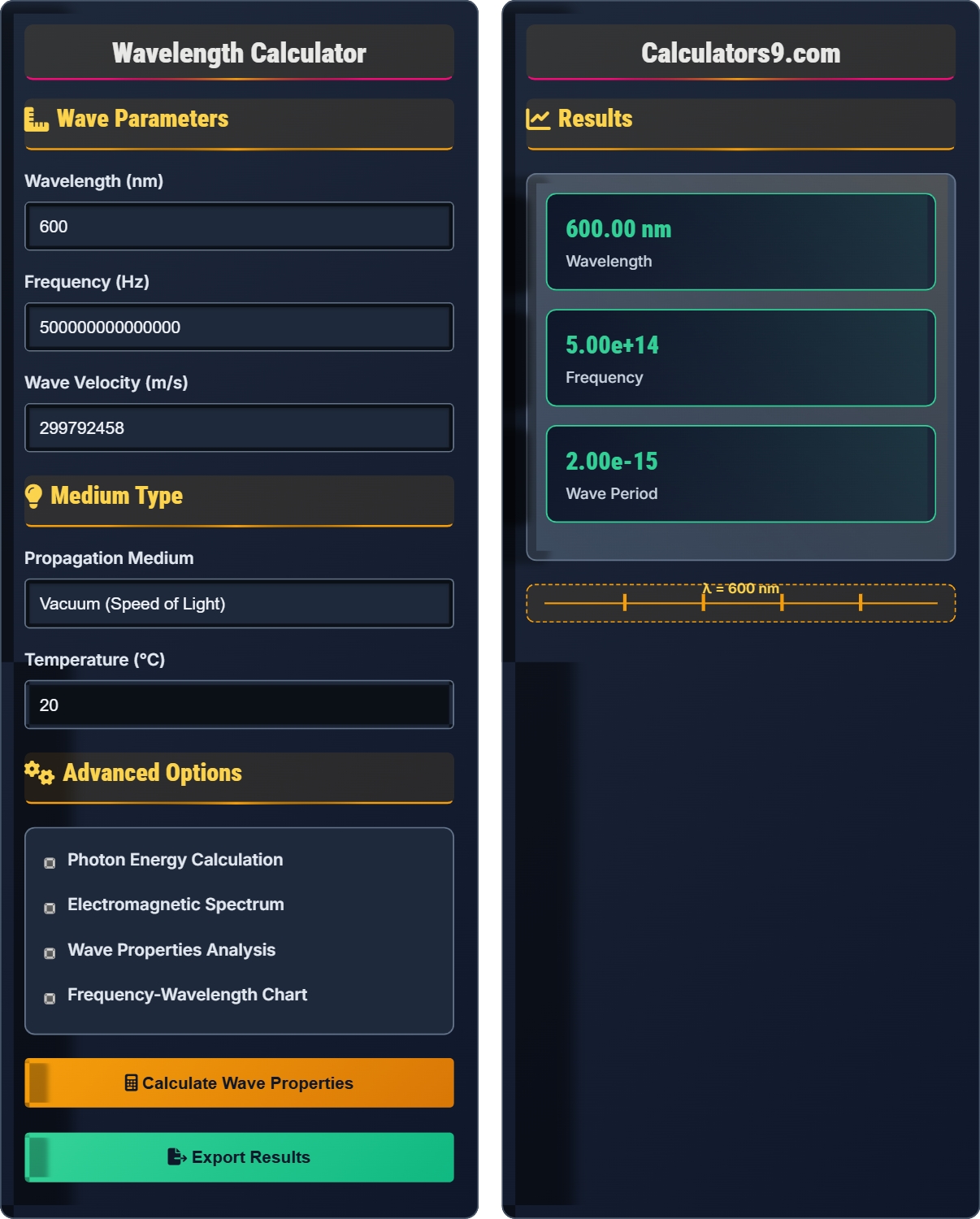
Example: For light with frequency 5.0×10¹⁴ Hz:
λ = c/f = (3×10⁸ m/s) ÷ (5.0×10¹⁴ Hz) = 6.0×10⁻⁷ m = 600 nm
This corresponds to yellow-green light in the visible spectrum.
Wave Parameters
Medium Type
Advanced Options
Results
Wave Fundamentals
Wavelength (λ) is the distance between identical points on successive waves. It's the spatial period of a wave—the distance over which the wave's shape repeats. Wavelength is inversely proportional to frequency.
- Wave Equation: v = fλ
- Period: T = 1/f
- Energy: E = hf = hc/λ
- Wave Number: k = 2π/λ
- Speed of light: c = 299,792,458 m/s
- Planck's constant: h = 6.626×10⁻³⁴ J·s
- Speed of sound in air: ~343 m/s
- Electron volt: e = 1.602×10⁻¹⁹ J
Electromagnetic Spectrum
The electromagnetic spectrum encompasses all frequencies of electromagnetic radiation, from radio waves to gamma rays. Each range has distinct properties and applications.
- Radio: >1 mm, <3×10¹¹ Hz
- Microwave: 1 mm - 1 μm, 3×10¹¹ - 3×10¹⁴ Hz
- Infrared: 1 μm - 750 nm, 3×10¹⁴ - 4×10¹⁴ Hz
- Visible: 750 - 380 nm, 4×10¹⁴ - 8×10¹⁴ Hz
- UV: 380 - 10 nm, 8×10¹⁴ - 3×10¹⁶ Hz
- X-ray: 10 - 0.01 nm, 3×10¹⁶ - 3×10¹⁹ Hz
- Gamma: <0.01 nm, >3×10¹⁹ Hz
- Higher frequency = higher energy
- Lower wavelength = higher energy
- Frequency and wavelength are inversely related
- All travel at c in vacuum
- Can exhibit particle-wave duality
Wavelength Physics Learning Quiz
What is the relationship between wavelength (λ), frequency (f), and wave velocity (v)?
The answer is C) λ = v ÷ f. The fundamental wave equation states that wavelength equals velocity divided by frequency. This can also be written as v = fλ. The relationship shows that as frequency increases, wavelength decreases for a given velocity, and vice versa.
The wave equation v = fλ is fundamental to understanding wave behavior. It connects three measurable properties of waves. For electromagnetic waves in vacuum, v is always c (speed of light), so λ and f are inversely related. This equation applies to all types of waves: sound, light, water, etc., with the appropriate velocity.
Wavelength (λ): Distance between identical points on successive waves
Frequency (f): Number of wave cycles per second (Hertz)
Wave Velocity (v): Speed at which the wave propagates
• v = fλ (fundamental wave equation)
• λ = v/f (rearranged form)
• f = v/λ (alternative rearrangement)
• Remember: velocity = frequency × wavelength
• Higher frequency means shorter wavelength
• Lower frequency means longer wavelength
• Confusing the relationship between the three variables
• Thinking frequency and wavelength are directly related
• Forgetting that velocity depends on the medium
Calculate the energy of a photon with wavelength 500 nm. Show your work using Planck's constant and the speed of light, then convert to electron volts.
Step 1: Identify the constants and convert wavelength to meters
h = 6.626×10⁻³⁴ J·s (Planck's constant)
c = 299,792,458 m/s ≈ 3.00×10⁸ m/s (speed of light)
λ = 500 nm = 500 × 10⁻⁹ m = 5.00×10⁻⁷ m
Step 2: Use the energy equation E = hc/λ
E = (6.626×10⁻³⁴ J·s × 3.00×10⁸ m/s) ÷ (5.00×10⁻⁷ m)
E = (1.9878×10⁻²⁵ J·m) ÷ (5.00×10⁻⁷ m)
E = 3.976×10⁻¹⁹ J
Step 3: Convert to electron volts
1 eV = 1.602×10⁻¹⁹ J
E (eV) = (3.976×10⁻¹⁹ J) ÷ (1.602×10⁻¹⁹ J/eV)
E (eV) = 2.48 eV
Therefore, a 500 nm photon has energy of 3.98×10⁻¹⁹ J or 2.48 eV.
This calculation demonstrates the particle nature of light through photons. The energy is directly proportional to frequency and inversely proportional to wavelength. Green light (500 nm) has moderate energy in the visible spectrum. The conversion to eV is useful in atomic and molecular physics.
Photon: Quantum of electromagnetic radiation
Planck's Constant (h): Relates energy to frequency
Electron Volt (eV): Energy gained by electron through 1V potential
• E = hf = hc/λ
• Higher frequency = higher energy
• 1 eV = 1.602×10⁻¹⁹ J
• Use scientific notation for small values
• Convert nm to m for calculations
• eV is convenient for atomic energies
• Forgetting to convert wavelength to meters
• Using incorrect values for constants
• Confusing the order of operations in division
A laser emits light with frequency 6.00×10¹⁴ Hz. What is its wavelength? What color is this light, and which region of the electromagnetic spectrum does it belong to? How does the energy of these photons compare to blue light (450 nm)?
Step 1: Calculate wavelength using c = fλ
λ = c/f = (3.00×10⁸ m/s) ÷ (6.00×10¹⁴ Hz)
λ = 5.00×10⁻⁷ m = 500 nm
Step 2: Identify the color and spectrum region
500 nm corresponds to green light in the visible spectrum (380-700 nm).
Step 3: Calculate energy of the laser photons
E = hf = 6.626×10⁻³⁴ J·s × 6.00×10¹⁴ Hz = 3.98×10⁻¹⁹ J
Step 4: Calculate energy of blue light photons (450 nm)
E_blue = hc/λ = (6.626×10⁻³⁴ × 3.00×10⁸) ÷ (450×10⁻⁹)
E_blue = 4.42×10⁻¹⁹ J
Step 5: Compare energies
Blue light photons have more energy (4.42×10⁻¹⁹ J) than green light photons (3.98×10⁻¹⁹ J) because blue light has a shorter wavelength and higher frequency.
Therefore, the laser emits green light (500 nm) with energy 3.98×10⁻¹⁹ J, which is less energetic than blue light photons.
This problem demonstrates the relationship between frequency, wavelength, and energy. Shorter wavelengths correspond to higher frequencies and higher energies. Blue light is more energetic than green light, which is why blue light has a shorter wavelength. This relationship is crucial in understanding atomic spectra and photochemistry.
Visible Spectrum: 380-700 nm range detectable by human eye
Color: Perception based on wavelength of light
Photon Energy: Quantized energy packets of light
• c = fλ (constant in vacuum)
• E = hf (energy-frequency relationship)
• Shorter λ = higher f = higher E
• Remember ROYGBIV for visible spectrum order
• Violet has shortest λ, red has longest λ
• Higher energy photons can cause more chemical reactions
• Confusing the order of visible spectrum colors
• Thinking longer wavelengths have higher energy
• Forgetting that c is constant in vacuum
A sound wave travels through air at 20°C with frequency 1000 Hz. What is its wavelength? How would this change if the temperature increased to 30°C? How does this compare to the wavelength of a 1000 Hz electromagnetic wave in vacuum?
Step 1: Calculate speed of sound at 20°C
v_sound = 331 + (0.6 × T) = 331 + (0.6 × 20) = 343 m/s
Step 2: Calculate wavelength of sound wave at 20°C
λ_sound = v/f = 343 m/s ÷ 1000 Hz = 0.343 m = 34.3 cm
Step 3: Calculate speed of sound at 30°C
v_sound = 331 + (0.6 × 30) = 349 m/s
Step 4: Calculate wavelength at 30°C
λ_sound = 349 m/s ÷ 1000 Hz = 0.349 m = 34.9 cm
Step 5: Calculate wavelength of electromagnetic wave
λ_EM = c/f = (3.00×10⁸ m/s) ÷ 1000 Hz = 3.00×10⁵ m = 300 km
Step 6: Compare results
The electromagnetic wave has an enormously longer wavelength (300 km vs 34.3 cm). Sound waves travel much slower than light, so for the same frequency, they have much shorter wavelengths.
Therefore, sound wavelength increases slightly with temperature (34.3 to 34.9 cm), while EM waves are unaffected by air temperature.
This problem highlights the difference between mechanical waves (sound) and electromagnetic waves. Sound waves require a medium and their speed depends on medium properties (temperature, density). Electromagnetic waves travel at constant speed c in vacuum regardless of frequency or medium temperature.
Mechanical Wave: Requires medium to propagate (sound, water)
Electromagnetic Wave: Does not require medium (light)
Wave Medium: Substance through which wave travels
• Sound speed: v = 331 + 0.6T (T in °C)
• EM speed in vacuum: c = constant
• Mechanical waves depend on medium
• Sound speed increases with temperature
• Light speed is constant in vacuum
• Different wave types behave differently
• Applying light speed to sound waves
• Forgetting temperature dependence of sound speed
• Confusing mechanical and electromagnetic waves
Which statement about electromagnetic waves is TRUE?
The answer is C) They all travel at the same speed in vacuum. All electromagnetic waves travel at the speed of light (c = 299,792,458 m/s) in vacuum, regardless of their frequency or wavelength. This is a fundamental principle of electromagnetism and special relativity.
This is a key concept that distinguishes electromagnetic waves from mechanical waves. While sound waves travel at different speeds in different media, all electromagnetic radiation travels at the same speed in vacuum. This universality of the speed of light led to Einstein's theory of special relativity.
Electromagnetic Wave: Oscillating electric and magnetic fields
Speed of Light: Universal speed limit (c)
Vacuum: Space devoid of matter
• All EM waves: v = c in vacuum
• c = 299,792,458 m/s
• Independent of frequency/wavelength
• Light, radio, X-rays all same speed in vacuum
• Only mechanical waves need a medium
• c is universal constant
• Thinking EM waves need a medium
• Believing different types travel at different speeds
• Confusing with mechanical wave properties
FAQ
Q: What's the difference between wavelength and frequency?
A: Wavelength and frequency are related but distinct properties:
- Wavelength (λ): Distance between identical points on successive waves (meters)
- Frequency (f): Number of wave cycles passing a point per second (Hertz)
- Relationship: λ = v/f (inversely proportional)
- Analogy: Wavelength = distance between crests; frequency = how often crests pass
For electromagnetic waves in vacuum: λ = c/f where c = 3×10⁸ m/s.
Q: How do I calculate photon energy from wavelength?
A: Use Planck's equation:
- Formula: E = hc/λ
- Constants: h = 6.626×10⁻³⁴ J·s, c = 299,792,458 m/s
- Example: For λ = 500 nm = 500×10⁻⁹ m
- E = (6.626×10⁻³⁴ × 3.00×10⁸) ÷ (500×10⁻⁹) = 3.98×10⁻¹⁹ J
- Or E = 2.48 eV (divide by 1.602×10⁻¹⁹)
Shorter wavelengths correspond to higher energies.