Pool Chemical Calculator
Pool chemical dosing & water balance calculator • Maintenance optimized
Chemical Dosing & Water Balance Formulas:
Show the calculatorChemical Dosing: \( A = V \times C \times F \)
Chlorine Demand: \( CD = CI - CR \)
Stabilizer Effect: \( CE = CL \times (1 - \frac{CY}{100}) \)
Where:
- \( A \) = amount of chemical needed
- \( V \) = pool volume in gallons
- \( C \) = desired concentration change (ppm)
- \( F \) = chemical factor (specific to product)
- \( CD \) = chlorine demand
- \( CI \) = initial chlorine reading
- \( CR \) = residual chlorine reading
- \( CE \) = effective chlorine
- \( CL \) = total chlorine level
- \( CY \) = cyanuric acid level (%)
These formulas calculate precise chemical requirements for maintaining safe and balanced pool water. The dosing formula accounts for pool volume, desired concentration change, and product-specific factors. The chlorine demand calculation helps determine how much chemical is consumed by contaminants. Stabilizer effects show how cyanuric acid protects chlorine from sunlight degradation.
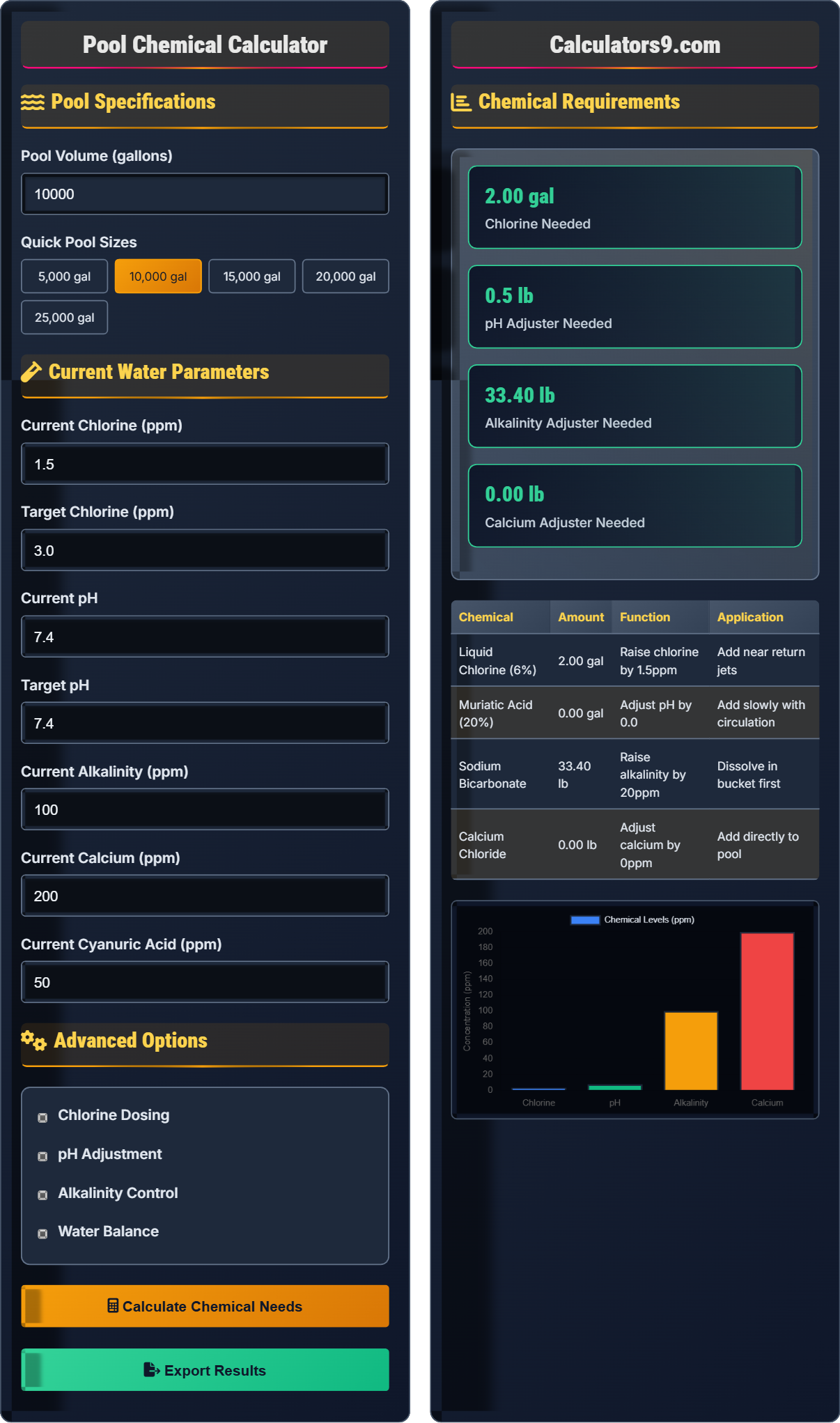
Example: For a 10,000-gallon pool needing 2ppm chlorine rise with 6% liquid chlorine:
\( A = 10,000 \times 2 \times 0.000133 = 2.66 \) gallons
If cyanuric acid is 50ppm, effective chlorine protection:
\( CE = 3 \times (1 - \frac{50}{100}) = 1.5 \) ppm protection
Therefore, add 2.66 gallons of liquid chlorine for 2ppm rise with 1.5ppm effective protection.
Pool Specifications
Current Water Parameters
Advanced Options
Chemical Requirements
| Chemical | Amount | Function | Application |
|---|
Comprehensive Pool Chemical Guide
Proper pool chemistry is essential for safe swimming, equipment longevity, and water clarity. The main chemical parameters include chlorine for sanitization, pH for comfort and sanitizer effectiveness, alkalinity for pH stability, calcium for surface protection, and cyanuric acid for chlorine stabilization. Maintaining these parameters within proper ranges prevents algae growth, corrosion, and skin irritation.
Key calculations for chemical dosing:
Where:
- \(A\) = amount of chemical needed
- \(V\) = pool volume in gallons
- \(C\) = desired concentration change
- \(F\) = chemical factor
- \(CD\) = chlorine demand
- \(CI\) = initial chlorine reading
- \(CR\) = residual chlorine reading
Each chemical serves specific purposes in pool maintenance:
- Chlorine: Sanitizes water by killing bacteria and algae
- pH Adjusters: Maintain proper acidity levels for comfort and effectiveness
- Alkalinity Increasers: Buffer pH fluctuations and maintain stability
- Calcium Chloride: Prevents corrosion and maintains water hardness
- Cyanuric Acid: Protects chlorine from UV degradation
- Never Mix: Combine different chemicals directly
- Protective Gear: Wear gloves and eye protection
- Pre-Dissolve: Dissolve powders in water before adding
- Proper Storage: Store in cool, dry places away from children
- Follow Directions: Always read product labels carefully
Chemical Balance Fundamentals
Concentration unit representing milligrams of substance per liter of water.
\(A = V \times C \times F\)
Where A=amount, V=volume, C=concentration, F=factor.
- Test water before adding chemicals
- Add chemicals gradually and retest
- Never add water to acid
Water Balance Index
Measure of water's tendency to dissolve or deposit calcium carbonate.
- LSI = pH + TF + AF + CF - 12.1
- TF = Temperature Factor
- AF = Alkalinity Factor
- CF = Calcium Factor
- LSI between -0.3 and +0.3 is balanced
- Negative LSI indicates corrosive water
- Positive LSI indicates scaling potential
Pool Chemical Learning Quiz
How much 6% liquid chlorine is needed to raise the chlorine level by 2ppm in a 15,000-gallon pool? (Formula: Amount = Volume × Concentration Change × Factor, where Factor for 6% liquid chlorine is 0.000133)
The answer is B) 4.0 gallons. Using the formula: Amount = Volume × Concentration Change × Factor
Amount = 15,000 × 2 × 0.000133 = 4.0 gallons
Therefore, 4.0 gallons of 6% liquid chlorine is needed.
Chemical dosing calculations ensure precise treatment of pool water. The factor accounts for the concentration of the chemical product. Different products have different factors based on their active ingredient concentration and effectiveness.
Parts Per Million (ppm): Unit of measurement for chemical concentration
Chemical Factor: Constant that accounts for product concentration and conversion
Concentration Change: Difference between current and target levels
• Always calculate the difference between current and target levels
• Use the correct factor for your specific chemical product
• Add chemicals gradually and retest before adding more
• Pre-dissolve powdered chemicals in a bucket of water first
• Add chemicals near return jets for better circulation
• Wait before retesting after adding chemicals
• Using the wrong chemical factor for the product concentration
• Adding too much chemical at once
Calculate the amount of muriatic acid (20%) needed to lower the pH from 7.8 to 7.4 in a 20,000-gallon pool. (Formula: Amount = Volume × pH Change × Factor, where Factor for 20% muriatic acid is 0.00008)
Given:
- Volume = 20,000 gallons
- pH Change = 7.8 - 7.4 = 0.4
- Factor for 20% muriatic acid = 0.00008
Step 1: Apply formula: Amount = 20,000 × 0.4 × 0.00008
Step 2: Amount = 8,000 × 0.00008
Step 3: Amount = 0.64 gallons
Therefore, 0.64 gallons of 20% muriatic acid should be added.
pH adjustment requires careful calculation to avoid overshooting the target. Muriatic acid is commonly used to lower pH. The factor accounts for the acid strength and its effectiveness in water.
pH Scale: Measure of acidity/alkalinity from 0-14
Muriatic Acid: Hydrochloric acid solution used for pH adjustment
Buffering: Water's resistance to pH change
• Add acid slowly and in multiple locations
• Never add water to acid, always acid to water
• Retest after adding chemicals before adding more
• Add acid near return jets for rapid mixing
• Wear protective gear when handling acid
• Keep baking soda nearby as a neutralizer
• Adding too much acid at once causing pH crash
• Not accounting for total alkalinity in pH adjustments
Your pool test shows alkalinity at 150ppm, but the ideal range is 80-120ppm. To lower alkalinity by 30ppm in a 12,000-gallon pool, how much sodium bisulfate should you add? (Rule of thumb: 1.2 lbs per 1,000 gallons per 10ppm change)
Step 1: Calculate adjustment needed = 150 - 120 = 30 ppm
Step 2: Calculate per 1,000 gallons = 30 ÷ 10 = 3 times the base amount
Step 3: Calculate total needed = (12,000 ÷ 1,000) × 3 × 1.2 lbs
Step 4: Total = 12 × 3 × 1.2 lbs = 43.2 lbs
Therefore, you should add 43.2 pounds of sodium bisulfate to lower alkalinity by 30ppm.
Alkalinity control is crucial for pH stability. High alkalinity makes pH adjustment difficult. Sodium bisulfate is commonly used to lower alkalinity. The rule of thumb provides a starting point, but always retest after adding chemicals.
Total Alkalinity: Water's capacity to neutralize acids
Sodium Bisulfate: Chemical used to lower alkalinity
Buffering Capacity: Ability to resist pH changes
• Test alkalinity before adjusting pH
• Lower alkalinity gradually to avoid pH swings
• Retest after adding chemicals
• Add chemicals near return jets for distribution
• Run pump during chemical addition
• Retest after 6 hours of circulation
• Adjusting pH without addressing alkalinity first
• Adding too much alkalinity reducer at once
Your pool has 4ppm of free chlorine and 80ppm of cyanuric acid. Calculate the effective chlorine available for sanitization using the formula: Effective Chlorine = Free Chlorine × (1 - (Cyanuric Acid ÷ 100)). What is the effective chlorine percentage?
Given:
- Free Chlorine = 4ppm
- Cyanuric Acid = 80ppm
Step 1: Apply formula: Effective Chlorine = 4 × (1 - (80 ÷ 100))
Step 2: EC = 4 × (1 - 0.8)
Step 3: EC = 4 × 0.2 = 0.8 ppm
Step 4: Effective percentage = (0.8 ÷ 4) × 100 = 20%
Therefore, only 20% of the chlorine is effective for sanitization.
Cyanuric acid protects chlorine from UV degradation but also reduces its effectiveness. At 80ppm CYA, only 20% of chlorine is available for sanitization. This is why pools with high CYA need higher chlorine levels to maintain sanitation.
Cyanuric Acid: Stabilizer that protects chlorine from sun degradation
Free Chlorine: Available chlorine for sanitization
Effective Chlorine: Chlorine available for sanitization after CYA effect
• Keep CYA between 30-50ppm for optimal balance
• Higher CYA requires higher chlorine levels
• Test CYA monthly in chlorinated pools
• Drain and refill to lower high CYA levels
• Use non-stabilized chlorine for shocking
• Monitor chlorine levels more closely with high CYA
• Not accounting for CYA effect on chlorine effectiveness
• Letting CYA levels get too high (>100ppm)
What is the ideal range for total alkalinity in a pool to maintain proper pH stability?
The answer is B) 80-120 ppm. Total alkalinity acts as a buffer that prevents rapid pH fluctuations. Levels in this range provide sufficient buffering capacity to maintain stable pH while allowing for normal pH adjustments when needed.
Alkalinity is crucial for pH stability. It acts like a buffer system that absorbs excess acid or base, preventing dramatic pH swings. Too little alkalinity causes pH bounce, while too much makes pH adjustment difficult.
Total Alkalinity: Water's capacity to neutralize acids
Buffering Capacity: Ability to resist pH changes
pH Stability: Resistance to pH fluctuations
• Test alkalinity weekly during active season
• Adjust alkalinity before making pH corrections
• Raise alkalinity with sodium bicarbonate
• Lower alkalinity with muriatic acid
• Make gradual adjustments to avoid shocking the system
• Adjusting pH without checking alkalinity first
• Making too large adjustments at once
FAQ
Q: How do I calculate the exact amount of chemicals needed for my pool?
A: The basic formula is: \( A = V \times C \times F \), where \( A \) is the amount of chemical needed, \( V \) is pool volume in gallons, \( C \) is the desired concentration change in ppm, and \( F \) is the chemical factor specific to the product.
For example, to raise chlorine by 2ppm in a 10,000-gallon pool using 6% liquid chlorine: \( A = 10,000 \times 2 \times 0.000133 = 2.66 \) gallons.
Chemical factors vary by product: 6% liquid chlorine has a factor of 0.000133, while 12% liquid chlorine has 0.0000665. Always verify the specific factor for your product.
Q: What's the relationship between cyanuric acid and chlorine effectiveness?
A: Cyanuric acid (CYA) forms a weak bond with chlorine, protecting it from UV degradation but reducing its effectiveness. The relationship follows: \( \text{Effective Chlorine} = \text{Free Chlorine} \times (1 - \frac{\text{CYA}}{100}) \).
For example, with 3ppm free chlorine and 50ppm CYA: \( \text{Effective Chlorine} = 3 \times (1 - \frac{50}{100}) = 1.5 \) ppm effective chlorine.
This means only 50% of the chlorine is available for sanitization. At 80ppm CYA, only 20% of chlorine is effective, requiring higher total chlorine levels to maintain sanitation.