Pool Volume Calculator

Pool volume & chemical calculator • Maintenance optimized

Pool Volume & Chemical Dosing Formulas:

Show the calculator

Rectangular Pool: \( V = L \times W \times D \times 7.5 \)

Round Pool: \( V = \pi \times r^2 \times D \times 7.5 \)

Oval Pool: \( V = L \times W \times D \times 5.9 \)

Chemical Dosing: \( A = C \times V \times F \)

Where:

  • \( V \) = volume in gallons
  • \( L \) = length in feet
  • \( W \) = width in feet
  • \( D \) = depth in feet
  • \( r \) = radius in feet
  • \( A \) = amount of chemical needed
  • \( C \) = concentration needed per volume
  • \( F \) = conversion factor

These formulas calculate pool volume in gallons and determine chemical dosing requirements. The volume calculation varies by pool shape, with different multipliers to convert cubic feet to gallons. Chemical dosing formulas help maintain proper water chemistry for safe swimming.

Example: For a rectangular pool 20ft × 10ft × 4ft deep:

Volume = 20 × 10 × 4 × 7.5 = 6,000 gallons

To raise chlorine by 1ppm in 6,000 gallons:

Liquid chlorine (6%) needed = 6,000 × 0.000133 = 0.8 gallons

Thus, the pool contains 6,000 gallons of water requiring 0.8 gallons of liquid chlorine to achieve 1ppm increase.
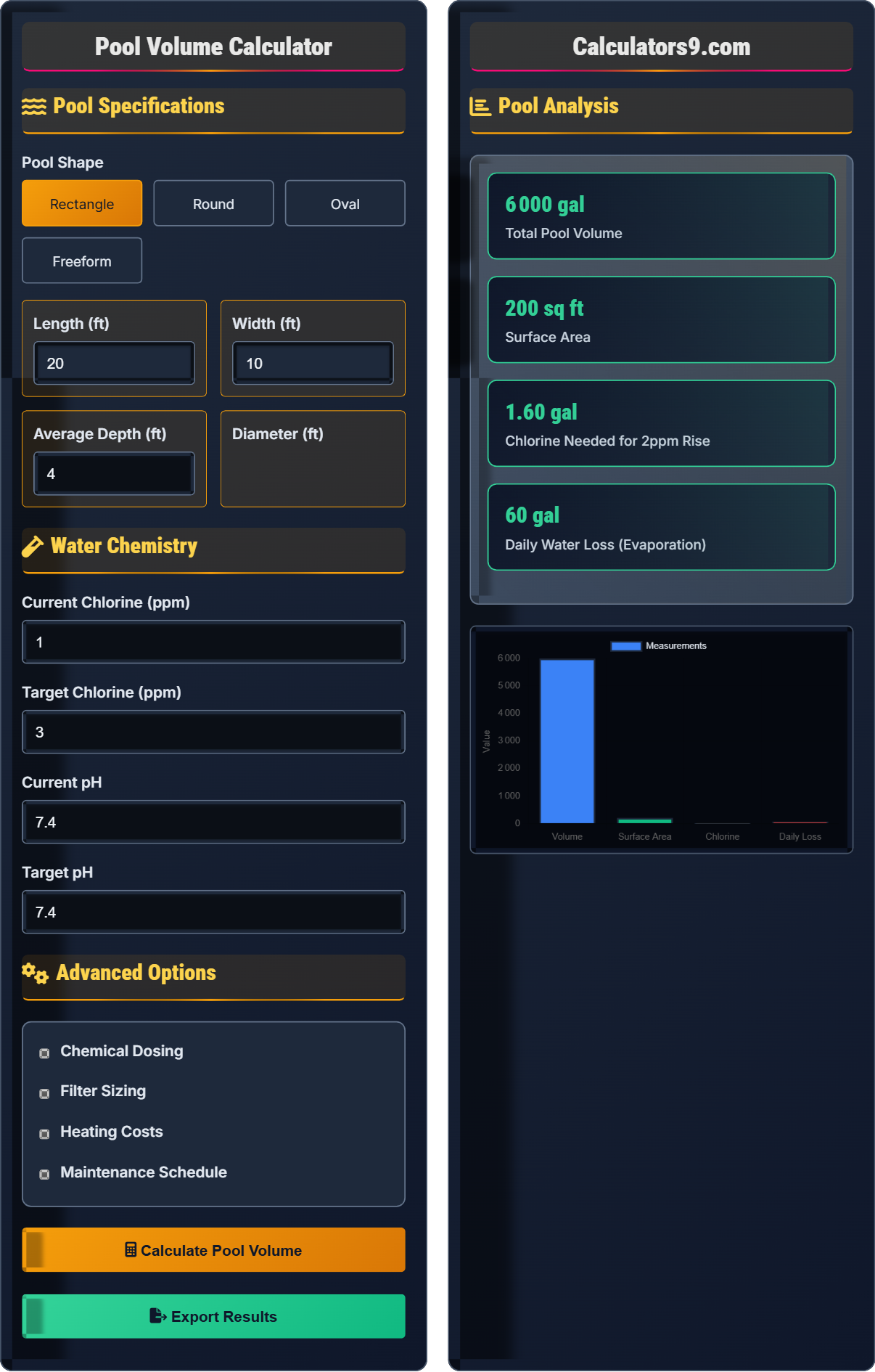
Pool Specifications

Rectangle
Round
Oval
Freeform

Water Chemistry

Advanced Options

Pool Analysis

6,000 gal
Total Pool Volume
200 sq ft
Surface Area
0.8 gal
Chlorine Needed for 2ppm Rise
60 gal
Daily Water Loss (Evaporation)

Comprehensive Pool Volume Guide

Understanding Pool Volume

Accurate pool volume calculation is essential for proper chemical dosing, equipment sizing, and maintenance planning. The volume determines how much water needs to be circulated, heated, and chemically treated. Incorrect volume calculations can lead to under-dosing (unsafe water) or over-dosing (wasted chemicals and potential damage).

Volume Calculation Formulas

Different pool shapes require different calculation methods:

\(\text{Rectangle}: V = L \times W \times D \times 7.5\)
\(\text{Round}: V = \pi \times r^2 \times D \times 7.5\)
\(\text{Oval}: V = L \times W \times D \times 5.9\)

Where:

  • \(V\) = volume in gallons
  • \(L\) = length in feet
  • \(W\) = width in feet
  • \(D\) = depth in feet
  • \(r\) = radius in feet
  • \(7.5\) = conversion factor (gallons per cubic foot)
  • \(5.9\) = conversion factor for oval pools

Chemical Dosing Guidelines
1
Chlorine: Maintain 1-3 ppm for safety, shock at 10ppm
2
pH: Keep between 7.2-7.8 for comfort and sanitizer effectiveness
3
Alkalinity: Maintain 80-120 ppm to stabilize pH
4
Calcium Hardness: Keep 200-400 ppm to protect surfaces
5
Cyanuric Acid: Maintain 30-50 ppm to protect chlorine
Equipment Sizing Factors

Proper equipment sizing based on pool volume:

  • Filters: Size for complete turnover in 8 hours
  • Pumps: Deliver 1.5 times pool volume per hour
  • Heaters: 100,000 BTU per 1,000 gallons for quick heating
  • Chlorinators: Feed rate based on bather load and volume
  • Covers: Reduce evaporation and heat loss by up to 90%
Maintenance Strategies
  • Daily: Skim debris and check water level
  • Weekly: Test chemicals and brush walls
  • Monthly: Deep clean and inspect equipment
  • Seasonally: Open/close procedures and equipment maintenance
  • As Needed: Shock treatments and algaecide applications

Pool Chemistry Fundamentals

Parts Per Million (ppm)

Measurement unit representing milligrams of substance per liter of water.

Volume Calculation

\(V = L \times W \times D \times 7.5\)

Where V=volume, L=length, W=width, D=depth.

Key Rules:
  • Accurate volume is critical for chemical dosing
  • Test water chemistry regularly
  • Shock after heavy use or contamination

Equipment Sizing

Turnover Rate

Time required to circulate all pool water through the filtration system.

Pump Sizing
  1. Calculate: Volume ÷ Turnover hours = GPH needed
  2. Select pump rated at 1.5x calculated GPH
  3. Account for head pressure and pipe friction
Considerations:
  • 8-hour turnover is standard for residential pools
  • Commercial pools require 4-hour turnover
  • Larger pipes reduce head pressure

Pool Volume Learning Quiz

Question 1: Multiple Choice - Volume Calculation

What is the volume of a rectangular pool that is 20 feet long, 10 feet wide, and 4 feet deep?

Solution:

The answer is C) 6,000 gallons. Using the rectangular pool formula: \(V = L \times W \times D \times 7.5\)

V = 20 × 10 × 4 × 7.5 = 6,000 gallons

The multiplier 7.5 converts cubic feet to gallons (since 1 cubic foot = 7.48 gallons).

Pedagogical Explanation:

This calculation is fundamental to pool maintenance. The volume determines how much chemical to add, how large equipment needs to be, and how long it takes to turnover the water. Accurate measurements ensure proper chemical dosing and equipment performance.

Key Definitions:

Pool Volume: Total amount of water contained in the pool measured in gallons

Cubic Feet: Three-dimensional measurement of space (length × width × depth)

Conversion Factor: Multiplier used to convert between different units of measurement

Important Rules:

• Always measure in feet for pool calculations

• Use 7.5 as the conversion factor for rectangular pools

• Measure average depth for pools with varying depths

Tips & Tricks:

• For pools with shallow and deep ends, use average depth: (shallow + deep) ÷ 2

• Double-check measurements before calculating

• Record volume for future reference

Common Mistakes:

• Forgetting to multiply by the conversion factor

• Using maximum depth instead of average depth

Question 2: Chemical Dosing Calculation

How much liquid chlorine (6%) should be added to a 10,000-gallon pool to raise the chlorine level from 1ppm to 3ppm? (Formula: Amount = Volume × Desired Rise × Factor, where Factor for 6% liquid chlorine is 0.000133)

Solution:

Given:

  • Volume = 10,000 gallons
  • Desired rise = 3ppm - 1ppm = 2ppm
  • Factor for 6% liquid chlorine = 0.000133

Step 1: Apply formula: Amount = 10,000 × 2 × 0.000133

Step 2: Amount = 20,000 × 0.000133

Step 3: Amount = 2.66 gallons

Therefore, 2.66 gallons of 6% liquid chlorine should be added.

Pedagogical Explanation:

Chemical dosing calculations ensure safe and effective pool maintenance. The factor accounts for the concentration of the chemical product. Different products have different factors based on their active ingredient concentration.

Key Definitions:

Parts Per Million (ppm): Unit of measurement for chemical concentration

Chemical Factor: Constant that accounts for product concentration and conversion

Desired Rise: Difference between current and target chemical levels

Important Rules:

• Always calculate the difference between current and target levels

• Use the correct factor for your specific chemical product

• Add chemicals gradually and retest before adding more

Tips & Tricks:

• Pre-dissolve powdered chemicals in a bucket of water first

• Add chemicals near return jets for better circulation

• Wait before retesting after adding chemicals

Common Mistakes:

• Using the wrong chemical factor for the product concentration

• Adding too much chemical at once

Question 3: Word Problem - Filter Sizing

You have a 12,000-gallon pool that needs to turnover completely in 8 hours. What flow rate (GPH) should your pump deliver? If you want to account for system inefficiencies, what pump rating should you select?

Solution:

Step 1: Calculate required flow rate = Volume ÷ Turnover time

Step 2: Required flow = 12,000 gallons ÷ 8 hours = 1,500 GPH

Step 3: Account for inefficiencies (typically 1.5x): 1,500 × 1.5 = 2,250 GPH

Therefore, you need a pump rated for approximately 2,250 GPH to ensure proper circulation.

Pedagogical Explanation:

Pump sizing ensures adequate water circulation and filtration. The 8-hour turnover rule is standard for residential pools. The safety factor accounts for head pressure losses from pipes, fittings, and equipment resistance.

Key Definitions:

Gallons Per Hour (GPH): Flow rate measurement for pumps and filters

Turnover Rate: Time to circulate all pool water through the system

Head Pressure: Resistance to water flow in the system

Important Rules:

• Residential pools need 8-hour turnover

• Commercial pools need 4-hour turnover

• Oversize pump to account for system losses

Tips & Tricks:

• Larger diameter pipes reduce head pressure

• Minimize sharp turns in plumbing

• Consider variable speed pumps for energy savings

Common Mistakes:

• Undersizing the pump for cost savings

• Not accounting for head pressure losses

Question 4: Application-Based Problem - pH Adjustment

Your pool test shows a pH of 8.0, but the ideal range is 7.2-7.8. To lower the pH by 0.5 units in a 15,000-gallon pool, how much muriatic acid (20%) should you add? (Rule of thumb: 0.16 oz per 1,000 gallons per 0.1 pH unit change)

Solution:

Step 1: Calculate adjustment needed = 8.0 - 7.5 = 0.5 pH units

Step 2: Calculate per 1,000 gallons = 0.5 ÷ 0.1 = 5 times the base amount

Step 3: Calculate total acid needed = (15,000 ÷ 1,000) × 5 × 0.16 oz

Step 4: Total = 15 × 5 × 0.16 oz = 12 oz

Therefore, you should add 12 ounces of 20% muriatic acid to lower the pH by 0.5 units.

Pedagogical Explanation:

pH adjustment requires careful calculation to avoid overshooting the target. Muriatic acid is commonly used to lower pH. The rule of thumb provides a starting point, but always retest after adding chemicals.

Key Definitions:

pH Scale: Measure of acidity/alkalinity from 0-14

Muriatic Acid: Hydrochloric acid solution used for pH adjustment

Buffering: Water's resistance to pH change

Important Rules:

• Add acid slowly and in multiple locations

• Never add water to acid, always acid to water

• Retest after adding chemicals before adding more

Tips & Tricks:

• Add acid near return jets for rapid mixing

• Wear protective gear when handling acid

• Keep baking soda nearby as a neutralizer

Common Mistakes:

• Adding too much acid at once causing pH crash

• Not accounting for total alkalinity in pH adjustments

Question 5: Multiple Choice - Evaporation Calculation

Which factor has the greatest impact on pool water evaporation rate?

Solution:

The answer is B) Surface area. Evaporation occurs at the water surface, so the surface area directly determines the rate of water loss. A larger surface area exposes more water to air, increasing evaporation. Wind speed, humidity, and temperature also affect evaporation but surface area is the primary factor.

Pedagogical Explanation:

Evaporation is a surface phenomenon where water molecules gain enough energy to escape into the air. The amount of surface area directly correlates with the number of water molecules that can potentially evaporate. This is why pools lose more water during hot, dry, windy conditions.

Key Definitions:

Evaporation: Phase change from liquid to gas at the surface

Surface Area: Total area of water exposed to air

Heat Transfer: Energy movement affecting evaporation rate

Important Rules:

• Evaporation increases with surface area

• Covers reduce evaporation by up to 90%

• Wind and temperature accelerate evaporation

Tips & Tricks:

• Use pool covers to reduce water loss

• Monitor water level during hot weather

• Consider automatic fill valves for convenience

Common Mistakes:

• Not accounting for evaporation in water level monitoring

• Assuming all water loss is due to leaks

Pool Volume Calculator

FAQ

Q: How do I calculate the volume of an irregularly shaped pool?

A: For irregular pools, divide the pool into geometric sections (rectangles, circles, triangles) and calculate each separately. Sum the volumes: \( V_{total} = \sum V_i \).

Alternatively, use the bucket method: Fill a known volume container (like a 5-gallon bucket) and count how many it takes to raise the water level by a measurable amount (e.g., 1 inch). Then calculate: \( V = \frac{\text{Bucket Volume} \times \text{Number of Buckets}}{\text{Water Rise in Feet}} \times \text{Pool Surface Area} \).

For example, if it takes 20 five-gallon buckets to raise water 1 inch (0.083 feet) in a 200 sq ft pool: \( V = \frac{100 \times 20}{0.083} \times 200 = 24,000 \) gallons.

Q: What's the relationship between pool volume and chemical maintenance?

A: Chemical dosing follows the dilution equation: \( C_1V_1 = C_2V_2 \), where concentration times volume remains constant. For dosing: \( \text{Amount} = \text{Volume} \times \text{Concentration Change} \times \text{Factor} \).

For example, to raise chlorine by 2ppm in a 10,000-gallon pool using 6% liquid chlorine: \( \text{Amount} = 10,000 \times 2 \times 0.000133 = 2.66 \) gallons.

Water balance also depends on volume: \( \text{ppm} = \frac{\text{mg of substance}}{\text{liters of water}} \). Larger volumes require more chemicals for the same ppm change, while smaller volumes are more sensitive to chemical additions.

About

Pool Maintenance Team
This calculator was created
This calculator was created by our Pool & Spa Team , may make errors. Consider checking important information. Updated: April 2026.