Baby Name Generator
Find perfect baby names • 2026 edition
Name Generation Formula:
Show the calculator\( \text{Name Score} = \frac{\text{Popularity Rank} + \text{Meaning Value} + \text{Sound Harmony}}{\text{Length Factor}} \)
Where:
- \( \text{Popularity Rank} \) = 1-1000 scale (1 being most popular)
- \( \text{Meaning Value} \) = Cultural significance rating (1-10)
- \( \text{Sound Harmony} \) = Compatibility with surname (1-10)
- \( \text{Length Factor} \) = Name length normalization
This formula evaluates potential baby names by combining multiple factors. The scoring system helps parents find names that balance popularity, meaning, and compatibility:
\( \text{Compatibility Score} = \frac{\text{Initial Match} + \text{Syllable Harmony}}{2} \)
Where Initial Match checks if initials match desired criteria and Syllable Harmony evaluates rhythm. This systematic approach helps parents make informed naming decisions.
Example: For name "Emma" with surname "Johnson":
Popularity Rank: 3 (very popular)
Meaning Value: 8 (universal love)
Sound Harmony: 9 (flows well with Johnson)
Length Factor: 4 (4 letters)
Name Score: (3 + 8 + 9) ÷ 4 = 5.0
This provides a balanced score for evaluating name suitability.
Parent Preferences
Name Criteria
Advanced Options
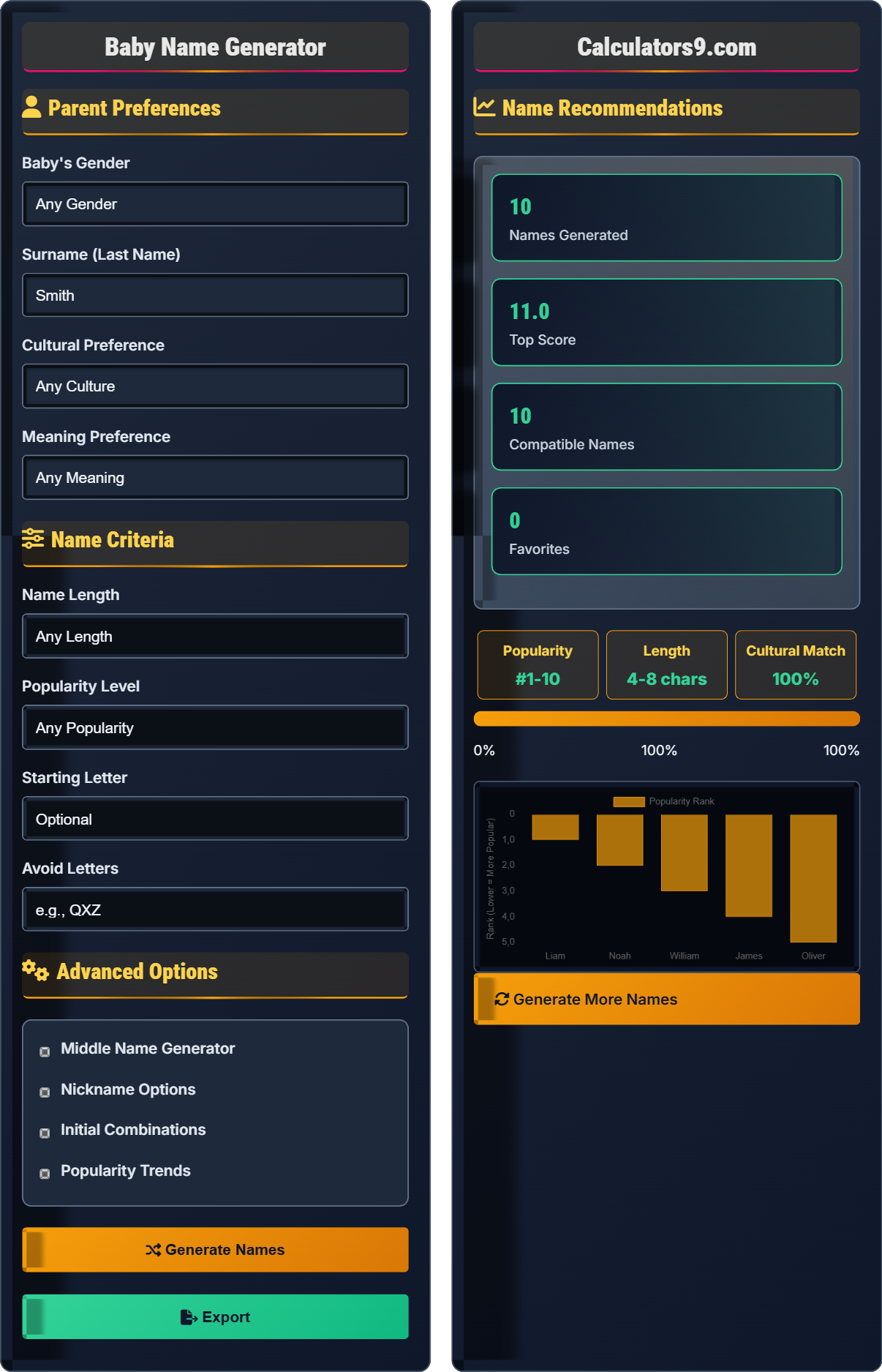
Name Recommendations
| Name | Score | Popularity | Meaning |
|---|
Name Trends
Baby Naming Guide
Selecting a baby name is one of the most important decisions for expecting parents. A name becomes part of your child's identity for life, so choosing thoughtfully is essential. Consider both current trends and timeless appeal.
Evaluate potential names using multiple criteria:
Where:
- \( \text{Meaning} = \) Cultural significance and personal relevance
- \( \text{Sound} = \) How the name flows and sounds
- \( \text{Compatibility} = \) Fit with surname and initials
Consider the popularity spectrum:
- Very Popular: Easy recognition, potential for confusion
- Moderately Popular: Good balance of familiarity
- Unique: Distinctive but may require explanation
- Rare: Special but potential for mispronunciation
- Say it aloud: Practice the full name several times
- Initial test: Check the initials for unintended acronyms
- Future consideration: Think how it will sound at different ages
- Family input: Consider family traditions and preferences
- Test with nickname: Consider potential nicknames
Naming Basics
Evaluating name quality.
\( \text{Suitability} = \frac{\text{Meaning} + \text{Sound} + \text{Compatibility}}{3} \)
Score from 1-10 in each category.
- Consider long-term implications
- Check compatibility with surname
- Think about nicknames
Selection Strategies
Choosing name frequency.
- List meaningful names
- Check compatibility
- Consider pronunciation
- Test with full name
- How it sounds at different ages
- Initial combinations
- Family traditions
- Future professional settings
Baby Naming Learning Quiz
Which of the following is the most important factor to consider when evaluating a baby name?
The answer is B) Compatibility with surname and middle name. While all factors are important, the name must flow well with the full name combination. A name that sounds awkward with the surname or creates unwanted initials can cause lifelong challenges for the child.
When evaluating names, compatibility with the surname is fundamental because it creates the child's permanent identity. The full name combination should be tested by saying it aloud multiple times and considering how it will sound in various contexts throughout the child's life.
Compatibility: How well names work together
Identity: Permanent aspect of self
Flow: Natural rhythm of name combination
• Test the full name combination
• Consider all possible initials
• Say it aloud multiple times
• Practice introducing the child with the name
• Consider how it sounds with your voice
• Test with common nicknames
• Not testing with surname
• Ignoring potential initials
• Choosing based on temporary trends
If you want to evaluate the name "Alexander" with the surname "Thompson" using the formula: Suitability = (Meaning + Sound + Compatibility) ÷ 3, and you rate Meaning=8, Sound=7, Compatibility=9, what is the overall suitability score?
Suitability = (Meaning + Sound + Compatibility) ÷ 3
Suitability = (8 + 7 + 9) ÷ 3
Suitability = 24 ÷ 3 = 8.0
The overall suitability score is 8.0 out of 10.
This calculation demonstrates how to systematically evaluate a name using multiple criteria. Each aspect (meaning, sound, compatibility) contributes equally to the overall score. A score of 8.0 indicates a very suitable name choice.
Suitability Score: Overall evaluation rating
Systematic Evaluation: Using multiple criteria
Rating Scale: 1-10 for each factor
• Use consistent rating scale
• Consider all three factors
• Higher scores indicate better suitability
• Rate each factor independently
• Consider long-term implications
• Test with middle name too
• Rating all factors too high
• Not considering all three aspects
• Being inconsistent in ratings
A couple wants to name their child "Eric James Peterson". What should they consider regarding the initials EJP, and what alternative might they explore if they're concerned about potential teasing?
For the initials EJP, the couple should consider:
1. Potential acronyms: EJP could stand for various phrases
2. Ease of pronunciation: E-J-P flows reasonably well
3. Professional implications: May appear on documents
Alternative approaches:
1. Use middle name initial: Eric J. Peterson (EJP) or
2. Consider different middle name: Eric Matthew Peterson (EMP)
3. Use nickname: Eri Peterson (EP)
The key is ensuring initials don't form potentially embarrassing acronyms and flow well together.
Initial combinations are an important consideration because they become part of the child's identity on documents, school supplies, and other items. Parents should consider how initials might be perceived or potentially misused by others.
Initials: First letters of full name
Acronyms: Initials that form words
Identity: Permanent name association
• Check all possible initial combinations
• Consider potential acronyms
• Think about professional settings
• Write initials together frequently
• Consider how they look on paper
• Think of potential jokes or associations
• Not checking initial combinations
• Ignoring potential teasing
• Focusing only on first name
A family of Irish descent wants to honor their heritage while choosing a name that will be easy for others to pronounce in America. How should they balance these competing priorities?
The family can balance these priorities by:
1. Choosing traditional Irish names with easier pronunciations:
- Sean (instead of Seán) or Shannon
- Patrick (instead of Pádraig) or Patricia
- Siobhan (phonetically "Shiv-awn" - explain pronunciation)
2. Using Irish names with anglicized spellings:
- Aidan instead of Aodhán
- Cian instead of Cían
3. Combining Irish first names with more common middle names for easier daily use
This approach honors heritage while ensuring practical usability in their environment.This scenario demonstrates the balance between cultural heritage and practical considerations. Families often want to honor their roots while ensuring their child's name is accessible in their current environment. The solution involves finding names that bridge both worlds effectively.
Cultural Heritage: Family traditions and origins
Anglicized: Adapted to English pronunciation
Practical Usability: Ease of use in daily life
• Honor heritage while considering environment
• Explain pronunciation when needed
• Consider long-term implications
• Choose names with familiar sounds
• Be prepared to teach pronunciation
• Consider hyphenated or dual names
• Choosing names too difficult to pronounce
• Not considering cultural sensitivity
• Ignoring practical implications
Which statement about name popularity is most accurate?
The answer is B) Moderately popular names often provide the best balance. Names that are moderately popular offer recognition without being overly common, and they're typically easier for others to pronounce and spell while still feeling distinctive. This provides a good balance between familiarity and uniqueness.
Moderately popular names represent a sweet spot in naming - they're familiar enough that teachers and peers won't struggle with pronunciation or spelling, but unique enough that the child won't constantly be confused with others sharing the same name. This balance can contribute to a positive naming experience throughout life.
Popularity Spectrum: Range from rare to very common
Recognition: How familiar others are with name
Uniqueness: Distinctiveness of the name
• Consider the popularity spectrum
• Balance familiarity and uniqueness
• Think about practical implications
• Check recent popularity lists
• Consider how it sounds in classroom
• Think about future professional settings
• Choosing extremes of popularity
• Not considering practical implications
• Following temporary trends
FAQ
Q: How do we balance trendy names with timeless names?
A: The key is finding names that have both classic appeal and contemporary relevance. Use the formula:
\( \text{Timeless Factor} = \frac{\text{Historical Usage} + \text{Current Appeal}}{2} \)
Look for names that have been in use for decades but remain popular. Examples include Emma, Sophia, Liam, and Noah. These names have historical roots but modern appeal, providing longevity while feeling current.
Q: What if my partner and I can't agree on a name?
A: Try the compromise approach:
• Use one name each as first and middle
• Take turns naming children
• Find names that incorporate both preferences
• Create a list of 5 names each, then find common ground
• Remember: the goal is a name you both can love
Sometimes creating a scoring system helps: rate each name on meaning, sound, and compatibility. This removes emotion from the decision-making process.