Baby Registry Budget Calculator
Smart planning for expecting parents • 2026 edition
Baby Registry Budget Formula:
Show the calculator\( \text{Budget Allocation} = \text{Total Budget} \times \text{Category Percentage} \)
Where:
- \( \text{Total Budget} \) = Overall amount allocated for baby registry items
- \( \text{Category Percentage} \) = Percentage allocated to each category (e.g., 25% for clothing, 20% for nursery, etc.)
- \( \text{Budget Allocation} \) = Amount allocated to specific category
This formula helps expecting parents distribute their baby registry budget across essential categories based on priorities and needs.
Example: For a total budget of \( \$1{,}500 \) with 30% allocated to nursery items:
Nursery allocation: \( \$1{,}500 \times 0.30 = \$450 \)
Thus, the nursery category would receive $450 of the total budget.
Budget Inputs
Registry Categories
Advanced Options
Budget Results
| Item | Category | Budget | Status |
|---|---|---|---|
| Newborn Outfit Set | Clothing | $25 | Needed |
| Crib with Mattress | Nursery | $150 | Received |
| Bottle Feeding Set | Feeding | $50 | Pending |
| Infant Car Seat | Safety | $120 | Needed |
Baby Registry Budgeting Guide
A baby registry budget is a financial plan that helps expecting parents allocate funds across essential baby items and categories. It ensures adequate preparation without overspending.
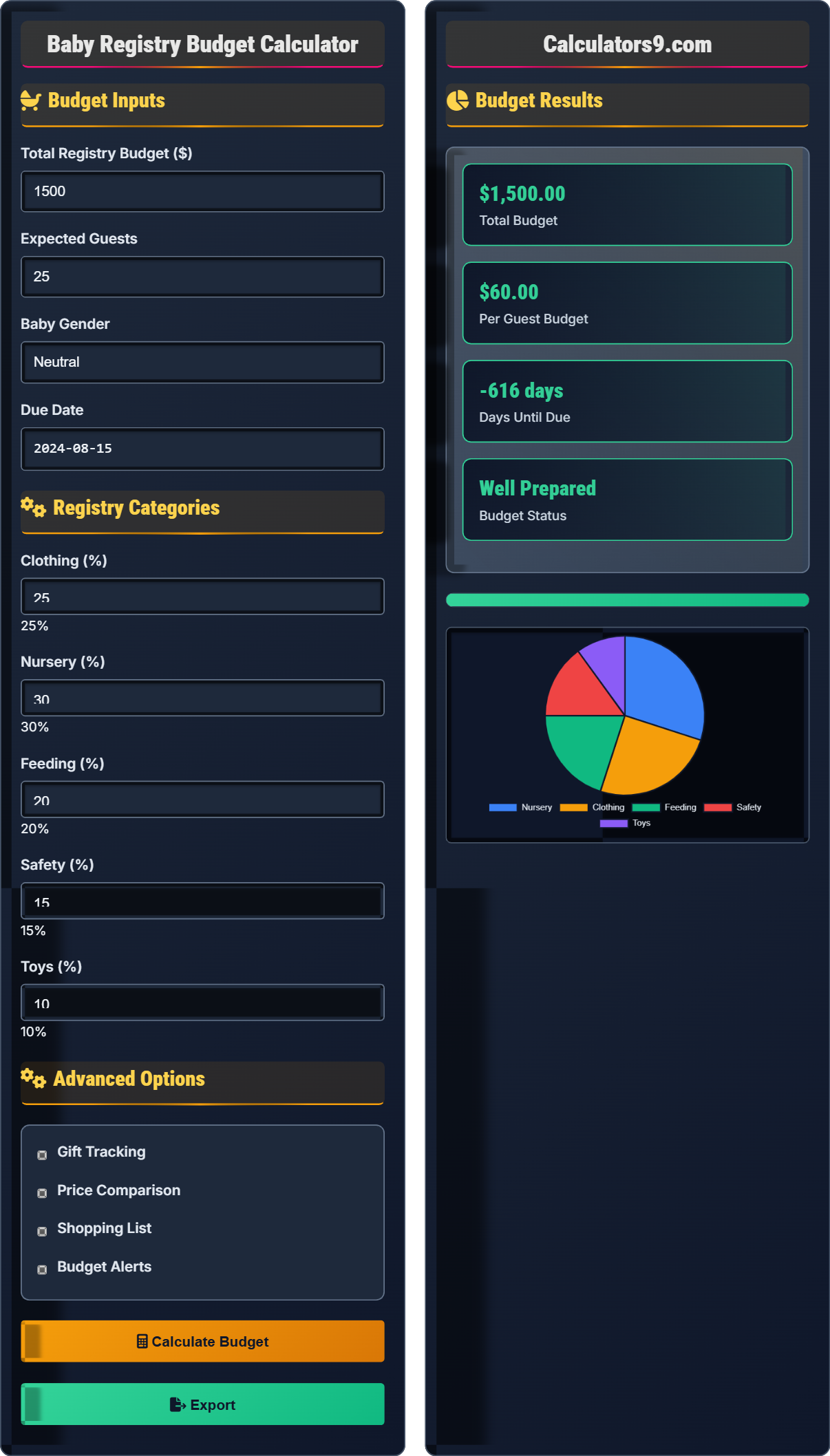
Allocate percentages based on priority: Nursery (30%), Clothing (25%), Feeding (20%), Safety (15%), Toys (10%). Adjust based on needs and preferences.
- Essential items come first
- Plan for unexpected costs
- Track gifts to avoid duplicates
- Set realistic expectations
Essential Categories
Safety and feeding items should be prioritized as they're critical for baby's health and wellbeing.
- Nursery: Crib, mattress, changing table
- Safety: Car seat, outlet covers, gates
- Feeding: Bottles, high chair, stroller
- Clothing: Basic outfits, sleepwear, outerwear
- Toys: Age-appropriate developmental toys
- Size up on clothing
- Research safety standards
- Consider gender-neutral options
- Plan for growth stages
Baby Registry Budgeting Quiz
According to standard baby registry planning, which category should receive the highest percentage of the budget?
The answer is B) Nursery. Standard baby registry budgets typically allocate 30% to nursery items, which is the highest percentage among categories. This includes the crib, mattress, changing table, and other essential sleeping and care furniture.
Understanding category priorities is crucial for effective budget allocation. The nursery category receives the highest allocation because it encompasses the most expensive and essential items for a baby's safety and comfort. The standard allocation follows: Nursery (30%), Clothing (25%), Feeding (20%), Safety (15%), and Toys (10%).
Baby Registry Budget: Financial plan allocating funds across essential baby categories
Nursery Category: Includes crib, mattress, changing table, and other sleeping/care furniture
Budget Allocation: Distribution of total budget across different spending categories
• Nursery items are the largest expense category
• Safety items should never be compromised for budget reasons
• Allocate percentages based on priority, not preference
• Remember the standard allocation: 30-25-20-15-10 (Nursery-Clothing-Feeding-Safety-Toys)
• Prioritize safety items regardless of budget constraints
• Overspending on toys while neglecting essentials
• Underestimating nursery costs
• Not accounting for safety items in the budget
Calculate the budget allocation for each category if the total registry budget is $2,000 using the standard allocation percentages. Show your work.
Using standard allocation percentages:
Nursery: $2,000 × 30% = $2,000 × 0.30 = $600
Clothing: $2,000 × 25% = $2,000 × 0.25 = $500
Feeding: $2,000 × 20% = $2,000 × 0.20 = $400
Safety: $2,000 × 15% = $2,000 × 0.15 = $300
Toys: $2,000 × 10% = $2,000 × 0.10 = $200
Total: $600 + $500 + $400 + $300 + $200 = $2,000 ✓
This calculation demonstrates how percentage allocation works in budget planning. Each category gets its designated percentage of the total budget. The calculation involves converting percentages to decimals (by dividing by 100) and multiplying by the total budget amount. The sum of all allocations should equal the total budget.
Percentage Allocation: Distributing budget based on percentage of total
Decimal Conversion: Converting percentage to decimal by dividing by 100
Budget Verification: Ensuring all allocations sum to total budget
• Always verify that allocations sum to total budget
• Convert percentages to decimals for multiplication
• Essential categories receive higher allocations
• To convert percentage to decimal: divide by 100 (30% = 0.30)
• Always double-check calculations to ensure totals match
• Forgetting to convert percentages to decimals
• Not verifying that allocations sum to total budget
• Misapplying percentage values in calculations
Sarah has a total registry budget of $1,800. She received a $300 gift for a crib and mattress (part of the nursery category). If she originally planned to spend $540 on the nursery category (30% of total), how much does she now have available for other nursery items?
Step 1: Original nursery budget = $1,800 × 30% = $540
Step 2: Gift received for nursery = $300
Step 3: Remaining nursery budget = Original budget - Gift received
Step 4: Remaining nursery budget = $540 - $300 = $240
Therefore, Sarah has $240 available for other nursery items.
This problem demonstrates how receiving gifts affects budget allocation. When a gift is received for a specific category, the available budget for that category decreases by the gift value. This allows families to either save money or reallocate funds to other categories that may need more attention.
Gift Deduction: Reducing category budget by value of received gift
Remaining Budget: Available funds after accounting for gifts
Category Rebalancing: Adjusting budgets when gifts are received
• Gifts reduce the available budget for the corresponding category
• Recalculate remaining budget after receiving gifts
• Consider reallocating freed-up funds to other categories
• Track gifts separately from budget calculations
• Consider using gift money for higher-end items in the same category
• Forgetting to subtract gifts from category budgets
• Double-counting gift items in budget calculations
• Not adjusting budget when gifts are received
Mark and Lisa have a $2,500 registry budget with standard allocation. They've received gifts worth $400 in nursery items, $150 in feeding items, and $100 in clothing. Calculate how much they still need to budget for each category and determine if they need to adjust their allocations.
Step 1: Calculate original allocations
Nursery: $2,500 × 30% = $750
Clothing: $2,500 × 25% = $625
Feeding: $2,500 × 20% = $500
Safety: $2,500 × 15% = $375
Toys: $2,500 × 10% = $250
Step 2: Calculate remaining budget per category
Nursery: $750 - $400 = $350
Clothing: $625 - $100 = $525
Feeding: $500 - $150 = $350
Safety: $375 (no gifts received)
Toys: $250 (no gifts received)
Step 3: Total spent on gifts = $400 + $150 + $100 = $650
Step 4: Remaining total budget = $2,500 - $650 = $1,850
They don't need to adjust allocations since gifts were within expected categories.
This example shows how to track multiple gifts across different categories. The key is to subtract each gift from its corresponding category's budget, then calculate the remaining amount needed for each category. When gifts cover part of a category's budget, the family can decide whether to save the remaining amount or redistribute it.
Budget Tracking: Monitoring actual spending against planned allocations
Category Adjustment: Modifying planned spending based on received gifts
Gift Inventory: Recording all received gifts by category
• Track gifts by category for accurate budget management
• Subtract gifts from corresponding category budgets
• Maintain safety and essential items regardless of gifts
• Keep a running list of received gifts
• Update budget regularly as gifts are received
• Consider gift quality when calculating budget impact
• Not tracking gifts by category
• Forgetting to update budgets when gifts are received
• Assuming all gifts have equal value to purchased items
Which strategy best helps expecting parents stay within their baby registry budget?
The answer is B) Prioritize essential items and allocate percentages accordingly. This systematic approach ensures that critical needs are met first while maintaining budget discipline. The percentage allocation method helps distribute funds appropriately across all necessary categories.
Effective budget management for baby registries requires strategic thinking about priorities. Essential items like car seats, cribs, and feeding equipment should take precedence over non-essential items. The percentage allocation system provides structure while allowing flexibility within categories. This approach prevents overspending in one area while neglecting another.
Priority-Based Spending: Allocating funds based on necessity rather than preference
Essential Items: Products critical for baby's safety and health
Budget Discipline: Sticking to planned allocations despite temptations
• Safety items are non-negotiable regardless of budget
• Essential needs come before wants
• Percentage allocation maintains balance across categories
• Follow the 30-25-20-15-10 allocation rule for balanced spending
• Research safety standards before purchasing
• Consider second-hand options for non-safety items
• Compromising on safety to stay within budget
• Overspending on decorative items at the expense of essentials
• Not accounting for growth and changing needs
FAQ
Q: How do I determine how much to budget for my baby registry?
A: Determining your baby registry budget involves considering your financial situation and the needs of your growing family. A common approach is to budget between $1,000-$2,500 depending on your economic circumstances.
Standard allocation suggests: Nursery (30%), Clothing (25%), Feeding (20%), Safety (15%), and Toys (10%). For example, with a $1,500 budget:
- Nursery: $450 (30%) - crib, mattress, changing table
- Clothing: $375 (25%) - basic outfits, sleepwear
- Feeding: $300 (20%) - bottles, high chair, stroller
- Safety: $225 (15%) - car seat, outlet covers
- Toys: $150 (10%) - age-appropriate toys
This systematic approach ensures you cover all essential categories without overspending.
Q: Should I register for expensive items or stick to basics?
A: Balance is key when selecting registry items. Prioritize safety and essential items first, regardless of price:
- Car seat: Must meet current safety standards (don't compromise)
- Crib: Should meet current safety regulations
- Feeding items: Quality is important for hygiene
For non-essential items, consider your budget and preferences. You can mix higher-end safety items with more affordable options in other categories. Remember that guests appreciate having options at various price points.