Breastfeeding Calorie Calculator
Optimize your nursing nutrition • 2026 edition
Calorie Formula:
Show the calculator\( \text{Breastfeeding Calories} = \text{BMR} + \text{Lactation Demand} + \text{Activity Level} \)
Where:
- \( \text{BMR} = \text{Basal Metabolic Rate} = 10 \times \text{Weight (kg)} + 6.25 \times \text{Height (cm)} - 5 \times \text{Age (years)} + 5 \)
- \( \text{Lactation Demand} = 300-500 \text{ calories per day} \)
- \( \text{Activity Level} = \text{Multiplier based on physical activity} \)
According to lactation experts, breastfeeding mothers need an additional 300-500 calories per day to support milk production. The exact amount depends on:
\( \text{Daily Calorie Need} = \text{Pre-pregnancy BMR} + 330 \text{ to } 400 \text{ calories} \)
This additional energy supports milk production and maintains maternal nutrition. For exclusively breastfeeding mothers, the demand is higher than for those supplementing with formula.
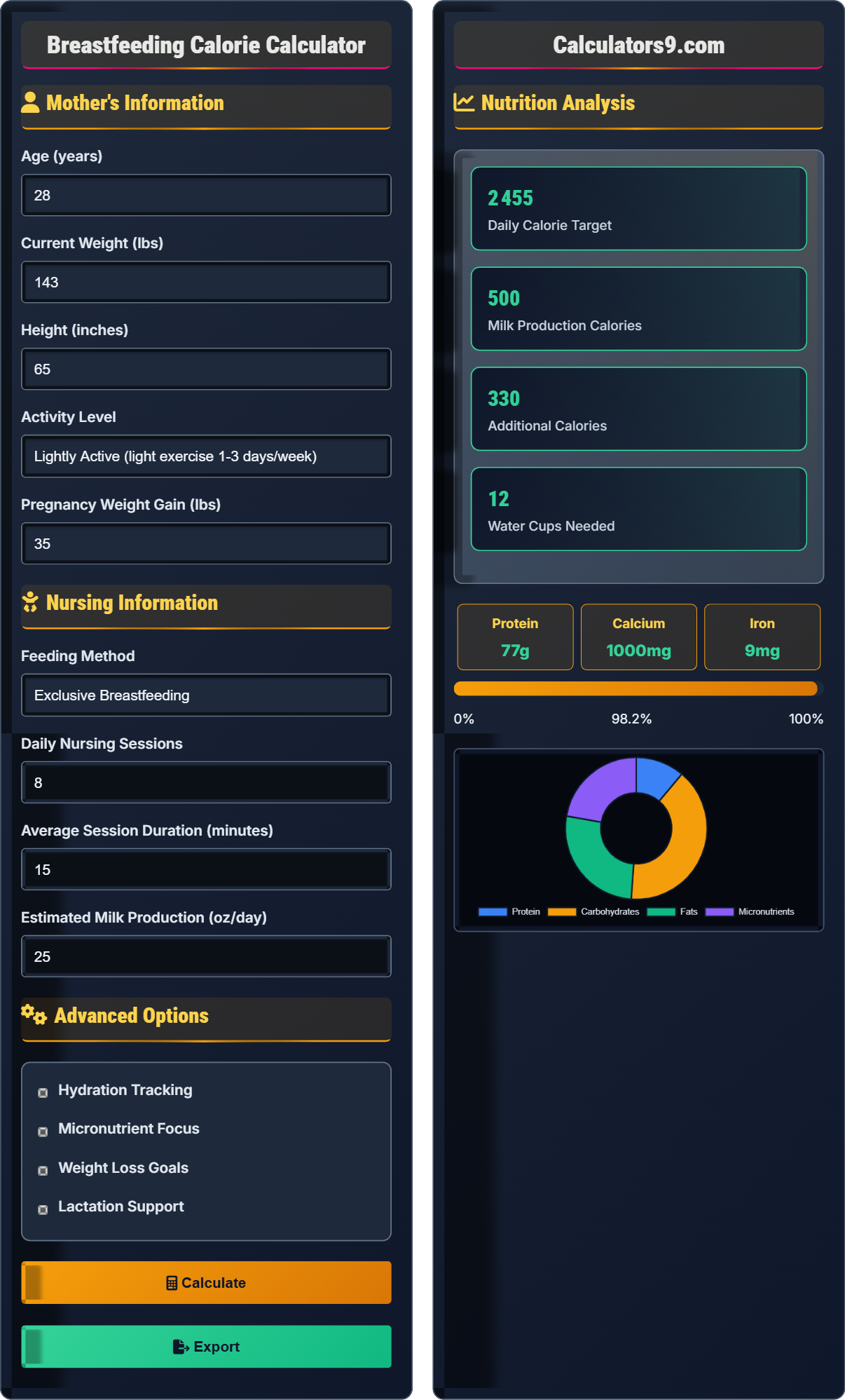
Example: For a 28-year-old mother weighing 65kg (143 lbs), height 165cm (5'5"), sedentary:
BMR = 10×65 + 6.25×165 - 5×28 + 5 = 1,420 calories
With lactation: 1,420 + 330 = 1,750 calories daily
This provides the energy needed for milk production while maintaining maternal health.
Mother's Information
Nursing Information
Advanced Options
Nutrition Analysis
| Nutrient | Amount | Source | Benefits |
|---|
| Food | Calories | Protein (g) | Notes |
|---|
Nutrition Recommendations
Breastfeeding Nutrition Guide
During breastfeeding, your body requires additional calories to produce milk. On average, producing 25 ounces of breast milk daily requires approximately 500 extra calories. This energy comes from both your diet and stored body fat.
The Harris-Benedict equation calculates caloric needs:
Where:
- \( \text{BMR} = 10 \times \text{Weight(kg)} + 6.25 \times \text{Height(cm)} - 5 \times \text{Age} + 5 \)
- \( \text{Lactation Demand} = 300-500 \text{ calories} \)
- \( \text{Activity Factor} = 1.2-1.9 \text{ (based on activity level)} \)
Proper hydration is crucial for milk production:
- Water intake: 8-10 glasses (64-80 oz) daily
- Additional fluid: 16-20 oz per nursing session
- Thirst indicator: Drink when thirsty
- Urine color: Pale yellow indicates adequate hydration
- Eat frequently: 3 meals + 2-3 snacks daily
- Choose nutrient-dense foods: Whole grains, lean proteins, fruits, vegetables
- Limit caffeine: Max 200mg daily (2 cups coffee)
- Avoid alcohol: Can pass to baby through milk
- Take prenatal vitamins: Continue while breastfeeding
Breastfeeding Nutrition Basics
Optimal diet for milk production.
\( \text{Calories} = \text{BMR} \times \text{Activity} + 330 \)
Additional 330 calories for milk production.
- Extra 300-500 calories daily
- Focus on nutrient density
- Maintain hydration
Nutrition Strategies
Key components for milk quality.
- Protein: 71g daily
- Calcium: 1000mg daily
- Iron: 9mg daily
- Vitamins: Continue prenatal
- Adjust for feeding method
- Monitor weight changes
- Listen to hunger cues
- Avoid restrictive diets
Breastfeeding Nutrition Learning Quiz
How many additional calories per day does the average breastfeeding mother need compared to her pre-pregnancy needs?
The answer is B) 300-500 calories. Breastfeeding mothers need an additional 300-500 calories per day to support milk production. This energy requirement varies based on the frequency and exclusivity of breastfeeding, with exclusively breastfeeding mothers needing more calories than those supplementing with formula.
The additional caloric requirement during breastfeeding is necessary to produce breast milk, which contains all the nutrients a baby needs. The body uses both dietary calories and stored fat to meet this demand. This is why many mothers experience increased hunger during the nursing period.
Caloric Requirement: Energy needed for milk production
Milk Production: Process of creating breast milk
Energy Demand: Additional calories needed
• Add 300-500 calories daily
• Exclusive breastfeeding requires more
• Listen to hunger cues
• Eat nutrient-dense foods
• Snack before nursing sessions
• Stay hydrated
• Severely restricting calories
• Not eating enough during nursing
• Focusing only on quantity
If a breastfeeding mother needs 2,100 calories per day and her pre-pregnancy requirement was 1,800 calories, how many additional calories are needed for milk production?
Additional calories = Breastfeeding requirement - Pre-pregnancy requirement
Additional calories = 2,100 - 1,800 = 300 calories
The mother needs an additional 300 calories per day for milk production.
This calculation shows how to determine the additional caloric needs during breastfeeding. The difference between the breastfeeding requirement and pre-pregnancy requirement represents the energy needed for milk production. This value typically falls within the 300-500 calorie range.
Pre-pregnancy Requirement: Calories needed before pregnancy
Breastfeeding Requirement: Total calories needed while nursing
Additional Calories: Energy for milk production
• Calculate individual needs
• Adjust for feeding method
• Consider activity level
• Use online calculators for accuracy
• Adjust based on hunger cues
• Monitor weight changes
• Using generic recommendations
• Not accounting for activity level
• Ignoring individual variation
A breastfeeding mother nurses 8 times per day for an average of 15 minutes each session. She should drink 16-20 oz of fluid with each nursing session. How much total fluid should she consume daily just for nursing sessions, and what is the recommended total daily fluid intake?
Step 1: Calculate fluid needed for nursing sessions
Fluid per session: 16-20 oz
Number of sessions: 8
Total for sessions: 8 × 16 oz = 128 oz (minimum)
Or: 8 × 20 oz = 160 oz (maximum)
Step 2: Calculate recommended total daily intake
General recommendation: 8-10 glasses (64-80 oz)
Additional for nursing: 128-160 oz
Total recommendation: 192-240 oz daily
The mother should drink 128-160 oz just for nursing sessions, with a total daily intake of 192-240 oz.
Hydration is crucial for milk production, as breast milk is primarily composed of water. The recommendation to drink 16-20 oz per nursing session ensures adequate hydration during milk production. This example shows how frequent nursing sessions significantly increase fluid requirements.
Hydration: Maintaining adequate fluid levels
Milk Production: Process requiring significant water
Fluid Requirements: Daily water intake needs
• Drink when thirsty
• 8-10 glasses minimum daily
• More with frequent nursing
• Keep water nearby during nursing
• Monitor urine color
• Include other fluids (milk, juice)
• Not drinking enough fluids
• Confusing thirst with hunger
• Dehydrating beverages
A breastfeeding mother needs 71g of protein daily. If she consumes 25g at breakfast, 30g at lunch, and 20g at dinner, how much more protein does she need to meet her daily requirement? What are some good protein sources for nursing mothers?
Step 1: Calculate protein consumed
Breakfast: 25g
Lunch: 30g
Dinner: 20g
Total consumed: 25 + 30 + 20 = 75g
Step 2: Calculate remaining requirement
Daily requirement: 71g
Consumed: 75g
Difference: 75 - 71 = 4g excess
The mother has already met her daily protein requirement with 4g to spare. Good protein sources include: lean meats, fish, poultry, eggs, dairy products, legumes, nuts, seeds, and quinoa.
This problem demonstrates how to track protein intake to meet breastfeeding requirements. The mother in this example has exceeded her daily protein needs. It's important to choose high-quality protein sources that also provide other essential nutrients needed during lactation.
Protein Requirement: Daily amount needed for milk production
High-Quality Protein: Contains all essential amino acids
Essential Amino Acids: Building blocks not produced by body
• 71g protein daily during breastfeeding
• Choose varied protein sources
• Include plant-based options
• Include protein at every meal
• Snack on nuts or yogurt
• Combine plant proteins for completeness
• Not tracking protein intake
• Relying on low-quality sources
• Ignoring vegetarian options
Which of the following is the recommended daily calcium intake for breastfeeding mothers?
The answer is C) 1000mg. Breastfeeding mothers need 1000mg of calcium daily to maintain their own bone health while providing calcium to their babies through breast milk. This is the same requirement as for non-pregnant women, but it's crucial to maintain adequate intake during lactation.
Calcium is essential during breastfeeding because the baby receives calcium through breast milk. If the mother doesn't consume enough calcium, her body will draw from her bone reserves, potentially compromising her bone health. Good sources include dairy products, leafy green vegetables, fortified plant-based milks, and sardines with bones.
Calcium: Mineral for bone health
Bone Health: Maintaining skeletal integrity
Fortified Foods: Enriched with additional nutrients
• 1000mg calcium daily
• Maintain bone health
• Support milk quality
• Include dairy at meals
• Choose fortified alternatives
• Eat leafy greens
• Not consuming enough calcium
• Assuming all needs are met
• Not knowing good sources
FAQ
Q: How do I calculate my exact caloric needs while breastfeeding?
A: Use the Harris-Benedict equation with lactation addition:
\( \text{BMR} = 10 \times \text{Weight(kg)} + 6.25 \times \text{Height(cm)} - 5 \times \text{Age} + 5 \)
\( \text{Total Calories} = \text{BMR} \times \text{Activity Factor} + 330 \)
For example, a 28-year-old weighing 65kg, 165cm tall, lightly active: BMR = 1,420, Total = 1,420 × 1.375 + 330 = 2,293 calories daily.
Q: What if I'm trying to lose weight while breastfeeding?
A: Safe weight loss during breastfeeding is 1-2 lbs per week. The formula for adjusted needs:
\( \text{Adjusted Calories} = \text{BMR} \times \text{Activity} + 330 - \text{Deficit} \)
For 1 lb/week loss, subtract 500 calories. However, never go below 1,800 calories daily while breastfeeding. Focus on nutrient-dense foods to maintain milk quality.