Conception Date Calculator
Plan your pregnancy • 2026 edition
Conception Date Formula:
Show the calculator\( \text{Conception Date} = \text{LMP} + \text{Cycle Length} - 14 \)
Where:
- \( \text{LMP} \) = Last Menstrual Period (first day of last period)
- \( \text{Cycle Length} \) = Average length of menstrual cycle in days
- \( 14 \) = Average days from ovulation to next period (luteal phase)
Alternatively, to calculate from due date:
\( \text{Conception Date} = \text{Due Date} - 266 \)
This formula estimates the conception date based on the first day of the last menstrual period and the average menstrual cycle length. Ovulation typically occurs 14 days before the next expected period, making conception most likely during this fertile window.
Example: If the last period started on January 1, 2026, and the cycle is 28 days:
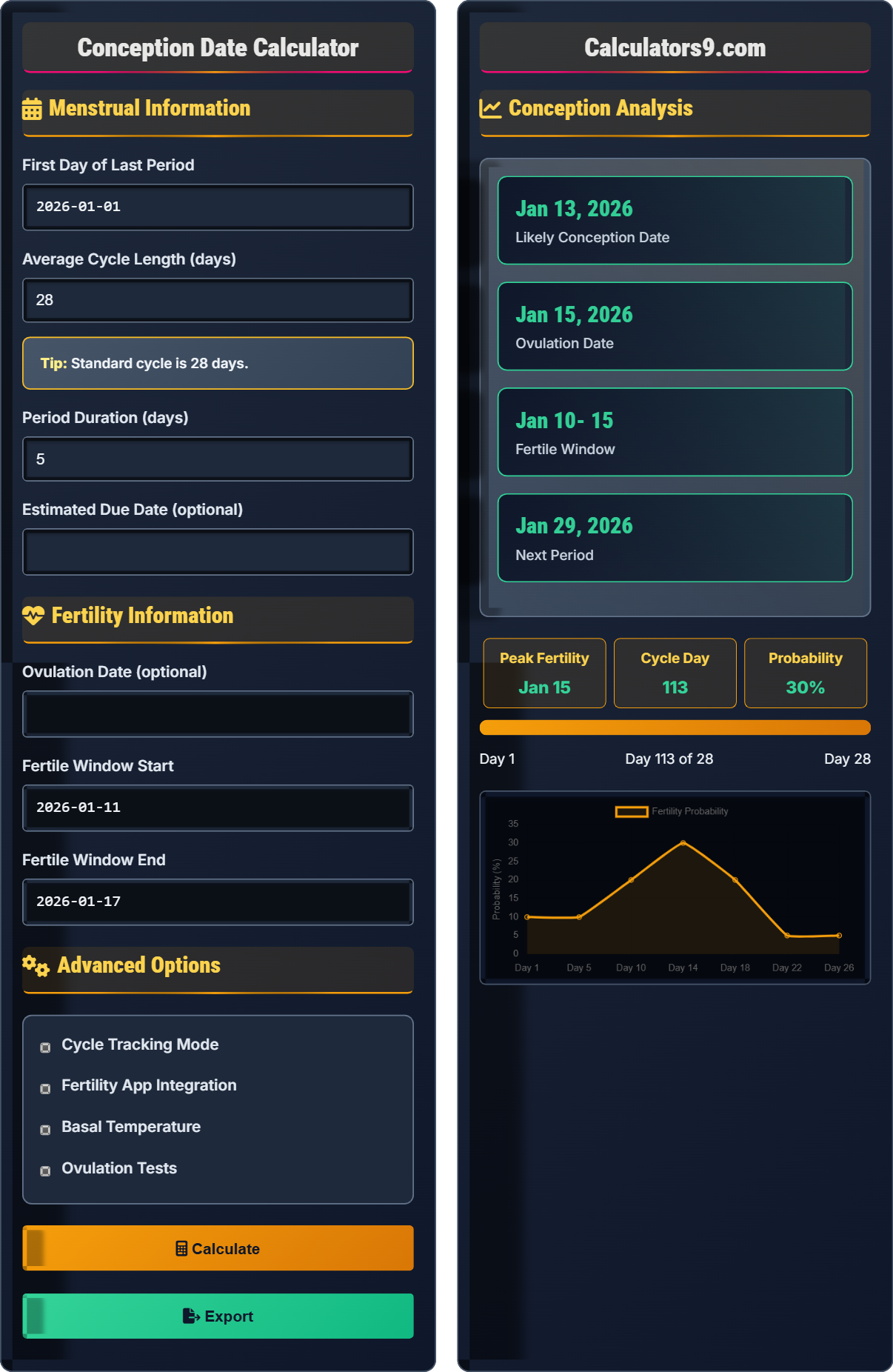
Ovulation date: January 1 + 28 - 14 = January 15, 2026
Conception likely between: January 13-17, 2026
This provides a 5-day fertile window around ovulation.
Menstrual Information
Fertility Information
Advanced Options
Conception Analysis
| Date | Day | Phase | Fertility |
|---|
| Phase | Days | Description | Signs |
|---|
Fertility Insights
Conception Planning Guide
Conception occurs when a sperm fertilizes an egg during the fertile window around ovulation. The fertile window typically spans 5-6 days ending on the day of ovulation. Understanding your menstrual cycle is crucial for optimizing conception timing.
The conception date is estimated based on the menstrual cycle:
Where:
- \(CD\) = Conception date
- \(LMP\) = Last menstrual period
- \(CL\) = Cycle length
- \(14\) = Days from ovulation to next period
Timing intercourse during the fertile window maximizes conception chances:
- 5 days before ovulation: 10% chance
- 4 days before ovulation: 16% chance
- 3 days before ovulation: 14% chance
- 2 days before ovulation: 27% chance
- 1 day before ovulation: 31% chance
- Day of ovulation: 33% chance
- Track your cycle: Use apps or calendars to identify patterns
- Monitor ovulation: Look for cervical mucus changes
- Have regular intercourse: Every 2-3 days during fertile window
- Maintain health: Exercise, eat well, avoid smoking
- Reduce stress: High stress can affect fertility
Conception Basics
Fertilization of egg by sperm.
\(CD = LMP + CL - 14\)
Where CD=conception date, LMP=last period, CL=cycle length.
- Ovulation occurs 14 days before next period
- Fertile window is 5-6 days
- Peak fertility 1-2 days before ovulation
Planning Strategies
Days with highest conception probability.
- Record period start dates
- Calculate average cycle length
- Identify ovulation day
- Plan intercourse during fertile window
- Irregular cycles require different approaches
- Age affects fertility
- Health impacts conception
- Patience is important
Conception Planning Learning Quiz
When does ovulation typically occur in a 28-day menstrual cycle?
The answer is B) Day 14. In a typical 28-day menstrual cycle, ovulation occurs approximately 14 days before the next expected period. This is because the luteal phase (from ovulation to the next period) is typically 14 days long regardless of cycle length. So for a 28-day cycle: 28 - 14 = Day 14.
The key to understanding ovulation timing is recognizing that the luteal phase remains relatively constant at about 14 days. This means that regardless of the total cycle length, ovulation will occur 14 days before the next period. For a 28-day cycle, that's Day 14; for a 30-day cycle, it's Day 16.
Ovulation: Release of mature egg from ovary
Luteal Phase: Period after ovulation until next period
Follicular Phase: Period from period start until ovulation
• Luteal phase is typically 14 days
• Ovulation = Cycle length - 14
• Fertile window occurs before ovulation
• Track multiple cycles to identify patterns
• Use ovulation predictor kits
• Monitor cervical mucus changes
• Assuming ovulation always occurs on Day 14
• Not accounting for cycle variations
• Missing the fertile window timing
If a woman's last menstrual period started on February 1, 2026, and her cycle length is 30 days, what is her ovulation date?
Using the ovulation formula:
Ovulation date = LMP + Cycle Length - 14
Ovulation date = February 1 + 30 days - 14 days
Ovulation date = February 1 + 16 days = February 17, 2026
The ovulation date is February 17, 2026.
This calculation demonstrates how to determine ovulation date based on the first day of the last period and average cycle length. The key insight is that ovulation occurs 14 days before the next expected period, regardless of the total cycle length. This formula works for any regular cycle length.
LMP: Last Menstrual Period
Cycle Length: Days from first day of one period to first day of next
Ovulation Date: Day egg is released
• Ovulation = LMP + Cycle Length - 14
• Luteal phase is typically 14 days
• Fertile window precedes ovulation
• Calculate for multiple cycles
• Track to confirm pattern
• Use calendar for accuracy
• Forgetting to subtract 14 days
• Counting incorrectly
• Not accounting for irregular cycles
Sarah has a 26-day menstrual cycle. Her last period started on March 5, 2026. When is her most fertile time for conception, and what is the likely conception date?
Step 1: Calculate ovulation date
Ovulation date = LMP + Cycle Length - 14
Ovulation date = March 5 + 26 - 14 = March 5 + 12 = March 17, 2026
Step 2: Determine fertile window
Peak fertility occurs 1-2 days before ovulation
Fertile window: March 12-17, 2026 (5-6 days)
Step 3: Likely conception date
Most likely during peak fertility: March 15-17, 2026
Sarah's most fertile time is March 12-17, with peak fertility on March 15-17.
This problem demonstrates how to calculate the fertile window for conception. The fertile window includes the days leading up to ovulation when sperm can survive and wait for the egg. The most fertile days are typically 1-2 days before ovulation when the egg is about to be released.
Fertile Window: Days with conception possibility
Peak Fertility: Highest conception probability
Sperm Survival: Sperm can live 3-5 days in reproductive tract
• Fertile window is 5-6 days
• Peak fertility 1-2 days before ovulation
• Sperm can survive up to 5 days
• Have intercourse every 2 days during window
• Look for cervical mucus changes
• Use ovulation predictor kits
• Only having intercourse on ovulation day
• Not accounting for sperm survival
• Missing the full fertile window
Maria has irregular cycles ranging from 25 to 32 days. She wants to conceive. How should she adjust her conception planning compared to someone with regular 28-day cycles? What methods can she use to identify her fertile window?
For irregular cycles, Maria cannot rely on calendar calculations alone. Instead, she should:
1. Track multiple cycles to identify patterns: Average cycle length = (25+32)/2 = 28.5 days
2. Use ovulation predictor kits (OPKs) to detect LH surge
3. Monitor basal body temperature (BBT) for temperature rise
4. Observe cervical mucus changes (becomes clear, stretchy)
5. Consider fertility apps that track multiple signs
Her fertile window will vary each month, so she needs more precise tracking methods than calendar calculations.
Irregular cycles require different approaches because the standard calendar method becomes unreliable. Women with irregular cycles need to use multiple tracking methods to identify their fertile window. The combination of OPKs, BBT tracking, and cervical mucus observation provides more accurate results than calendar calculations alone.
Irregular Cycles: Varying lengths from month to month
LH Surge: Hormone spike indicating ovulation
BBT: Basal Body Temperature tracking
• Calendar method unreliable for irregular cycles
• Use multiple tracking methods
• Track for several months to identify patterns
• Keep detailed records
• Use fertility tracking apps
• Consult healthcare provider if cycles are very irregular
• Using calendar method for irregular cycles
• Not tracking multiple signs
• Getting frustrated with inconsistent patterns
According to fertility research, when is the probability of conception highest?
The answer is B) 2 days before ovulation. Research shows that the probability of conception is highest 1-2 days before ovulation, with studies indicating approximately 30-33% chance during this time. This is because sperm can survive in the reproductive tract for up to 5 days, waiting for the egg, while the egg is only viable for 12-24 hours after release.
The peak fertility window occurs just before ovulation because of the different lifespans of sperm and eggs. Sperm can survive for 3-5 days in optimal conditions, while the egg is only viable for about 12-24 hours after ovulation. This creates a window where sperm are already present when the egg is released, maximizing the chance of fertilization.
Fertility Probability: Likelihood of conception
Sperm Lifespan: Duration sperm remain viable
Egg Lifespan: Duration egg remains fertilizable
• Peak fertility 1-2 days before ovulation
• Sperm survive longer than eggs
• Fertile window opens before ovulation
• Have intercourse every 1-2 days during fertile window
• Don't wait until ovulation day
• Plan ahead of ovulation
• Only having intercourse on ovulation day
• Not accounting for sperm survival
• Missing the pre-ovulation fertile window
FAQ
Q: How accurate is conception date calculation?
A: Conception date calculation is an estimate with a margin of error. The formula:
\( \text{Conception Date} = \text{LMP} + \text{Cycle Length} - 14 \)
Provides a likely date within 2-3 days of actual conception. Factors affecting accuracy include irregular cycles, variation in luteal phase length, and uncertainty about exact ovulation timing. Ultrasound measurements in early pregnancy provide more accurate dating.
Q: What are the signs of ovulation?
A: Common signs of ovulation include:
• Cervical mucus becomes clear, stretchy (egg-white consistency)
• Slight increase in basal body temperature (0.5-1°F)
• Mild pelvic pain or cramping (mittelschmerz)
• Increased sexual desire
• Breast tenderness
These signs, combined with ovulation predictor kits, can help identify the fertile window. The probability equation shows peak fertility 1-2 days before ovulation.