Diaper Cost Calculator
Plan your baby's expenses • 2026 edition
Diaper Cost Formula:
Show the calculator\( \text{Total Diaper Cost} = \sum_{i=1}^{n} (\text{Diapers per Day}_i \times \text{Price per Diaper}_i \times \text{Days}_i) \)
Where:
- \( \text{Diapers per Day}_i \) = Average number of diapers used per day in stage i
- \( \text{Price per Diaper}_i \) = Cost of one diaper in stage i
- \( \text{Days}_i \) = Number of days in stage i
- \( n \) = Number of diaper stages (Newborn, Infant, Toddler)
This formula calculates the total cost of diapers over the entire period a baby wears them. Diapers are typically used in 3 stages with different quantities and prices:
\( \text{Daily Cost} = \frac{\text{Pack Price}}{\text{Diapers per Pack}} \)
According to research, babies use approximately 2,500-3,000 diapers in their first year, with costs ranging from $500-$1,000 annually.
Example: For a baby using 8 diapers per day in newborn stage (0-3 months) at $0.30 per diaper:
Days in stage: 90 days
Diapers per day: 8
Price per diaper: $0.30
Stage cost: 8 × $0.30 × 90 = $216
This formula helps parents budget for this essential recurring expense.
Baby Information
Brand Preferences
Advanced Options
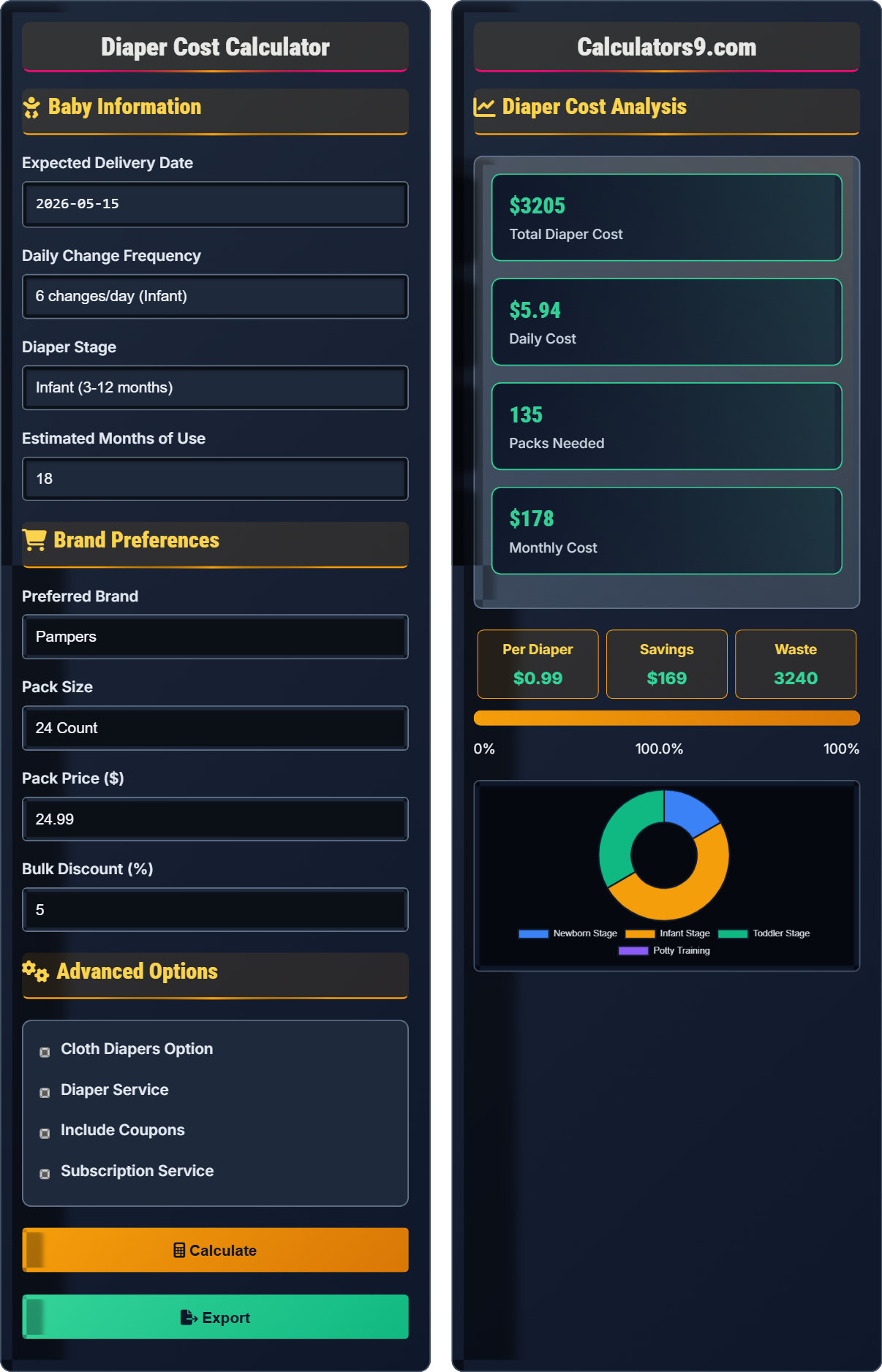
Diaper Cost Analysis
| Category | Quantity | Unit Cost | Total |
|---|
| Brand | Price/Pack | Price/Diaper | Annual Cost |
|---|
Cost Comparison
Diaper Cost Planning Guide
Diapers are one of the largest recurring expenses for new parents. On average, babies use 2,500-3,000 diapers in their first year, costing $500-$1,000. Planning for these expenses helps ensure financial preparedness for your baby's needs.
The total cost calculation follows this formula:
Where:
- \( \text{Diapers/Day} = \) Average daily usage by stage
- \( \text{Days} = \) Number of days in each stage
- \( \text{Price/Diaper} = \) Cost per individual diaper
Ways to reduce diaper expenses:
- Buy in bulk: 10-20% savings on larger packs
- Use coupons: Retailer and manufacturer discounts
- Join subscription services: 5-15% regular discounts
- Compare brands: Store brands cost 30-50% less
- Wait for sales: Stock up during promotions
- Plan ahead: Budget for 2,500-3,000 diapers in first year
- Track usage: Monitor actual vs. estimated consumption
- Set monthly budget: Allocate $40-80 monthly for diapers
- Consider cloth: Higher initial cost, lower long-term expense
- Factor in accessories: Wipes, rash cream, disposal bags
Diaper Cost Basics
Essential baby expense.
\( \text{Total} = \text{Daily} \times \text{Days} \times \text{Unit Price} \)
Based on usage patterns.
- Plan for 2,500-3,000 diapers
- Monthly budget $40-80
- Consider bulk purchasing
Budgeting Strategies
Reducing ongoing expenses.
- Compare brand prices
- Use coupons and promotions
- Buy in bulk when on sale
- Consider store brands
- Balance cost with quality
- Factor in baby's sensitivity
- Consider environmental impact
- Plan for changing needs
Diaper Cost Planning Learning Quiz
How many diapers does the average baby use in their first year of life?
The answer is C) 2,500-3,000. The average baby uses approximately 2,500-3,000 diapers in their first year. This is based on an average of 8 diapers per day for the first 3 months, 6 per day for months 4-12, and 4 per day for months 13-18. This high usage rate makes diapers one of the largest recurring expenses for new parents.
Understanding diaper usage patterns helps parents budget appropriately. The high number of diapers needed in the first year emphasizes the importance of planning for this expense. Parents should consider this when creating their baby budget and look for ways to reduce costs without compromising quality.
Diaper Usage: Number of diapers used per day
Annual Need: Total diapers in first year
Recurring Expense: Regular ongoing cost
• Plan for 2,500-3,000 diapers
• Usage decreases with age
• Budget accordingly
• Stock up during sales
• Compare unit prices
• Consider bulk purchases
• Underestimating total usage
• Not budgeting for this expense
• Focusing only on pack price
If a pack of 40 diapers costs $28.00, what is the cost per diaper?
Cost per diaper = Pack price ÷ Number of diapers
Cost per diaper = $28.00 ÷ 40 = $0.70
The cost per diaper is $0.70.
This calculation is essential for comparing diaper brands and sizes. Parents should focus on cost per diaper rather than pack price when making purchasing decisions. This allows for accurate comparison regardless of pack size differences.
Unit Cost: Price per individual diaper
Comparison Shopping: Evaluating optionsValue Calculation: Cost-effectiveness
• Calculate cost per diaper
• Compare unit prices
• Consider bulk discounts
• Compare prices across retailers
• Factor in shipping for online purchases
• Consider subscription discounts
• Comparing pack prices only
• Not considering bulk savings
• Ignoring additional costs
Sarah's baby uses 8 diapers per day for the first 3 months, then 6 diapers per day for the remaining 9 months of the first year. If each diaper costs $0.30, what is the total annual cost for diapers?
Step 1: Calculate costs for first 3 months
Days: 3 × 30 = 90 days
Diapers: 90 × 8 = 720 diapers
Cost: 720 × $0.30 = $216
Step 2: Calculate costs for remaining 9 months
Days: 9 × 30 = 270 days
Diapers: 270 × 6 = 1,620 diapers
Cost: 1,620 × $0.30 = $486
Step 3: Calculate total annual cost
Total cost: $216 + $486 = $702
The total annual cost for diapers is $702.
This problem demonstrates how diaper usage changes over time and how to calculate total costs across different stages. The decreasing usage as babies grow is important for accurate budgeting. Parents can use this pattern to plan their diaper purchases accordingly.
Usage Pattern: Changing diaper needs over time
Annual Planning: Budgeting for full year
Staged Budgeting: Planning by development stage
• Account for changing usage patterns
• Calculate by time periods
• Sum all periods for total
• Plan purchases by stage
• Stock up on smaller sizes early
• Adjust as baby grows
• Assuming constant usage throughout year
• Not accounting for size changes
• Forgetting to adjust for growth
A regular pack of 32 diapers costs $24.00 at the store. A bulk pack of 96 diapers costs $60.00. What percentage of money is saved per diaper by buying the bulk pack instead of three regular packs?
Step 1: Calculate cost per diaper for regular pack
Regular pack: $24.00 ÷ 32 = $0.75 per diaper
Step 2: Calculate cost per diaper for bulk pack
Bulk pack: $60.00 ÷ 96 = $0.625 per diaper
Step 3: Calculate savings per diaper
Savings: $0.75 - $0.625 = $0.125 per diaper
Step 4: Calculate percentage savings
Percentage savings: ($0.125 ÷ $0.75) × 100 = 16.67%
Buying the bulk pack saves 16.67% per diaper compared to three regular packs.
This problem demonstrates the value of bulk purchasing for consumable items like diapers. The percentage savings calculation helps quantify the benefit of buying larger quantities. For parents purchasing thousands of diapers, even small percentage savings can result in significant dollar savings over time.
Bulk Purchasing: Buying larger quantities
Unit Economics: Cost per individual item
Percentage Savings: Relative cost reduction
• Compare unit costs
• Consider storage capacity
• Factor in expiration
• Wait for sales before bulk buying
• Consider storage space
• Check for bulk discounts
• Not comparing unit prices
• Buying too much without storage
• Missing out on bulk savings
Which of the following is the most effective strategy for reducing diaper costs over the first year?
The answer is C) Buying in bulk during sales. This strategy can reduce diaper costs by 15-25% without sacrificing quality or convenience. While cloth diapers may have lower long-term costs, they require significant initial investment and ongoing maintenance. Bulk purchasing offers consistent savings throughout the diaper-wearing period.
Bulk purchasing during sales is the most practical cost-saving strategy for most families. It maintains convenience while achieving significant savings. This approach works for both disposable and cloth diapers and can be combined with other strategies for maximum savings.
Cost-Effectiveness: Value relative to expense
Practical Strategy: Feasible for most families
Convenience Factor: Ease of implementation
• Combine multiple strategies
• Balance cost with convenience
• Consider baby's needs
• Sign up for retailer loyalty programs
• Use manufacturer coupons
• Plan purchases around sales cycles
• Focusing on single strategy only
• Sacrificing quality for savings
• Not planning purchases
FAQ
Q: How can I calculate the cost per diaper for different brands?
A: Use the formula:
\( \text{Cost per Diaper} = \frac{\text{Pack Price}}{\text{Number of Diapers in Pack}} \)
For example, if a pack of 32 diapers costs $24.00: $24.00 ÷ 32 = $0.75 per diaper. Compare this value across brands and pack sizes to find the best value. Don't forget to factor in bulk discounts or subscription savings.
Q: Are cloth diapers really more cost-effective than disposables?
A: Yes, cloth diapers can be more cost-effective over time:
Initial investment: $200-400 for 20-24 cloth diapers
Annual running cost: ~$50 for detergent and water
Total 2-year cost: ~$300-500
Disposables: $500-1,000 annually
However, consider the time investment for washing and the convenience factor. The break-even point is typically 10-12 months.