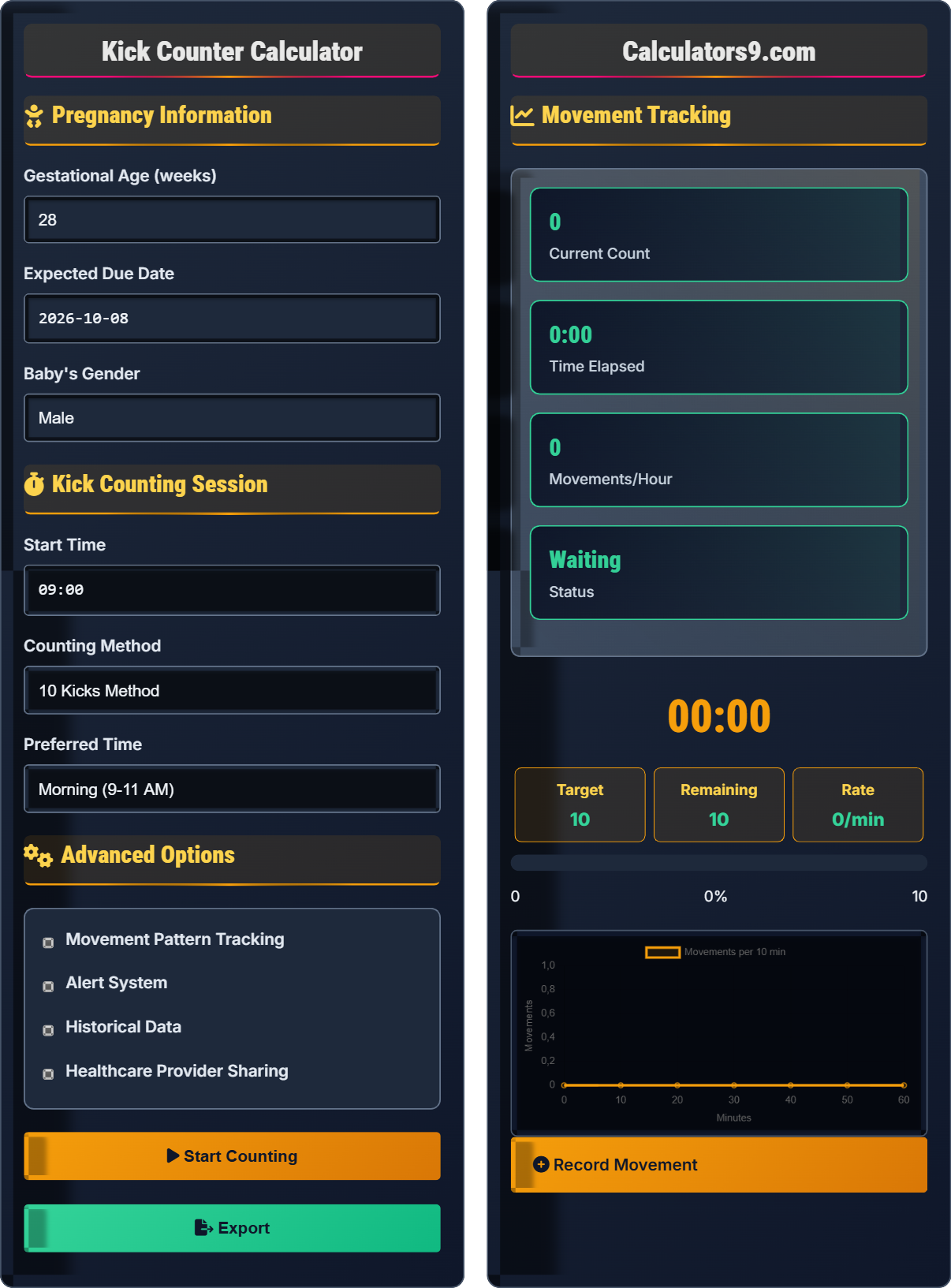
Kick Counter Calculator
Track your baby's movements • 2026 edition
Kick Counting Formula:
Show the calculator\( \text{Movement Rate} = \frac{\text{Number of Kicks}}{\text{Time Interval}} \)
Where:
- \( \text{Number of Kicks} \) = Count of fetal movements
- \( \text{Time Interval} \) = Duration of observation period
According to medical guidelines, expectant mothers should feel at least 10 movements within 2 hours of counting. The "10-kick rule" is a common monitoring method:
\( \text{Target Movements} = 10 \text{ kicks in } 2 \text{ hours} \)
This monitoring technique helps assess fetal well-being. A healthy baby typically moves 15-20 times per hour. The kick counting method provides a simple way for expectant parents to monitor their baby's activity.
Example: If you count 8 movements in 1.5 hours:
Movement rate = 8 kicks ÷ 1.5 hours = 5.3 kicks per hour
Since the expected rate is ~10 kicks per 2 hours (or 5 per hour), you're approaching the target but should continue monitoring.
Pregnancy Information
Kick Counting Session
Advanced Options
Movement Tracking
| Time | Movement | Intensity | Notes |
|---|
| Date | Movements | Time | Status |
|---|
Movement Guidelines
Fetal Movement Monitoring Guide
Fetal movement counting is a simple way to monitor your baby's well-being. Regular movement indicates that your baby is healthy and receiving adequate oxygen. After 28 weeks, babies move less frequently but more strongly.
The "10-kick rule" is a standard monitoring method:
Where:
- \( \text{Movements} \) = Kicks, rolls, jabs, or punches
- \( \text{Time Limit} \) = Maximum 2 hours for 10 movements
Expected movement by gestational age:
- 20-24 weeks: Gentle flutters and movements
- 24-28 weeks: Stronger kicks and rolls
- 28-32 weeks: Frequent strong movements
- 32+ weeks: Less frequent but stronger movements
- Count daily: Establish a routine at the same time
- Be patient: Some babies take longer to reach 10 movements
- Track patterns: Note when baby is most active
- Call if concerned: If baby is less active than usual
- Don't panic: Babies have quiet periods too
Movement Monitoring Basics
Monitoring baby's movements.
Count 10 movements in 2 hours.
Record each distinct movement.
- Count daily after 28 weeks
- Expect 10 movements in 2 hours
- Call doctor if fewer than 10 in 2 hours
Monitoring Strategies
When baby is most active.
- Choose consistent time daily
- Get comfortable lying on side
- Record each movement
- Note time for each movement
- Activity varies by time of day
- Some babies are more active
- Pattern changes as pregnancy progresses
- Trust your instincts
Fetal Movement Monitoring Learning Quiz
According to medical guidelines, how many fetal movements should a pregnant woman feel in 2 hours?
The answer is B) 10 movements. The standard "10-kick rule" recommends that pregnant women should feel at least 10 distinct fetal movements within a 2-hour period. This is a widely accepted method for monitoring fetal well-being after 28 weeks of pregnancy.
The 10-kick rule is a simple, non-invasive way for expectant mothers to monitor their baby's activity. Healthcare providers recommend this method because consistent fetal movement indicates that the baby is receiving adequate oxygen and nutrients. The 2-hour timeframe accounts for the natural variation in baby's activity patterns.
10-Kick Rule: Standard fetal movement counting method
Fetal Movement: Kicks, rolls, jabs, or punches
Well-being: Indication of baby's health
• Count 10 movements in 2 hours
• After 28 weeks of pregnancy
• Contact healthcare provider if not reached
• Count after eating when baby is active
• Lie on your side for better sensation
• Keep a consistent daily schedule
• Not counting after 28 weeks
• Giving up too early
• Confusing hiccups with movements
If a pregnant woman counts 8 movements in 1.5 hours, what is the movement rate per hour?
Movement rate = Number of movements ÷ Time interval
Movement rate = 8 movements ÷ 1.5 hours = 5.33 movements per hour
The movement rate is approximately 5.3 movements per hour.
This calculation helps understand the baby's movement pattern over time. The standard expectation is approximately 5 movements per hour (since 10 movements in 2 hours equals 5 per hour). At 5.3 movements per hour, the baby is meeting the expected rate.
Movement Rate: Movements per unit of time
Time Interval: Duration of observation
Expected Rate: Normal movement frequency
• Calculate rate for better understanding
• Compare to expected values
• Track patterns over time
• Use consistent time intervals
• Compare rates over days
• Note patterns and triggers
• Not accounting for time intervals
• Confusing different types of movements
• Not tracking consistently
Sarah has been counting kicks for 2 hours and has only felt 6 movements. According to medical guidelines, what should she do?
According to the 10-kick rule, Sarah should feel at least 10 movements within 2 hours. Since she has only counted 6 movements after 2 full hours, she has not met the minimum requirement. Medical guidelines recommend calling her healthcare provider when fewer than 10 movements are felt in 2 hours.
Steps Sarah should take:
1. Stop the counting session
2. Contact her healthcare provider immediately
3. Report the results of her kick count
4. Follow provider's instructions for next steps
This scenario demonstrates the importance of the 10-kick rule as a safety measure. When babies move less than expected, it could indicate potential issues such as umbilical cord compression or reduced oxygen supply. Healthcare providers can perform additional assessments like non-stress tests to ensure the baby's well-being.
Medical Guidelines: Professional recommendations
Healthcare Provider: Doctor or midwife
Non-Stress Test: Fetal heart rate monitoring
• Call provider if <10 movements in 2 hours
• Don't delay seeking help
• Follow professional advice
• Keep provider's contact information handy
• Don't hesitate to call if concerned
• Document the counting session details
• Waiting to see if baby becomes more active
• Not contacting provider when concerned
• Assuming baby is just sleeping
Emily notices that her baby is most active between 7-9 PM but barely moves during the day. She's at 32 weeks gestation. How should she interpret this pattern and when should she do her kick counts?
This is a normal pattern for many babies. As pregnancy progresses, babies develop sleep-wake cycles, and many are more active during evening hours when the mother is resting. Emily should do her kick counts during the time when her baby is typically most active - in this case, between 7-9 PM.
Key considerations:
• Babies often become more active after the mother eats
• Evening hours are common for increased activity
• Each baby has unique patterns
• Consistency in timing helps track changes
Emily should continue counting during her baby's active time and report any significant changes in the pattern.
Fetal movement patterns are unique to each baby and can vary significantly. As babies mature, they develop sleep-wake cycles similar to newborns. Understanding these patterns helps mothers know when to expect activity and notice changes that might indicate concerns. Consistency in counting time helps establish baseline patterns.
Sleep-Wake Cycles: Baby's rest and activity patterns
Baseline Patterns: Normal activity for individual babyConsistency: Regular timing for comparisons
• Count during baby's active time
• Establish consistent timing
• Watch for pattern changes
• Learn your baby's unique patterns
• Count after eating or drinking
• Try different positions to encourage movement
• Counting during baby's quiet time
• Not accounting for individual patterns
• Comparing to other pregnancies
How does fetal movement intensity typically change as pregnancy progresses beyond 28 weeks?
The answer is B) Movements become stronger but less frequent. After 28 weeks, babies have less space to move in the uterus, so movements may become less frequent but more forceful. The baby is larger and stronger, making movements feel more intense even though they occur less often.
As pregnancy advances, the baby grows larger and has less room to move freely in the uterus. This leads to fewer overall movements but each movement is typically stronger and more noticeable. Mothers often describe later movements as "punches" or "jabs" rather than the gentle flutters felt earlier in pregnancy.
Movement Intensity: Strength of fetal movements
Frequency: How often movements occur
Uterine Space: Room available for baby movement
• Movements change as pregnancy progresses
• Strength increases as frequency decreases
• Continue monitoring throughout pregnancy
• Expect pattern changes in third trimester
• Strong movements are often normal
• Focus on consistent patterns
• Worrying about decreased frequency
• Not understanding pattern changes
• Confusing intensity with concern
FAQ
Q: How accurate is kick counting for monitoring baby's health?
A: Kick counting is a valuable screening tool with proven effectiveness. Studies show that decreased fetal movement is associated with increased risk of complications. The formula:
\( \text{Movement Rate} = \frac{\text{Number of Kicks}}{\text{Time Interval}} \)
When applied consistently, kick counting has helped reduce stillbirth rates by alerting mothers to seek care when movements decrease. However, it's not diagnostic - further testing is needed to assess fetal well-being.
Q: What if my baby seems to have quiet periods?
A: Babies do have sleep cycles, typically lasting 20-40 minutes. However, they shouldn't be completely still for more than 2 hours. The 10-kick rule accounts for sleep periods:
• Babies may sleep for up to 40 minutes at a time
• After 2 hours of counting, you should feel 10 movements
• If baby seems unusually quiet, try eating or changing position to stimulate activity
• Contact your healthcare provider if concerned
Remember: any significant change from your baby's normal pattern warrants medical attention.