Milestone Tracker Calculator
Track baby development milestones • 2026 edition
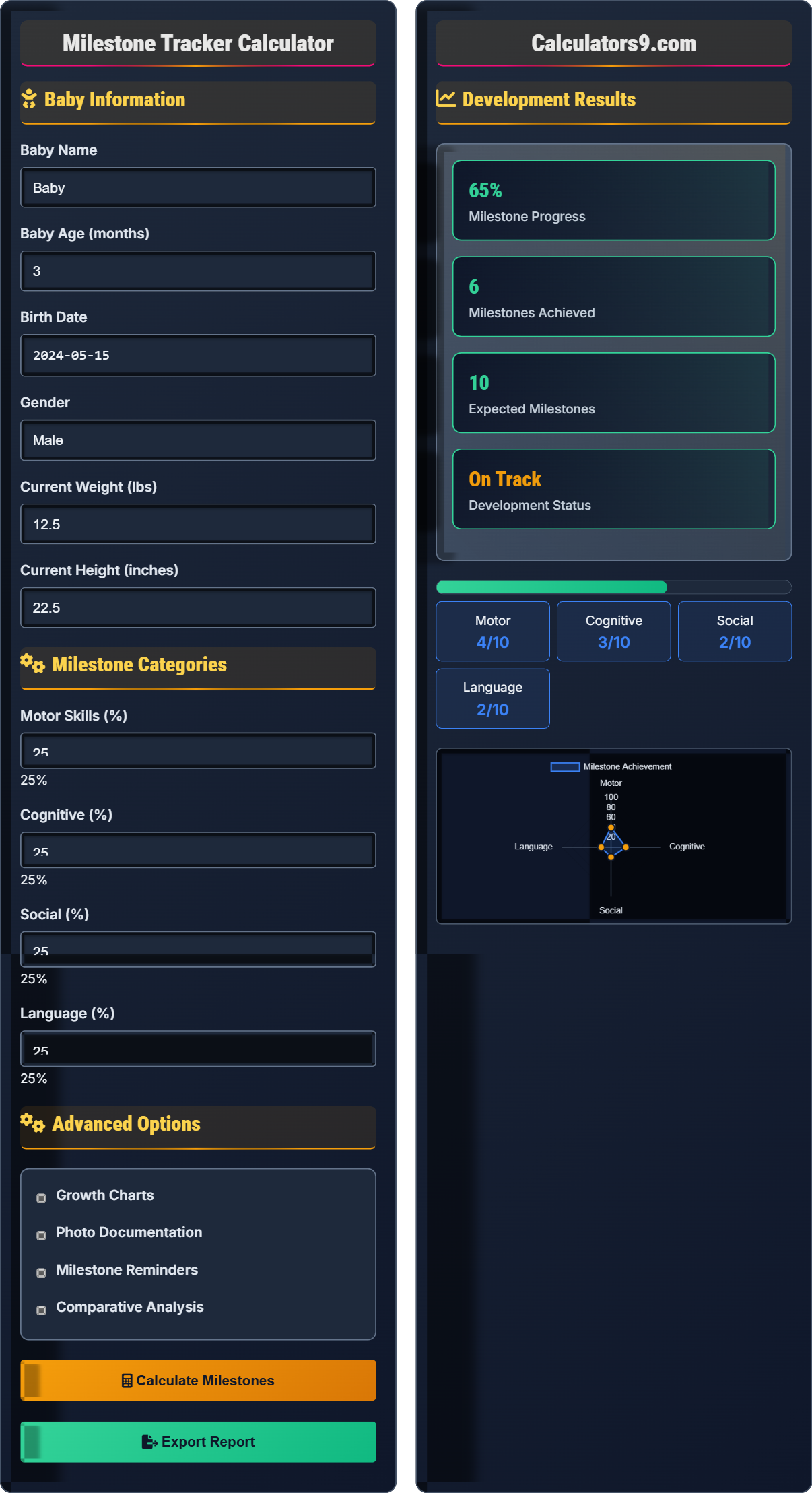
Development Milestone Formula:
Show the calculator\( \text{Milestone Progress} = \frac{\text{Achieved Milestones}}{\text{Expected Milestones}} \times 100\% \)
Where:
- \( \text{Achieved Milestones} \) = Number of milestones the baby has reached
- \( \text{Expected Milestones} \) = Number of milestones typically expected at baby's age
- \( \text{Milestone Progress} \) = Percentage of expected development achieved
This formula helps track and evaluate baby's developmental progress against standard benchmarks.
Example: For a 6-month-old baby with 15 achieved milestones out of 20 expected:
Progress: \( \frac{15}{20} \times 100\% = 75\% \)
Thus, the baby has achieved 75% of expected milestones for their age.
Baby Information
Milestone Categories
Advanced Options
Development Results
Milestone Tracking Guide
Developmental milestones are behavioral or physical checkpoints that children reach by a certain age. They help track healthy development across motor, cognitive, social, and language domains.
Track progress by comparing achieved milestones to expected benchmarks for baby's age. Monitor all four domains: motor skills, cognitive abilities, social interaction, and language development.
- Every child develops differently
- Range of normal development is wide
- Consult pediatrician if concerned
- Focus on progress, not perfection
Development Domains
Child development occurs across four main domains: Motor (physical abilities), Cognitive (thinking skills), Social (interaction), and Language (communication).
- Motor: Physical abilities and coordination
- Cognitive: Thinking, learning, problem-solving
- Social: Interaction with others
- Language: Communication skills
- Domains influence each other
- Environment impacts development
- Early intervention helps significantly
- Regular monitoring is important
Development Milestone Quiz
Which milestone is typically achieved first in newborn development?
The answer is C) Basic reflexes. Newborns are born with essential reflexes like sucking, grasping, and the startle reflex. These basic reflexes appear immediately at birth, while social smiling typically occurs around 6-8 weeks, holding head up around 1-2 months, and grasping objects around 2-3 months.
Understanding the sequence of milestone achievement helps parents set appropriate expectations. Basic reflexes are automatic responses that are present at birth and serve survival functions. These precede voluntary movements and intentional behaviors, which develop later as the nervous system matures.
Developmental Milestone: Behavioral or physical checkpoint achieved by a certain age
Basic Reflexes: Automatic responses present at birth for survival
Milestone Sequence: Order in which developmental abilities typically emerge
• Basic reflexes appear first at birth
• Voluntary movements develop later
• Each domain has its own timeline
• Learn the typical sequence of milestones
• Focus on ranges, not exact ages
• Celebrate each achievement
• Expecting all milestones at exact ages
• Comparing to other babies too closely
• Missing early reflexive behaviors
Calculate the milestone progress percentage if a 4-month-old baby has achieved 12 out of 16 expected milestones. Show your work and interpret the result.
Formula: Milestone Progress = (Achieved Milestones / Expected Milestones) × 100%
Given:
- Achieved Milestones = 12
- Expected Milestones = 16
Calculation: (12 / 16) × 100% = 0.75 × 100% = 75%
Interpretation: The baby has achieved 75% of the expected milestones for their age, which indicates good developmental progress within the normal range.
This calculation provides an objective measure of developmental progress. A 75% achievement rate indicates that the child is meeting most, but not all, of the expected milestones for their age. This is within the normal range of variation in development, as children don't typically achieve 100% of milestones simultaneously. The percentage helps identify areas of strength and potential focus areas.
Milestone Progress: Percentage of expected achievements reached
Expected Milestones: Benchmarks for a given age group
Developmental Range: Normal variation in achievement timing
• Normal range is typically 50-100%
• Percentages provide comparative measures
• Individual variation is expected
• Calculate progress regularly to track trends
• Focus on consistent progress over time
• Use percentages as general guidance
• Expecting 100% achievement at all times
• Overreacting to minor delays
• Not accounting for normal variation
Jennifer's 5-month-old daughter has achieved 14 out of 18 expected motor skill milestones, 12 out of 15 cognitive milestones, 10 out of 12 social milestones, and 8 out of 10 language milestones. Calculate the overall milestone progress and determine which domain is developing fastest.
Step 1: Calculate progress for each domain
Motor: (14/18) × 100% = 77.8%
Cognitive: (12/15) × 100% = 80.0%
Social: (10/12) × 100% = 83.3%
Language: (8/10) × 100% = 80.0%
Step 2: Calculate total achievements
Achieved: 14 + 12 + 10 + 8 = 44
Expected: 18 + 15 + 12 + 10 = 55
Overall progress: (44/55) × 100% = 80.0%
Step 3: Determine fastest developing domain
Social development is progressing fastest at 83.3%
This problem demonstrates how to analyze development across multiple domains. The social domain shows the highest achievement rate, indicating the child is particularly strong in this area. The overall 80% indicates good progress, with some domains developing faster than others, which is normal. This kind of analysis helps identify strengths and potential areas needing support.
Domain Analysis: Evaluating development in specific areas
Strength Identification: Recognizing areas of exceptional progress
Support Areas: Domains needing additional focus
• Domains develop at different rates
• Strengths can compensate for slower areas
• Overall progress is what matters most
• Track each domain separately
• Celebrate domain-specific achievements
• Provide targeted support where needed
• Focusing only on overall scores
• Not recognizing domain-specific strengths
• Overlooking areas needing support
David notices his 8-month-old son has only achieved 6 out of 12 expected language milestones while achieving 10 out of 12 in other domains. Calculate the language development percentage and suggest an appropriate response based on this finding.
Step 1: Calculate language development percentage
Language progress: (6/12) × 100% = 50%
Step 2: Analyze the situation
The language development is at 50%, which is significantly lower than the 83% in other domains (30/36).
Step 3: Suggested response
Since language development is lagging, David should:
- Engage in more verbal interactions with his son
- Read books together daily
- Describe activities and objects during daily routines
- Consult with a pediatrician about the delay
- Consider early intervention services if recommended
This scenario demonstrates how milestone tracking can identify specific areas of concern. The 50% achievement in language while other domains are at 83% suggests a potential delay that warrants attention. Early identification and intervention are crucial for addressing developmental delays. The calculation helps quantify the concern and provides a basis for action.
Developmental Delay: Significant lag in achieving expected milestones
Early Intervention: Services provided to address delays before age 3
Quantitative Assessment: Using numbers to evaluate development
• Address significant delays early
• Quantify concerns for documentation
• Consult professionals when needed
• Track changes over time to identify patterns
• Document concerns with specific examples
• Seek support early for better outcomes
• Dismissing early signs of delays
• Waiting too long to seek help
• Not tracking progress consistently
Which statement best describes the importance of tracking developmental milestones?
The answer is B) To identify potential developmental delays early. Milestone tracking serves as an early warning system to detect when a child may be experiencing developmental challenges. Early identification allows for timely intervention, which is most effective when started young. While children do develop at different rates, tracking helps distinguish between normal variation and concerning delays.
Milestone tracking is a valuable screening tool rather than a competitive measure. Its primary purpose is to monitor healthy development and catch potential issues early. The goal is not to accelerate development but to ensure appropriate support when needed. Early intervention during critical periods can significantly improve outcomes for children experiencing delays.
Screening Tool: Method to identify potential issues early
Early Intervention: Support provided during critical development periods
Developmental Surveillance: Ongoing monitoring of development
• Early detection improves outcomes
• Individual variation is normal
• Professional guidance is essential
• Track consistently over time
• Focus on trends rather than single points
• Consult professionals for concerns
• Using milestones as strict deadlines
• Comparing children directly
• Ignoring significant delays
FAQ
Q: My baby hasn't reached a milestone by the expected age. Should I be concerned?
A: Mild delays are often normal as children develop at different rates. However, certain guidelines help determine when to be concerned:
- Delays of 1-2 months in single milestones are usually not concerning
- Multiple delays in one domain warrant evaluation
- Delays across multiple domains need assessment
- Loss of previously acquired skills requires immediate attention
Trust your instincts - if you're concerned, consult your pediatrician. Early intervention is most effective when started early.
Q: How often should I track my baby's milestones?
A: Milestone tracking should occur regularly but not obsessively:
- Weekly observations during rapid development phases (0-6 months)
- Bi-weekly tracking during 6-12 months
- Monthly assessments after 12 months
- During routine pediatric visits
Focus on documenting general trends and notable achievements rather than daily tracking. Consistency is more important than frequency.