Newborn Sleep Calculator
Predict baby's sleep patterns • 2026 edition
Newborn Sleep Formula:
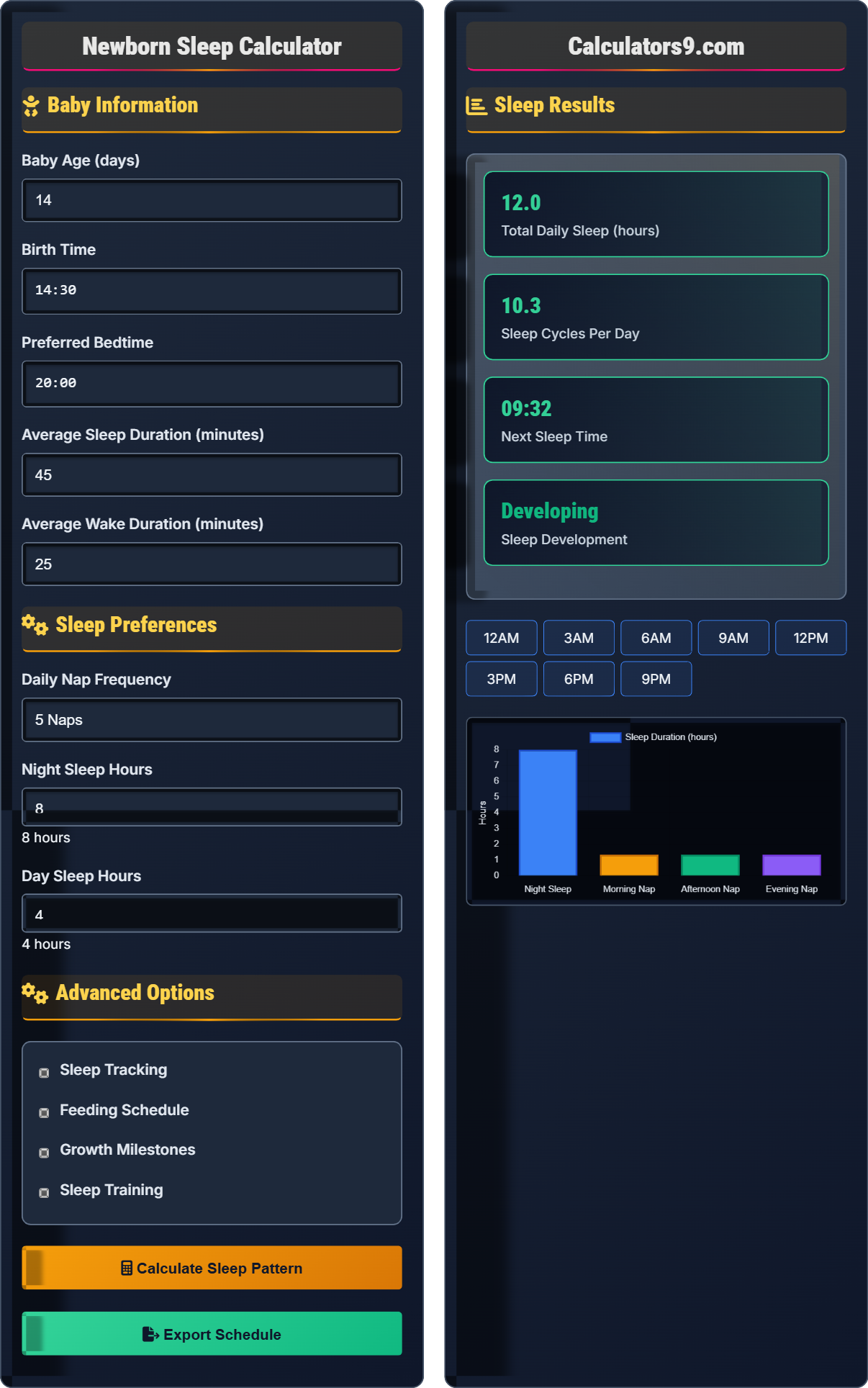
Show the calculator\( \text{Sleep Cycle} = \text{Sleep Duration} + \text{Wake Duration} \)
Where:
- \( \text{Sleep Duration} \) = Average sleep time per cycle (typically 45-60 minutes for newborns)
- \( \text{Wake Duration} \) = Time awake between sleep cycles (typically 15-45 minutes)
- \( \text{Sleep Cycle} \) = Complete cycle of sleep and wake time
This formula helps predict newborn sleep patterns based on their natural sleep-wake cycles.
Example: For a sleep duration of 50 minutes and wake duration of 20 minutes:
Sleep cycle: \( 50 + 20 = 70 \) minutes
Thus, the baby completes a sleep-wake cycle every 70 minutes.
Baby Information
Sleep Preferences
Advanced Options
Sleep Results
| Time | Activity | Duration | Notes |
|---|---|---|---|
| 7:00 AM | Wake Up | 15 min | Diaper Change |
| 7:15 AM | Feeding | 30 min | Breakfast |
| 7:45 AM | Play Time | 45 min | Interactive Play |
| 8:30 AM | Morning Nap | 60 min | Deep Sleep |
| 9:30 AM | Wake Up | 15 min | Diaper Change |
| 9:45 AM | Feeding | 25 min | Snack |
| 10:10 AM | Play Time | 50 min | Quiet Activities |
| 11:00 AM | Mid-Morning Nap | 60 min | Light Sleep |
Newborn Sleep Patterns
Newborns sleep 14-17 hours daily in irregular patterns. Sleep cycles last 50-60 minutes with frequent awakenings for feeding.
Sleep Cycle = Sleep Duration + Wake Duration. Newborns average 45 min sleep + 25 min awake = 70 min cycle.
- Sleep in short bursts initially
- Feeding drives sleep schedule
- Patterns develop over weeks
- Safe sleep practices paramount
Sleep Development
Sleep patterns evolve with development: 0-3 months = frequent naps, 3-6 months = longer stretches, 6+ months = consolidated nights.
- Record sleep times
- Note feeding patterns
- Identify cues
- Establish routines
- Every baby is unique
- Flexibility is key
- Safe sleep practices
- Consult pediatrician
Newborn Sleep Quiz
How many hours do newborns typically sleep per day?
The answer is C) 14-17 hours. Newborns typically sleep 14-17 hours per day, though this sleep is distributed in short bursts throughout the day and night. The sleep is not consolidated into long nighttime stretches until several months after birth.
Understanding normal sleep ranges for newborns helps parents set realistic expectations. Unlike adults who consolidate sleep into one long nighttime period, newborns have small stomachs requiring frequent feeding, which interrupts their sleep. Their circadian rhythms are also not yet established, contributing to irregular sleep patterns.
Newborn Sleep: Sleep pattern of infants under 3 months old
Circadian Rhythm: Internal biological clock regulating sleep-wake cycles
Sleep Consolidation: Process of combining shorter sleep periods into longer ones
• Newborns sleep in 2-4 hour stretches
• Sleep needs vary by individual baby
• Feeding needs drive sleep schedule
• Expect frequent night wakings initially
• Focus on safe sleep practices
• Sleep patterns will improve over time
• Expecting newborns to sleep through the night
• Comparing sleep patterns to older babies
• Ignoring feeding requirements
If a newborn sleeps for 50 minutes and stays awake for 20 minutes, what is the complete sleep-wake cycle duration? Calculate and explain the significance of this cycle length.
Sleep-wake cycle = Sleep duration + Wake duration
Sleep-wake cycle = 50 minutes + 20 minutes = 70 minutes
The complete sleep-wake cycle lasts 70 minutes.
Significance: Newborn sleep cycles are much shorter than adult cycles (which are 90-120 minutes). This explains why newborns wake frequently - they complete their sleep cycle quickly and transition to light sleep or wakefulness. Understanding this helps parents anticipate when their baby might wake up and plan accordingly.
This calculation demonstrates the fundamental difference between adult and newborn sleep architecture. Adult sleep cycles are longer and include deeper stages, while newborn cycles are shorter and include more REM sleep. The 70-minute cycle length means parents can expect their baby to transition between sleep states approximately every hour, which is normal and expected behavior.
Sleep Cycle: Complete sequence of sleep stages including deep and light sleep
REM Sleep: Rapid Eye Movement sleep, associated with dreaming and brain development
Sleep Architecture: Structure and organization of sleep stages
• Newborn cycles are 50-60 minutes long
• Frequent wakings are normal
• Cycle length increases with age
• Learn your baby's cycle length to anticipate needs
• Prepare for transitions at predictable intervals
• Use cycle knowledge for scheduling activities
• Expecting newborns to sleep like adults
• Misinterpreting normal cycles as problems
• Not understanding sleep stage transitions
Sarah's 2-week-old baby currently sleeps 40 minutes and stays awake 30 minutes (70-minute cycle). At 6 weeks, the sleep duration increases to 45 minutes while awake time decreases to 20 minutes. How does this change affect the total sleep-wake cycle, and what does this indicate about the baby's development?
Initial cycle: 40 minutes sleep + 30 minutes awake = 70 minutes total
At 6 weeks: 45 minutes sleep + 20 minutes awake = 65 minutes total
Change: 70 minutes → 65 minutes = 5 minute decrease
This indicates positive development as the baby is getting more consolidated sleep (longer sleep periods) and spending less time awake between sleep periods. This is a normal maturation of the sleep-wake cycle.
This example illustrates how sleep patterns mature over the first few weeks. As babies develop, their sleep becomes more efficient - they sleep longer stretches and require less time to be awake between sleep periods. This change reflects neurological development and the gradual establishment of circadian rhythms. The shorter cycle time indicates more efficient sleep regulation.
Sleep Consolidation: Process of combining shorter sleep periods into longer ones
Neurological Development: Maturation of brain structures controlling sleep
Circadian Development: Formation of internal clock regulating sleep-wake cycles
• Sleep patterns mature over weeks
• Longer sleep periods indicate development
• Individual variations are normal
• Track changes to identify improvement trends
• Expect gradual improvements in sleep
• Celebrate small milestones in sleep development
• Expecting immediate dramatic improvements
• Comparing development to other babies
• Not recognizing gradual positive changes
Mark and Lisa want to establish a consistent sleep schedule for their 3-week-old. Their baby currently follows a 65-minute sleep-wake cycle (45 min sleep, 20 min awake). If their baby wakes up at 7:00 AM, what time should they expect the next sleep period to begin? How many complete sleep cycles occur in a 12-hour period starting from 7:00 AM?
Starting point: 7:00 AM (wake time)
First sleep period: 7:00 AM + 20 min awake = 7:20 AM
First wake after sleep: 7:20 AM + 45 min sleep = 8:05 AM
Second sleep period: 8:05 AM + 20 min awake = 8:25 AM
For 12-hour period (7:00 AM to 7:00 PM):
Each complete cycle = 65 minutes
12 hours = 720 minutes
Number of complete cycles = 720 ÷ 65 = 11.07
So there are 11 complete sleep cycles in 12 hours.
This calculation helps parents predict their baby's sleep schedule and plan activities around it. By understanding the cycle length, parents can anticipate when their baby will be ready for sleep again, making it easier to establish routines. The 11 cycles in 12 hours shows how frequently newborns cycle through sleep and wake states, which is normal for their development stage.
Sleep Schedule: Predictable pattern of sleep and wake times
Sleep Routine: Consistent sequence of activities before sleep
Cycle Timing: Predictable intervals between sleep and wake periods
• Use cycle knowledge for planning
• Flexibility remains important
• Patterns emerge gradually
• Track patterns to identify optimal timing
• Prepare for transitions at predictable intervals
• Use cycle knowledge to prevent overtiredness
• Trying to force rigid schedules too early
• Not accounting for individual variations
• Misunderstanding normal sleep frequency
Which of the following best indicates healthy sleep development in a 6-week-old infant?
The answer is B) Longer sleep periods with shorter wake times. This indicates that the baby's sleep is becoming more consolidated and efficient, which is a sign of healthy neurological development. The baby is able to sleep longer stretches and requires less time to be awake between sleep periods.
Healthy sleep development in infants follows a predictable pattern: sleep periods become longer, wake times between sleep periods become shorter, and sleep becomes more consolidated. This reflects the maturation of the central nervous system and the development of circadian rhythms. Parents should look for these positive changes rather than expecting adult-like sleep patterns immediately.
Sleep Consolidation: Combining shorter sleep periods into longer ones
Neurological Maturation: Development of brain functions controlling sleep
Developmental Milestone: Achievement indicating healthy growth
• Look for gradual improvements
• Longer sleep periods indicate development
• Individual variations are normal
• Track improvements in sleep duration
• Note reductions in wake time between sleeps
• Understand that development is gradual
• Expecting immediate adult-like sleep
• Misinterpreting normal development as problems
• Not recognizing positive changes in sleep
FAQ
Q: How can I tell if my newborn's sleep patterns are normal?
A: Normal newborn sleep patterns include 14-17 hours of sleep daily in short bursts. Newborns typically follow 50-70 minute sleep-wake cycles, sleeping 45 minutes and staying awake 20-25 minutes.
Signs of normal sleep:
- Irregular sleep times initially
- Frequent night wakings for feeding
- Short sleep periods (2-4 hours)
- Gradual consolidation over weeks
Concerning signs: excessive irritability, inability to settle, or significant deviation from normal ranges. Always consult your pediatrician if concerned about your baby's sleep patterns.
Q: When will my baby start sleeping longer stretches?
A: Sleep consolidation occurs gradually over the first few months:
- 0-3 months: Sleep in 2-4 hour stretches
- 3-6 months: May sleep 4-6 hour stretches
- 6+ months: Potential for 6-8 hour stretches
Each baby develops at their own pace. Look for signs of readiness: longer sleep periods, shorter wake times between sleeps, and improved settling abilities. Safe sleep practices remain paramount throughout development.