Deep Work Hours Calculator
Maximize productive time • 2026 edition
Deep Work Hours Formula:
Show the calculator\( \text{Deep Work Hours} = \text{Focus Sessions} \times \text{Session Duration} \times \text{Focus Quality Factor} \)
Where:
- Deep Work Hours = Total productive focused time
- Focus Sessions = Number of concentrated work blocks
- Session Duration = Length of each focus session
- Focus Quality Factor = Efficiency multiplier based on focus level
This formula calculates the effective hours of deep work by multiplying the number of focus sessions by their duration and adjusting for the quality of focus achieved.
Example: If you have 3 focus sessions of 2 hours each with a focus quality of 85%:
\( \text{Deep Work Hours} = 3 \times 2 \times 0.85 = 5.1 \text{ effective hours} \)
Thus, you achieve 5.1 hours of effective deep work despite spending 6 hours in focus sessions.
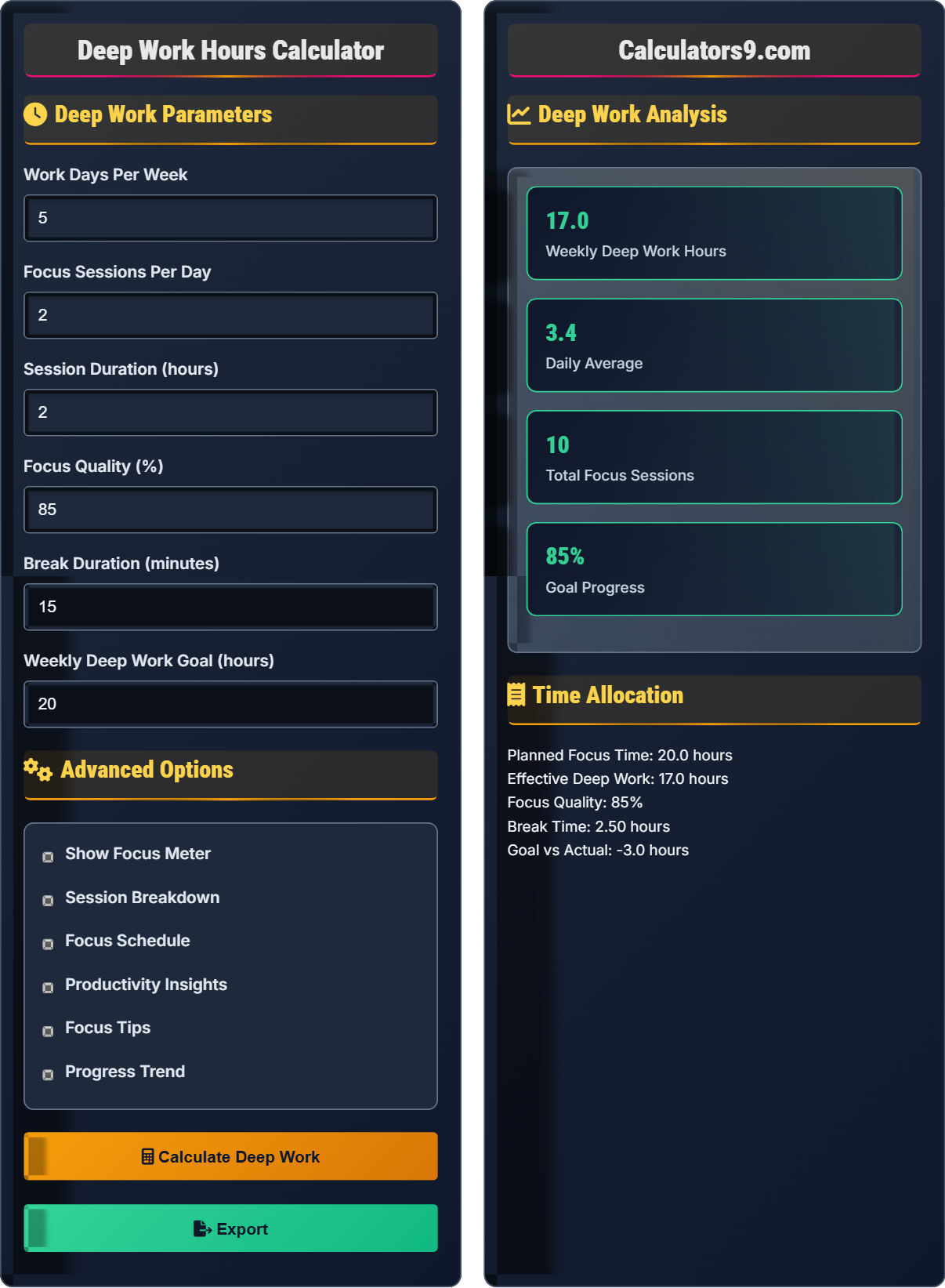
Deep Work Parameters
Advanced Options
Deep Work Analysis
Time Allocation
Deep Work Fundamentals
Deep work is the ability to focus intensely on cognitively demanding tasks without distraction. It enables high-quality output and rapid skill development.
\( \text{Deep Work Hours} = \text{Focus Sessions} \times \text{Session Duration} \times \text{Focus Quality Factor} \)
Where Deep Work Hours=effective productive time, Focus Sessions=number of concentrated work blocks, Session Duration=length of each focus session, Focus Quality Factor=efficiency multiplier.
- Quality over quantity in focus sessions
- Minimize distractions during deep work
- Plan focus blocks in advance
- Take deliberate breaks between sessions
Optimization Strategies
Focus quality is affected by environment, preparation, and mental state. Optimal conditions can achieve 90-95% focus quality.
- Eliminate digital distractions
- Create dedicated focus spaces
- Use time-blocking techniques
- Practice mindfulness exercises
- Start with shorter sessions and build up
- Schedule deep work during peak energy times
- Prepare materials before focus sessions
- Reflect on focus quality after each session
Deep Work Learning Quiz
According to Cal Newport's definition, which of the following best describes deep work?
The answer is B) Focusing intensely on cognitively demanding tasks without distraction. Deep work is defined as professional activities performed in a state of distraction-free concentration that push cognitive capabilities to their limit.
Deep work emphasizes the quality of focus over the quantity of time spent working. It requires eliminating distractions and concentrating on tasks that require high cognitive engagement. This differs from shallow work, which includes tasks that don't require intense concentration.
Deep Work: Professional activities performed in a state of distraction-free concentration
Cognitive Load: The amount of mental effort being used in working memory
Concentration: The faculty of attending with the mind to a single object
• Deep work requires distraction-free environments
• Cognitive demands must be high during deep work
• Quality of focus is more important than duration
• Create physical barriers to distractions
• Use specific tools to block digital interruptions
• Schedule deep work during peak energy hours
• Confusing busyness with productivity
• Attempting deep work in distracting environments
• Not preparing adequately for focused sessions
Calculate the effective deep work hours for someone who has 3 focus sessions per day, each lasting 2 hours, with a focus quality of 90%. They work 5 days per week. What is their weekly effective deep work output?
Step 1: Calculate daily focus time = 3 sessions × 2 hours = 6 hours
Step 2: Calculate daily effective deep work = 6 hours × 0.90 = 5.4 hours
Step 3: Calculate weekly effective deep work = 5.4 hours/day × 5 days = 27 hours
Therefore, the person achieves 27 hours of effective deep work per week.
This calculation demonstrates how focus quality affects actual productivity. Even though the person spends 30 hours in focus sessions (6 hours × 5 days), the 90% focus quality means only 27 hours are truly productive. This emphasizes the importance of maintaining high focus quality.
Effective Hours: Time spent in high-quality focused work
Focus Quality: The percentage of time spent in true deep work
Focus Sessions: Dedicated time blocks for concentrated work
• Effective hours = Planned hours × Focus quality
• Focus quality significantly impacts productivity
• Consistency in scheduling improves focus quality
• Track focus quality separately from time spent
• Aim for 85%+ focus quality for optimal results
• Gradually increase session duration as focus improves
• Equating time spent with productivity achieved
• Not accounting for focus quality in calculations
• Scheduling sessions that are too long for current focus ability
Jane wants to achieve 25 hours of deep work per week. Currently, she has 2 focus sessions per day, each lasting 1.5 hours, with 80% focus quality. She works 5 days per week. How many additional hours of focus time does she need to add to reach her goal, assuming she can improve her focus quality to 90%?
Step 1: Calculate current weekly focus time = 2 sessions/day × 1.5 hours × 5 days = 15 hours
Step 2: Calculate current effective deep work = 15 hours × 0.80 = 12 hours
Step 3: Let x = additional hours needed
Step 4: New equation: (15 + x) × 0.90 = 25
Step 5: Solve for x: 13.5 + 0.90x = 25
Step 6: 0.90x = 11.5
Step 7: x = 12.78 hours (approximately 13 additional hours)
Therefore, Jane needs to add approximately 13 hours of focus time to reach her goal.
This problem demonstrates how improving focus quality amplifies the effectiveness of focus time. Jane needs to add 13 hours of scheduled time, but due to the improved focus quality, she'll achieve more effective deep work per hour. This shows the compound effect of both time investment and quality improvement.
Optimization: Maximizing output given constraints
Focus Quality Improvement: Enhancing concentration ability
Time Investment: Adding scheduled focus time
• Both time and quality contribute to effective output
• Focus quality improvements have multiplicative effects
• Optimization requires balancing time and quality
• Focus on quality improvements first for maximum impact
• Use the compound effect of quality and time improvements
• Track both scheduled and effective focus time
• Only adding time without improving quality
• Not accounting for the multiplicative effect of quality improvements
• Focusing on quantity over quality improvements
A professional needs to achieve 30 hours of deep work per week. They work 6 days per week and want to distribute their focus sessions across morning (8-12 PM) and afternoon (1-5 PM) blocks. If they can maintain 90% focus quality, how should they distribute 3-hour daily focus sessions to maximize effectiveness?
Step 1: Calculate required daily focus time = 30 hours ÷ 6 days = 5 hours per day
Step 2: Since they want 3-hour daily sessions, total weekly time = 3 hours/day × 6 days = 18 hours
Step 3: With 90% focus quality, effective hours = 18 hours × 0.90 = 16.2 hours
Step 4: To reach 30 effective hours, required scheduled time = 30 ÷ 0.90 = 33.33 hours
Step 5: Daily scheduled time needed = 33.33 ÷ 6 = 5.56 hours per day
Recommendation: Schedule 3 hours in the morning and 2.5 hours in the afternoon, totaling 5.5 hours per day.
This problem shows the relationship between scheduled time and effective output. Due to focus quality being less than 100%, more scheduled time is needed than the target effective hours. The solution demonstrates how to work backward from the goal to determine necessary scheduling.
Scheduled Time: Time allocated for focus sessions
Effective Time: Actual productive output
Time Distribution: How focus sessions are allocated throughout the day
• Scheduled time > Effective time when focus quality < 100%
• Distribution should match energy patterns
• Consider peak performance hours for scheduling
• Align focus sessions with circadian rhythms
• Schedule harder tasks during peak energy times
• Account for focus quality degradation over time
• Assuming scheduled time equals effective time
• Not accounting for focus quality in planning
• Scheduling during low-energy periods
Which of the following has the LEAST impact on focus quality during deep work sessions?
The answer is C) The color of your computer screen. While physical environment, digital distractions, and mental preparation significantly impact focus quality, the specific color of your screen has minimal effect on your ability to concentrate. More important factors include lighting, noise levels, and cognitive preparation.
Focus quality is influenced by environmental factors, psychological state, and preparation. While some visual elements can impact focus (like lighting), the specific color of the screen itself doesn't significantly affect cognitive concentration. The other options directly impact attention and cognitive load.
Focus Quality Factors: Variables that affect concentration ability
Cognitive Load: The amount of mental effort being used
Environmental Distractions: External factors that interrupt focus
• Focus on high-impact environmental factors
• Prioritize elimination of digital distractions
• Psychological preparation is crucial for focus quality
• Focus on controllable environmental factors first
• Use technology to eliminate digital interruptions
• Develop pre-focus rituals to improve mental preparation
• Over-optimizing minor environmental details
• Neglecting major distraction sources
• Not addressing psychological preparation
FAQ
Q: How do I calculate effective deep work hours when my focus quality varies throughout the day?
A: The formula for deep work hours is: \( \text{Deep Work Hours} = \text{Focus Sessions} \times \text{Session Duration} \times \text{Focus Quality Factor} \).
For varying focus quality, calculate each session separately:
If you have 2 sessions of 2 hours each with 90% and 75% focus quality:
\( \text{Effective Hours} = (2 \times 0.90) + (2 \times 0.75) = 1.8 + 1.5 = 3.3 \text{ hours} \)
This gives you a more accurate measure of productive time than using an average focus quality.
Q: What's the optimal duration for deep work sessions?
A: Research suggests that deep work sessions should ideally last 90-120 minutes, as this aligns with natural ultradian rhythms. However, beginners should start with 45-60 minute sessions and gradually increase.
For the formula: \( \text{Deep Work Hours} = \text{Sessions} \times \text{Duration} \times \text{Quality Factor} \), consider:
- Beginners: 1-1.5 hour sessions with 70-80% quality
- Intermediate: 1.5-2 hour sessions with 80-85% quality
- Advanced: 2-3 hour sessions with 85-90% quality
Adjust based on your individual focus capacity and the cognitive demand of your tasks.