Distraction Cost Calculator
Quantify lost productivity • 2026 edition
Distraction Cost Formula:
Show the calculator\( \text{Cost} = \text{Hourly Rate} \times \text{Distraction Frequency} \times \text{Average Distraction Duration} \times \text{Work Days per Year} \)
Where:
- Cost = Annual productivity loss due to distractions
- Hourly Rate = Effective hourly wage including benefits
- Frequency = Times distracted per hour/day
- Duration = Average time lost per distraction
- Work Days = Annual working days
This formula calculates the financial impact of distractions by multiplying the cost of time lost per distraction by the frequency and duration of distractions across the working year.
Example: If you earn $50/hour and get distracted 10 times per day for 5 minutes each time, over 250 work days:
\( \text{Cost} = 50 \times \frac{10 \times 5}{60} \times 250 = 50 \times 0.833 \times 250 = \$10,417 \)
Thus, distractions cost approximately $10,417 per year in lost productivity.
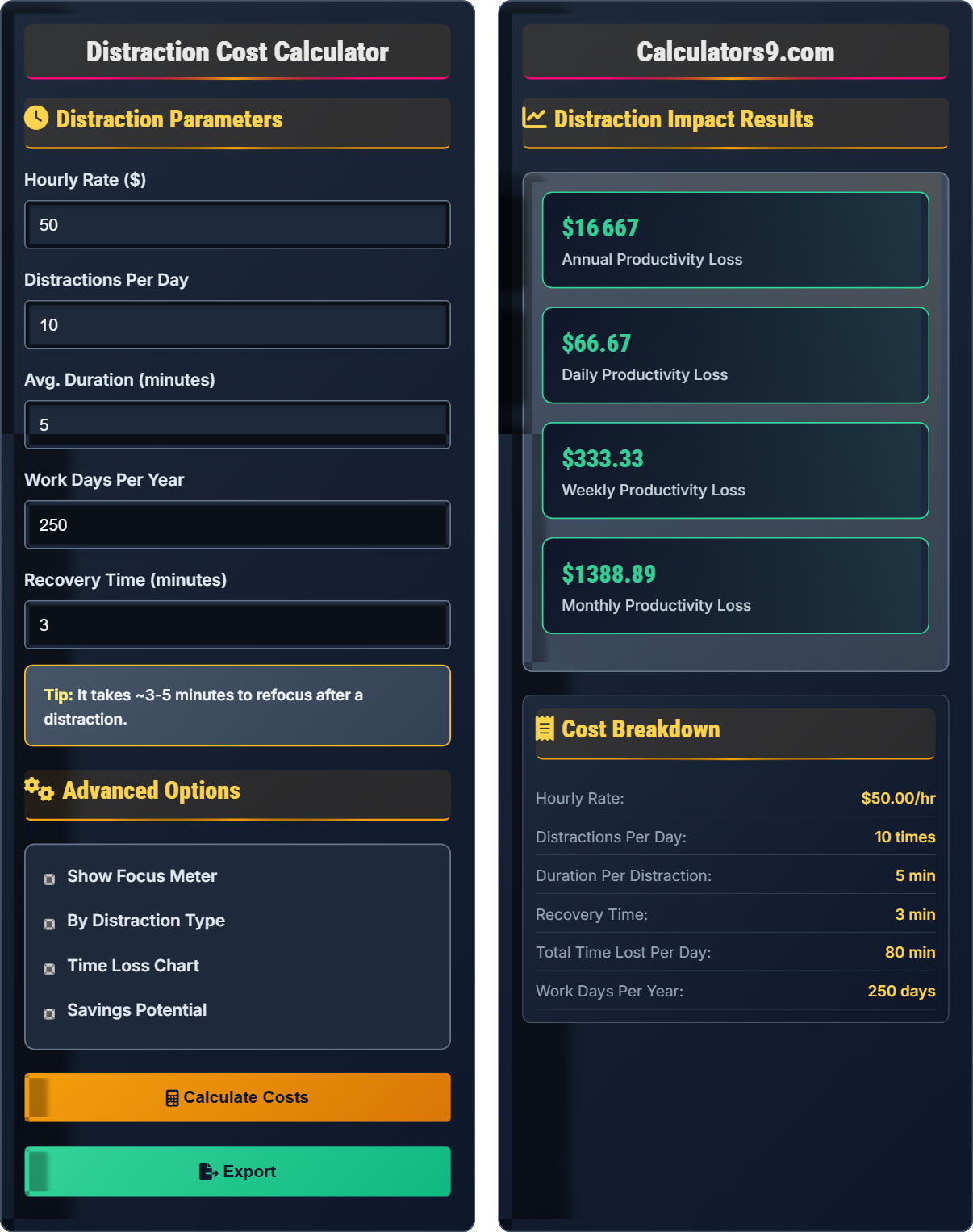
Distraction Parameters
Advanced Options
Distraction Impact Results
Cost Breakdown
Distraction Impact Fundamentals
Distraction cost refers to the financial and productivity losses incurred when attention is diverted from primary tasks. It encompasses both direct time loss and the cognitive cost of task-switching.
\( \text{Cost} = \text{Hourly Rate} \times \text{Distraction Frequency} \times \text{Average Duration} \times \text{Work Days per Year} \)
Where Cost=financial loss, Hourly Rate=effective wage, Frequency=times distracted, Duration=time lost per distraction, Work Days=annual working days.
- Each distraction costs more than just the interruption time
- Recovery time adds significantly to total loss
- Task-switching reduces overall efficiency
- Compounding effect over time is substantial
Mitigation Strategies
It takes an average of 23 minutes to fully refocus after a distraction, according to research by Gloria Mark.
- Implement focused work blocks
- Minimize notification interruptions
- Create dedicated focus time
- Use productivity tools
- Batch similar activities
- Turn off non-essential notifications
- Schedule specific times for communications
- Create physical barriers to distractions
Distraction Cost Learning Quiz
According to research, how long does it take on average to refocus after a distraction?
The answer is C) 23 minutes. According to research by Gloria Mark at UC Irvine, it takes an average of 23 minutes and 15 seconds to refocus after an interruption. This significantly amplifies the cost of each distraction beyond just the initial interruption time.
This finding highlights the true cost of interruptions. When we consider that each distraction takes 23 minutes to recover from, a 2-minute interruption actually costs 25 minutes of productive time. This explains why frequent small distractions can be more damaging than fewer, longer interruptions.
Attention Recovery: The time needed to return to the original task after an interruption
Task-Switching Cost: The cognitive load and time penalty of shifting between tasks
Focus Disruption: Any event that diverts attention from the primary task
• Recovery time often exceeds the original interruption
• Task-switching reduces overall efficiency by 40%
• Context switching incurs significant cognitive costs
• Batch similar activities to minimize context switching
• Use "Do Not Disturb" modes during focus time
• Schedule specific times for checking communications
• Underestimating the recovery time needed after interruptions
• Believing that multitasking improves productivity
• Ignoring the cumulative effect of frequent small distractions
Calculate the annual distraction cost for an employee earning $40/hour who gets distracted 8 times per day for an average of 4 minutes each time, with 250 work days per year. Include a 3-minute recovery time per distraction.
Step 1: Calculate total time lost per distraction = 4 minutes (distraction) + 3 minutes (recovery) = 7 minutes
Step 2: Calculate daily time loss = 8 distractions × 7 minutes = 56 minutes = 0.933 hours
Step 3: Calculate daily cost = $40/hour × 0.933 hours = $37.33
Step 4: Calculate annual cost = $37.33 × 250 days = $9,332.50
Therefore, the annual distraction cost is $9,332.50, representing significant lost productivity.
This calculation demonstrates how seemingly minor interruptions accumulate into substantial costs. The inclusion of recovery time is crucial, as it often represents the majority of the time lost. The formula emphasizes that both the duration of the distraction and the time needed to refocus contribute to the total cost.
Total Time Loss: Distraction duration plus recovery time
Effective Hourly Cost: The true cost of an hour including benefits and overheadCompounding Effect: How small daily losses accumulate over time
• Always include recovery time in calculations
• Multiply by work days, not calendar days
• Consider both direct and indirect costs
• Track actual distraction frequency for accurate calculations
• Include opportunity cost of lost focus time
• Calculate costs for teams to understand organizational impact
• Forgetting to include recovery time in calculations
• Using calendar days instead of work days
• Underestimating the frequency of self-inflicted distractions
Company A has employees who check email 15 times per day for 3 minutes each time. Company B implements a policy limiting email checks to twice per day. If both companies have 100 employees earning $30/hour and working 250 days per year, how much does Company B save annually in distraction costs? Assume 5 minutes recovery time per email check.
Step 1: Calculate Company A's daily cost per employee:
Total time per email check = 3 minutes + 5 minutes recovery = 8 minutes
Daily time loss = 15 checks × 8 minutes = 120 minutes = 2 hours
Daily cost per employee = $30 × 2 hours = $60
Step 2: Calculate Company B's daily cost per employee:
Daily time loss = 2 checks × 8 minutes = 16 minutes = 0.267 hours
Daily cost per employee = $30 × 0.267 hours = $8
Step 3: Calculate annual savings per employee = ($60 - $8) × 250 = $13,000
Step 4: Calculate total company savings = $13,000 × 100 employees = $1,300,000
Therefore, Company B saves $1,300,000 annually in distraction costs.
This example illustrates the dramatic impact of simple behavioral changes at scale. By reducing email checks from 15 to 2 times per day, the organization saves over $1.3 million annually. The calculation shows how small individual improvements can lead to substantial organizational benefits.
Organizational Impact: How individual behaviors affect the entire company
Scale Effect: How individual changes amplify across multiple employees
Policy Intervention: Organizational changes to reduce distractions
• Individual changes have exponential effects at organizational scale
• Small reductions in distraction frequency yield large savings
• Recovery time multiplies the impact of each interruption
• Calculate organizational impact to justify focus initiatives
• Use batching strategies to reduce frequency
• Measure before and after to quantify improvements
• Not considering the organizational scale of individual improvements
• Focusing only on time saved rather than productivity gained
• Underestimating the cumulative effect of small changes
An employee earning $60/hour currently gets distracted 12 times per day for 6 minutes each time, with 4 minutes recovery time. If they implement focus techniques that reduce distractions by 60%, what is the annual ROI of this improvement? Assume it takes 10 hours of training to implement these techniques.
Step 1: Calculate current daily cost:
Current time loss per day = 12 distractions × (6 + 4) minutes = 120 minutes = 2 hours
Current daily cost = $60 × 2 = $120
Step 2: Calculate improved daily cost:
Reduced distractions = 12 × (1 - 0.60) = 4.8 ≈ 5 distractions
Improved time loss per day = 5 × (6 + 4) minutes = 50 minutes = 0.833 hours
Improved daily cost = $60 × 0.833 = $50
Step 3: Calculate daily savings = $120 - $50 = $70
Step 4: Calculate annual savings = $70 × 250 days = $17,500
Step 5: Calculate training cost = 10 hours × $60 = $600
Step 6: Calculate net annual benefit = $17,500 - $600 = $16,900
Step 7: Calculate ROI = ($16,900 / $600) × 100% = 2,783%
Therefore, the investment in focus techniques yields a 2,783% ROI.
This calculation demonstrates the exceptional ROI of focus improvement initiatives. The 2,783% return shows that investing time and resources in focus techniques is highly profitable. The calculation considers both the direct cost savings and the investment required to implement improvements.
Return on Investment (ROI): The financial return relative to the investment cost
Focus Techniques: Methods to improve concentration and reduce interruptions
Productivity Gains: Increased output from improved focus
• Focus improvements have high ROI due to compounding effects
• Small investments in focus yield large returns
• Consider both direct and indirect benefits in ROI calculations
• Calculate ROI to justify focus improvement investments
• Include productivity gains beyond time savings
• Consider the compounding effect of sustained focus improvements
• Not accounting for the full impact of focus improvements
• Underestimating the time savings from reduced distractions
• Failing to consider the compounding nature of focus gains
Which of the following distraction mitigation strategies typically provides the highest return on investment?
The answer is B) Batch processing communication tasks. Research shows that batching similar activities like email, messaging, and meetings reduces the cognitive load of task-switching and can improve productivity by 40%. This approach addresses the root cause of distraction rather than just symptoms, providing the highest ROI.
Batch processing is effective because it reduces the frequency of context switches, which are the primary source of productivity loss. Instead of switching between tasks frequently, batching allows for deeper focus periods. This strategy addresses the systemic issue of frequent interruptions rather than just treating symptoms.
Batch Processing: Grouping similar tasks together to minimize context switching
Context Switching: The cognitive cost of moving between different tasks
Systemic Solution: Addressing root causes rather than symptoms
• Address root causes of distractions, not just symptoms
• Systemic changes have greater impact than tool-based solutions
• Reducing frequency of task-switching improves focus significantly
• Schedule specific times for checking communications
• Group similar activities in time blocks
• Use "Do Not Disturb" during focused work sessions
• Relying solely on tools without changing behaviors
• Not addressing the frequency of interruptions
• Focusing on symptom relief rather than root cause solutions
FAQ
Q: How can I quantify the cost of interruptions for my team?
A: The formula for distraction cost is: \( \text{Cost} = \text{Hourly Rate} \times \text{Distraction Frequency} \times \text{Average Duration} \times \text{Work Days per Year} \).
For example, if your team member earns $40/hour and gets distracted 10 times per day for 5 minutes each time (including 3 minutes recovery), over 250 work days:
\( \text{Cost} = 40 \times \frac{10 \times 8}{60} \times 250 = 40 \times 1.333 \times 250 = \$13,333 \)
This means each team member loses approximately $13,333 annually to distractions. For a team of 5, that's $66,665 in lost productivity.
Q: What are the most effective strategies to reduce personal distractions?
A: Research shows that batching communication tasks is the most effective strategy. Instead of checking email constantly, set specific times (e.g., 9 AM, 1 PM, 4 PM). This reduces context switching by up to 40%.
Other effective strategies include:
- Time blocking: Dedicate specific hours to deep work
- Notification management: Turn off non-essential alerts
- Physical environment: Create a dedicated workspace
- Recovery protocols: Have a system to quickly return to focused work
These strategies can reduce distraction costs by 50-70% when implemented consistently.