Focus Session Planner
Optimize deep work & concentration • 2026 trends
Focus Session Formula:
Show the calculator\( Focus\ Index = \frac{Productive\ Time}{Total\ Session\ Time} \times 100 \)
Where:
- Productive Time: Time spent in concentrated work without distractions
- Total Session Time: Full duration of the focus session
- Optimal Range: 80-95% focus index for maximum productivity
This formula calculates the effectiveness of your focus sessions by measuring the percentage of time spent in concentrated work versus total session time. Research shows that optimal focus sessions last 90-120 minutes with 15-30 minute breaks. The formula helps determine the ideal session length based on your concentration patterns.
Example: For a 90-minute focus session with 75 minutes of productive work:
Focus Index = (75 ÷ 90) × 100 = 83.3%
Therefore, this session achieved 83.3% focus efficiency, which is within the optimal range.
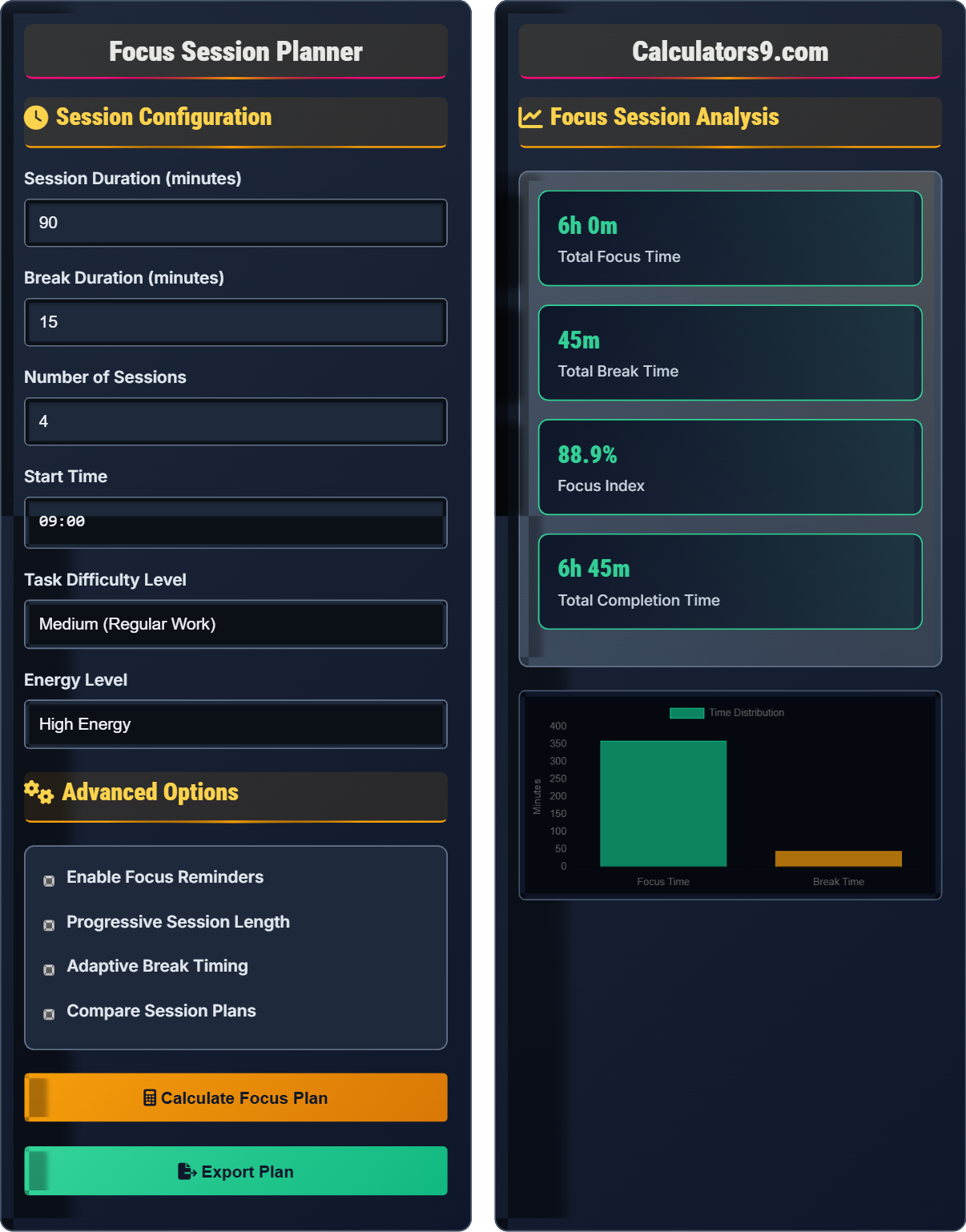
Session Configuration
Advanced Options
Focus Session Analysis
| Session | Start Time | End Time | Duration | Break Time | Status |
|---|
| Metric | Value | Optimal | Status | Recommendation |
|---|
Comprehensive Focus Session Guide
Focus session planning is a systematic approach to structuring deep work periods that maximize concentration and productivity. It involves scheduling dedicated time blocks for intensive, distraction-free work, combined with strategic breaks to maintain mental freshness. This methodology is based on research showing that humans can sustain peak concentration for 90-120 minutes before experiencing significant cognitive fatigue.
The effectiveness of focus sessions can be measured using this formula:
Where:
- Productive Time: Time spent in concentrated work without distractions
- Total Session Time: Full duration of the focus session
- Optimal Range: 80-95% focus index for maximum productivity
Research shows that different types of work benefit from different session lengths:
- Routine Tasks: 45-60 minutes with 10-15 minute breaks
- Regular Work: 75-90 minutes with 15-20 minute breaks
- Complex Problems: 60-90 minutes with 15-25 minute breaks
- Deep Creative Work: 90-120 minutes with 20-30 minute breaks
- Learning New Skills: 30-45 minutes with 5-10 minute breaks
- Environment Control: Minimize visual and auditory distractions
- Energy Matching: Schedule demanding work during peak energy times
- Goal Setting: Define specific, measurable outcomes for each session
- Progress Tracking: Monitor focus index and adjust accordingly
- Recovery Planning: Ensure adequate rest between sessions
Focus Session Planning Quiz
According to research, what is the optimal duration for a focus session?
The answer is C) 90-120 minutes. Research in cognitive psychology shows that humans can maintain peak concentration for approximately 90-120 minutes before experiencing significant cognitive fatigue. This corresponds to the natural ultradian rhythm of the brain. Sessions shorter than this may not allow for deep work, while longer sessions lead to diminishing returns due to mental fatigue.
The 90-120 minute window aligns with our brain's natural attention cycles. During this period, we can engage in what researchers call "deep work" - the ability to focus without distraction on cognitively demanding tasks. After this timeframe, our brains naturally signal the need for a break to consolidate information and restore mental resources. This biological rhythm explains why many successful people structure their day around this pattern.
Deep Work: Professional activities performed in a state of distraction-free concentration
Ultradian Rhythm: Natural 90-120 minute biological cycle of the brain
Cognitive Fatigue: Mental exhaustion that impairs concentration
• Optimal focus: 90-120 minutes
• Include strategic breaks
• Align with natural rhythms
• Start with 90-minute sessions
• Adjust based on task difficulty
• Track your personal optimal duration
• Working for too long without breaks
• Not accounting for task complexity
• Ignoring personal energy patterns
Calculate the focus index for a 90-minute session where 75 minutes were spent in productive work. Show your work.
Step 1: Identify the values
Productive Time: 75 minutes
Total Session Time: 90 minutes
Step 2: Apply the formula
Focus Index = (Productive Time ÷ Total Session Time) × 100
Focus Index = (75 ÷ 90) × 100 = 83.3%
Step 3: Interpret the result
A focus index of 83.3% is within the optimal range of 80-95%.
Therefore, the focus index is 83.3%.
The focus index provides a quantifiable measure of session effectiveness. An index of 83.3% indicates that 83.3% of the session time was spent in productive work, which is considered excellent. This metric helps identify areas for improvement and track progress over time. The optimal range of 80-95% accounts for the fact that some transition time is normal and beneficial.
Focus Index: Percentage of time spent in productive work
Productive Time: Time spent on intended tasks without distractionOptimal Range: 80-95% for maximum effectiveness
• Focus Index = (Productive Time ÷ Total Time) × 100
• Optimal range: 80-95%
• Some transition time is normal
• Track focus index over time
• Identify patterns in effectiveness
• Adjust session parameters based on results
• Expecting 100% focus (not realistic)
• Not accounting for brief transitions
• Comparing across different task types
Sarah wants to complete 4 focus sessions of 90 minutes each with 15-minute breaks between sessions. If she starts at 9:00 AM, what time will she finish?
Step 1: Calculate time for one complete cycle
Session time: 90 minutes
Break time: 15 minutes
One cycle: 90 + 15 = 105 minutes
Step 2: Calculate time for 4 sessions
For 4 sessions: 3 complete cycles (since the last session doesn't need a break afterward)
Time for 3 cycles: 3 × 105 = 315 minutes
Time for last session: 90 minutes
Total time: 315 + 90 = 405 minutes
Step 3: Convert to hours and minutes
405 minutes = 6 hours 45 minutes
Step 4: Calculate end time
Start: 9:00 AM
End: 9:00 AM + 6 hours 45 minutes = 3:45 PM
Therefore, Sarah will finish at 3:45 PM.
This problem demonstrates the importance of considering break time when planning multiple focus sessions. The key insight is that breaks occur between sessions, not after the final session. This requires careful calculation to avoid overestimating the total time needed. The calculation also shows how multiple sessions with breaks can create a substantial block of focused time.
Session Cycle: Focus time + Break time
Time Blocking: Allocating specific time slots for activities
Session Planning: Scheduling focus periods with breaks
• Breaks occur between sessions
• Last session doesn't need a break afterward
• Account for all time segments
• Plan sessions around energy peaks
• Include buffer time for transitions
• Consider lunch breaks for longer sessions
• Forgetting that the last session doesn't need a break
• Not accounting for transition time
• Overestimating sustainable session count
John has peak energy from 8-10 AM and needs to complete a complex project requiring deep focus. He plans to work for 2 hours with a 30-minute break. If he starts at 8 AM, what will be his focus index if he maintains 90% concentration during the first hour and 70% during the second hour?
Step 1: Calculate productive time for each hour
First hour: 60 minutes × 90% = 54 minutes of productive work
Second hour: 60 minutes × 70% = 42 minutes of productive work
Step 2: Calculate total productive time
Total productive time: 54 + 42 = 96 minutes
Step 3: Calculate focus index
Total session time: 120 minutes (2 hours)
Focus Index = (96 ÷ 120) × 100 = 80%
Step 4: Interpretation
An 80% focus index is within the optimal range.
Therefore, John's focus index will be 80%.
This example demonstrates how energy levels affect focus quality over time. Even with declining concentration in the second hour, John still achieved an optimal focus index by scheduling his most challenging work during his peak energy period. This illustrates the importance of matching task difficulty with energy levels for maximum effectiveness.
Energy Matching: Scheduling tasks according to energy levels
Peak Performance: Times of maximum cognitive capacity
Concentration Decline: Natural reduction in focus over time
• Schedule demanding work during peak energy
• Expect some decline in concentration
• Focus index accounts for natural fluctuations
• Identify your personal energy peaks
• Plan complex tasks during high-energy periods
• Schedule simpler tasks during low-energy times
• Scheduling difficult tasks during low-energy periods
• Not accounting for natural concentration decline
• Expecting constant high-level focus
Which type of break is most effective for maintaining focus during a 90-minute session?
The answer is B) Taking a walk outside. Physical movement, especially outdoors, provides the best recovery for cognitive resources. Walking increases blood flow to the brain, reduces stress hormones, and provides sensory variety without overstimulation. Research shows that even brief outdoor walks can improve focus and creativity for the next work session.
Effective breaks are crucial for maintaining focus throughout sessions. The goal is to give the brain a chance to consolidate information and restore mental resources. Passive breaks (like checking social media) often lead to additional distractions, while active breaks like walking provide physiological benefits that enhance subsequent focus. The key is to choose activities that refresh without introducing new cognitive loads.
Active Break: Physical or mental activity that refreshes the mind
Passive Break: Resting without engaging in stimulating activities
Cognitive Recovery: Restoration of mental resources
• Choose breaks that refresh rather than stimulate
• Physical activity enhances recovery
• Avoid screen-based breaks when possible
• Take 5-minute walks for every 90-minute session
• Practice deep breathing exercises
• Stretch or do light physical activity
• Using screens during breaks
• Engaging in cognitively demanding break activities
• Not taking breaks at all
Focus Session Basics
Systematic approach to structuring deep work periods for maximum productivity.
\( Focus\ Index = \frac{Productive\ Time}{Total\ Session\ Time} \times 100 \)
Where optimal range is 80-95% for maximum effectiveness.
- Optimal session length: 90-120 minutes
- Include strategic breaks
- Match tasks to energy levels
Strategies
Percentage of time spent in concentrated work versus total session time.
- Eliminate distractions
- Set specific goals
- Take strategic breaks
- Track your progress
- Task complexity matters
- Energy levels fluctuate
- Environment affects focus
- Recovery is essential
FAQ
Q: How do I know if my focus sessions are effective?
A: You can measure focus session effectiveness through several indicators:
- Focus Index: Track the percentage of time spent in productive work
- Task Completion: Measure how many planned tasks you actually finish
- Quality of Work: Assess the accuracy and thoroughness of your output
- Energy Levels: Monitor if you feel refreshed or drained after sessions
- Distraction Tracking: Note how often and for how long you get interrupted
For example, if you plan to work for 90 minutes and spend 75 minutes in productive work, your focus index is 83.3%. This is within the optimal range. Additionally, if you consistently complete 80% of your planned tasks during these sessions, you're achieving good effectiveness. The focus index formula helps quantify this:
Focus Index = (Productive Time ÷ Total Session Time) × 100
Achieving 80%+ indicates effective focus sessions.
Q: Can I modify the standard 90-minute session duration?
A: Yes, absolutely! The 90-minute session is a guideline based on research, but you should adapt it to your individual needs and task types. Here are common modifications:
- Learning New Skills: 30-45 minutes with 5-10 minute breaks
- Routine Tasks: 45-60 minutes with 10-15 minute breaks
- Regular Work: 75-90 minutes with 15-20 minute breaks
- Complex Problems: 60-90 minutes with 15-25 minute breaks
- Deep Creative Work: 90-120 minutes with 20-30 minute breaks
For instance, if you're studying for exams, you might start with 45-minute sessions and gradually extend to 90 minutes as your focus improves. The key is to experiment and find what works best for you. The focus index formula helps you evaluate which duration is most effective:
If 45-min sessions: (40 ÷ 45) × 100 = 89% focus index
If 90-min sessions: (75 ÷ 90) × 100 = 83% focus index
Both are effective, but you get more total productive time with longer sessions.