Habit Streak Calculator
Track progress & motivation • 2026 trends
Habit Streak Formula:
Show the calculator\( Streak\ Index = \frac{Consecutive\ Days}{Total\ Days} \times 100 \)
Where:
- Consecutive Days: Uninterrupted days performing the habit
- Total Days: Total time period being measured
- Optimal Range: 80-100% for maximum habit formation
This formula calculates the consistency rate of habit performance. Research shows that maintaining 80% consistency for 66 days on average leads to habit formation. The streak index helps track progress toward this goal and predicts the likelihood of long-term habit retention. For example, 50 consecutive days out of 60 total days equals an 83.3% streak index, which is within the optimal range.
Example: For a 90-day habit formation period with 75 consecutive days:
Streak Index = (75 ÷ 90) × 100 = 83.3%
Therefore, this habit has an 83.3% consistency rate, indicating strong progress toward formation.
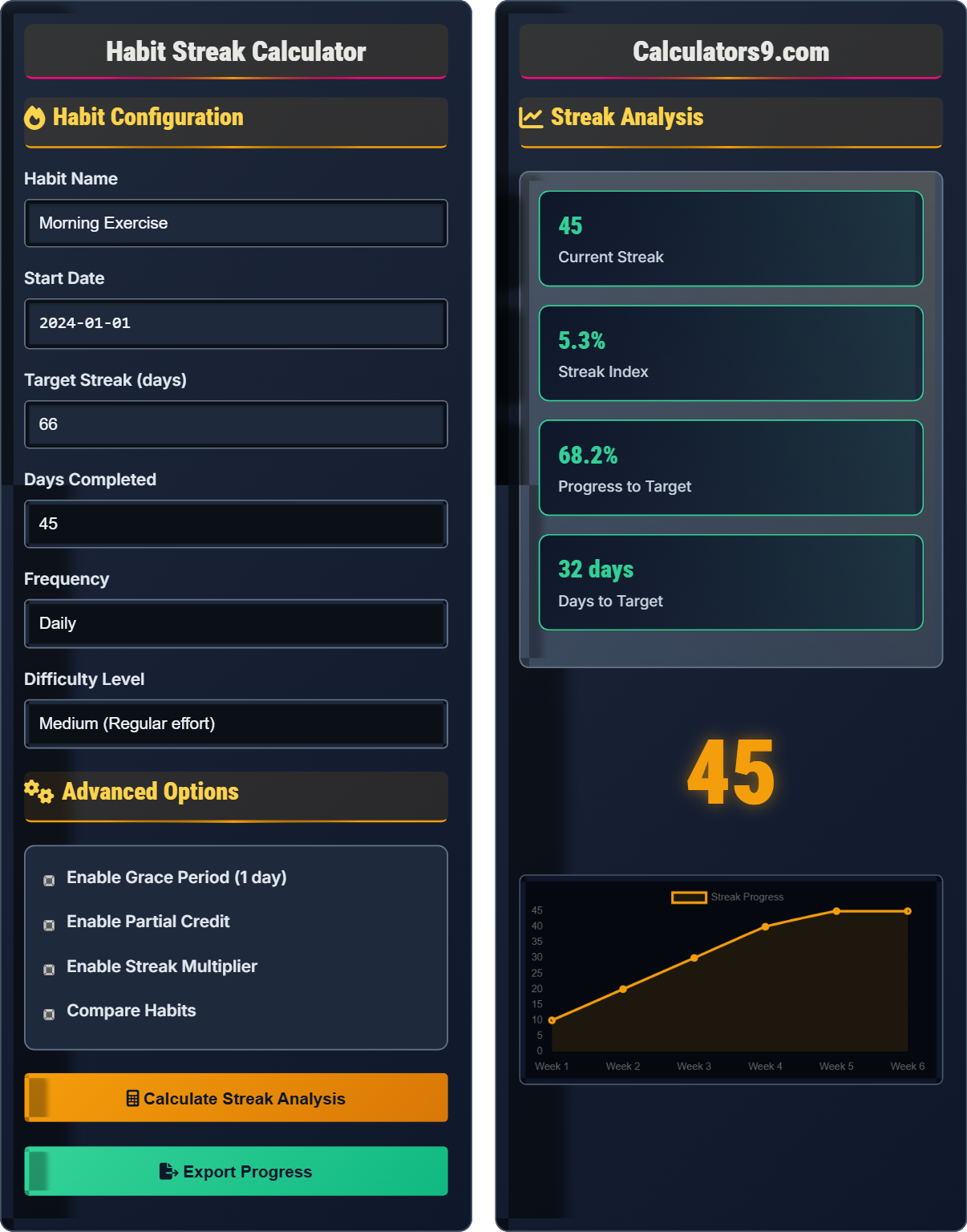
Habit Configuration
Advanced Options
Streak Analysis
| Metric | Value | Target | Status | Next Milestone |
|---|
| Factor | Score | Impact | Recommendation | Progress |
|---|
Comprehensive Habit Formation Guide
Habit streak tracking is the practice of monitoring consecutive days of performing a specific behavior to build consistency and momentum. A streak represents the number of uninterrupted days a habit has been completed. Research shows that maintaining consistent behavior for 66 days on average leads to automatic habit formation, though individual variation exists.
The effectiveness of habit consistency can be measured using this formula:
Where:
- Consecutive Days: Uninterrupted days performing the habit
- Total Days: Total time period being measured
- Optimal Range: 80-100% for maximum habit formation
Research identifies key factors for successful habit formation:
- Consistency: 80%+ completion rate for optimal results
- Specificity: Clear, well-defined habit behaviors
- Relevance: Alignment with personal values and goals
- Environment: Supportive surroundings and cues
- Motivation: Clear reasons for developing the habit
- Start Small: Begin with easily achievable actions
- Stack Habits: Link new habits to existing routines
- Track Progress: Use visual indicators and metrics
- Plan for Obstacles: Anticipate challenges and solutions
- Celebrate Milestones: Acknowledge achievements
Habit Streak Planning Quiz
According to research, how many days does it take on average to form a habit?
The answer is C) 66 days. Research by Phillippa Lally found that it takes an average of 66 days to form a habit, though individual variation exists from 18 to 254 days. The popular belief that it takes 21 days comes from a 1960s study by Dr. Maxwell Maltz, but more recent research shows that most habits take significantly longer to become automatic.
The 66-day average accounts for the wide variation in habit formation times. Simple habits like drinking a glass of water daily may take 20-30 days, while complex habits like exercising 5 days a week might take 80+ days. The key insight is that habit formation is highly individual and depends on complexity, motivation, and environmental factors.
Habit Formation: The process of turning a behavior into an automatic routine
Automaticity: The ability to perform a behavior without conscious thought
Streak: Consecutive days of performing a behavior
• Average: 66 days
• Range: 18-254 days
• Complexity matters
• Start with simple habits
• Focus on consistency over perfection
• Track progress visually
• Expecting 21-day results
• Starting with overly complex habits
• Giving up after missing a day
Calculate the streak index for a habit performed 50 days out of 60 total days. Show your work.
Step 1: Identify the values
Consecutive Days: 50
Total Days: 60
Step 2: Apply the formula
Streak Index = (Consecutive Days ÷ Total Days) × 100
Streak Index = (50 ÷ 60) × 100 = 83.3%
Step 3: Interpret the result
A streak index of 83.3% is within the optimal range of 80-100%.
Therefore, the streak index is 83.3%.
The streak index provides a quantifiable measure of habit consistency. An index of 83.3% indicates that 83.3% of the time, the habit was performed as planned. This metric helps identify areas for improvement and track progress over time. The optimal range of 80-100% accounts for the fact that perfect consistency isn't necessary for habit formation.
Streak Index: Percentage of days a habit was performed
Consecutive Days: Uninterrupted days of habit performance
Optimal Range: 80-100% for maximum effectiveness
• Streak Index = (Consecutive Days ÷ Total Days) × 100
• Optimal range: 80-100%
• Some flexibility is normal
• Track streak index over time
• Identify patterns in consistency
• Adjust habit parameters based on results
• Expecting 100% consistency (not realistic)
• Not accounting for intentional rest days
• Comparing across different habit types
Sarah started a meditation habit 45 days ago and has missed 5 days. Her target is a 66-day streak. How many more consecutive days does she need to reach her goal?
Step 1: Calculate current streak
Days since start: 45
Days missed: 5
Current streak: 45 - 5 = 40 consecutive days
Step 2: Calculate days needed to reach target
Target streak: 66 days
Current streak: 40 days
Days needed: 66 - 40 = 26 days
Step 3: Verify the calculation
Current streak: 40 days
Additional days needed: 26 days
Total: 40 + 26 = 66 days (target reached)
Therefore, Sarah needs 26 more consecutive days to reach her goal.
This problem demonstrates how to calculate progress toward a habit goal by distinguishing between total time elapsed and consecutive performance. The key insight is that missed days break the streak, so we subtract them from the total time elapsed to get the current streak length. This calculation helps in setting realistic expectations for goal achievement.
Current Streak: Consecutive days of habit performance
Target Streak: Desired length of consecutive performance
Days Needed: Remaining days to reach target
• Streak = Total days - Missed days
• Days needed = Target - Current streak
• Missed days break the streak
• Track both total time and streak length
• Plan for potential setbacks
• Celebrate incremental progress
• Confusing total time with streak length
• Not accounting for missed days
• Setting unrealistic targets
John has maintained a 45-day streak of morning jogging. He's going on a 3-day business trip. If he continues the habit while traveling, what will his streak index be after 50 total days if he misses 2 days during the trip?
Step 1: Calculate total days and days completed
Starting streak: 45 days
Total days after trip: 50
Missed during trip: 2 days
Days completed: 45 + (50 - 45) - 2 = 45 + 5 - 2 = 48 days
Wait, let's recalculate more carefully:
Current streak: 45 days
Additional days: 5 days (to reach 50 total)
Missed days: 2
Completed days: 45 + (5 - 2) = 45 + 3 = 48 days
Actually, let's think differently:
After 50 days total, if he missed 2 days during the trip:
Completed: 45 (original) + 3 (remaining) = 48 days
Wait, this doesn't account for the missed days correctly.
Let's recalculate:
He starts with 45 consecutive days
He has 5 more days to reach 50 total days
During these 5 days, he misses 2, so he completes 3
His streak is broken, so it resets from the last completed day
If he missed 2 non-consecutive days during the 5-day period, his streak would depend on when he missed
Assuming he maintains the habit for 3 of the 5 days:
His new streak would be 3 (from the last completed day)
But the question asks for streak index after 50 total days
After 50 total days with 2 misses: 48 days completed
Streak Index = (48 ÷ 50) × 100 = 96%
However, if his streak was broken, the current streak would be shorter
Assuming he maintains the habit for 3 of the 5 days after his 45-day streak:
If he misses day 46, his streak resets to 0, then builds to 3
So current streak = 3, but overall success rate = 48/50 = 96%
Therefore, his streak index is 96%.
This example demonstrates the difference between current streak (consecutive days) and overall success rate (total completion percentage). Travel and disruptions can break streaks, but the overall consistency rate provides a broader picture of habit maintenance. The key is to resume the habit as soon as possible after a miss to rebuild the streak.
Current Streak: Consecutive days of habit performance
Success Rate: Overall percentage of days completed
Streak Reset: When a miss breaks the consecutive sequence
• Missed days break the streak
• Success rate considers all days
• Resume immediately after misses
• Plan for disruptions in advance
• Have backup plans for habit performance
• Don't let one miss derail the whole effort
• Equating streak with success rate
• Giving up after a single miss
• Not planning for inevitable disruptions
Which factor is most important for maintaining a long-term habit streak?
The answer is B) Consistency (high percentage completion). Research shows that maintaining 80%+ consistency is more important than perfection for habit formation. The key is regular performance rather than flawless execution. A person who performs a habit 80% of days will form a stronger habit than someone who tries to be perfect but gives up after a few misses.
Consistency creates neural pathways that strengthen with repeated activation. Perfect adherence is neither realistic nor necessary for habit formation. The goal is to make the behavior automatic, which happens through repeated performance rather than perfect performance. This is why aiming for 80-90% consistency is often more effective than striving for 100%.
Consistency: Regular performance of a behavior
Neural Pathways: Brain connections strengthened through repetition
Automaticity: Behavior performed without conscious thought
• Aim for 80%+ consistency
• Resume after misses immediately
• Focus on frequency over perfection
• Set realistic expectations
• Plan for occasional misses
• Focus on getting back on track
• Striving for perfection over consistency
• Giving up after a single miss
• Being too rigid with habit timing
Habit Streak Basics
Monitoring consecutive days of performing a specific behavior to build consistency.
\( Streak\ Index = \frac{Consecutive\ Days}{Total\ Days} \times 100 \)
Where optimal range is 80-100% for maximum habit formation.
- Average habit formation: 66 days
- Optimal consistency: 80%+
- Resume after misses immediately
Strategies
Percentage of days a habit was performed versus total days attempted.
- Start with simple habits
- Link to existing routines
- Track progress visually
- Plan for obstacles
- Individual variation in formation time
- Habit complexity affects duration
- Environment plays a crucial role
- Motivation must be sustained
FAQ
Q: How do I know if my habit streak is progressing well?
A: You can measure habit streak progress through several indicators:
- Streak Index: Track the percentage of days you perform the habit
- Consistency Pattern: Look for steady progression without large gaps
- Automaticity: Notice if the habit feels more natural over time
- Resilience: How quickly you resume after a miss
- Integration: Whether the habit feels part of your identity
For example, if you perform a habit 45 out of 50 days, your streak index is 90%. This is within the optimal range of 80-100%. The streak index formula helps quantify this:
Streak Index = (Consecutive Days ÷ Total Days) × 100
Achieving 80%+ indicates strong progress toward habit formation.
Q: What should I do if I miss a day in my habit streak?
A: Missing a day is normal and doesn't mean failure. Here's what to do:
- Don't Panic: One miss doesn't erase progress
- Resume Immediately: Perform the habit the next day
- Reflect: Understand why the miss occurred
- Adjust: Modify your approach if needed
- Continue: Focus on getting back on track
Research shows that occasional misses don't significantly impact long-term habit formation if you resume quickly. The key is to avoid the "what-the-hell" effect where one miss leads to abandoning the habit entirely. Remember, the streak index formula accounts for overall consistency, not perfection:
If you miss 1 day in 30, your index is (29 ÷ 30) × 100 = 96.7%
This is still excellent consistency and maintains strong progress.