Meeting Cost Calculator
Calculate meeting ROI & productivity impact • 2026 trends
Meeting Cost Formula:
Show the calculator\( Total\ Meeting\ Cost = \sum{(Hourly\ Rate_i \times Meeting\ Duration)} + Overhead\ Costs \)
Where:
- Hourly Ratei: Hourly wage of each participant (including benefits)
- Meeting Duration: Length of meeting in hours
- Overhead Costs: Facilities, equipment, materials, opportunity costs
This formula calculates the total cost of a meeting by summing the wages of all participants for the duration of the meeting, plus additional overhead expenses. Studies show that poorly planned meetings cost US businesses over $37 billion annually. For example, a 1-hour meeting with 5 participants earning average salaries of $50,000-$80,000 annually would cost approximately $500-$800.
Example: For a 1.5-hour meeting with 4 participants earning $60,000, $75,000, $90,000, and $100,000 annually:
Hourly rates: $28.85, $36.06, $43.27, $48.08
Total per hour: $156.26
1.5-hour meeting cost: $156.26 × 1.5 = $234.39
Adding 20% overhead: $234.39 × 1.2 = $281.27
Therefore, the total meeting cost is $281.27.
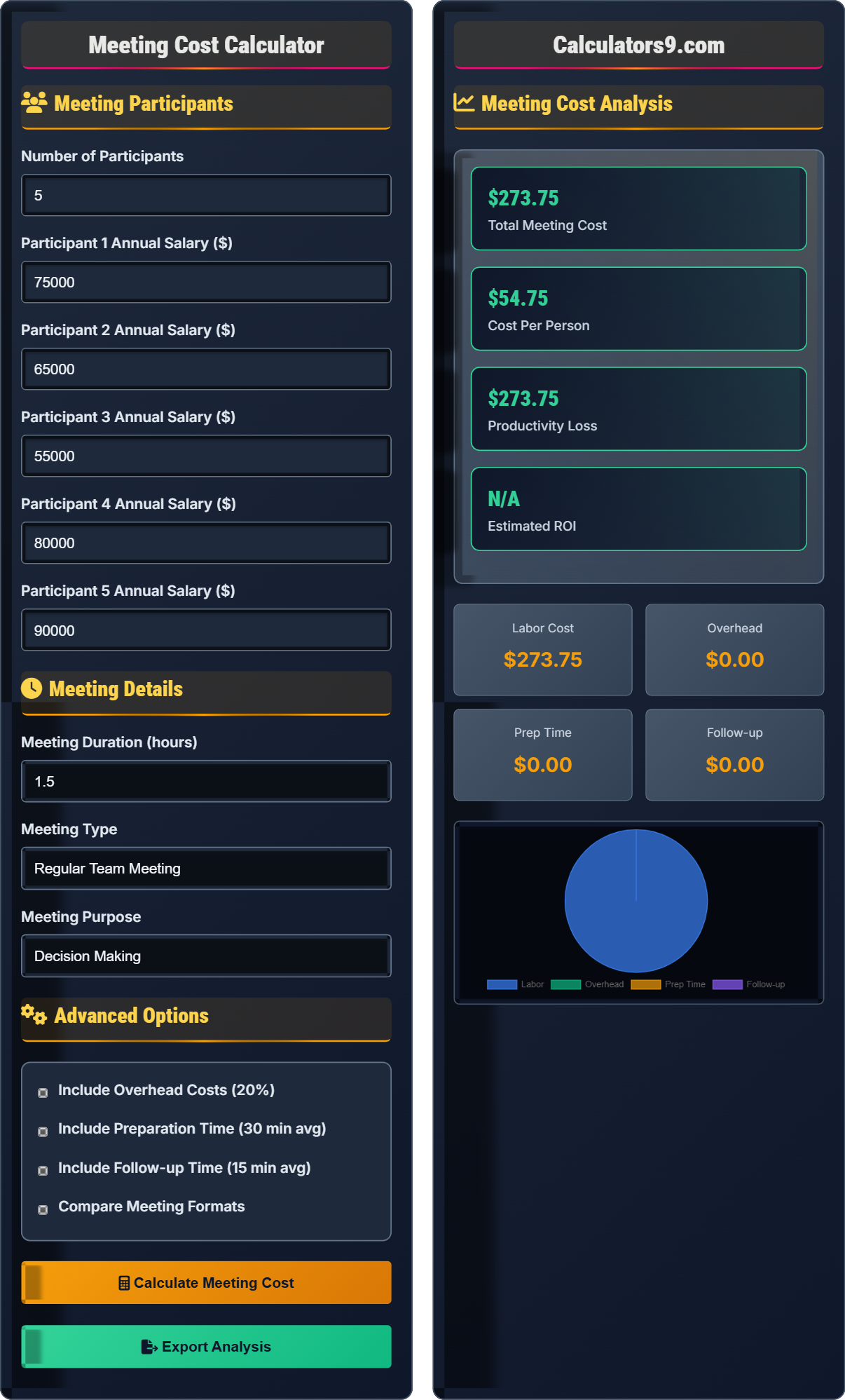
Meeting Participants
Meeting Details
Advanced Options
Meeting Cost Analysis
| Participant | Annual Salary | Hourly Rate | Meeting Cost | Role |
|---|
| Metric | Value | Industry Benchmark | Status | Recommendation |
|---|
Comprehensive Meeting Cost Guide
Meeting cost analysis is the systematic evaluation of the financial impact of business meetings. It calculates the total cost of a meeting by considering participant wages, time allocation, facilities, technology, and opportunity costs. This analysis helps organizations optimize meeting efficiency and reduce unnecessary expenses.
The comprehensive meeting cost formula includes:
Where:
- Hourly Ratei: Hourly wage of each participant (including benefits)
- Meeting Duration: Length of meeting in hours
- Overhead Costs: Facilities, equipment, materials, opportunity costs
Key metrics to evaluate meeting effectiveness include:
- Cost per Decision: Total meeting cost divided by decisions made
- Engagement Score: Participant participation and focus levels
- Outcome Achievement: Percentage of goals met from meeting
- Time Utilization: Actual productive time vs. scheduled time
- Follow-through Rate: Percentage of action items completed
- Limit Attendees: Only invite essential participants
- Set Time Limits: Establish clear start and end times
- Use Technology: Virtual meetings reduce facility costs
- Prepare Agendas: Focus discussions and reduce time waste
- Measure Outcomes: Track ROI and effectiveness
Meeting Cost Analysis Quiz
Which of the following is NOT typically included in meeting cost calculations?
The answer is C) Personal lunch expenses. Meeting cost calculations typically include labor costs, facilities, equipment, and preparation time. Personal lunch expenses for participants are not considered part of the meeting cost unless specifically provided for the meeting.
Meeting cost analysis focuses on organizational expenses related to conducting the meeting. This includes direct costs (wages, facilities) and indirect costs (opportunity costs, preparation time). Personal expenses unrelated to the meeting itself are excluded from the calculation. This distinction helps organizations accurately assess the true cost of their meetings.
Direct Costs: Expenses directly tied to meeting execution
Indirect Costs: Opportunity costs and overhead expenses
Opportunity Cost: Value of alternative activities forgone
• Include only meeting-related expenses
• Factor in participant wages during meeting time
• Consider both direct and indirect costs
• Calculate hourly rates including benefits
• Include preparation and follow-up time
• Consider virtual alternatives to reduce costs
• Forgetting to include benefits in hourly rates
• Omitting preparation and follow-up time
• Including unrelated personal expenses
Calculate the cost of a 2-hour meeting with 3 participants earning $60,000, $75,000, and $90,000 annually. Assume 40-hour work weeks and 50 working weeks per year. Show your work.
Step 1: Calculate hourly rates
Participant 1: $60,000 ÷ (40 hours/week × 50 weeks) = $60,000 ÷ 2,000 = $30/hour
Participant 2: $75,000 ÷ 2,000 = $37.50/hour
Participant 3: $90,000 ÷ 2,000 = $45/hour
Step 2: Calculate total hourly cost
Total per hour: $30 + $37.50 + $45 = $112.50/hour
Step 3: Calculate meeting cost
2-hour meeting cost: $112.50 × 2 = $225
Therefore, the total meeting cost is $225.
This calculation demonstrates how to convert annual salaries to hourly rates for cost analysis. The standard assumption of 2,000 working hours per year (40 hours/week × 50 weeks) provides a baseline for comparison. In practice, you might adjust for benefits, which typically add 20-30% to base salary costs.
Hourly Rate: Annual salary divided by total working hours
Working Hours: Standard work year calculation
Base Salary: Annual compensation before benefits
• Convert annual to hourly rates for accurate calculation
• Use consistent time units (hours, minutes)
• Sum individual costs to get total meeting cost
• Include benefits in hourly rate calculation
• Consider using 1.2-1.3 multiplier for total compensation
• Round to nearest dollar for simplicity
• Using gross salary instead of net equivalent
• Forgetting to account for holidays and vacation
• Incorrect division of annual salary
A team conducts a weekly 1-hour meeting with 6 participants averaging $70,000 annual salary. The meeting results in 2 decisions that save the company $5,000 annually. What is the return on investment (ROI) after one year of meetings?
Step 1: Calculate hourly rate per participant
Average hourly rate: $70,000 ÷ 2,000 hours = $35/hour
Step 2: Calculate cost per meeting
Cost per meeting: 6 participants × $35/hour × 1 hour = $210
Step 3: Calculate annual meeting cost
Annual cost: $210/meeting × 52 meetings = $10,920
Step 4: Calculate ROI
Annual savings: $5,000
ROI = (Savings - Cost) ÷ Cost × 100
ROI = ($5,000 - $10,920) ÷ $10,920 × 100 = -54.2%
Therefore, the ROI is -54.2%, indicating the meeting is not cost-effective.
This example demonstrates how to calculate ROI for meetings. A negative ROI indicates that costs exceed benefits. In this case, the meeting costs ($10,920) significantly exceed the savings ($5,000), suggesting the meeting may need restructuring or elimination. This analysis helps justify meeting decisions based on financial impact.
ROI (Return on Investment): Measure of profitability
Positive ROI: Benefits exceed costs
Negative ROI: Costs exceed benefits
• ROI = (Benefits - Costs) ÷ Costs × 100
• Positive ROI indicates value creation
• Negative ROI suggests inefficiency
• Track measurable outcomes from meetings
• Calculate ROI for recurring meetings
• Compare alternatives to identify best option
• Failing to track actual meeting outcomes
• Not considering opportunity costs
• Calculating ROI without sufficient data
A department holds a monthly 3-hour strategy meeting with 8 executives earning an average of $150,000 annually. They're considering switching to a 1-hour virtual format with 5 key participants. How much would they save annually?
Step 1: Calculate current meeting cost per session
Hourly rate: $150,000 ÷ 2,000 = $75/hour
Current cost per meeting: 8 participants × $75/hour × 3 hours = $1,800
Step 2: Calculate current annual cost
Annual cost: $1,800 × 12 meetings = $21,600
Step 3: Calculate proposed meeting cost per session
Proposed cost per meeting: 5 participants × $75/hour × 1 hour = $375
Step 4: Calculate proposed annual cost
Proposed annual cost: $375 × 12 = $4,500
Step 5: Calculate annual savings
Savings: $21,600 - $4,500 = $17,100
Therefore, they would save $17,100 annually.
This problem demonstrates the significant cost savings possible through meeting optimization. By reducing participants, duration, and switching to virtual format, the department could save over $17,000 annually. This analysis supports data-driven decisions about meeting formats and frequency. The savings could be reinvested in more productive activities.
Cost Optimization: Reducing expenses while maintaining value
Virtual Meetings: Online gatherings reducing facility costs
Meeting Efficiency: Value delivered per dollar spent
• Reduce participants to essential attendees
• Minimize meeting duration while maintaining effectiveness
• Consider virtual alternatives to reduce costs
• Conduct cost-benefit analysis for recurring meetings
• Use hybrid models for optimal participation
• Regularly review meeting necessity and format
• Keeping unnecessary attendees in meetings
• Failing to consider virtual alternatives
• Not regularly reviewing meeting efficiency
According to research, what percentage of meeting time is typically spent productively?
The answer is C) 50-60%. Research consistently shows that only 50-60% of meeting time is typically spent productively. This means that 40-50% of meeting time is often wasted on tangents, administrative tasks, or unfocused discussion. This statistic highlights the significant opportunity for improving meeting efficiency and reducing costs.
The low productivity rate in meetings explains why meeting cost analysis is so important. If only half the time is productive, organizations are essentially paying for unproductive time. This inefficiency can be addressed through better planning, focused agendas, and time management techniques. Understanding this reality helps justify investment in meeting optimization tools and training.
Productive Time: Time spent on meeting objectives
Meeting Waste: Unfocused or unproductive time
Time Utilization: Percentage of scheduled time used effectively
• Aim for 80%+ productive time
• Use structured agendas to maintain focus
• Regularly measure and improve meeting efficiency
• Start and end meetings on time
• Assign a timekeeper to maintain focus
• Use visual aids to keep discussions on track
• Tolerating off-topic discussions
• Not having a clear agenda
• Failing to track meeting effectiveness
Meeting Cost Basics
Systematic evaluation of financial impact of business meetings.
\( Total\ Meeting\ Cost = \sum{(Hourly\ Rate_i \times Meeting\ Duration)} + Overhead\ Costs \)
Where total cost includes all participant wages and associated expenses.
- Include all participant wages
- Add facility and equipment costs
- Consider opportunity costs
Strategies
Reduce costs while maintaining meeting effectiveness.
- Limit participant count
- Set strict time limits
- Use virtual alternatives
- Prepare detailed agendas
- Track meeting outcomes
- Measure ROI regularly
- Optimize meeting frequency
- Consider hybrid formats
FAQ
Q: How do I calculate the true cost of a meeting including benefits?
A: To calculate the true cost of a meeting including benefits, use this comprehensive approach:
Step 1: Calculate total compensation per employee
Total Compensation = Base Salary + Benefits + Payroll Taxes
Benefits typically add 20-30% to base salary (health insurance, retirement, PTO, etc.)
Step 2: Calculate hourly rate with benefits
Hourly Rate with Benefits = Total Compensation ÷ Working Hours
Standard: 2,000 hours per year (40 hours/week × 50 weeks)
Example: For an employee with $75,000 salary and 25% benefits:
Total Compensation = $75,000 × 1.25 = $93,750
Hourly Rate = $93,750 ÷ 2,000 = $46.88/hour
For a 1-hour meeting with 5 employees: 5 × $46.88 × 1 = $234.40
This calculation provides a more accurate representation of meeting costs.
Q: What's the difference between meeting cost and meeting ROI?
A: Meeting cost and meeting ROI are related but distinct concepts:
Meeting Cost: The total amount spent on conducting a meeting
Formula: Σ(Hourly Ratei × Meeting Duration) + Overhead Costs
This is the input - what you spend on the meeting
Meeting ROI (Return on Investment): The value gained relative to the cost
Formula: (Value of Outcomes - Meeting Cost) ÷ Meeting Cost × 100
This is the output - the return on your investment
Example: A $500 meeting results in decisions that save $2,000:
ROI = ($2,000 - $500) ÷ $500 × 100 = 300%
While cost tells you the expense, ROI tells you the effectiveness of that expenditure. Both metrics are essential for optimizing meeting practices.