Pomodoro Timer Calculator
Optimize your productivity sessions • 2026 trends
Pomodoro Technique Formula:
Show the calculator\( Productivity\ Index = \frac{Focused\ Work\ Minutes}{Total\ Session\ Minutes} \times 100 \)
Where:
- Focused Work Minutes: Time spent in concentrated work sessions
- Total Session Minutes: Sum of work and break times
- Standard Ratio: 25 minutes work to 5 minutes break (83.3% productivity)
This formula calculates the efficiency of your Pomodoro sessions by measuring the percentage of time spent in focused work versus total session time. The traditional 25:5 minute ratio yields 83.3% productivity time. Studies show that this technique can improve focus by 40% and reduce mental fatigue.
Example: For 4 Pomodoro sessions of 25 minutes work and 5 minutes break each:
Total focused time: 4 × 25 = 100 minutes
Total session time: 4 × (25 + 5) = 120 minutes
Productivity index: (100 ÷ 120) × 100 = 83.3%
Therefore, 83.3% of the time was spent in focused work.
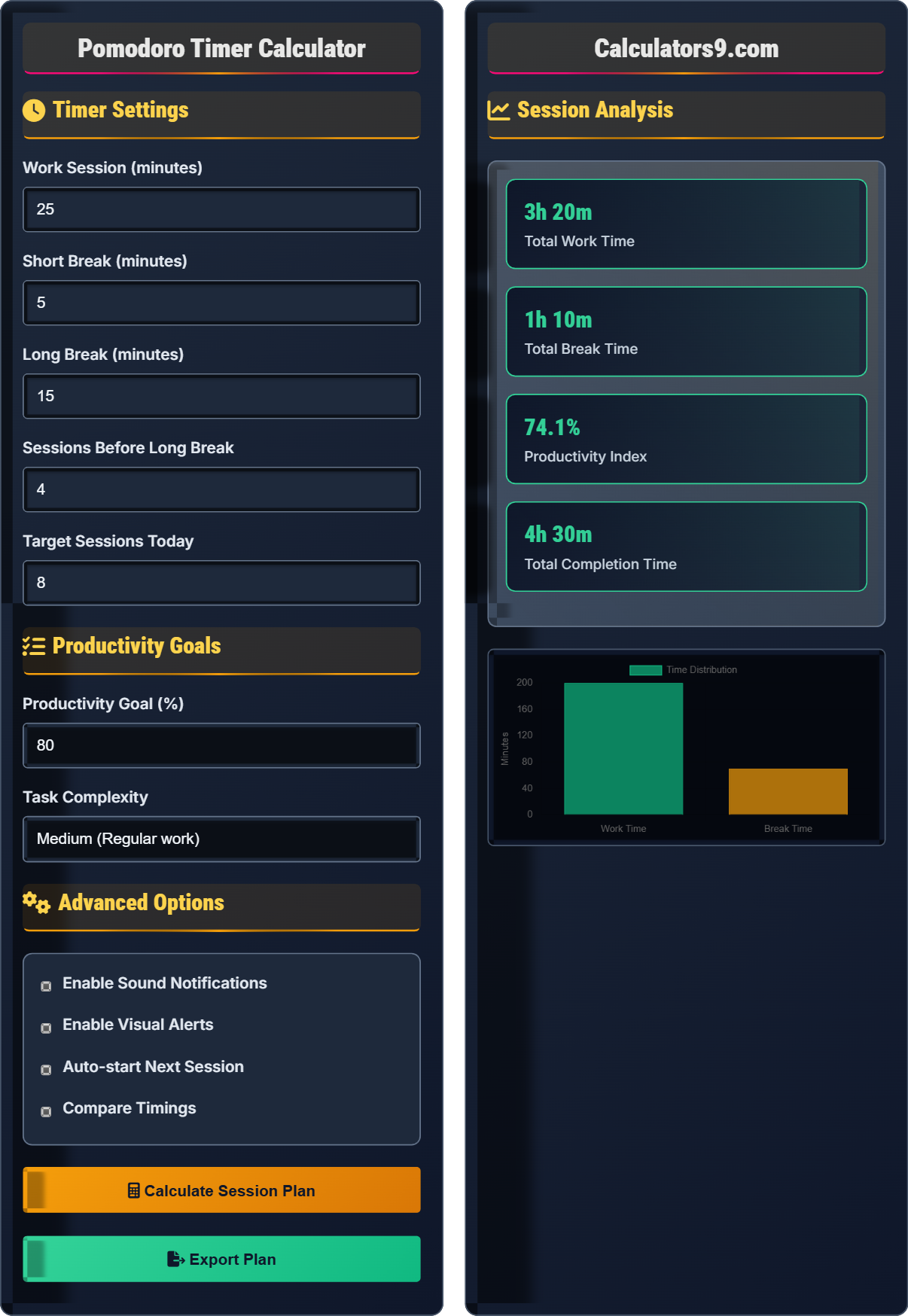
Timer Settings
Productivity Goals
Advanced Options
Session Analysis
| Session | Type | Duration | Start Time | End Time | Status |
|---|
| Metric | Value | Goal | Status | Improvement |
|---|
Comprehensive Pomodoro Guide
The Pomodoro Technique is a time management method developed by Francesco Cirillo in the late 1980s. It uses a timer to break work into intervals, traditionally 25 minutes in length, separated by short breaks. Each interval is known as a "pomodoro" (Italian for tomato, named after the tomato-shaped kitchen timer Cirillo used).
The effectiveness of Pomodoro sessions can be measured using this formula:
Where:
- Focused Work Minutes: Time spent in concentrated work sessions
- Total Session Minutes: Sum of work and break times
- Standard Ratio: 25 minutes work to 5 minutes break (83.3% productivity)
Research shows that the Pomodoro Technique offers numerous benefits:
- Improved Focus: 25-minute intervals prevent mental fatigue and maintain concentration
- Reduced Procrastination: Breaking tasks into smaller chunks makes them feel more manageable
- Better Time Awareness: Helps develop a better sense of how long tasks actually take
- Enhanced Motivation: Regular breaks and completed sessions provide a sense of accomplishment
- Stress Reduction: Scheduled breaks prevent burnout and mental exhaustion
- Micro-Pomodoro: 15-minute work sessions for very short tasks
- Extended Pomodoro: 45-60 minute sessions for deep work
- Reverse Pomodoro: Start with a break, then work period
- Double Pomodoro: Two consecutive work sessions before a break
- Pyramid Method: Gradually increase work time (20-25-30-35 minutes)
Pomodoro Technique Learning Quiz
What is the standard duration of a Pomodoro work session?
The answer is C) 25 minutes. The standard Pomodoro technique involves 25-minute focused work sessions followed by 5-minute breaks. This duration was chosen by Francesco Cirillo as an optimal balance between focus and preventing mental fatigue.
The 25-minute work interval is designed to be long enough to make meaningful progress on tasks while being short enough to maintain intense focus. This prevents the mental fatigue that typically sets in after 20-30 minutes of continuous work. The technique recognizes that attention spans have limits, and working with these natural rhythms improves productivity.
Pomodoro: A single work session using the Pomodoro Technique
Standard Cycle: 25 minutes work + 5 minutes break
Long Break: Extended break after 4 consecutive pomodoros
• Work session: 25 minutes
• Short break: 5 minutes
• Long break: 15-30 minutes after 4 sessions
• Start with standard timing and adjust as needed
• Use a physical timer to avoid digital distractions
• Track your progress to identify patterns
• Extending work sessions beyond 25 minutes initially
• Skipping breaks to "get more done"
• Multitasking during pomodoro sessions
Calculate the productivity index for 3 Pomodoro sessions of 25 minutes work and 5 minutes break each. Show your work.
Step 1: Calculate total focused work time
Work sessions: 3 × 25 minutes = 75 minutes
Step 2: Calculate total session time
Total time: 3 × (25 + 5) minutes = 3 × 30 = 90 minutes
Step 3: Calculate productivity index
Productivity Index = (Focused Work Time ÷ Total Session Time) × 100
Productivity Index = (75 ÷ 90) × 100 = 83.3%
Therefore, the productivity index is 83.3%.
The productivity index shows what percentage of your total session time is spent in focused work. In this example, 83.3% of the time is productive work, which is considered excellent. This calculation helps evaluate the efficiency of your time management approach and compare different timing strategies.
Productivity Index: Percentage of time spent in focused work
Focused Work Time: Time spent actively working on tasks
Total Session Time: Work time plus break time
• Productivity Index = (Work Time ÷ Total Time) × 100
• Higher percentages indicate more efficient use of time
• Standard Pomodoro achieves ~83% productivity
• Aim for productivity index above 80%
• Track your index to identify improvement areas
• Compare different timing strategies
• Forgetting to include break times in total calculation
• Calculating percentages incorrectly
• Not accounting for long breaks after 4 sessions
Sarah wants to complete 6 Pomodoro sessions today. Each work session is 25 minutes with 5-minute breaks. After every 4 sessions, she takes a 15-minute long break. How long will her entire session take?
Step 1: Calculate time for first 4 sessions
Work time: 4 × 25 = 100 minutes
Short breaks: 4 × 5 = 20 minutes
Long break after 4 sessions: 15 minutes
Time for first 4 sessions: 100 + 20 + 15 = 135 minutes
Step 2: Calculate time for remaining 2 sessions
Work time: 2 × 25 = 50 minutes
Short breaks: 2 × 5 = 10 minutes
Time for last 2 sessions: 50 + 10 = 60 minutes
Step 3: Calculate total time
Total time: 135 + 60 = 195 minutes = 3 hours 15 minutes
Therefore, Sarah's entire session will take 3 hours and 15 minutes.
This problem demonstrates the importance of understanding the full Pomodoro cycle, including long breaks. The long break after every 4 sessions is crucial for preventing fatigue and maintaining productivity. This calculation helps in planning your day and setting realistic expectations for how much time activities will take.
Full Cycle: 4 pomodoros + long break
Session Planning: Calculating total time including breaks
Time Blocking: Allocating specific time slots for activities
• Every 4th session ends with long break
• Long breaks are 15-30 minutes
• Include all breaks in total time calculation
• Plan your day around full cycles
• Schedule important tasks during first 2-3 pomodoros
• Use long breaks for stretching or light exercise
• Forgetting to include long breaks in time calculations
• Miscounting the number of breaks needed
• Not accounting for transition time between sessions
Mark plans to work for 4 hours using the Pomodoro technique (25-min work, 5-min break). He also wants to include a 30-minute lunch break in the middle. How many complete Pomodoro sessions can he fit, and what will his schedule look like?
Step 1: Calculate total available time excluding lunch
Total work time: 4 hours - 30 minutes = 3.5 hours = 210 minutes
Step 2: Calculate time for a full cycle (4 sessions + long break)
Work time: 4 × 25 = 100 minutes
Short breaks: 4 × 5 = 20 minutes
Long break: 15 minutes
Full cycle time: 100 + 20 + 15 = 135 minutes
Step 3: Determine how many full cycles fit
Remaining after 1 full cycle: 210 - 135 = 75 minutes
Can fit: 75 ÷ 30 = 2 more sessions (2 × 25 + 2 × 5 = 60 minutes)
Remaining: 75 - 60 = 15 minutes
Step 4: Final count
Total sessions: 4 + 2 = 6 complete sessions
Mark can fit 6 complete Pomodoro sessions in his 4-hour window.
This problem shows how to integrate the Pomodoro technique into a larger schedule that includes other commitments like meals. It demonstrates the importance of backward planning—starting with your total available time and working backwards to determine how many sessions fit. This approach helps in realistic planning and avoiding overcommitment.
Time Integration: Combining Pomodoro with other scheduled activities
Backward Planning: Starting with end time and working backwards
Schedule Optimization: Maximizing productive time within constraints
• Subtract non-Pomodoro time first
• Calculate full cycles before partial sessions
• Account for long breaks when planning
• Block out non-negotiable time first (meals, meetings)
• Plan Pomodoro sessions around your energy peaks
• Leave buffer time for unexpected interruptions
• Not accounting for non-Pomodoro activities
• Overestimating how many sessions will fit
• Forgetting to include transition time
Which adaptation of the Pomodoro technique would be most suitable for complex problem-solving tasks that require deep focus?
The answer is B) Extended Pomodoro (45-60 minutes). Complex problem-solving tasks often require longer periods of uninterrupted focus to enter a state of "flow." The standard 25-minute session may be too short for these types of tasks, as the brain needs time to fully engage with complex material. Extended sessions allow for deeper concentration while still providing structured breaks to prevent fatigue.
Not all tasks are equally suited to the standard Pomodoro timing. Complex tasks that require sustained concentration benefit from longer focus periods. The key is matching the time allocation to the cognitive demands of the task. For routine tasks, shorter sessions work well, but for deep work, extended sessions are more appropriate.
Flow State: Mental state of complete immersion in activity
Deep Work: Professional activities performed in a state of distraction-free concentrationTask Appropriateness: Matching time allocation to task requirements
• Match session length to task complexity
• Allow longer sessions for deep work
• Maintain breaks to prevent mental fatigue
• Use 25-minute sessions for routine tasks
• Extend to 45-60 minutes for complex problem-solving
• Experiment to find your optimal session length
• Using same timing for all types of tasks
• Not adjusting for individual focus capacity
• Ignoring task-specific requirements
Pomodoro Basics
Time management method using 25-minute focused work sessions with breaks.
\( Productivity\ Index = \frac{Focused\ Work\ Minutes}{Total\ Session\ Minutes} \times 100 \)
Where standard 25:5 ratio yields 83.3% productivity.
- 25 minutes focused work
- 5 minutes short break
- Long break after 4 sessions
Strategies
Percentage of time spent in focused work versus total session time.
- Choose specific tasks
- Eliminate distractions
- Take meaningful breaks
- Track your progress
- Task complexity matters
- Adjust timing as needed
- Consistency is key
- Listen to your energy
FAQ
Q: How do I know if the Pomodoro Technique is working for me?
A: You can measure the effectiveness of the Pomodoro Technique through several indicators:
- Completion Rate: Track how many planned tasks you actually finish
- Focus Quality: Notice if you're able to maintain concentration for the full 25 minutes
- Energy Levels: Monitor if you feel less mentally fatigued throughout the day
- Procrastination Reduction: See if you're starting tasks more readily
- Time Estimation: Improve your ability to predict how long tasks take
For example, if you were completing 60% of your planned daily tasks before using Pomodoro and now complete 85%, that's a 25% improvement. Additionally, if you notice you can maintain focus for 20-25 minutes consistently instead of 10-15 minutes before, the technique is working. The productivity index formula helps quantify these improvements:
Productivity Index = (Focused Work Minutes ÷ Total Session Minutes) × 100
Achieving 80%+ indicates effective use of the technique.
Q: Can I modify the standard 25-minute work periods?
A: Yes, absolutely! The Pomodoro Technique is flexible and should be adapted to your individual needs and task types. Here are common modifications:
- Micro-Pomodoro (15 min): For very short tasks or when focus is difficult
- Standard (25 min): For regular work and study tasks
- Extended (45-60 min): For complex problem-solving or deep work
- Double Pomodoro: Two consecutive work sessions for longer tasks
The key is to experiment and find what works best for you. For instance, if you're studying for exams, you might start with 25-minute sessions and gradually extend to 45 minutes as your focus improves. The productivity index formula helps you evaluate which timing works best:
If 25-min sessions: (25 ÷ 30) × 100 = 83.3% productivity time
If 45-min sessions: (45 ÷ 55) × 100 = 81.8% productivity time
Both are effective, but the longer session gives more continuous work time.