Task Priority Matrix Calculator
Eisenhower Decision Matrix • 2026 trends
Task Priority Matrix Formula:
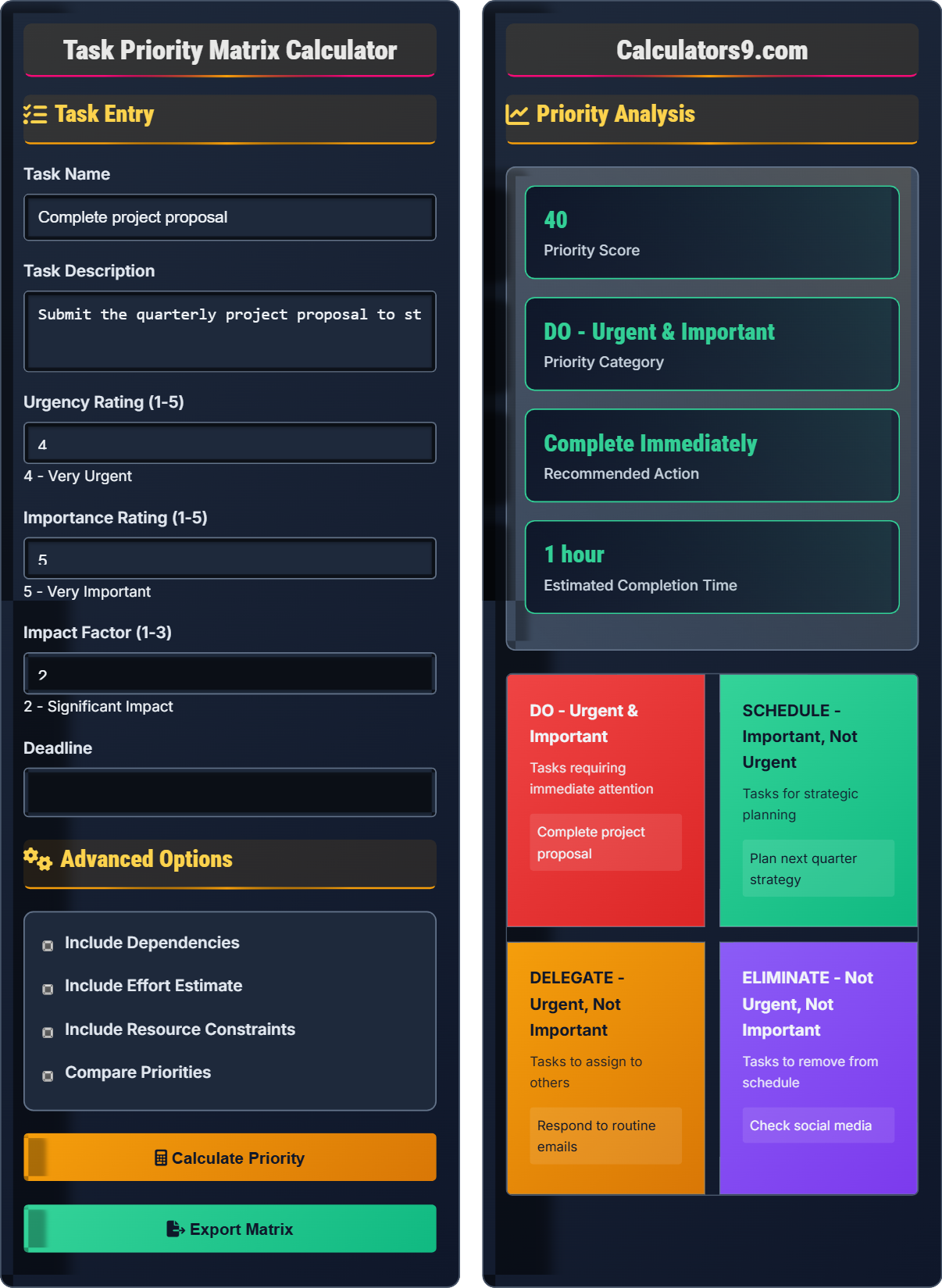
Show the calculator\( Priority\ Score = Urgency\ Rating \times Importance\ Rating \times Impact\ Factor \)
Where:
- Urgency Rating: How soon the task needs completion (1-5 scale)
- Importance Rating: How critical the task is to goals (1-5 scale)
- Impact Factor: Consequences of not completing the task (1-3 scale)
This formula calculates the priority score for tasks using the Eisenhower Matrix framework. Tasks are categorized based on urgency and importance: Do (Urgent + Important), Schedule (Important + Not Urgent), Delegate (Urgent + Not Important), and Eliminate (Not Urgent + Not Important). Studies show this system can improve productivity by 25-40%.
Example: For a task with urgency rating 4, importance rating 5, and impact factor 2:
Priority Score = 4 × 5 × 2 = 40
This high score indicates it's a "Do" task that should be completed immediately.
Task Entry
Advanced Options
Priority Analysis
| Metric | Value | Weight | Contribution | Recommendation |
|---|
| Quadrant | Criteria | Action | Examples | Time Allocation |
|---|
Comprehensive Priority Matrix Guide
The Eisenhower Matrix, also known as the Urgency-Importance Matrix, is a time management tool that helps prioritize tasks based on their urgency and importance. Named after President Dwight D. Eisenhower, it divides tasks into four quadrants: Do (Urgent + Important), Schedule (Important + Not Urgent), Delegate (Urgent + Not Important), and Eliminate (Not Urgent + Not Important).
The priority score is calculated using this weighted formula:
Where:
- Urgency Rating: How soon the task needs completion (1-5 scale)
- Importance Rating: How critical the task is to goals (1-5 scale)
- Impact Factor: Consequences of not completing the task (1-3 scale)
Research shows that using the Eisenhower Matrix offers numerous benefits:
- Improved Focus: Helps concentrate on what truly matters
- Reduced Stress: Prevents last-minute rushes by planning ahead
- Better Decision-Making: Provides clear criteria for prioritization
- Increased Productivity: Maximizes time spent on high-value activities
- Strategic Planning: Emphasizes important but non-urgent tasks
- Time Blocking: Allocate specific time slots for each quadrant
- Weekly Review: Reassess tasks and move between quadrants
- Delegate Effectively: Identify tasks for delegation in Quadrant 3
- Minimize Quadrant 4: Reduce time spent on non-essential activities
- Focus on Quadrant 2: Invest time in prevention and planning
Priority Matrix Learning Quiz
Which quadrant of the Eisenhower Matrix should contain tasks that are important but not urgent?
The answer is B) Quadrant 2 - Schedule. Tasks that are important but not urgent belong in Quadrant 2. These are strategic activities that contribute to long-term goals but don't have immediate deadlines. Examples include planning, relationship building, skill development, and preventive maintenance.
Quadrant 2 is often considered the most valuable quadrant because it contains activities that are important for long-term success but don't create immediate pressure. By scheduling time for these activities, you can prevent them from becoming urgent crises later. This proactive approach is fundamental to effective time management and stress reduction.
Quadrant 1: Urgent + Important (Do Now)
Quadrant 2: Important + Not Urgent (Schedule)
Quadrant 3: Urgent + Not Important (Delegate)
• Quadrant 1: Immediate action required
• Quadrant 2: Strategic planning and prevention
• Quadrant 3: Can be delegated to others
• Spend 60-80% of your time in Quadrant 2
• Regularly move tasks from Quadrant 1 to Quadrant 2
• Use calendar blocking for Quadrant 2 activities
• Spending too much time in Quadrant 1 (crisis management)
• Neglecting Quadrant 2 (strategic activities)
• Treating all urgent tasks as important
Calculate the priority score for a task with urgency rating 3, importance rating 4, and impact factor 2. Show your work.
Step 1: Identify the values
Urgency Rating: 3
Importance Rating: 4
Impact Factor: 2
Step 2: Apply the formula
Priority Score = Urgency Rating × Importance Rating × Impact Factor
Priority Score = 3 × 4 × 2 = 24
Therefore, the priority score is 24.
The priority score calculation multiplies three factors to determine the overall importance of a task. This weighted approach helps in comparing different tasks objectively. A score of 24 suggests this is a moderately high-priority task that likely falls in Quadrant 2 (Schedule) since it's important but may not be immediately urgent.
Priority Score: Numerical value indicating task importance
Urgency Rating: How soon the task needs completion
Importance Rating: How critical the task is to goals
• Priority Score = Urgency × Importance × Impact
• Higher scores indicate higher priority
• Scores above 30 typically indicate "Do" tasks
• Use consistent rating scales
• Consider both short and long-term impacts
• Reassess scores as circumstances change
• Using inconsistent rating scales
• Forgetting to multiply all three factors
• Not updating scores as situations evolve
Sarah has a task to prepare for an important client presentation next month. The presentation will significantly impact her company's revenue, but it's not due for another 4 weeks. Where should she place this task in the Eisenhower Matrix?
Step 1: Analyze the task characteristics
Urgency: Not urgent (due in 4 weeks)
Importance: Very important (significant revenue impact)
Step 2: Identify the quadrant
This task is Important + Not Urgent, which places it in Quadrant 2 (Schedule).
Step 3: Determine the action
Sarah should schedule time to work on this presentation in the coming weeks, treating it as a priority despite its distant deadline.
Therefore, this task belongs in Quadrant 2 - Schedule.
This example demonstrates the critical distinction between urgent and important tasks. Many people mistakenly believe that only urgent tasks deserve attention, but the most impactful activities often fall into Quadrant 2. By recognizing that the client presentation is important despite not being urgent, Sarah can plan appropriately and avoid last-minute stress.
Quadrant 2: Important but not urgent tasks
Strategic Planning: Activities that build long-term success
Prevention: Actions taken to avoid future problems
• Important ≠ Urgent
• Quadrant 2 prevents Quadrant 1 crises
• Schedule Quadrant 2 activities proactively
• Treat Quadrant 2 tasks as appointments
• Break large tasks into smaller, scheduled pieces
• Regularly review and update scheduled tasks
• Waiting until the last minute for Quadrant 2 tasks
• Failing to schedule important non-urgent tasks
• Getting distracted by urgent but less important tasks
John's manager asks him to attend an unplanned meeting that conflicts with his scheduled time for a long-term project. The meeting is urgent but the project is important. Using the Eisenhower Matrix, how should John handle this situation?
Step 1: Categorize both activities
Unplanned meeting: Urgent + Not Important (Quadrant 3 - Delegate/Attend briefly)
Long-term project: Important + Not Urgent (Quadrant 2 - Schedule)
Step 2: Apply matrix principles
According to the matrix, Quadrant 2 activities (important but not urgent) should take priority over Quadrant 3 activities (urgent but not important).
Step 3: Determine the action
John should try to delegate attendance at the meeting or attend briefly, then return to his important long-term project work. If he must attend, he should reschedule the project time immediately.
John should prioritize his scheduled Quadrant 2 work over the unscheduled Quadrant 3 interruption.
This scenario illustrates a common workplace challenge: the tendency to respond to urgent interruptions at the expense of important long-term work. The matrix teaches us that urgent tasks aren't necessarily more important. John's long-term project contributes to organizational goals, while the unplanned meeting, though urgent, may not be as important strategically.
Interruption Management: Handling urgent but non-critical tasks
Strategic vs Tactical: Long-term goals vs immediate needs
Priority Inversion: Treating urgent tasks as more important than they are
• Quadrant 2 tasks should not be sacrificed for Quadrant 3
• Urgent ≠ Important
• Protect scheduled time for important work
• Set boundaries around scheduled Quadrant 2 time
• Ask if urgent tasks could be handled by others
• Schedule make-up time immediately when interrupted
• Sacrificing important work for urgent interruptions
• Not having systems to protect Quadrant 2 time
• Failing to reschedule displaced important tasks
According to time management experts, what percentage of time should be allocated to Quadrant 2 (Important but Not Urgent) activities for optimal productivity?
The answer is C) 60-80%. Time management experts recommend that 60-80% of your time should be spent on Quadrant 2 activities. These are important tasks that contribute to long-term goals but aren't immediately urgent. Focusing on Quadrant 2 activities helps prevent crises and keeps you proactive rather than reactive.
The ideal time allocation reflects the principle that most of our time should be spent on activities that move us toward our goals rather than putting out fires. When we spend too much time in Quadrant 1 (urgent and important), we're constantly reacting to crises. Quadrant 2 time allows for planning, prevention, and strategic thinking.
Proactive Time: Time spent on planned, important activities
Reactive Time: Time spent responding to urgent demands
Strategic Time: Time invested in long-term success
• 60-80% in Quadrant 2 for optimal results
• Minimize time in Quadrant 4 (eliminate activities)
• Delegate Quadrant 3 (urgent but not important)
• Calendar-block Quadrant 2 time
• Use time audits to track actual allocation
• Regularly reassess and rebalance your time
• Spending too much time in Quadrant 1 (reactive)
• Not protecting Quadrant 2 time from interruptions
• Failing to plan and schedule important activities
Priority Matrix Basics
Time management tool categorizing tasks by urgency and importance.
\( Priority\ Score = Urgency\ Rating \times Importance\ Rating \times Impact\ Factor \)
Where tasks are categorized into four quadrants based on urgency and importance.
- Do: Urgent + Important
- Schedule: Important + Not Urgent
- Delegate: Urgent + Not Important
Strategies
60-80% of time should be spent on important but not urgent tasks.
- Protect Quadrant 2 time
- Minimize Quadrant 1 crises
- Delegate Quadrant 3 tasks
- Eliminate Quadrant 4 activities
- Regular review and reassessment
- Flexibility in task movement
- Clear definition of importance
- Protection of scheduled time
FAQ
Q: How do I distinguish between urgent and important tasks?
A: The distinction between urgent and important tasks is fundamental to effective time management:
- Urgent: Requires immediate attention; creates pressure to act now
- Important: Contributes to long-term goals and values; has significant consequences
Here's how to distinguish them:
Urgent + Important (Quadrant 1): Crisis management, deadline-driven projects
Important + Not Urgent (Quadrant 2): Planning, relationship building, prevention
Urgent + Not Important (Quadrant 3): Interruptions, some emails, unnecessary meetings
Not Urgent + Not Important (Quadrant 4): Time-wasting activities, busy work
The priority score formula helps quantify this: Priority Score = Urgency × Importance × Impact. A task with high importance but low urgency (like strategic planning) scores lower than one that's both urgent and important (like a crisis), but should still receive significant attention in Quadrant 2.
Q: How much time should I spend in each quadrant for optimal productivity?
A: Time allocation in the Eisenhower Matrix should follow these optimal proportions:
- Quadrant 2 (Important + Not Urgent): 60-80% of your time
- Quadrant 1 (Urgent + Important): 10-15% of your time
- Quadrant 3 (Urgent + Not Important): 5-10% of your time
- Quadrant 4 (Not Urgent + Not Important): Less than 5% of your time
The ideal distribution emphasizes Quadrant 2 activities because they prevent crises (Quadrant 1) and move you toward your goals. For example, if you have 8 hours of work time:
4.8-6.4 hours in Quadrant 2 (planning, prevention, skill building)
0.8-1.2 hours in Quadrant 1 (addressing necessary urgent matters)
0.4-0.8 hours in Quadrant 3 (delegating or handling necessary interruptions)
Less than 0.4 hours in Quadrant 4 (minimizing time-wasters)
This allocation maximizes productivity by focusing on activities that create long-term value while minimizing reactive crisis management.