Eisenhower Matrix Prioritizer
Task prioritization • Productivity tool
Add New Task
Advanced Options
Eisenhower Matrix
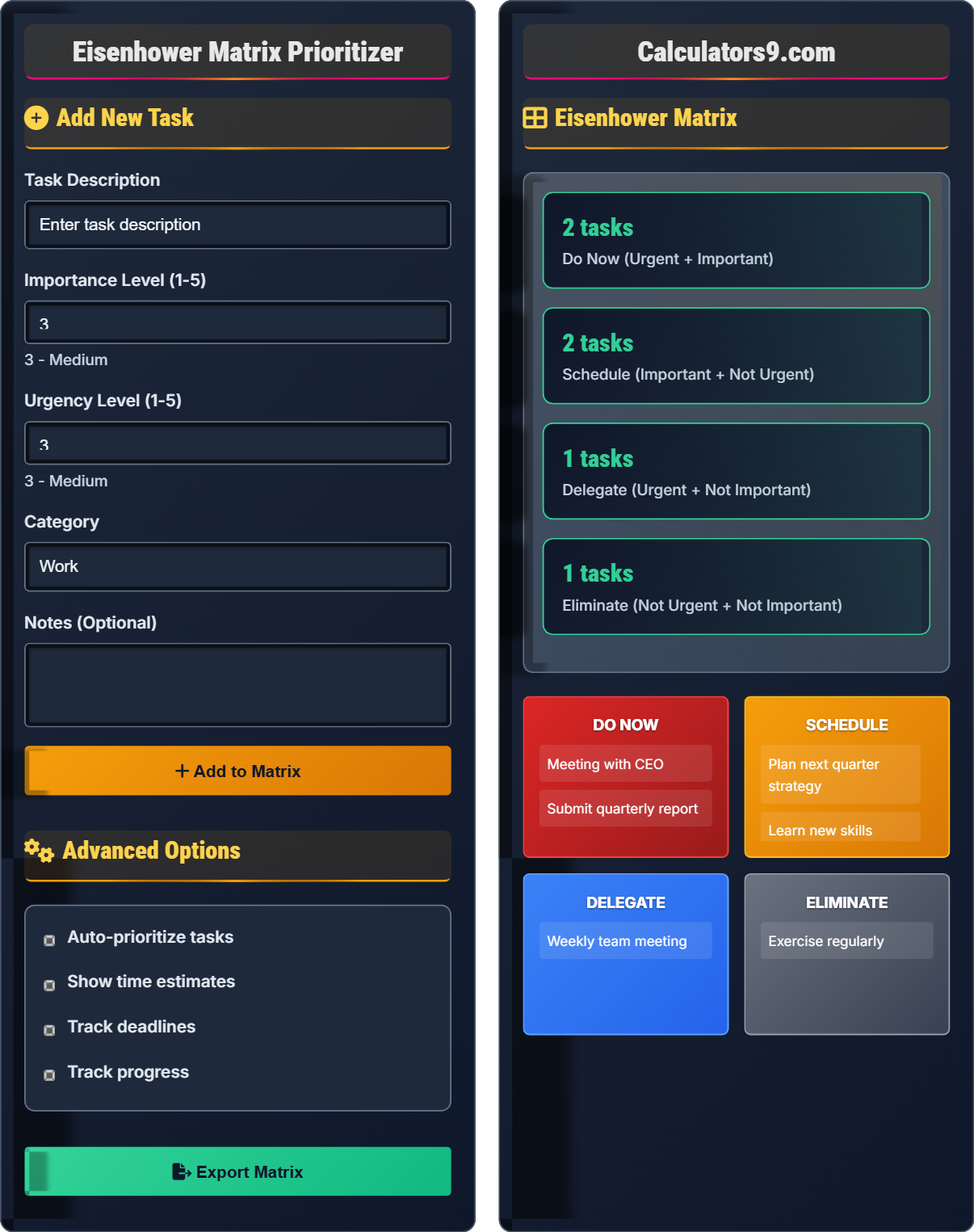
| Quadrant | Tasks | Action |
|---|---|---|
| Do Now | 2 | Complete immediately |
| Schedule | 3 | Plan for later |
| Delegate | 1 | Assign to others |
| Eliminate | 0 | Remove completely |
| Task | Importance | Urgency | Category |
|---|---|---|---|
| Meeting with CEO | 5 | 5 | Work |
| Submit quarterly report | 4 | 5 | Work |
| Plan next quarter strategy | 5 | 2 | Work |
| Learn new skills | 4 | 1 | Personal |
| Exercise regularly | 3 | 1 | Health |
| Weekly team meeting | 2 | 4 | Work |
Eisenhower Matrix Fundamentals
The Eisenhower Matrix, also known as the Urgency-Importance Matrix, is a time management tool that helps prioritize tasks based on their urgency and importance. Named after U.S. President Dwight D. Eisenhower, it divides tasks into four quadrants to help you decide on and prioritize tasks by distinguishing between urgency and importance.
Effective use of the Eisenhower Matrix requires consistent practice and honest self-assessment:
- Regular Review: Review and update your matrix weekly to ensure tasks are appropriately categorized
- Honest Assessment: Be truthful about what's truly important versus what feels urgent
- Preventive Planning: Move tasks from quadrant 3 to quadrant 2 by scheduling them in advance
- Focus on Quadrant 2: Spend most of your time on important but not urgent tasks to be proactive
- Minimize Quadrant 1: Effective planning reduces the number of urgent tasks
Eisenhower Matrix Quiz
Which quadrant of the Eisenhower Matrix contains tasks that are both urgent and important?
The answer is A) Do Now (Quadrant 1). This quadrant contains tasks that are both urgent and important. These are critical tasks that require immediate attention and cannot be postponed. Examples include crisis situations, deadline-driven projects, and pressing problems that need immediate resolution.
Understanding the first quadrant is crucial because it represents the highest priority tasks in the matrix. These tasks are both urgent (they have immediate consequences if not completed) and important (they contribute significantly to your goals). Managing this quadrant effectively is key to preventing crises and maintaining control over your schedule.
Urgent: Tasks that demand immediate attention due to time pressure or consequences
Important: Tasks that contribute to long-term goals, values, or mission
Quadrant 1: Tasks that are both urgent and important - must be done now
• Quadrant 1 tasks require immediate action
• These tasks often involve crises or deadlines
• Effective planning reduces the number of tasks in this quadrant
• Handle Quadrant 1 tasks efficiently but quickly
• Look for patterns that lead to frequent Quadrant 1 tasks
• Try to move tasks from Quadrant 1 to Quadrant 2 through planning
• Spending too much time in Quadrant 1 leads to stress and reactive behavior
• Misclassifying tasks as urgent when they're not
• Not properly assessing the importance of urgent tasks
Explain why Quadrant 2 (Important + Not Urgent) is considered the most strategic quadrant in the Eisenhower Matrix. Provide specific examples of tasks that belong in this quadrant and explain their long-term benefits.
Quadrant 2 is the most strategic quadrant because it contains activities that contribute to long-term success but don't have immediate deadlines. These tasks include:
1. Planning and goal setting - Establishing direction and priorities
2. Relationship building - Strengthening professional and personal connections
3. Learning and skill development - Building capabilities for future challenges
4. Health and wellness - Maintaining physical and mental fitness
5. Prevention and maintenance - Preventing problems before they occur
These activities build capacity, prevent crises, and move you toward your long-term goals. They're proactive rather than reactive, leading to sustainable success.
Quadrant 2 represents the difference between effectiveness and mere efficiency. While Quadrant 1 is about handling immediate demands, Quadrant 2 is about creating the future you want. It's where leadership and strategic thinking happen. Most people spend too little time in Quadrant 2, which leads to spending more time in Quadrant 1 dealing with preventable crises.
Proactive: Acting in anticipation of future problems or needs
Strategic: Relating to long-term planning and goal achievement
Quadrant 2: Important but not urgent tasks - the heart of effectiveness
• Quadrant 2 tasks require discipline to prioritize
• These activities prevent problems and create opportunities
• Success comes from spending most time in Quadrant 2
• Schedule Quadrant 2 tasks like appointments
• Set boundaries to protect time for important activities
• Use the 80/20 rule to identify high-impact activities
• Letting urgent tasks push important tasks aside
• Not recognizing the long-term value of preventive activities
• Treating Quadrant 2 tasks as optional rather than essential
Sarah is overwhelmed with her workload. She spends most of her day responding to emails (urgent but not important), attending meetings she didn't initiate (urgent but not important), and dealing with daily crises (urgent and important). She wants to be more productive. According to the Eisenhower Matrix, what should Sarah do to improve her productivity?
Step 1: Recognize that Sarah is spending too much time in Quadrant 1 (crises) and Quadrant 3 (urgent but not important tasks like emails and unwanted meetings).
Step 2: For Quadrant 3 tasks (emails, unwanted meetings): These should be delegated or eliminated where possible. Sarah could set specific times for email responses and decline unnecessary meetings.
Step 3: To reduce Quadrant 1 tasks: Sarah should move more activities to Quadrant 2 (important but not urgent) by planning ahead, preventing problems, and building systems.
Step 4: Focus on Quadrant 2 activities like strategic planning, skill development, relationship building, and preventive maintenance.
Therefore, Sarah should shift her focus from reactive tasks (Quadrants 1 and 3) to proactive tasks (Quadrant 2) while delegating or eliminating non-essential urgent tasks (Quadrant 3).
This problem illustrates a common productivity trap where people become trapped in urgent but not important activities. The solution isn't to work harder but to work smarter by focusing on important activities that prevent crises and create value. This shift from reactive to proactive thinking is fundamental to effectiveness.
Reactive: Responding to events after they happen
Proactive: Anticipating and acting before problems occur
Productivity: Achieving desired results with minimal waste
• Focus time on Quadrant 2 activities for maximum effectiveness
• Minimize time spent on Quadrant 3 activities
• Use delegation and elimination strategically
• Block time for Quadrant 2 activities
• Use the "2-minute rule" for small tasks
• Set boundaries around your time and attention
• Confusing activity with productivity
• Responding to everything immediately
• Not taking time for important but not urgent activities
You're managing a project and have identified the following tasks: A) Prepare for tomorrow's client presentation (due tomorrow), B) Plan the next quarter's marketing strategy, C) Respond to a vendor's inquiry about a routine matter, D) Exercise for 30 minutes. Categorize each task into the correct quadrant of the Eisenhower Matrix and explain your reasoning.
A) Prepare for tomorrow's client presentation: Quadrant 1 (Do Now) - Urgent (due tomorrow) and Important (client relationship and project success)
B) Plan the next quarter's marketing strategy: Quadrant 2 (Schedule) - Important (strategic planning) but Not Urgent (no immediate deadline)
C) Respond to vendor inquiry: Quadrant 3 (Delegate) - Urgent (requires response) but Not Important (routine matter that doesn't significantly impact goals)
D) Exercise for 30 minutes: Quadrant 2 (Schedule) - Important (health and well-being) but Not Urgent (no immediate deadline, but should be scheduled)
The key is to recognize the difference between urgency (time pressure) and importance (alignment with goals). Quadrant 1 requires immediate action, Quadrant 2 should be scheduled, Quadrant 3 can often be delegated, and Quadrant 4 should be eliminated.
This exercise demonstrates the importance of correctly categorizing tasks. Many people misclassify tasks, leading to poor time management. The distinction between urgent and important is crucial - urgent tasks demand immediate attention, while important tasks contribute to long-term goals. The most effective people spend most of their time on important tasks, whether urgent or not.
Urgent: Requires immediate attention due to time constraints
Important: Contributes to achieving goals or values
Categorization: The process of assigning tasks to appropriate quadrants
• Urgent ≠ Important (many urgent tasks aren't important)
• Important ≠ Urgent (many important tasks aren't urgent)
• Correct categorization leads to better decisions
• Ask: "Does this contribute to my main goals?" (importance)
• Ask: "Must this be done now?" (urgency)
• Regularly reassess task classifications
• Assuming all urgent tasks are important
• Neglecting important but not urgent tasks
• Not regularly reviewing and reclassifying tasks
According to the Eisenhower Matrix principle, which approach leads to the greatest long-term productivity?
The answer is B) Spend most time on important but not urgent tasks. This corresponds to Quadrant 2 of the Eisenhower Matrix, which contains activities like planning, prevention, relationship building, and skill development. These activities are proactive and lead to long-term success, preventing crises and creating opportunities.
Effective people spend most of their time in Quadrant 2, which is the heart of effectiveness. This quadrant contains the activities that build capacity, prevent problems, and move you toward your goals. People who live predominantly in Quadrants 1 and 3 are constantly reacting to circumstances, while those who focus on Quadrant 2 are proactive and create their desired future.
Effectiveness: Doing the right things
Efficiency: Doing things right
Proactivity: Taking initiative rather than reacting
• Effectiveness trumps efficiency
• Prevention is better than cure
• Long-term thinking leads to sustainable success
• Schedule Quadrant 2 activities as non-negotiable appointments
• Protect your time for important activities
• Regularly assess how much time you spend in each quadrant
• Confusing busyness with productivity
• Letting urgent tasks drive the agenda
• Not investing time in important preventive activities
Matrix Essentials
Quadrant 2 (Important+Not Urgent) is the most strategic area for long-term success.
Ask two questions: Is it urgent? Is it important? Place accordingly in the 4-quadrant matrix.
- Quadrant 2 is the heart of effectiveness
- Urgent ≠ Important
- Prevention beats crisis management
Implementation Strategies
Successful people spend 65-80% of time in Quadrant 2 activities.
- Do Now (Quadrant 1)
- Schedule (Quadrant 2)
- Delegate (Quadrant 3)
- Eliminate (Quadrant 4)
- Regular review and reclassification
- Set boundaries for urgent interruptions
- Build systems to prevent crises
- Protect time for important activities
FAQ
Q: How do I know if something is important?
A: Ask: Does this contribute to my goals/values? Will this matter in 5 years? Important tasks align with your mission and create lasting value.
Q: What if everything seems urgent?
A: This indicates poor planning. Focus on Quadrant 2 to prevent crises. True emergencies are rare - most "urgencies" are preventable with proper planning.