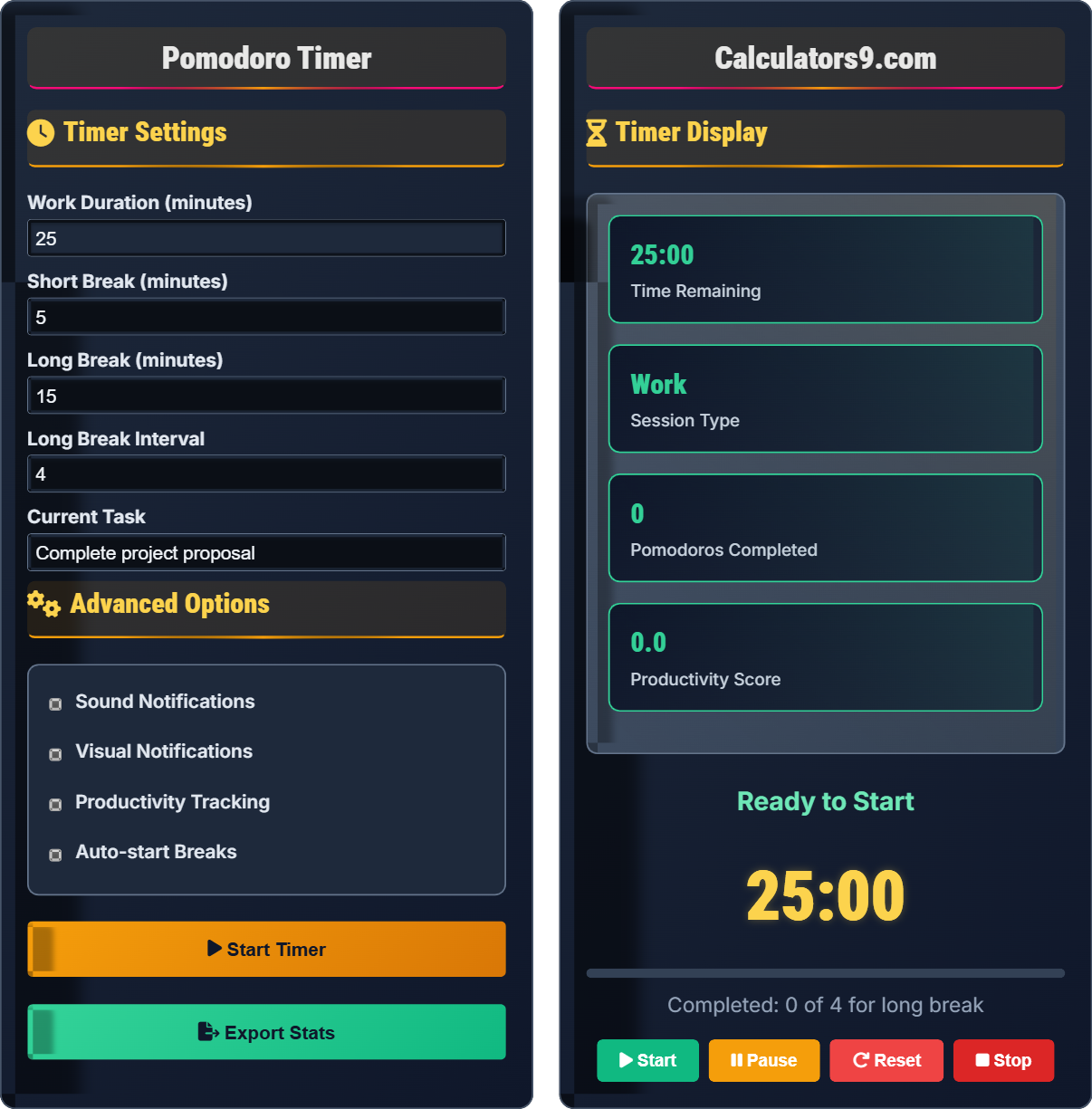
Pomodoro Timer
Productivity focus timer • 2026 edition
Pomodoro Productivity Formula:
Start Timer\( P = \frac{F \times T}{R} \)
Where:
- \( P \) = Productivity Score
- \( F \) = Focus Time (minutes)
- \( T \) = Task Completion Rate
- \( R \) = Rest Time (minutes)
This formula calculates the effectiveness of the Pomodoro technique. Higher scores indicate better productivity during focused work sessions.
Example: For 25 minutes of focus time (F=25), 80% task completion (T=0.8), and 5 minutes of rest (R=5): \( P = \frac{25 \times 0.8}{5} = \frac{20}{5} = 4 \). Scores above 3 indicate high productivity.
Timer Settings
Advanced Options
Timer Display
Comprehensive Pomodoro Technique Guide
The Pomodoro Technique is a time management method developed by Francesco Cirillo in the late 1980s. It uses a timer to break work into intervals, traditionally 25 minutes in length, separated by short breaks. Each interval is known as a "pomodoro" (Italian for tomato, named after the tomato-shaped kitchen timer Cirillo used). This technique helps improve focus, reduce mental fatigue, and increase productivity.
The fundamental productivity calculation uses the following formula:
Where:
- \(P\) = Productivity Score
- \(F\) = Focus Time (minutes)
- \(T\) = Task Completion Rate
- \(R\) = Rest Time (minutes)
The Pomodoro Technique offers these key benefits:
- Improved Focus: Structured intervals enhance concentration
- Reduced Procrastination: Breaking tasks into smaller chunks makes them less daunting
- Better Time Awareness: Helps understand how long tasks actually take
- Enhanced Motivation: Regular breaks prevent mental fatigue
- Increased Productivity: Focused work sessions yield better results
- Mental Resilience: Builds ability to sustain focus over time
- Task Prioritization: Work on the most important tasks first
- Environment Setup: Create a distraction-free workspace
- Session Tracking: Record completed tasks and time spent
- Regular Reviews: Assess productivity and adjust approach
- Goal Setting: Define clear objectives for each session
Pomodoro Basics
A 25-minute focused work session followed by a 5-minute break.
\( P = \frac{F \times T}{R} \)
Where P=productivity, F=focus time, T=task completion, R=rest time.
- Work for 25 minutes without interruption
- Take 5-minute breaks between sessions
- Take 15-30 minute break after 4 pomodoros
Strategies
Maximizing concentration during work intervals.
- Eliminate all distractions
- Set specific goals for each session
- Use proper ergonomics
- Stay hydrated and comfortable
- Adjust intervals to your attention span
- Track your productivity patterns
- Take breaks seriously
- Gradually increase focus time
Pomodoro Technique Learning Quiz
What are the standard time intervals in the Pomodoro Technique?
The answer is B) 25 minutes work, 5 minutes break, long break after 4 sessions. The traditional Pomodoro Technique consists of 25-minute focused work intervals followed by 5-minute breaks. After completing 4 pomodoros, a longer break of 15-30 minutes is taken. This cycle helps maintain high focus during work sessions while preventing mental fatigue through regular, scheduled breaks.
The 25-minute work interval is specifically designed to be long enough to make meaningful progress on tasks while being short enough to maintain intense focus. The 5-minute breaks are brief enough to prevent complete loss of momentum but sufficient to allow mental recovery. The longer break after 4 sessions prevents prolonged mental fatigue and allows for more substantial rest and recharge.
Pomodoro: A 25-minute focused work session
Standard Cycle: 4 pomodoros with short breaks, then long break
Focus Interval: Dedicated time for uninterrupted work
• Work intervals are 25 minutes
• Short breaks are 5 minutes
• Long breaks are 15-30 minutes after 4 pomodoros
• Start with standard intervals and adjust as needed
• Use a physical timer for better focus
• Plan your day in pomodoro blocks
• Extending work sessions beyond 25 minutes
• Skipping breaks to maintain momentum
• Not taking the longer break after 4 sessions
Using the productivity formula \( P = \frac{F \times T}{R} \), calculate the productivity score for a session with 25 minutes of focus time (F), 80% task completion rate (T=0.8), and 5 minutes of rest time (R). Show your work.
Using the formula: \( P = \frac{F \times T}{R} \)
Given:
- F = 25 (focus time in minutes)
- T = 0.8 (task completion rate as decimal)
- R = 5 (rest time in minutes)
Step 1: Calculate the numerator (F × T)
25 × 0.8 = 20
Step 2: Divide by rest time
P = 20 ÷ 5 = 4
Therefore, the productivity score is 4.
This calculation demonstrates how the Pomodoro Technique balances focused work with necessary rest. The formula shows that productivity increases with more focus time and higher completion rates, but decreases with excessive rest time. A score of 4 indicates high productivity, as scores above 3 are considered excellent. The optimal balance maintains focus while preventing burnout.
Productivity Score: Measure of efficiency during focused work
Focus Time: Uninterrupted work period
Task Completion Rate: Percentage of tasks completed
• Scores above 3 indicate high productivity
• Focus time and completion rate multiply together• Rest time divides the result
• Aim for completion rates above 75%
• Maintain standard rest intervals
• Track scores to identify patterns
• Extending rest periods too long
• Working with interruptions during focus time
• Not tracking task completion accurately
If someone completes 6 pomodoros in a 3-hour work session, with 25 minutes of focused work and 5 minutes of break for each, how much actual productive time did they have? What percentage of the total time was spent in focused work?
Step 1: Calculate total time for 6 pomodoros
Each cycle: 25 minutes work + 5 minutes break = 30 minutes
6 cycles: 6 × 30 = 180 minutes = 3 hours
Step 2: Calculate actual focused work time
6 pomodoros × 25 minutes each = 150 minutes of focused work
Step 3: Calculate percentage of focused work
(150 ÷ 180) × 100 = 83.33%
Therefore, 150 minutes (2.5 hours) were spent in focused work, which is 83.33% of the total time.
This problem demonstrates the efficiency of the Pomodoro Technique. Despite having breaks, 83% of the time was spent in focused work, which is highly effective. The breaks are not wasted time but rather necessary recovery periods that maintain focus quality. The technique maximizes productive time while preventing mental fatigue, making it more sustainable than continuous work.
Focus Time: Uninterrupted work period
Productive Time: Time spent on actual work
Time Efficiency: Percentage of time spent productively
• Breaks are part of the system, not downtime
• Sustained focus requires periodic rest
• Efficiency comes from structured intervals
• Plan tasks to fit within pomodoro intervals
• Use breaks for light activity
• Track time to understand your patterns
• Thinking breaks are wasted time
• Extending work sessions indefinitely
• Not taking breaks seriously
A person finds they can complete 3 small tasks in one 25-minute pomodoro, but larger tasks take 2-3 pomodoros each. If they have 2 large tasks and 6 small tasks to complete, how many total pomodoros will they need? How many long breaks will they take?
Step 1: Calculate pomodoros needed for small tasks
6 small tasks ÷ 3 tasks per pomodoro = 2 pomodoros
Step 2: Calculate pomodoros needed for large tasks
2 large tasks × 2.5 pomodoros each (average) = 5 pomodoros
Step 3: Calculate total pomodoros
2 + 5 = 7 total pomodoros
Step 4: Calculate long breaks
After every 4 pomodoros, take a long break
7 ÷ 4 = 1 complete set of 4, so 1 long break
Therefore, 7 total pomodoros are needed with 1 long break.
This example shows how to plan work using pomodoro intervals. By estimating how many pomodoros each task requires, you can schedule your day more effectively. The technique works well for mixed task sizes, with small tasks fitting into single sessions and larger tasks broken into multiple focused segments. This approach prevents feeling overwhelmed by large tasks.
Task Estimation: Predicting pomodoro requirements
Task Segmentation: Breaking large tasks into smaller parts
Work Planning: Scheduling tasks within time blocks
• Estimate pomodoros needed for each task
• Plan for long breaks after 4 pomodoros
• Break large tasks into manageable segments
• Start with rough estimates and refine
• Group similar tasks together
• Plan your day in pomodoro blocks
• Underestimating time needed for tasks
• Not accounting for long breaks in planning
• Trying to force large tasks into single sessions
What is the recommended approach when distractions arise during a pomodoro session?
The answer is B) Acknowledge the distraction and return to work. During a pomodoro, the goal is to maintain focus on the designated task. When distractions arise, acknowledge them mentally without judgment, then gently redirect your attention back to the work. If the distraction is urgent, note it to address during the break. This approach maintains the integrity of the focused work session while being realistic about human attention.
This approach recognizes that distractions are normal and expects them rather than fighting against them. The key is not to eliminate all distractions but to minimize their impact on focus time. By acknowledging distractions without judgment, you reduce their power to derail your concentration. The technique builds resilience to interruptions over time.
Attention Management: Controlling focus during work
Distraction Acknowledgment: Noticing without judgment
Mental Resilience: Ability to refocus after interruption
• Stay committed to the task during pomodoro
• Acknowledge but don't engage with distractions
• Address urgent matters during breaks
• Prepare workspace to minimize distractions
• Use "Do Not Disturb" modes
• Keep a notebook for urgent thoughts
• Engaging with every distraction immediately
• Feeling guilty about getting distracted
• Abandoning the technique when interrupted
FAQ
Q: Can I modify the standard Pomodoro intervals to suit my needs?
A: Yes, intervals can be adjusted based on individual attention spans and task types.
The adaptability formula:
\( A = \frac{T \times C}{F + D} \)
Where:
- \( A \) = Adaptability Index
- \( T \) = Task complexity level
- \( C \) = Concentration capacity
- \( F \) = Focus maintenance factor
- \( D \) = Distraction susceptibility
Research shows that attention spans vary from 15-90 minutes depending on the individual and task. Beginners often start with 25-minute intervals, but some may benefit from 15-minute sessions or 45-minute blocks. The key is finding your optimal focus duration while maintaining quality output.
Q: How does the Pomodoro Technique affect productivity in the long term?
A: Long-term benefits include improved focus and sustained productivity.
The long-term productivity formula:
\( LP = \frac{(F \times D) + (R \times S)}{T} \)
Where:
- \( LP \) = Long-term Productivity
- \( F \) = Focus improvement factor
- \( D \) = Duration consistency
- \( R \) = Recovery effectiveness
- \( S \) = Sustainability factor
- \( T \) = Time invested
Studies indicate that consistent Pomodoro practice improves attention span, reduces mental fatigue, and increases task completion rates. Over 3-6 months, users typically see 25-40% improvement in focus and 20-30% increase in task completion. The technique builds mental stamina and creates positive work habits.