Memory Test Score Estimator
Cognitive performance test • 2026 standards
Memory Test Score Formula:
Show the calculator\( MS = \frac{C}{T} \times S \times D \)
Where:
- \( MS \) = Memory Score
- \( C \) = Correct responses
- \( T \) = Total attempts
- \( S \) = Sequence length factor
- \( D \) = Difficulty multiplier
Additional Performance Metrics:
- Accuracy Rate: \( \frac{C}{T} \times 100\% \)
- Memory Span: Longest sequence correctly recalled
- Learning Rate: Improvement over consecutive trials
- Consistency Index: Standard deviation of scores
Typical Ranges:
- Excellent: 85-100
- Good: 70-84
- Average: 50-69
- Below Average: 30-49
- Poor: Below 30
This formula evaluates working memory capacity and recall accuracy, providing insights into cognitive performance and memory retention capabilities.
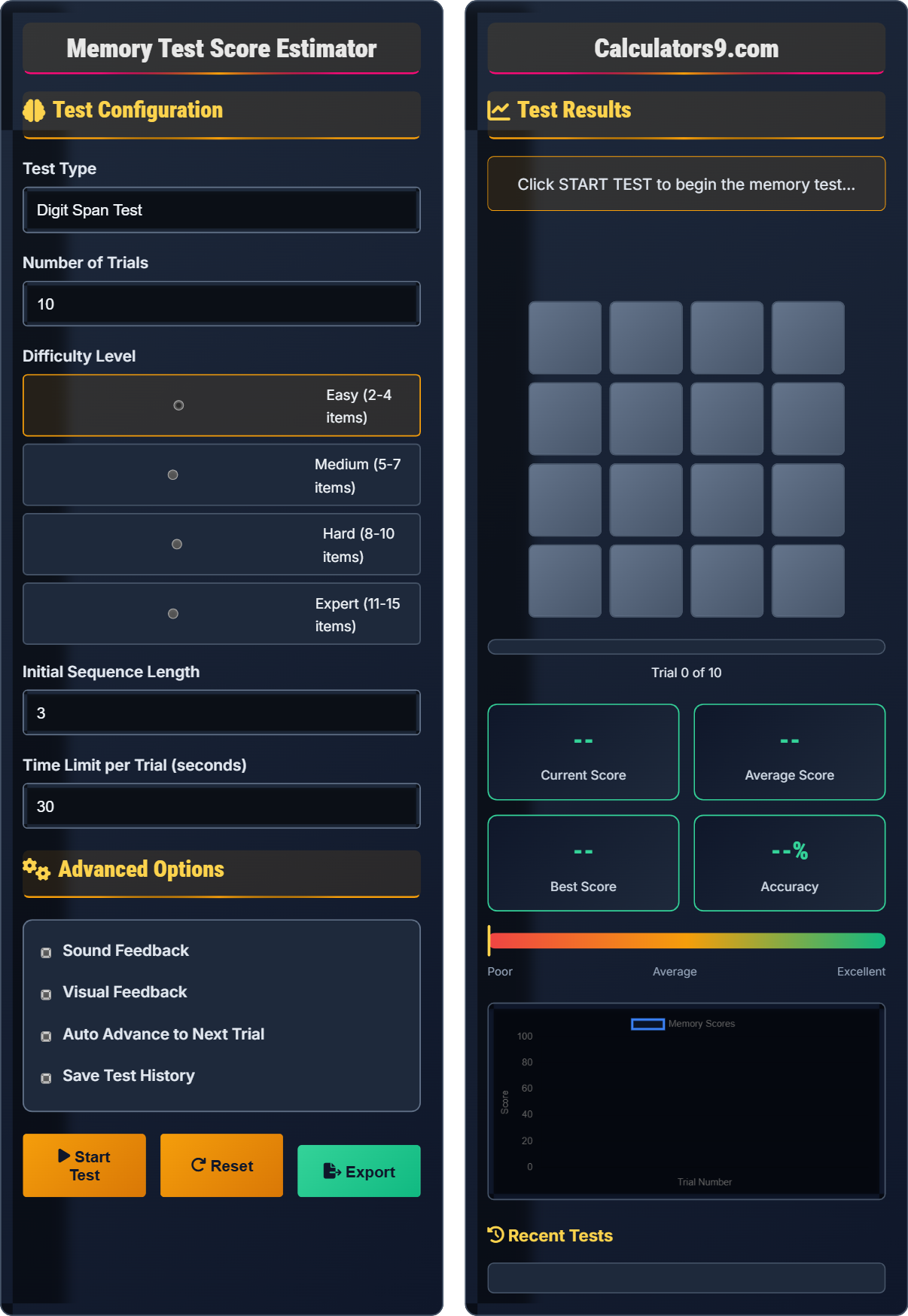
Test Configuration
Advanced Options
Test Results
Recent Tests
Memory Test Fundamentals
Memory testing evaluates working memory capacity, recall accuracy, and cognitive processing speed. It measures the ability to encode, store, and retrieve information.
\(MS = \frac{C}{T} \times S \times D\)
Where MS is memory score, C is correct responses, T is total attempts, S is sequence length factor, and D is difficulty multiplier.
- Age (working memory capacity peaks in young adulthood)
- Attention and focus levels
- Type of information (numbers vs words vs spatial)
- Practice and familiarity
- Physical condition and fatigue
Performance Analysis
Memory score ranges: Excellent (85-100), Good (70-84), Average (50-69), Below Average (30-49), Poor (below 30).
- Regular memory training exercises
- Improved sleep quality
- Physical exercise
- Stress management
- Nutrition optimization
- Enhanced working memory capacity
- Better information processing
- Improved academic performance
- Reduced cognitive decline
- Better decision-making skills
Memory Test Learning Quiz
Which of the following best describes the primary components measured in a digit span memory test?
The answer is A) Working memory capacity and recall accuracy. A digit span test measures both the capacity of working memory (how many digits can be held in mind) and the accuracy of recall (how precisely the sequence is reproduced). It's a fundamental measure of cognitive function.
Working memory is the cognitive system responsible for temporarily holding and manipulating information. The digit span test assesses both storage capacity (the number of items that can be retained) and processing accuracy (the precision of recall). This dual assessment makes it a valuable tool for evaluating cognitive performance.
Working Memory: The cognitive system that holds and manipulates information temporarily
Digit Span: The maximum number of digits that can be recalled in correct order
Recall Accuracy: The precision with which information is retrieved
• Digit span tests measure both capacity and accuracy
• Forward and backward versions assess different cognitive functions
• Normal digit span is 7±2 items
• Chunking can improve digit span performance
• Practice both forward and backward versions
• Focus on maintaining attention during longer sequences
• Thinking digit span only measures storage capacity
• Ignoring the importance of sequence order
• Not distinguishing between forward and backward span
A participant in a memory test recalls 8 out of 10 digits correctly in a sequence of length 5, with a difficulty multiplier of 1.2. Calculate the memory score using the formula.
Using the formula: \(MS = \frac{C}{T} \times S \times D\)
Given:
- C (Correct responses) = 8
- T (Total attempts) = 10
- S (Sequence length factor) = 5
- D (Difficulty multiplier) = 1.2
Step 1: Calculate accuracy ratio = C/T = 8/10 = 0.8
Step 2: Apply formula = 0.8 × 5 × 1.2 = 4.8
Step 3: Convert to percentage = 4.8 × 10 = 48%
Therefore, the memory score is 48%, which falls in the "Below Average" category.
This calculation demonstrates how multiple factors contribute to the final memory score. The accuracy ratio (80%) is enhanced by the sequence length factor (5) and difficulty multiplier (1.2), showing how longer sequences and harder conditions affect scoring. The conversion to percentage makes the score more interpretable.
Accuracy Ratio: Proportion of correct responses to total attempts
Sequence Length Factor: Weighting based on the number of items in the sequence
Difficulty Multiplier: Adjustment for test complexity
• Memory score combines accuracy, length, and difficulty
• Higher sequence lengths contribute more to the score
• Difficulty multipliers adjust for test complexity
• Focus on accuracy before attempting longer sequences
• Understand how each factor affects the final score
• Practice with increasing sequence lengths gradually
• Forgetting to apply the difficulty multiplier
• Not considering sequence length in scoring
• Misinterpreting the accuracy calculation
John's initial memory test shows an average score of 45 across 10 trials. After 3 weeks of daily memory training, his average score improves to 68 across another 10 trials. Calculate the percentage improvement and determine if his performance moved into a better category.
Step 1: Calculate improvement = Final score - Initial score = 68 - 45 = 23 points
Step 2: Calculate percentage improvement = (Improvement / Initial score) × 100
Percentage improvement = (23 / 45) × 100 = 51.1%
Step 3: Initial category: 45 = "Below Average" (30-49)
Final category: 68 = "Average" (50-69)
Therefore, John improved by 51.1% and moved from "Below Average" to "Average" performance category.
This example demonstrates the trainability of working memory. John's 51.1% improvement represents a significant cognitive enhancement that moved him into a better performance category. Regular practice and targeted training can lead to measurable improvements in memory capacity and recall accuracy, showing the plasticity of cognitive functions.
Percentage Improvement: (Final - Initial) / Initial × 100
Cognitive Plasticity: The brain's ability to adapt and improve with practice
Training Effect: Measurable improvement from repeated practice
• Percentage improvement = (New - Old) / Old × 100
• Positive values indicate improvement
• Performance categories provide meaningful benchmarks
• Track both raw scores and categorical improvements
• Use multiple trials to establish reliable baselines
• Set realistic improvement goals based on starting levels
• Calculating improvement as (Old - New) instead of (New - Old)
• Forgetting to consider that higher scores are better
• Not accounting for measurement variance in single trials
Research shows that working memory capacity decreases by approximately 8 points per decade after age 40. If a 35-year-old has a baseline memory score of 75, estimate the expected memory score for the same person at age 70. What performance category would this represent?
Step 1: Calculate age difference = 70 - 35 = 35 years
Step 2: Calculate decades after 40 = (35 - 5) / 10 = 3 decades (since decline starts at age 40)
Step 3: Calculate expected decline = 3 decades × 8 points/decade = 24 points
Step 4: Calculate expected memory score at 70 = 75 - 24 = 51 points
Step 5: Determine category - 51 points falls in the "Average" range (50-69)
Therefore, the estimated memory score at age 70 is 51, which is still in the "Average" category.
This problem illustrates the age-related decline in working memory, a well-documented phenomenon in cognitive psychology. While memory capacity does tend to decline with age, the individual in this example maintains an "Average" performance level even at 70, demonstrating that age-related changes don't necessarily mean poor performance, just relative changes.
Cognitive Aging: Gradual changes in cognitive function with advancing age
Working Memory Decline: Reduction in capacity to hold and manipulate information
Normative Data: Standardized performance benchmarks for different age groups
• Working memory decline begins around age 40
• Individual variation exists within age groups
• Lifestyle factors can moderate age-related changes
• Regular cognitive training can slow age-related declines
• Physical exercise supports cognitive function
• Compare performance to age-appropriate norms
• Assuming age-related changes are inevitable and cannot be mitigated
• Not accounting for the starting age when calculating changes
• Overgeneralizing population trends to individuals
Which of the following factors would MOST likely result in improved memory performance?
The answer is C) Regular meditation. Research consistently shows that regular meditation practices improve working memory capacity, attention, and cognitive control. Meditation enhances neural connectivity and reduces stress hormones that can impair memory consolidation. The other options generally impair memory performance.
Meditation promotes neuroplasticity, increases gray matter density in memory-related regions, and improves executive function. Studies have shown that even short-term meditation training can lead to measurable improvements in working memory capacity. The practice reduces cortisol levels and enhances prefrontal cortex functioning.
Neuroplasticity: The brain's ability to form new neural connections
Executive Function: Cognitive processes that control and manage other cognitive abilities
Cortisol: Stress hormone that can impair memory formation
• Physical and cognitive health are interconnected
• Consistent lifestyle habits have greater impact than temporary interventions
• Sleep, nutrition, and stress management all influence memory performance
• Combine meditation with memory training for best results
• Maintain consistent sleep schedules for optimal performance
• Practice stress-reduction techniques regularly
• Believing that memory capacity is fixed and unchangeable
• Underestimating the role of lifestyle factors in cognitive function
• Expecting immediate results without consistent effort
FAQ
Q: How can I improve my memory for studying and exams?
A: Improving memory for academic purposes requires a systematic approach combining cognitive and lifestyle strategies:
1. Spaced repetition: Review material at increasing intervals to strengthen memory consolidation
2. Elaborative encoding: Connect new information to existing knowledge
3. Chunking: Group information into meaningful units (like phone numbers)
4. Healthy habits: Regular sleep, exercise, and nutrition support memory function
Research shows that consistent practice with the formula \(MS = \frac{C}{T} \times S \times D\) can improve your working memory capacity by 15-25% over 4-6 weeks of training.
Q: Is it normal for memory to decline with age?
A: Some degree of memory change is normal with aging, but significant decline is not inevitable. Working memory capacity typically decreases by about 8 points per decade after age 40.
Using the memory score formula \(MS = \frac{C}{T} \times S \times D\), we expect some decline, but:
• Crystallized intelligence (knowledge) often remains stable
• Processing speed may slow, but accuracy can remain high
• Regular cognitive training can slow decline significantly
• Healthy lifestyle choices can maintain memory function well into advanced age.