Reaction Time Calculator
Cognitive performance test • 2026 standards
Reaction Time Formula:
Show the calculator\( RT = T_{response} - T_{stimulus} \)
Where:
- \( RT \) = Reaction Time (milliseconds)
- \( T_{response} \) = Time of response (when user clicks)
- \( T_{stimulus} \) = Time of stimulus presentation (when target appears)
Additional Performance Metrics:
- Mean Reaction Time: Average of all test results
- Standard Deviation: Measure of consistency
- Median: Middle value of sorted results
- Best/Worst: Minimum and maximum values
Typical Ranges:
- Excellent: Below 200ms
- Good: 200-250ms
- Average: 250-300ms
- Above Average: 300-400ms
- Below Average: Above 400ms
This formula measures the time interval between stimulus presentation and response initiation, providing insights into cognitive processing speed and motor coordination.
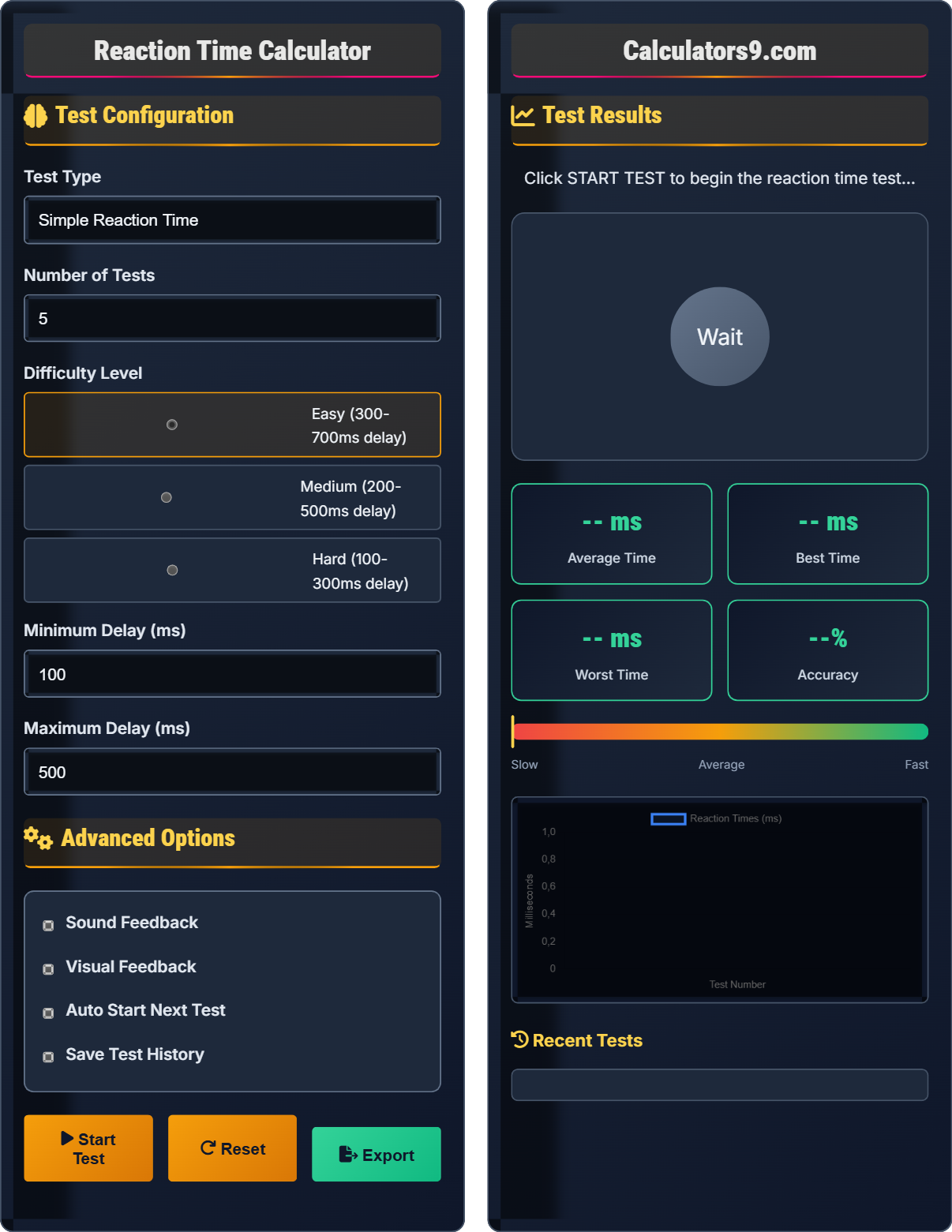
Test Configuration
Advanced Options
Test Results
Recent Tests
Reaction Time Fundamentals
Reaction time is the duration between the presentation of a stimulus and the initiation of a response. It measures cognitive processing speed, attention, and motor coordination.
\(RT = T_{response} - T_{stimulus}\)
Where RT is reaction time, T_response is response time, and T_stimulus is stimulus presentation time.
- Age (younger individuals typically have faster reaction times)
- Attention and focus levels
- Type of stimulus (visual vs auditory)
- Practice and familiarity
- Physical condition and fatigue
Performance Analysis
Reaction time ranges: Excellent (<200ms), Good (200-250ms), Average (250-300ms), Above Average (300-400ms), Below Average (>400ms).
- Regular practice and testing
- Improved sleep quality
- Physical exercise
- Stress management
- Nutrition optimization
- Enhanced cognitive function
- Better decision-making under pressure
- Improved hand-eye coordination
- Reduced accident risk
- Better athletic performance
Reaction Time Learning Quiz
Which of the following best describes the components measured in a simple reaction time test?
The answer is A) Stimulus detection + Processing + Motor response. A simple reaction time test measures the complete process from stimulus presentation to response initiation. This includes sensory detection (seeing/feeling the stimulus), neural processing (brain interpreting the stimulus), and motor response (physical action like clicking).
Reaction time is a composite measure involving multiple cognitive and physical processes. The three main components are: 1) Sensory processing (detecting the stimulus), 2) Central processing (interpreting and deciding on a response), and 3) Motor processing (executing the response). Understanding this helps explain why reaction times vary and what factors influence them.
Reaction Time (RT): The time interval between stimulus onset and response initiation
Sensory Processing: The time required to detect and recognize a stimulus
Motor Response: The time required to execute a physical response
• Reaction time includes all processing stages, not just one component
• Each component contributes to the total reaction time
• Different tasks may emphasize different components
• Think of reaction time as a pipeline: stimulus → brain → response
• Any bottleneck in the pipeline affects the total time
• Practice can improve specific components of the reaction process
• Confusing reaction time with response time
• Thinking reaction time measures only one cognitive process
• Ignoring that multiple factors contribute to the measurement
A participant in a reaction time study sees a light at 10:30:15.250 and responds at 10:30:15.475. Calculate the reaction time and determine the performance category.
Using the formula: \(RT = T_{response} - T_{stimulus}\)
Given:
- Stimulus time: 10:30:15.250
- Response time: 10:30:15.475
Step 1: Calculate reaction time = 10:30:15.475 - 10:30:15.250 = 225 milliseconds
Step 2: Determine performance category - 225ms falls in the "Good" category (200-250ms)
Therefore, the reaction time is 225ms and the performance is categorized as "Good".
This calculation demonstrates the basic principle of reaction time measurement. The time difference between stimulus presentation and response initiation gives us the total processing time. Performance categories help interpret whether a given reaction time is fast, average, or slow compared to established norms.
Millisecond (ms): One-thousandth of a second (0.001 seconds)
Performance Categories: Excellent (<200ms), Good (200-250ms), Average (250-300ms)
Baseline Time: The starting point for measuring reaction intervals
• Always subtract stimulus time from response time
• Reaction times are typically measured in milliseconds
• Performance categories provide context for interpretation
• Remember: Response time - Stimulus time = Reaction time
• Convert time measurements to milliseconds for consistency
• Use performance categories to evaluate results
• Calculating response time minus reaction time instead of stimulus time
• Forgetting to convert time units to milliseconds
• Misapplying performance categories to incorrect ranges
Sarah's initial reaction time test shows an average of 350ms across 10 trials. After 2 weeks of daily practice, her average reaction time improves to 280ms across another 10 trials. Calculate the percentage improvement and determine if her performance moved into a better category.
Step 1: Calculate improvement = Initial time - Final time = 350ms - 280ms = 70ms
Step 2: Calculate percentage improvement = (Improvement / Initial time) × 100
Percentage improvement = (70 / 350) × 100 = 20%
Step 3: Initial category: 350ms = "Above Average" (300-400ms)
Final category: 280ms = "Average" (250-300ms)
Therefore, Sarah improved by 20% and moved from "Above Average" to "Average" performance category.
This example demonstrates the trainability of reaction time. Even though Sarah's final score is still in the "Average" range, her improvement of 20% represents a significant cognitive enhancement. Regular practice and targeted training can lead to measurable improvements in reaction time, showing the plasticity of cognitive functions.
Percentage Improvement: (Initial - Final) / Initial × 100
Cognitive Plasticity: The brain's ability to adapt and improve with practice
Training Effect: Measurable improvement from repeated practice
• Percentage improvement = (Old - New) / Old × 100
• Negative values indicate worsening performance
• Performance categories provide meaningful benchmarks
• Track both raw scores and categorical improvements
• Use multiple trials to establish reliable baselines
• Set realistic improvement goals based on starting levels
• Calculating improvement as (New - Old) instead of (Old - New)
• Forgetting to consider that lower reaction times are better
• Not accounting for measurement variance in single trials
Research shows that reaction time increases by approximately 15ms per decade after age 30. If a 25-year-old has a baseline reaction time of 220ms, estimate the expected reaction time for the same person at age 65. What performance category would this represent?
Step 1: Calculate age difference = 65 - 25 = 40 years
Step 2: Calculate decades after 30 = (40 - 5) / 10 = 3.5 decades (since increase starts at age 30)
Step 3: Calculate expected increase = 3.5 decades × 15ms/decade = 52.5ms
Step 4: Calculate expected reaction time at 65 = 220ms + 52.5ms = 272.5ms
Step 5: Determine category - 272.5ms falls in the "Average" range (250-300ms)
Therefore, the estimated reaction time at age 65 is 273ms, which is still in the "Average" category.
This problem illustrates the age-related decline in reaction time, a well-documented phenomenon in cognitive psychology. While reaction time does tend to slow with age, the individual in this example maintains an "Average" performance level even at 65, demonstrating that age-related changes don't necessarily mean poor performance, just relative changes.
Cognitive Aging: Gradual changes in cognitive function with advancing age
Normative Data: Standardized performance benchmarks for different age groups
Age-Related Decline: Gradual slowing of cognitive processes over time
• Age-related changes begin around age 30 for reaction time
• Individual variation exists within age groups
• Lifestyle factors can moderate age-related changes
• Regular cognitive training can slow age-related declines
• Physical exercise supports cognitive function
• Compare performance to age-appropriate norms
• Assuming age-related changes are inevitable and cannot be mitigated
• Not accounting for the starting age when calculating changes
• Overgeneralizing population trends to individuals
Which of the following factors would MOST likely result in improved reaction time performance?
The answer is D) Regular exercise. Regular physical exercise has been consistently shown to improve reaction time by enhancing neural efficiency, increasing blood flow to the brain, and improving overall cognitive function. While moderate caffeine intake might temporarily improve alertness, regular exercise provides sustained cognitive benefits. Sleep deprivation, chronic stress, and other factors generally impair reaction time.
Physical exercise promotes neuroplasticity, increases neurotransmitter availability, and improves cardiovascular health, all of which support faster neural processing. The connection between physical fitness and cognitive performance is well-established in research. Exercise increases BDNF (Brain-Derived Neurotrophic Factor), which supports neural growth and maintenance.
Neuroplasticity: The brain's ability to form new neural connections
BDNF: Brain-Derived Neurotrophic Factor, supporting neuron health
Cognitive Enhancement: Improvement in mental processing abilities
• Physical and cognitive health are interconnected
• Consistent lifestyle habits have greater impact than temporary interventions
• Sleep, nutrition, and exercise all influence cognitive performance
• Combine physical exercise with cognitive training for best results
• Maintain consistent sleep schedules for optimal performance
• Manage stress through relaxation techniques
• Believing that stimulants alone improve long-term performance
• Underestimating the role of lifestyle factors in cognitive function
• Expecting immediate results without consistent effort
FAQ
Q: How can I improve my reaction time for sports performance?
A: Improving reaction time for sports requires a multi-faceted approach combining physical and cognitive training:
1. Specific sport drills: Practice sport-specific reaction scenarios (tennis returns, baseball swings)
2. Neural training: Use reaction time apps and exercises to enhance processing speed
3. Physical conditioning: Improve overall fitness to support faster neural transmission
4. Anticipation training: Learn to read opponent cues and game patterns
Research indicates that consistent training can improve reaction times by 10-20%. The formula \(RT = T_{response} - T_{stimulus}\) shows that training can optimize both the processing phase and the motor response phase.
Q: How does reaction time affect driving safety?
A: Reaction time is critical for driving safety, especially at highway speeds. At 60 mph (88 ft/s), a 200ms reaction time means the car travels 17.6 feet before braking begins.
Formula for stopping distance: \(SD = RD + BD\)
Where: \(RD = v \times RT\) (Reaction Distance) and \(BD\) is Braking Distance
With a 200ms reaction time at 60 mph: \(RD = 88 \times 0.2 = 17.6\) feet
At 300ms reaction time: \(RD = 88 \times 0.3 = 26.4\) feet
This 8.8-foot difference can be the difference between avoiding and causing an accident.